
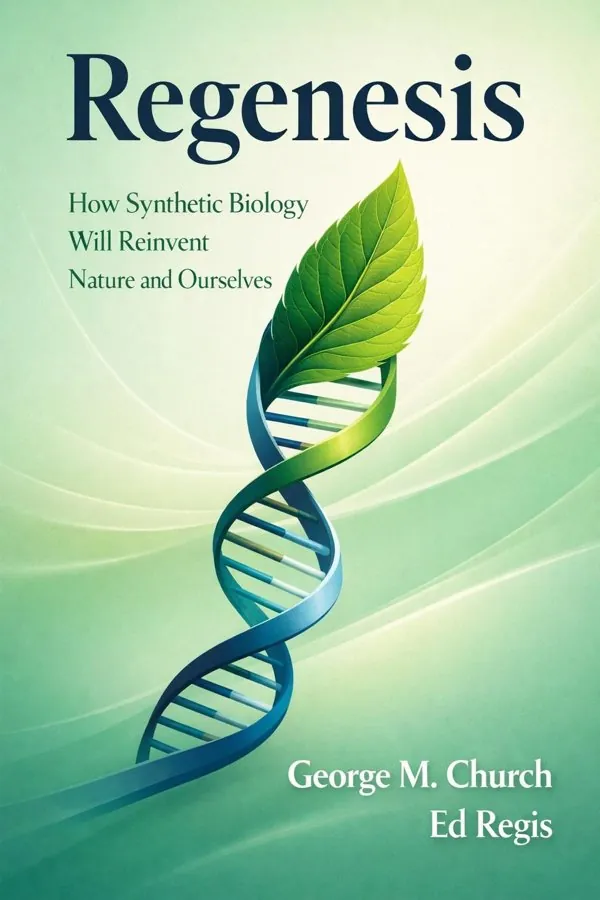
Regenesis: How Synthetic Biology Will Reinvent Nature and Ourselves: Summary & Key Insights
 10 min9 chaptersAudio available
What Is Regenesis: How Synthetic Biology Will Reinvent Nature and Ourselves About?
Regenesis: How Synthetic Biology Will Reinvent Nature and Ourselves by George M. Church, Ed Regis is a life_science book spanning 9 pages. Regenesis explores the revolutionary field of synthetic biology, where scientists are learning to redesign life itself. George Church and Ed Regis describe how advances in genetic engineering could lead to new forms of renewable energy, the revival of extinct species, and radical improvements in human health and longevity. The book presents both the scientific foundations and the ethical implications of rewriting the genetic code of living organisms.
This FizzRead summary covers all 9 key chapters of Regenesis: How Synthetic Biology Will Reinvent Nature and Ourselves in approximately 10 minutes, distilling the most important ideas, arguments, and takeaways from George M. Church, Ed Regis's work. Also available as an audio summary and Key Quotes Podcast.
Regenesis: How Synthetic Biology Will Reinvent Nature and Ourselves
Regenesis explores the revolutionary field of synthetic biology, where scientists are learning to redesign life itself. George Church and Ed Regis describe how advances in genetic engineering could lead to new forms of renewable energy, the revival of extinct species, and radical improvements in human health and longevity. The book presents both the scientific foundations and the ethical implications of rewriting the genetic code of living organisms.
Who Should Read Regenesis: How Synthetic Biology Will Reinvent Nature and Ourselves?
This book is perfect for anyone interested in life_science and looking to gain actionable insights in a short read. Whether you're a student, professional, or lifelong learner, the key ideas from Regenesis: How Synthetic Biology Will Reinvent Nature and Ourselves by George M. Church, Ed Regis will help you think differently.
- ✓Readers who enjoy life_science and want practical takeaways
- ✓Professionals looking to apply new ideas to their work and life
- ✓Anyone who wants the core insights of Regenesis: How Synthetic Biology Will Reinvent Nature and Ourselves in just 10 minutes
Want the full summary?
Get instant access to this book summary and 100K+ more with Fizz Moment.
Get Free SummaryAvailable on App Store • Free to download
Key Chapters
To appreciate where synthetic biology stands today, we must first trace the great lineage of genetic discovery. It began with a mystery: What was the physical substance of inheritance? From Mendel’s peas to Watson and Crick’s double helix, scientists unraveled layer after layer of complexity, culminating in the recognition that DNA encodes the program of life.
By the late twentieth century, molecular biology had given us the ability to cut and paste genes—a crude beginning compared to the elegant rewrite capabilities of today. The birth of biotechnology, with recombinant DNA in the 1970s, led to genetically modified crops and life-saving insulin-producing bacteria. Yet these were small edits on nature’s existing manuscripts. The shift to synthetic biology came when we realized we could not merely edit but compose entirely new genetic stories from scratch.
In the early 2000s, advances in automation and computation made it possible to read entire genomes—first at a cost of billions of dollars, then thousands, and eventually hundreds. As sequencing became routine, the complementary field of gene synthesis matured: instead of merely deciphering DNA, we could assemble it base by base. This capacity to read and write genetic code with digital precision turned biology into an information science, one that obeyed the same principles that underlie computing and engineering. We were no longer decoding nature; we were beginning to design it.
In programming, clarity begins with understanding the syntax of code. In biology, the syntax is DNA’s four letters—A, T, C, and G—whose orchestrated sequences create proteins, cells, and organisms. Sequencing tells us what the code says; synthesis lets us write new instructions; editing gives us the power to revise existing text.
When we sequenced the human genome, we opened the most detailed instruction manual ever devised. But the true revolution began when we could write and recompile these instructions ourselves. Early synthesis efforts created simple viral genomes; then came the landmark creation of a synthetic bacterial cell by Craig Venter’s team in 2010, assembled entirely from chemically synthesized DNA. It wasn’t merely an artificial organism—it was a proof that lifelike function could arise from human-written code.
Meanwhile, gene-editing technologies accelerated dramatically. Tools like CRISPR-Cas9, still young when this book was written, allowed precise, programmable modifications of any gene in virtually any organism. For the first time, biology could be treated as an editable platform. Each of these technologies—sequencing, synthesis, and editing—forms a feedback loop: the more we can read, the better we can write; the more we can write, the more we learn what the language of life can say.
+ 7 more chapters — available in the FizzRead app
All Chapters in Regenesis: How Synthetic Biology Will Reinvent Nature and Ourselves
About the Authors
George M. Church is a professor of genetics at Harvard Medical School and a pioneer in genomics and synthetic biology. Ed Regis is a science writer known for his works on biotechnology and scientific innovation.
Get This Summary in Your Preferred Format
Read or listen to the Regenesis: How Synthetic Biology Will Reinvent Nature and Ourselves summary by George M. Church, Ed Regis anytime, anywhere. FizzRead offers multiple formats so you can learn on your terms — all free.
Available formats: App · Audio · PDF · EPUB — All included free with FizzRead
Download Regenesis: How Synthetic Biology Will Reinvent Nature and Ourselves PDF and EPUB Summary
Key Quotes from Regenesis: How Synthetic Biology Will Reinvent Nature and Ourselves
“To appreciate where synthetic biology stands today, we must first trace the great lineage of genetic discovery.”
“In programming, clarity begins with understanding the syntax of code.”
Frequently Asked Questions about Regenesis: How Synthetic Biology Will Reinvent Nature and Ourselves
Regenesis: How Synthetic Biology Will Reinvent Nature and Ourselves by George M. Church, Ed Regis is a life_science book that explores key ideas across 9 chapters. Regenesis explores the revolutionary field of synthetic biology, where scientists are learning to redesign life itself. George Church and Ed Regis describe how advances in genetic engineering could lead to new forms of renewable energy, the revival of extinct species, and radical improvements in human health and longevity. The book presents both the scientific foundations and the ethical implications of rewriting the genetic code of living organisms.
You Might Also Like
The Selfish Gene
Richard Dawkins
10 min
Awakenings
Oliver Sacks
10 min
Parasite Rex: Inside the Bizarre World of Nature's Most Dangerous Creatures
Carl Zimmer
10 min
The Atlas of Life on Earth
Various
10 min
The Book of Humans: The Story of How We Became Us
Adam Rutherford
10 min
The Horse
Wendy Williams
10 minBrowse by Category
Ready to read Regenesis: How Synthetic Biology Will Reinvent Nature and Ourselves?
Get the full summary and 100K+ more books with Fizz Moment.