
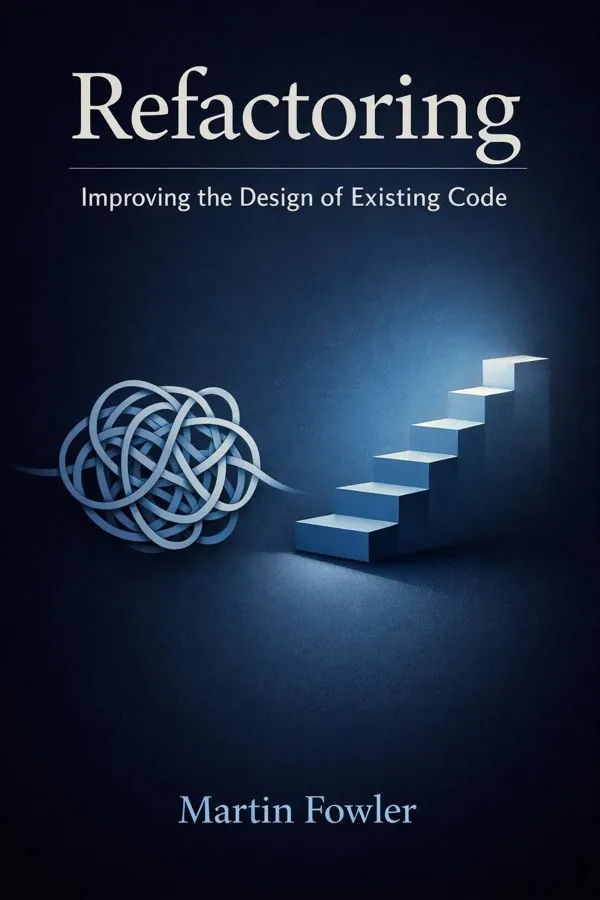
Refactoring: Improving the Design of Existing Code: Summary & Key Insights
 10 min6 chaptersAudio available
What Is Refactoring: Improving the Design of Existing Code About?
Refactoring: Improving the Design of Existing Code by Martin Fowler is a programming book spanning 6 pages. Refactoring es una técnica disciplinada para reestructurar un cuerpo existente de código, alterando su estructura interna sin cambiar su comportamiento externo. Este libro introduce los principios, patrones y métodos para mejorar el diseño de software existente, haciéndolo más fácil de entender y mantener. Martin Fowler presenta un catálogo de refactorizaciones con ejemplos prácticos y explica cómo aplicarlas de manera sistemática para mejorar la calidad del código.
This FizzRead summary covers all 6 key chapters of Refactoring: Improving the Design of Existing Code in approximately 10 minutes, distilling the most important ideas, arguments, and takeaways from Martin Fowler's work. Also available as an audio summary and Key Quotes Podcast.
Refactoring: Improving the Design of Existing Code
Refactoring es una técnica disciplinada para reestructurar un cuerpo existente de código, alterando su estructura interna sin cambiar su comportamiento externo. Este libro introduce los principios, patrones y métodos para mejorar el diseño de software existente, haciéndolo más fácil de entender y mantener. Martin Fowler presenta un catálogo de refactorizaciones con ejemplos prácticos y explica cómo aplicarlas de manera sistemática para mejorar la calidad del código.
Who Should Read Refactoring: Improving the Design of Existing Code?
This book is perfect for anyone interested in programming and looking to gain actionable insights in a short read. Whether you're a student, professional, or lifelong learner, the key ideas from Refactoring: Improving the Design of Existing Code by Martin Fowler will help you think differently.
- ✓Readers who enjoy programming and want practical takeaways
- ✓Professionals looking to apply new ideas to their work and life
- ✓Anyone who wants the core insights of Refactoring: Improving the Design of Existing Code in just 10 minutes
Want the full summary?
Get instant access to this book summary and 100K+ more with Fizz Moment.
Get Free SummaryAvailable on App Store • Free to download
Key Chapters
When software first makes its way into production, much of its design has been driven by immediate necessity—deadlines, incomplete information, and evolving requirements. Over time, the original clarity begins to fade. Changes are squeezed into awkward corners, dependencies multiply, and soon what was once a neat structure becomes brittle. Yet the software still works. This deceptive functionality often leads developers to avoid touching anything that isn’t broken. I begin by challenging that notion. Code that merely works is not enough; code that can evolve gracefully is the true goal.
The necessity of refactoring emerges from this gap between working code and well-designed code. Poorly designed code slows every subsequent change. Each fix becomes a potential bug. Each new feature becomes a struggle against invisible resistance. The cumulative cost—what I call *technical debt*—can eventually cripple the project. Refactoring provides a disciplined way to pay down that debt continuously.
But refactoring isn’t just cleanup. It’s a process of design improvement. Every line of code you alter is intended to make future changes easier. It’s about reducing duplication, clarifying intention, decoupling responsibilities, and making dependencies explicit. The external behavior must remain the same—that’s the rule that keeps refactoring safe. Through a careful series of small transformations, we make the internal design healthier without changing what the system does. This distinction between internal structure and external behavior is critical; you never refactor to fix a bug or add a feature, you refactor to make fixing and adding easier.
I emphasize this because programmers must learn to see refactoring as investment. The time you spend today restructuring a messy method saves hours—or days—tomorrow when new requirements arrive. Refactoring doesn’t slow you down; it makes speed sustainable. Over time, it becomes second nature, part of everyday coding rather than a special maintenance phase. Once you commit to this mindset, you begin to measure progress not only by how much you build but by how gracefully your code can accept change.
The core discipline of refactoring lies in doing it safely. The golden rule I repeat throughout the book is simple but profound: *refactor in small steps and preserve behavior.* Each transformation must leave the program functioning exactly as it did before. The moment you cross that boundary, you are no longer refactoring—you are altering functionality.
To maintain safety, you must rely on tests. Automated tests become the safety net that lets you move confidently through the code. With a solid testing foundation, each small change can be verified immediately. Refactoring without tests is like performing surgery without anesthesia—it might succeed, but every move carries unnecessary pain and risk.
Small steps are equally critical. A refactoring is rarely a massive rewrite; rather, it’s a sequence of highly localized edits, each clear and reversible. I move a method from one class to another, extract a confusing block into a well-named routine, or replace a field with an accessor. After each change, I run the tests. This rhythm—change, verify, commit—turns refactoring into a reliable habit. Over hundreds of iterations, the code evolves from confusion to clarity.
Preserving behavior also sharpens your sense of design. When you refactor, you focus on how responsibilities are distributed, how abstractions communicate, and how dependencies flow. You begin to think in terms of design principles: cohesion, coupling, encapsulation. Behavior preservation is not a constraint; it’s a mirror that reveals where your design hides complexity. To ensure the same behavior can persist across structural changes, you must build designs that are flexible yet consistent in purpose.
+ 4 more chapters — available in the FizzRead app
All Chapters in Refactoring: Improving the Design of Existing Code
About the Author
Martin Fowler es un reconocido autor, consultor y conferencista en el campo del desarrollo de software. Es miembro principal de ThoughtWorks y ha escrito varios libros influyentes sobre arquitectura de software, patrones de diseño y metodologías ágiles.
Get This Summary in Your Preferred Format
Read or listen to the Refactoring: Improving the Design of Existing Code summary by Martin Fowler anytime, anywhere. FizzRead offers multiple formats so you can learn on your terms — all free.
Available formats: App · Audio · PDF · EPUB — All included free with FizzRead
Download Refactoring: Improving the Design of Existing Code PDF and EPUB Summary
Key Quotes from Refactoring: Improving the Design of Existing Code
“When software first makes its way into production, much of its design has been driven by immediate necessity—deadlines, incomplete information, and evolving requirements.”
“The core discipline of refactoring lies in doing it safely.”
Frequently Asked Questions about Refactoring: Improving the Design of Existing Code
Refactoring: Improving the Design of Existing Code by Martin Fowler is a programming book that explores key ideas across 6 chapters. Refactoring es una técnica disciplinada para reestructurar un cuerpo existente de código, alterando su estructura interna sin cambiar su comportamiento externo. Este libro introduce los principios, patrones y métodos para mejorar el diseño de software existente, haciéndolo más fácil de entender y mantener. Martin Fowler presenta un catálogo de refactorizaciones con ejemplos prácticos y explica cómo aplicarlas de manera sistemática para mejorar la calidad del código.
You Might Also Like

ANSI Common Lisp
Paul Graham
10 min
Automate the Boring Stuff with Python: Practical Programming for Total Beginners
Al Sweigart
10 min
Black Hat Python: Python Programming for Hackers and Pentesters
Justin Seitz
10 min
Building Microservices: Designing Fine-Grained Systems
Sam Newman
10 min
C++ Primer
Stanley B. Lippman, Josée Lajoie, Barbara E. Moo
10 min
Clean Code: A Handbook of Agile Software Craftsmanship
Robert C. Martin
10 minBrowse by Category
Ready to read Refactoring: Improving the Design of Existing Code?
Get the full summary and 100K+ more books with Fizz Moment.