
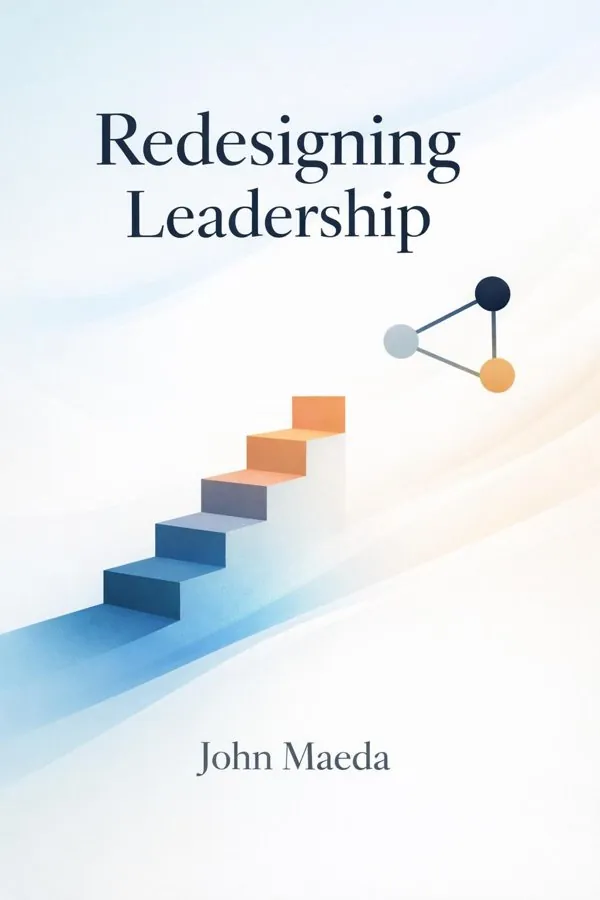
Redesigning Leadership: Summary & Key Insights
by John Maeda
 10 min9 chaptersAudio available
Key Takeaways from Redesigning Leadership
Most people think design is about making things beautiful, but Maeda’s deeper point is that design is really about solving problems with intention.
New leaders often believe they are expected to arrive with answers, but Maeda discovered that leadership starts with humility.
People can tolerate difficult decisions more easily than they can tolerate confusion.
Many leaders assume creativity and administration pull in opposite directions, but Maeda shows that durable innovation depends on both.
In a digital age, it is easy to confuse efficiency with progress.
What Is Redesigning Leadership About?
Redesigning Leadership by John Maeda is a leadership book spanning 9 pages. Leadership is often described in the language of strategy, authority, and execution, but John Maeda argues that the best leaders think more like designers. In Redesigning Leadership, he reflects on his transition from celebrated technologist and designer to president of the Rhode Island School of Design, where he had to learn how to guide an institution filled with strong personalities, creative talent, and competing priorities. The result is a thoughtful, highly personal exploration of what leadership looks like when it is grounded in curiosity, empathy, experimentation, and clarity rather than control alone. What makes this book especially valuable is Maeda’s unusual vantage point. He has worked across design, technology, education, and business, and he brings those worlds together in a way few leadership authors can. Instead of offering rigid formulas, he shows how leaders can approach organizations as living systems that must be understood, iterated, and humanized. For anyone trying to lead in a fast-changing, innovation-driven environment, Redesigning Leadership offers a fresh and practical message: great leadership is not about having all the answers, but about creating the conditions for better ones to emerge.
This FizzRead summary covers all 9 key chapters of Redesigning Leadership in approximately 10 minutes, distilling the most important ideas, arguments, and takeaways from John Maeda's work. Also available as an audio summary and Key Quotes Podcast.
Redesigning Leadership
Leadership is often described in the language of strategy, authority, and execution, but John Maeda argues that the best leaders think more like designers. In Redesigning Leadership, he reflects on his transition from celebrated technologist and designer to president of the Rhode Island School of Design, where he had to learn how to guide an institution filled with strong personalities, creative talent, and competing priorities. The result is a thoughtful, highly personal exploration of what leadership looks like when it is grounded in curiosity, empathy, experimentation, and clarity rather than control alone.
What makes this book especially valuable is Maeda’s unusual vantage point. He has worked across design, technology, education, and business, and he brings those worlds together in a way few leadership authors can. Instead of offering rigid formulas, he shows how leaders can approach organizations as living systems that must be understood, iterated, and humanized. For anyone trying to lead in a fast-changing, innovation-driven environment, Redesigning Leadership offers a fresh and practical message: great leadership is not about having all the answers, but about creating the conditions for better ones to emerge.
Who Should Read Redesigning Leadership?
This book is perfect for anyone interested in leadership and looking to gain actionable insights in a short read. Whether you're a student, professional, or lifelong learner, the key ideas from Redesigning Leadership by John Maeda will help you think differently.
- ✓Readers who enjoy leadership and want practical takeaways
- ✓Professionals looking to apply new ideas to their work and life
- ✓Anyone who wants the core insights of Redesigning Leadership in just 10 minutes
Want the full summary?
Get instant access to this book summary and 100K+ more with Fizz Moment.
Get Free SummaryAvailable on App Store • Free to download
Key Chapters
Most people think design is about making things beautiful, but Maeda’s deeper point is that design is really about solving problems with intention. Once you understand that, leadership begins to look less like command and more like design work. A leader is not simply managing tasks or enforcing rules; a leader is shaping environments, processes, relationships, and decisions so that people can do meaningful work well.
Maeda uses his own journey to show how this shift in thinking matters. Coming from a background in art, computation, and design, he learned that the same mindset used to build an elegant product can also help build a healthier institution. Designers observe before acting. They prototype before finalizing. They ask what people need, not just what systems demand. In organizations, this means leaders must resist the temptation to treat problems as purely technical. A conflict between teams, a lack of innovation, or a drop in morale cannot be fixed by process charts alone. These are design challenges involving human behavior, incentives, communication, and trust.
A practical application of this idea is to redesign meetings, workflows, and reporting structures the same way a designer would rethink an interface. If employees feel confused, ask where friction exists. If ideas are not flowing, examine whether the environment invites contribution. If change efforts fail, consider whether the experience of change itself has been poorly designed.
The takeaway is simple but powerful: stop seeing leadership as control over people and start seeing it as the thoughtful design of conditions in which people can succeed.
New leaders often believe they are expected to arrive with answers, but Maeda discovered that leadership starts with humility. When he became president of RISD, he entered a world with its own traditions, language, politics, and emotional dynamics. His instincts initially pushed him to define direction quickly, yet he came to see that his first responsibility was not to speak, but to learn.
This is a difficult lesson because leadership roles reward decisiveness. Still, Maeda argues that asking better questions is often more valuable than delivering fast solutions. Every institution has hidden assumptions and informal networks that outsiders cannot understand immediately. A leader who acts too soon may solve the wrong problem or create resistance where collaboration was possible. Listening tours, one-on-one conversations, and close observation are not signs of uncertainty; they are forms of research.
This mindset resembles user-centered design. Before creating a solution, designers study users. Leaders should do the same with their teams. What are people afraid of? Where are they frustrated? What values are nonnegotiable? What does success look like from their perspective? For example, a manager taking over a struggling department might spend the first month interviewing team members, mapping bottlenecks, and identifying cultural tensions before making structural changes.
The goal is not endless analysis. It is informed action. Learning creates credibility because people are more willing to follow leaders who demonstrate respect for context. It also improves judgment by replacing assumptions with insight.
The actionable takeaway: in any new leadership situation, spend more time diagnosing than declaring. Ask questions that reveal reality before designing solutions that shape it.
People can tolerate difficult decisions more easily than they can tolerate confusion. One of Maeda’s clearest insights is that communication is not an accessory to leadership; it is one of its core tools. In creative institutions especially, where autonomy and identity matter deeply, silence from leadership quickly breeds speculation, anxiety, and distrust.
Transparency does not mean sharing every detail or abandoning discretion. It means making intentions, constraints, and reasoning visible whenever possible. Maeda learned that when leaders fail to explain why decisions are being made, people fill in the gaps with stories of incompetence, secrecy, or politics. Even a reasonable decision can feel threatening if it arrives without context. By contrast, when leaders communicate openly about trade-offs, uncertainty, and goals, they create a sense of shared reality.
This is especially important during change. Imagine a company restructuring teams to adapt to new market demands. If management simply announces the changes, employees may focus on what they are losing. But if leaders explain the external pressures, the alternatives considered, the principles guiding the reorganization, and the support available during transition, people are more likely to engage constructively.
Maeda’s perspective also highlights that transparency is not just about broadcasting information. It is about making communication understandable. Dense memos, vague language, and inconsistent messaging undermine trust as much as secrecy does. Clarity is a form of respect.
A practical habit is to communicate decisions in three parts: what is happening, why it is happening, and what it means for the people affected. Then invite questions.
The actionable takeaway: do not wait for uncertainty to grow in silence. Explain your thinking early and clearly so trust has room to develop.
Many leaders assume creativity and administration pull in opposite directions, but Maeda shows that durable innovation depends on both. Creative work needs freedom, experimentation, and space for intuition. Institutions, however, also need budgets, policies, timelines, and accountability. Leadership becomes difficult precisely because it must honor both realities at once.
At RISD, Maeda confronted the tension between protecting artistic culture and managing operational demands. It is tempting for leaders to take sides. Some become overly bureaucratic and suffocate imagination with controls. Others romanticize creativity and ignore the structures required to sustain it. Maeda argues that effective leadership means translating between these worlds rather than choosing one over the other.
A useful example is product development in a growing company. Designers and engineers may want broad freedom to explore new ideas, while finance and operations teams push for predictable delivery and cost control. If leadership frames this as a battle, the organization fractures. If leadership instead creates clear stages for experimentation, review, and execution, creativity gains structure without losing vitality.
This principle applies beyond the arts. Teachers need administrative systems to support learning. Entrepreneurs need discipline to scale ideas. Nonprofits need process to protect mission. Administration is not the enemy of creativity when it is designed to serve purpose rather than dominate it.
Leaders can help by distinguishing where flexibility is essential and where consistency is necessary. Not every process should be rigid, but not everything can remain fluid either. Good leadership makes these boundaries explicit.
The actionable takeaway: treat structure as a scaffold for creativity, not a cage. Design systems that protect experimentation while keeping the organization functional and sustainable.
In a digital age, it is easy to confuse efficiency with progress. Maeda, with his deep experience in technology, warns against treating tools as solutions in themselves. Technology can accelerate communication, automate workflows, and expand access, but leadership fails when it forgets that organizations are still made of people. The real question is not what technology can do, but what kind of human experience it creates.
This insight is especially relevant in workplaces where platforms, dashboards, and remote collaboration tools mediate daily interaction. A new system may improve measurable efficiency while weakening trust, creativity, or belonging. For example, replacing live discussion with endless asynchronous updates may save time on paper, yet reduce the nuance and empathy that come from real conversation. Similarly, overreliance on metrics can flatten judgment by privileging what is easy to count over what actually matters.
Maeda’s design-informed view suggests leaders should evaluate tools the way designers evaluate products: by considering usability, emotional impact, and context. Does the technology make people feel empowered or monitored? Does it improve understanding or add noise? Does it support relationships or isolate individuals behind screens?
The best applications of technology are those that remove friction without removing humanity. A clear internal platform can make information accessible. Video calls can connect distributed teams. Shared digital workspaces can spark collaboration. But all of these work best when paired with intentional human practices such as listening, recognition, and dialogue.
The actionable takeaway: adopt technology to enhance human connection and clarity, not merely to automate tasks. Before implementing any tool, ask how it will affect trust, collaboration, and the lived experience of the people using it.
Empathy is often dismissed as a personal virtue rather than a leadership capability, but Maeda presents it as essential to effective decision-making. To lead well, you must understand how people experience the systems you create. Without that understanding, even intelligent strategies can fail because they collide with fear, identity, pride, or exhaustion.
Empathy does not mean avoiding hard choices. It means making those choices with awareness of their human consequences. In a school, company, or nonprofit, people do not respond only to logic. They respond to whether they feel seen, respected, and heard. Leaders who ignore this may confuse compliance with commitment. Employees might follow instructions while emotionally disengaging from the mission.
A practical example is performance feedback. A purely transactional leader may focus only on outcomes and deficiencies. An empathetic leader still addresses performance, but does so in a way that considers motivation, confidence, and growth. The message becomes more useful because it is delivered in a form the other person can actually hear.
Empathy also sharpens organizational insight. By understanding the perspectives of students, staff, customers, or community members, leaders uncover needs that spreadsheets cannot reveal. Design thinking has long relied on empathy to generate better solutions; Maeda extends that principle to leadership itself.
This does not require extraordinary emotional fluency. It begins with simple disciplines: listening without interrupting, asking how decisions will land on different groups, and resisting the urge to reduce people to roles or functions.
The actionable takeaway: before making a major decision, deliberately view it from the perspective of those most affected. Leadership becomes stronger when empathy informs strategy rather than being treated as an afterthought.
Leaders are often expected to project confidence, yet Maeda’s perspective invites something more realistic and more productive: the willingness to treat failure as information. In design, iteration is normal. Early ideas are tested, refined, and sometimes discarded. Leadership, he suggests, should work much the same way. Not every initiative will succeed, and pretending otherwise creates fear that stifles innovation.
This idea is particularly important in organizations that want creativity but punish imperfection. If employees believe every experiment must succeed on the first attempt, they will default to safe, familiar choices. Leaders then wonder why bold thinking disappears. By contrast, when leaders frame failure as part of learning, teams become more resilient and inventive.
That does not mean celebrating carelessness. Productive failure is disciplined. It happens when organizations test assumptions, gather feedback, and improve. For example, a university might pilot a new student advising model in one department before rolling it out broadly. A business might launch a small-scale prototype of a service, learn from customer behavior, and revise it before expansion.
Maeda’s own leadership experience underscores how uncomfortable this can be. Public roles make mistakes visible. Still, a leader who acknowledges missteps, explains what was learned, and adjusts course models maturity rather than weakness. This creates psychological safety for others to surface problems early instead of hiding them.
The actionable takeaway: replace the expectation of immediate perfection with a process of visible learning. When something does not work, ask what it revealed, what can be improved, and how the next iteration can be smarter.
Organizations do not become what leaders announce; they become what leaders repeatedly model. Maeda emphasizes that leadership by example is not symbolic window dressing. It is one of the most powerful forces in shaping culture. People watch what leaders prioritize, how they behave under pressure, and whether their actions align with their stated values.
A leader may talk about openness, but if dissent is punished in meetings, the real culture becomes silence. A leader may praise collaboration, but if rewards go only to individual stars, competition takes over. Culture is built from repeated signals. Maeda’s design mindset helps illuminate this: every action by leadership becomes part of the user experience of the organization.
This is especially true in moments of tension. During uncertainty, people study leaders for cues on what matters. If a leader remains calm, curious, and respectful, that tone spreads. If a leader becomes defensive, opaque, or erratic, that also spreads. Values are tested in difficulty, not in mission statements.
Practical applications are straightforward but demanding. If you want thoughtful communication, communicate thoughtfully yourself. If you want people to learn, admit what you are learning. If you want balance and sustainability, do not glorify burnout. If you want inclusion, ensure your own behavior invites different voices into the room.
The importance of example also means that small actions matter. Showing up prepared, following through on commitments, acknowledging others’ contributions, and treating everyone with dignity all shape institutional norms over time.
The actionable takeaway: identify the three values you most want your organization to embody, then audit your own daily behavior. Culture will follow what you practice more reliably than what you proclaim.
One of Maeda’s most important arguments is that leadership can no longer rely on static models built for slower, more predictable environments. The future belongs to leaders who can navigate ambiguity, bridge disciplines, and continuously redesign their approach as conditions change. This is not a call for instability; it is a call for responsiveness.
Creative industries, educational institutions, and modern businesses all face rapid shifts in technology, expectations, and organizational form. In such contexts, expertise alone is insufficient. Leaders must combine strategic thinking with curiosity, technical awareness with human sensitivity, and vision with flexibility. Maeda’s own career across art, code, academia, and business gives weight to this claim. The most effective leaders are often translators who connect domains that rarely speak clearly to one another.
Adaptability also means letting go of the fantasy of total certainty. Leaders are often trained to project confidence through fixed plans, but dynamic environments reward those who can update their thinking in light of new evidence. For instance, a leader guiding a hybrid workplace must revisit assumptions about productivity, collaboration, and culture instead of simply applying pre-digital management habits to new circumstances.
This future-oriented model of leadership is deeply compatible with design. Designers work iteratively, test ideas, stay close to users, and refine direction as they learn. Leaders can do the same without losing authority. In fact, adaptability strengthens credibility when it is grounded in clear values.
The actionable takeaway: build leadership around principles rather than rigid formulas. Hold your core mission steady, but stay willing to revise methods, structures, and assumptions as the world changes.
All Chapters in Redesigning Leadership
About the Author
John Maeda is an American designer, technologist, educator, and author whose career has bridged art, computation, business, and leadership. He first became widely known for his pioneering work in digital design and for exploring how code and creativity can inform one another. Maeda has held influential roles at the MIT Media Lab, served as president of the Rhode Island School of Design, and later worked in leadership positions connected to design, venture capital, and technology, including Automattic. Across these roles, he has been a prominent advocate for the value of design not just in products, but in organizations and decision-making. His writing and speaking often focus on how leaders can combine empathy, innovation, and technological awareness to build more thoughtful and adaptive institutions.
Get This Summary in Your Preferred Format
Read or listen to the Redesigning Leadership summary by John Maeda anytime, anywhere. FizzRead offers multiple formats so you can learn on your terms — all free.
Available formats: App · Audio · PDF · EPUB — All included free with FizzRead
Download Redesigning Leadership PDF and EPUB Summary
Key Quotes from Redesigning Leadership
“Most people think design is about making things beautiful, but Maeda’s deeper point is that design is really about solving problems with intention.”
“New leaders often believe they are expected to arrive with answers, but Maeda discovered that leadership starts with humility.”
“People can tolerate difficult decisions more easily than they can tolerate confusion.”
“Many leaders assume creativity and administration pull in opposite directions, but Maeda shows that durable innovation depends on both.”
“In a digital age, it is easy to confuse efficiency with progress.”
Frequently Asked Questions about Redesigning Leadership
Redesigning Leadership by John Maeda is a leadership book that explores key ideas across 9 chapters. Leadership is often described in the language of strategy, authority, and execution, but John Maeda argues that the best leaders think more like designers. In Redesigning Leadership, he reflects on his transition from celebrated technologist and designer to president of the Rhode Island School of Design, where he had to learn how to guide an institution filled with strong personalities, creative talent, and competing priorities. The result is a thoughtful, highly personal exploration of what leadership looks like when it is grounded in curiosity, empathy, experimentation, and clarity rather than control alone. What makes this book especially valuable is Maeda’s unusual vantage point. He has worked across design, technology, education, and business, and he brings those worlds together in a way few leadership authors can. Instead of offering rigid formulas, he shows how leaders can approach organizations as living systems that must be understood, iterated, and humanized. For anyone trying to lead in a fast-changing, innovation-driven environment, Redesigning Leadership offers a fresh and practical message: great leadership is not about having all the answers, but about creating the conditions for better ones to emerge.
More by John Maeda

You Might Also Like

Extreme Ownership
Jocko Willink
10 min
Dare to Lead
Brene Brown
10 min
Leaders Eat Last
Simon Sinek
10 min
The 21 Irrefutable Laws of Leadership
John Maxwell
10 min
Start With Why
Simon Sinek
10 min
How to Lead When You're Not in Charge
Clay Scroggins
10 minBrowse by Category
Ready to read Redesigning Leadership?
Get the full summary and 100K+ more books with Fizz Moment.