
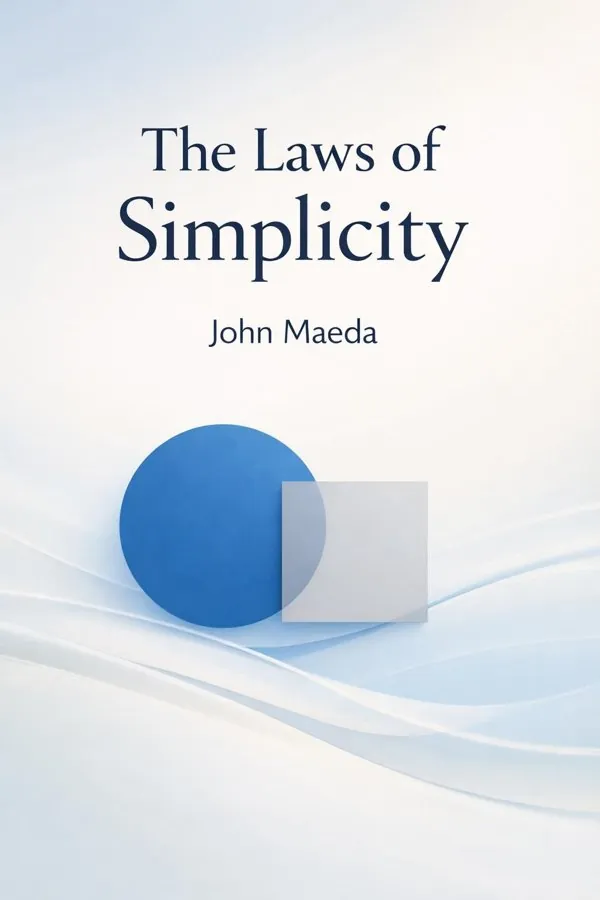
The Laws of Simplicity: Design, Technology, Business, Life: Summary & Key Insights
by John Maeda
 10 min9 chaptersAudio available
Key Takeaways from The Laws of Simplicity: Design, Technology, Business, Life
Simplicity begins not with adding brilliance, but with removing burden.
When you cannot eliminate complexity, you can still make it manageable through structure.
Nothing feels simple if it takes too long.
What seems complicated to a beginner can feel natural to someone who understands it.
We only recognize simplicity because complexity exists beside it.
What Is The Laws of Simplicity: Design, Technology, Business, Life About?
The Laws of Simplicity: Design, Technology, Business, Life by John Maeda is a design book spanning 11 pages. In The Laws of Simplicity, John Maeda tackles a problem that defines modern life: we are surrounded by powerful systems, endless choices, and constant information, yet very little feels truly easy to use or understand. His answer is not to romanticize minimalism or reject complexity altogether. Instead, he shows that simplicity is a thoughtful discipline—one that requires intelligence, restraint, empathy, and design judgment. Built around ten concise laws and supported by three guiding keys, the book offers a practical framework for making products, services, decisions, and experiences feel clearer and more meaningful. What makes this book matter is its breadth. Maeda writes not only for designers, but for technologists, business leaders, and anyone trying to navigate a crowded world with more elegance and less friction. His ideas apply equally to software interfaces, organizational processes, communication, and personal habits. Maeda brings unusual authority to the subject: he is a designer, engineer, educator, and former leader at both MIT Media Lab and the Rhode Island School of Design. That rare combination allows him to translate simplicity from an aesthetic preference into a strategy for better living and better work.
This FizzRead summary covers all 9 key chapters of The Laws of Simplicity: Design, Technology, Business, Life in approximately 10 minutes, distilling the most important ideas, arguments, and takeaways from John Maeda's work. Also available as an audio summary and Key Quotes Podcast.
The Laws of Simplicity: Design, Technology, Business, Life
In The Laws of Simplicity, John Maeda tackles a problem that defines modern life: we are surrounded by powerful systems, endless choices, and constant information, yet very little feels truly easy to use or understand. His answer is not to romanticize minimalism or reject complexity altogether. Instead, he shows that simplicity is a thoughtful discipline—one that requires intelligence, restraint, empathy, and design judgment. Built around ten concise laws and supported by three guiding keys, the book offers a practical framework for making products, services, decisions, and experiences feel clearer and more meaningful.
What makes this book matter is its breadth. Maeda writes not only for designers, but for technologists, business leaders, and anyone trying to navigate a crowded world with more elegance and less friction. His ideas apply equally to software interfaces, organizational processes, communication, and personal habits. Maeda brings unusual authority to the subject: he is a designer, engineer, educator, and former leader at both MIT Media Lab and the Rhode Island School of Design. That rare combination allows him to translate simplicity from an aesthetic preference into a strategy for better living and better work.
Who Should Read The Laws of Simplicity: Design, Technology, Business, Life?
This book is perfect for anyone interested in design and looking to gain actionable insights in a short read. Whether you're a student, professional, or lifelong learner, the key ideas from The Laws of Simplicity: Design, Technology, Business, Life by John Maeda will help you think differently.
- ✓Readers who enjoy design and want practical takeaways
- ✓Professionals looking to apply new ideas to their work and life
- ✓Anyone who wants the core insights of The Laws of Simplicity: Design, Technology, Business, Life in just 10 minutes
Want the full summary?
Get instant access to this book summary and 100K+ more with Fizz Moment.
Get Free SummaryAvailable on App Store • Free to download
Key Chapters
Simplicity begins not with adding brilliance, but with removing burden. Maeda’s first law, Reduce, argues that the simplest way to make a system easier is to thoughtfully take things away. But reduction is not the same as deprivation. The real challenge is deciding what is essential and what merely clutters the experience. Good design does not strip away value; it reveals value by clearing the path to it.
This idea matters because complexity often accumulates invisibly. Products gain features to satisfy every customer segment. Meetings gain agenda items. Websites gain menus, pop-ups, and messages. Personal schedules fill with obligations that once seemed useful. Over time, abundance stops feeling generous and starts feeling exhausting. Reduction restores focus. It asks: what is the core purpose here, and what elements directly support it?
A smartphone app offers a practical example. An app with twenty buttons on its home screen may technically provide more options, but users often feel overwhelmed. A better design may hide advanced tools behind progressive layers while making the main action instantly obvious. In business, a company might reduce the number of approval steps in a process, cutting delay without sacrificing quality. In everyday life, a person might reduce commitments or possessions to make room for attention and energy.
Maeda’s insight is that reduction works best when paired with care. The goal is not emptiness, but meaningful clarity. If subtraction makes people feel lost, the design has gone too far. If it makes them feel relieved and capable, simplicity has been achieved.
Actionable takeaway: Identify one product, workflow, or routine you control and remove one nonessential element this week, then test whether the experience becomes clearer and more useful.
When you cannot eliminate complexity, you can still make it manageable through structure. Maeda’s second law, Organize, reminds us that people do not experience complexity only by quantity; they experience it by arrangement. Ten things thrown into a pile feel overwhelming. The same ten things sorted into meaningful groups feel understandable.
Organization is a hidden form of simplicity. It does not always reduce the number of elements, but it reduces the mental work required to navigate them. This is why clean menus, intuitive categories, visual hierarchy, and predictable systems matter so much. They help users build a map. Once people know where things belong, they feel in control.
Think of a supermarket. A store with thousands of items can still feel easy to shop if products are grouped logically, signs are clear, and pathways are intuitive. The same principle applies to digital experiences. A software dashboard may contain many tools, but if they are clustered by task, labeled clearly, and presented progressively, users can move confidently. In organizations, clear roles and decision rights reduce confusion. In personal life, organizing files, calendars, or home spaces can lower stress even when the amount of responsibility remains the same.
Maeda’s point is subtle: order creates perceived simplicity. A complicated thing can become less intimidating when its internal logic is visible. This is especially important in technology, where underlying systems may be sophisticated, but the user experience should feel coherent.
Actionable takeaway: Take one cluttered space or process—your desktop, inbox, team workflow, or app navigation—and reorganize it into a few clear categories so people can understand it at a glance.
Nothing feels simple if it takes too long. Maeda’s law of Time recognizes that speed is not just a technical metric; it shapes emotional experience. A process that is fast feels easier, lighter, and more respectful. A process that is slow feels more complicated than it may actually be. In other words, reducing waiting is a direct path to increasing simplicity.
This applies far beyond computers. A website that loads instantly appears better designed than one with identical content that stalls. A checkout process with one-click payment feels elegant because it removes delay at the moment of decision. In customer service, a company that resolves a problem in minutes appears competent and trustworthy, while one that requires long hold times creates frustration, even if the ultimate solution is the same.
Maeda is not arguing that everything must be rushed. Some experiences deserve slowness—learning, reflection, craftsmanship, conversation. But when users are trying to complete a clear task, unnecessary delay adds friction. Smart simplicity therefore involves understanding where time matters most and engineering the experience accordingly.
The principle also applies personally. Morning routines, travel plans, recurring tasks, and digital habits all consume time. A simplified routine is not always shorter because it is smaller; often it is shorter because it is better designed. Templates, defaults, automation, and preparation all help convert complexity into ease.
Time-saving improvements are often underestimated because they seem small. Yet shaving thirty seconds off a common action performed millions of times creates enormous value. In life, reclaiming small amounts of time across many habits can noticeably reduce stress.
Actionable takeaway: Find one repeated task that causes delay and redesign it with defaults, automation, or fewer steps so it becomes faster without becoming confusing.
What seems complicated to a beginner can feel natural to someone who understands it. Maeda’s law of Learn shows that simplicity is partly a function of familiarity. The more we know, the less effort we need to interpret a system. This means that true simplicity does not always come from reducing the system itself; sometimes it comes from helping people learn how it works.
This is an important correction to overly simplistic thinking. Designers and leaders often assume they must hide all complexity. But some complexity is unavoidable and even valuable. Financial tools, creative software, medical devices, and professional platforms may need depth. The key is to make learning possible, gradual, and rewarding.
Good onboarding is one example. A product can introduce features in stages rather than all at once. A camera may provide an automatic mode for beginners while still allowing experts to explore manual controls over time. In a workplace, a well-designed training process can make sophisticated systems feel straightforward. In personal life, habits become simpler as they become familiar: cooking, budgeting, exercise, and parenting all feel less chaotic with practice and understanding.
Maeda’s point is that simplicity and education are partners. If people are given context, guidance, and a chance to build confidence, they can handle far more than designers sometimes assume. Learning reduces fear, and reduced fear makes experiences feel cleaner and more accessible.
Still, the burden should not fall entirely on the user. The best systems combine clear design with supportive learning. They meet people where they are and invite them into deeper capability without punishing them for being new.
Actionable takeaway: Look at one complex tool or process you offer and create a gentler learning path—such as a quick guide, staged tutorial, or starter mode—to make first use dramatically easier.
We only recognize simplicity because complexity exists beside it. Maeda explores this through the laws of Differences and Context, showing that simple experiences do not stand alone as abstract ideals. They are understood relative to alternatives, surroundings, expectations, and contrast. Without context, simplicity can become meaningless or even invisible.
A blank page is not inherently useful. It becomes elegant when it appears in contrast to a crowded page and when it supports a specific purpose. A quiet room feels calming because the world outside is noisy. A product with a restrained interface feels refreshingly simple because competitors overload users. This means designers and decision-makers must ask not only whether something is simple, but simple compared to what, and within what environment.
Context also determines how much complexity users can tolerate. Professional software for engineers can include more controls than a meditation app because user expectations differ. A luxury brand might use spacious design to signal confidence, while an emergency dashboard might prioritize density because speed and visibility matter more than visual calm. In communication, a short message can feel elegant in one situation and careless in another.
Maeda’s insight is that simplicity is relational. It depends on framing, contrast, and fit. This protects us from applying one universal style to every problem. The simplest solution is not always the one with the fewest elements; it is the one that makes sense in its setting and helps people achieve their goal with minimal confusion.
Actionable takeaway: Before simplifying anything, define the user’s context and compare your design with realistic alternatives so you simplify for the real environment, not for an abstract ideal.
People do not judge simplicity by logic alone. Maeda’s law of Emotion argues that how something feels is inseparable from how simple it seems. An experience may be technically efficient, but if it feels cold, stressful, or unfriendly, users will still perceive friction. Emotion softens complexity and helps people accept, trust, and enjoy what they are using.
This is why beautifully designed products often feel simpler than they objectively are. Thoughtful materials, satisfying interactions, reassuring microcopy, pleasant sounds, and humane details all reduce psychological resistance. A banking app that uses calm language and clear feedback may feel easier than one with identical functionality but more intimidating design. A customer support interaction that acknowledges frustration can make a difficult process feel manageable. Even in personal relationships, warmth and empathy can simplify hard conversations by reducing defensiveness.
Maeda does not suggest that emotion should replace function. Rather, emotion enhances function by making people more comfortable engaging with complexity. A user is more willing to explore when the experience feels forgiving. A team is more willing to embrace change when communication feels respectful. A product becomes memorable not only because it works, but because it creates a sense of ease.
This idea broadens simplicity beyond minimal aesthetics. Simplicity is not merely fewer buttons or shorter text. It is also the emotional removal of anxiety. Designers, managers, and leaders who ignore this dimension risk creating efficient systems that people still avoid.
Actionable takeaway: Review one experience you control and ask where users may feel uncertainty or tension, then add one emotionally supportive element such as clearer feedback, friendlier language, or a more reassuring visual cue.
When trust is present, systems feel simpler because people stop wasting energy on doubt. Maeda’s law of Trust highlights a truth often overlooked in design and business: complexity increases when users must constantly verify, question, or protect themselves. If they do not trust the interface, the company, or the process, every action becomes mentally heavier.
Trust shows up in many forms. Users trust a product when it behaves predictably, protects their data, and communicates honestly. Customers trust a brand when pricing is transparent and promises are kept. Employees trust leaders when decisions are explained clearly and values match behavior. In all these cases, trust reduces the need for defensive thinking. People do not have to second-guess every click, every fee, or every instruction.
Consider online payments. A checkout page may be visually simple, but if it looks suspicious or hides important details, people hesitate. Conversely, even a more detailed page can feel straightforward when security signals are clear, branding is consistent, and the company has credibility. The same applies to software updates, privacy settings, contracts, and healthcare systems. Trust makes action easier.
Maeda’s point is powerful because it connects simplicity to ethics. You cannot fake simplicity for long if the underlying relationship is manipulative. Dark patterns may appear efficient in the short term, but they create long-term confusion and resentment. Honest design, on the other hand, builds confidence and lowers cognitive load.
Actionable takeaway: Identify one point where users may feel uncertainty—pricing, privacy, security, or process clarity—and increase transparency there so trust becomes part of the design rather than an afterthought.
Simplicity is not a perfect state you arrive at once and keep forever. Maeda’s law of Failure acknowledges that attempts to simplify will sometimes backfire. Remove too much, and users become lost. Automate too much, and people feel powerless. Streamline too aggressively, and important nuance disappears. Failure is not evidence that simplicity is impossible; it is part of learning what clarity actually requires.
This law matters because simplicity is often treated as obvious in hindsight but difficult in practice. Designers, product teams, and leaders must make trade-offs without complete certainty. Real people use things in unexpected ways. Assumptions about what is essential may prove wrong. A supposedly cleaner process may reveal hidden dependencies. Failure therefore becomes feedback about where complexity truly lives.
The healthiest organizations test simplification rather than declaring it. They prototype, observe, and refine. A company redesigning a website might discover that removing navigation labels hurts discoverability. A team shortening a report might realize decision-makers still need one specific data table. A person trying to simplify a schedule might learn that eliminating all margin creates new stress rather than less.
Maeda’s broader message is humility. Simplicity requires experimentation because it is relational and contextual. We learn by seeing where users struggle, where systems break, and where elegance turns into oversimplification. Failure keeps simplicity honest.
The law also carries encouragement. Fear of getting it wrong often leads teams to preserve bloated systems. But refusing to simplify is its own failure. Better to make thoughtful changes, learn quickly, and improve.
Actionable takeaway: Treat your next simplification effort as an experiment—test it with real users, watch where confusion appears, and revise based on what actually happens rather than what you assumed would happen.
At the heart of Maeda’s framework lies the final law, The One: simplicity is about subtracting the obvious and adding the meaningful. This idea gathers the previous laws into a single discipline of balance. The goal is not total reduction, total speed, or total minimalism. It is to create an experience where what remains carries purpose, coherence, and value.
This law helps resolve the tension running through the entire book. Simplicity is desirable, but life and technology are inherently complex. We cannot eliminate all complication without also eliminating richness. So the designer’s task is not to wage war on complexity, but to shape it wisely. The obvious should be removed because it distracts, duplicates, or confuses. The meaningful should be added because it improves understanding, delight, trust, or performance.
This principle appears everywhere. In product design, it may mean removing unnecessary settings while adding one beautifully considered feature that solves the main problem. In writing, it means cutting jargon but adding a vivid example. In leadership, it means reducing bureaucracy while adding clarity of mission. In personal life, it can mean saying no to low-value obligations while saying yes more fully to relationships, health, and meaningful work.
Maeda also ends with three keys—Away, Open, Power—which deepen this vision. More appears less distant when technology brings it nearer. More appears less overwhelming when systems remain open to understanding. More can feel better than less when it is intelligently powered and well controlled. These keys remind us that simplicity is dynamic, not static.
Actionable takeaway: For any design or decision, ask two questions: what obvious element can be removed, and what meaningful element can be strengthened so the whole experience becomes clearer and more valuable?
All Chapters in The Laws of Simplicity: Design, Technology, Business, Life
About the Author
John Maeda is an American designer, technologist, educator, and author whose work sits at the intersection of design, engineering, and leadership. Trained in both computer science and visual communication, he became widely known for bringing artistic thinking into the world of technology. Maeda taught at the MIT Media Lab and later served as president of the Rhode Island School of Design, where he championed the value of design in business and innovation. Over the course of his career, he has advised companies, written influential books and essays, and helped popularize the idea that good design is not decoration but strategic problem-solving. His perspective is especially distinctive because he combines technical rigor with human-centered thinking, making him a respected voice on simplicity, creativity, and modern innovation.
Get This Summary in Your Preferred Format
Read or listen to the The Laws of Simplicity: Design, Technology, Business, Life summary by John Maeda anytime, anywhere. FizzRead offers multiple formats so you can learn on your terms — all free.
Available formats: App · Audio · PDF · EPUB — All included free with FizzRead
Download The Laws of Simplicity: Design, Technology, Business, Life PDF and EPUB Summary
Key Quotes from The Laws of Simplicity: Design, Technology, Business, Life
“Simplicity begins not with adding brilliance, but with removing burden.”
“When you cannot eliminate complexity, you can still make it manageable through structure.”
“Nothing feels simple if it takes too long.”
“What seems complicated to a beginner can feel natural to someone who understands it.”
“We only recognize simplicity because complexity exists beside it.”
Frequently Asked Questions about The Laws of Simplicity: Design, Technology, Business, Life
The Laws of Simplicity: Design, Technology, Business, Life by John Maeda is a design book that explores key ideas across 9 chapters. In The Laws of Simplicity, John Maeda tackles a problem that defines modern life: we are surrounded by powerful systems, endless choices, and constant information, yet very little feels truly easy to use or understand. His answer is not to romanticize minimalism or reject complexity altogether. Instead, he shows that simplicity is a thoughtful discipline—one that requires intelligence, restraint, empathy, and design judgment. Built around ten concise laws and supported by three guiding keys, the book offers a practical framework for making products, services, decisions, and experiences feel clearer and more meaningful. What makes this book matter is its breadth. Maeda writes not only for designers, but for technologists, business leaders, and anyone trying to navigate a crowded world with more elegance and less friction. His ideas apply equally to software interfaces, organizational processes, communication, and personal habits. Maeda brings unusual authority to the subject: he is a designer, engineer, educator, and former leader at both MIT Media Lab and the Rhode Island School of Design. That rare combination allows him to translate simplicity from an aesthetic preference into a strategy for better living and better work.
More by John Maeda
You Might Also Like
The Design of Everyday Things
Don Norman
10 min
The Better Angels of Our Nature
Steven Pinker
10 min
A Designer's Art
Paul Rand
10 min
Architects' Sketchbooks
Various Editors
10 min
Architectural Graphic Standards
The American Institute of Architects
10 min
Design Is Storytelling
Ellen Lupton
10 minBrowse by Category
Ready to read The Laws of Simplicity: Design, Technology, Business, Life?
Get the full summary and 100K+ more books with Fizz Moment.