
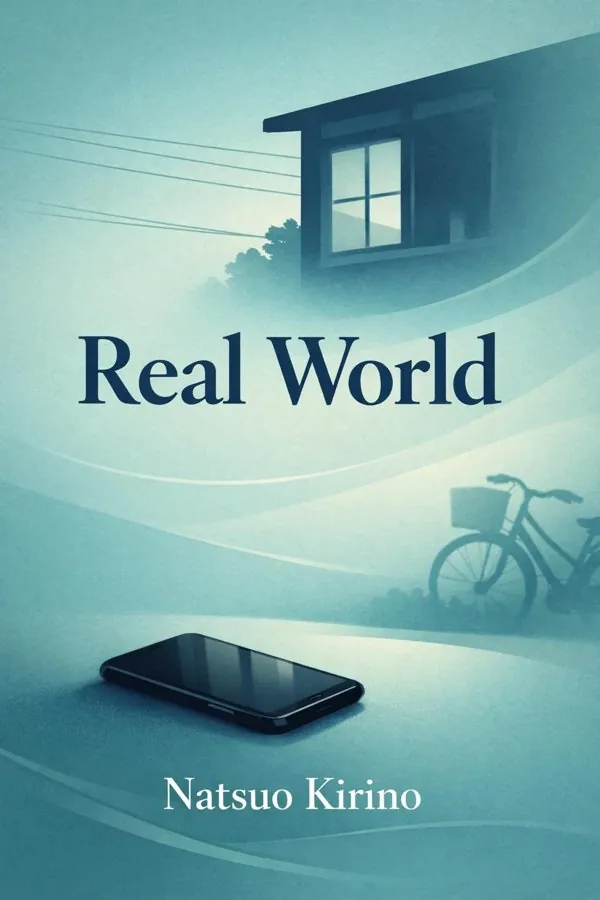
Real World: Summary & Key Insights
 10 min9 chaptersAudio available
Key Takeaways from Real World
Violence is most disturbing when it erupts inside the familiar.
People can be surrounded by information and still remain deeply alone.
Moral clarity becomes most valuable when nobody feels fully innocent.
Teenage life in Real World is not portrayed as innocent transition but as a psychologically volatile borderland.
Danger often disguises itself as authenticity.
What Is Real World About?
Real World by Natsuo Kirino is a bestsellers book spanning 3 pages. Real World by Natsuo Kirino is a sharp, unsettling novel about adolescence, violence, and emotional disconnection in modern Japan. Set during a sweltering summer in suburban Tokyo, it follows four high school girls whose ordinary routines are shattered when a teenage boy known as Worm murders his mother and goes on the run. What begins as a shocking local crime quickly becomes a psychological test for everyone who circles around it. Through multiple perspectives, Kirino reveals how boredom, loneliness, media saturation, and the pressure to perform normality can distort judgment and erode moral boundaries. The novel is not simply a crime story. It is a portrait of youth drifting through a world full of noise but starved of real connection. Kirino, one of Japan’s most acclaimed contemporary novelists, is known for her unflinching explorations of gender, society, and hidden violence in books such as Out and Grotesque. In Real World, her precise psychological insight and fearless social critique make the novel both intimate and disturbing, offering a powerful look at what happens when private emptiness meets public spectacle.
This FizzRead summary covers all 9 key chapters of Real World in approximately 10 minutes, distilling the most important ideas, arguments, and takeaways from Natsuo Kirino's work. Also available as an audio summary and Key Quotes Podcast.
Real World
Real World by Natsuo Kirino is a sharp, unsettling novel about adolescence, violence, and emotional disconnection in modern Japan. Set during a sweltering summer in suburban Tokyo, it follows four high school girls whose ordinary routines are shattered when a teenage boy known as Worm murders his mother and goes on the run. What begins as a shocking local crime quickly becomes a psychological test for everyone who circles around it. Through multiple perspectives, Kirino reveals how boredom, loneliness, media saturation, and the pressure to perform normality can distort judgment and erode moral boundaries. The novel is not simply a crime story. It is a portrait of youth drifting through a world full of noise but starved of real connection. Kirino, one of Japan’s most acclaimed contemporary novelists, is known for her unflinching explorations of gender, society, and hidden violence in books such as Out and Grotesque. In Real World, her precise psychological insight and fearless social critique make the novel both intimate and disturbing, offering a powerful look at what happens when private emptiness meets public spectacle.
Who Should Read Real World?
This book is perfect for anyone interested in bestsellers and looking to gain actionable insights in a short read. Whether you're a student, professional, or lifelong learner, the key ideas from Real World by Natsuo Kirino will help you think differently.
- ✓Readers who enjoy bestsellers and want practical takeaways
- ✓Professionals looking to apply new ideas to their work and life
- ✓Anyone who wants the core insights of Real World in just 10 minutes
Want the full summary?
Get instant access to this book summary and 100K+ more with Fizz Moment.
Get Free SummaryAvailable on App Store • Free to download
Key Chapters
Violence is most disturbing when it erupts inside the familiar. Real World begins with the repetitive routines of suburban teenage life: exam preparation, friendships of convenience, family expectations, and the deadening sense that every day resembles the last. Kirino deliberately establishes this ordinary setting so that the murder at the center of the story does not feel like an isolated horror, but like a crack opening inside a supposedly stable social order. Toshiko and her friends are not rebellious archetypes or dramatic outsiders. They are recognizable girls moving through systems that demand obedience, achievement, and emotional restraint. That is exactly why the crime unsettles them so deeply. It exposes how fragile the idea of “normal life” really is.
The novel shows that routine can function as both comfort and imprisonment. The girls live in a world of prescribed schedules and silent pressures, where identity is shaped by school performance, appearance, and social role. Beneath this structure, however, lies boredom, resentment, and a hunger for intensity. When Worm appears after killing his mother, he seems at once terrifying and strangely liberating because he has shattered the script everyone else continues to follow. That tension gives the novel its psychological force.
In real life, this idea applies beyond adolescence. Communities often assume that predictability means safety, but emotional fracture can exist beneath polished surfaces at school, at work, or within families. Paying attention to quiet dissatisfaction is often more important than reacting only to visible crises.
Actionable takeaway: Look past appearances of order in your own environment and ask what unspoken pressures or unmet needs might be hiding beneath routine normality.
People can be surrounded by information and still remain deeply alone. One of Kirino’s most striking achievements in Real World is her use of multiple perspectives to show how each girl interprets the same events through her own isolation. The murder becomes a media spectacle, but instead of producing clarity, the flood of commentary, rumor, and attention intensifies confusion. Toshiko, Yuzan, Kirarin, and Terauchi all respond differently to Worm and to the crime, yet what links them is their inability to truly connect their inner lives with the social world around them.
Kirino presents media not as a source of truth, but as a force that transforms tragedy into consumable drama. The girls do not simply hear about the crime; they absorb it into their private fantasies, fears, and insecurities. Their thoughts are fragmented, self-conscious, and often contradictory. This creates an unsettling contrast: an event that seems publicly visible is, at the level of feeling, almost impossible to understand. The murder becomes both a real danger and a symbolic escape from boredom, making the girls’ reactions morally unstable.
This dynamic feels especially contemporary. In any age of nonstop news and social media, people can begin experiencing events less as lived reality and more as emotional content. The boundary between witness, participant, and spectator blurs. A person may mistake proximity to a dramatic event for meaningful engagement, when in fact they are drifting further from grounded judgment.
Actionable takeaway: When a shocking event dominates attention, pause before reacting and ask whether your response comes from genuine understanding or from the seductive pull of spectacle.
Moral clarity becomes most valuable when nobody feels fully innocent. Among the girls in Real World, Terauchi often serves as the closest thing to an ethical counterweight. She is not idealized or untouched by confusion, but her perspective introduces reflection where others drift toward thrill, projection, or emotional chaos. Through her, Kirino explores what it means to observe a disturbing situation without surrendering entirely to its seductive disorder.
Terauchi’s importance lies in her hesitation. In many thrillers, quick judgment is rewarded, but Kirino values the slower, harder work of recognizing ambiguity. Terauchi sees that Worm is not merely a monster from a headline, yet she also resists romanticizing him into a misunderstood rebel. This distinction matters. The novel repeatedly warns against simplistic narratives, whether they demonize or glamorize violence. Terauchi’s way of thinking suggests that morality is not a fixed pose but an ongoing effort to remain honest about human complexity.
In practical terms, this idea matters whenever people face manipulative personalities, scandal, or social pressure. It is easy to become fascinated by transgression and mistake emotional intensity for depth. It is just as easy to retreat into easy condemnation that avoids understanding. Terauchi occupies the difficult middle ground: she tries to see clearly without excusing harm.
Her perspective also highlights that ethical judgment is often lonely. People who question the dominant emotional current may feel detached from friends or misunderstood by peers. Yet that discomfort is often the price of maturity.
Actionable takeaway: In morally confusing situations, resist both romanticizing and oversimplifying. Slow down, hold complexity in view, and let careful judgment guide your response.
Teenage life in Real World is not portrayed as innocent transition but as a psychologically volatile borderland. Kirino understands adolescence as a stage where identity is unfinished, self-awareness is intense, and the desire to feel real can become dangerous. The girls are old enough to perceive the emptiness and hypocrisy around them, but not yet equipped with stable frameworks to interpret what they feel. This makes them vulnerable to dramatic impulses, distorted attachments, and moral confusion.
What the novel captures especially well is how adolescents can swing between numbness and extremity. The girls are bored by school, family, and the expected future mapped out for them, yet they are also hungry for significance. Worm’s crime enters this emotional landscape like an electric charge. It is horrifying, but it also offers the possibility of rupture, of stepping outside the bland routines that make them feel invisible. Kirino does not excuse their fascination. She shows how the adolescent need for intensity can magnify risk.
This borderland quality is relevant beyond the novel. Anyone working with teenagers, whether as a parent, teacher, mentor, or counselor, can recognize the danger of dismissing boredom as trivial. Chronic alienation can feed reckless choices, susceptibility to harmful relationships, or attraction to destructive ideas. Young people do not only need rules. They need language for their inner lives and trustworthy ways to process frustration, anger, and longing.
Kirino’s portrayal suggests that adolescence becomes most perilous when emotional turbulence is met with social indifference.
Actionable takeaway: Treat boredom, detachment, and extreme fascination in young people as signals worth exploring seriously, not phases to be ignored.
Danger often disguises itself as authenticity. Worm, the teenage killer at the center of Real World, is not compelling because he is admirable, but because he appears to embody an escape from the suffocating rules that constrain everyone else. He has done the unthinkable, and that act creates a dark charisma around him. For the girls, especially in moments of frustration and emotional drift, he becomes more than a fugitive. He becomes a screen onto which they project rebellion, pain, freedom, and meaning.
Kirino is deeply interested in this psychological mechanism. Violent outsiders often attract attention not only through fear but through the fantasy that they are more real than ordinary people. Worm seems to have crossed a line that polite society only pretends does not exist. In a world of masks, scripts, and exam schedules, such transgression can look perversely honest. But the novel steadily dismantles this illusion. Violence does not reveal authentic freedom. It creates devastation, distortion, and emotional contamination for everyone nearby.
This pattern appears in many contexts. Troubled individuals can be glamorized in schools, online spaces, or social circles where alienation runs high. People sometimes confuse volatility with depth or cruelty with independence. Kirino exposes the cost of this confusion. Fascination with damage can become a form of self-endangerment.
The novel therefore invites readers to examine why destructive figures gain symbolic power. Often they do so because ordinary life feels spiritually vacant. The answer is not to romanticize the outsider, but to confront the conditions that make destructive rebellion look meaningful.
Actionable takeaway: When someone’s dangerous behavior seems strangely magnetic, ask what unmet need or hidden frustration is making that danger appear attractive.
One of the quiet cruelties of social life is the demand to look fine while feeling lost. Real World pays close attention to the specific pressures placed on young women: to be pleasant, presentable, successful enough, and emotionally manageable. The girls inhabit a social world where appearance and performance matter constantly, yet there is little room for authentic vulnerability. Kirino shows how this pressure creates fragmentation. The girls monitor themselves and one another, balancing friendship, competition, and the need to fit a narrow image of acceptable femininity.
This performance of normalcy is exhausting because it disconnects outward behavior from inward experience. A girl may look competent while feeling numb, sociable while feeling isolated, or calm while carrying deep anger. The murder destabilizes these masks. As the girls encounter Worm and confront their own reactions, the gap between social role and private reality becomes harder to sustain. Kirino suggests that part of the novel’s danger comes from this very split. Suppressed feeling does not disappear; it seeks expression in fantasy, impulsive behavior, or emotional collapse.
The insight remains highly relevant. Many people, especially young women, still learn to convert distress into high performance. They appear functional, then wonder why they feel unreal or detached. Kirino’s novel reminds us that what looks like composure may actually be concealment.
A healthier response is not radical self-exposure, but the creation of spaces where complexity can be acknowledged without punishment. Friendships, classrooms, and families become safer when they allow imperfection rather than demanding endless polish.
Actionable takeaway: Notice where you are performing stability instead of living honestly, and try naming one concealed pressure in a trusted conversation.
Communication can multiply while genuine understanding declines. Although Real World is rooted in a particular moment of contemporary Japan, its treatment of technology feels remarkably current. Phones, media updates, and urban information networks create the sense that everyone is linked, informed, and reachable. Yet Kirino shows that these channels do not produce intimacy. They often intensify distance by turning experience into fragments, signals, and reactions rather than sustained connection.
The girls are constantly aware of one another and of the crime’s expanding public visibility, but awareness is not the same as emotional closeness. Technology becomes part of the novel’s atmosphere of nervous immediacy. News travels quickly, impressions shift rapidly, and the line between personal encounter and mediated image weakens. Worm himself becomes not just a person but a circulating figure, shaped by fear, rumor, and projection. In this environment, people relate as much to representations as to actual human beings.
This is one reason the novel still resonates. In digitally saturated cultures, individuals may have constant contact yet lack meaningful conversation. A crisis can trend before it is understood. Personal identities can harden around how people are seen rather than what they actually feel. Kirino suggests that technologies of connection, if not matched by emotional depth, can leave people even more exposed to loneliness and distortion.
A practical application is to distinguish between communication volume and relational quality. More messages, updates, or posts do not automatically mean stronger bonds. Real understanding requires time, presence, and curiosity that technology alone cannot provide.
Actionable takeaway: Evaluate your closest relationships by the depth of honesty and attention they contain, not by how frequently you exchange information.
When tragedy becomes entertainment, empathy begins to thin out. Real World examines not only the emotional reactions of its characters but also the broader cultural environment that turns violence into an absorbing public event. The murder is shocking, but it is also narrativized, circulated, and consumed. Kirino is acutely aware that modern societies do not merely report violence; they package it into stories that invite fascination. This process changes how people feel. Instead of asking what suffering means, they ask what happens next.
The girls are especially vulnerable to this shift because they are already living in a state of emotional restlessness. The crime gives shape to their boredom and offers a dramatic script into which they can insert themselves. The public language surrounding the event flattens moral complexity and turns everyone involved into types: killer, victim, witness, girl next door. But real lives do not fit cleanly into those labels. Kirino pushes readers to feel the damage caused by sensational framing.
This has obvious modern applications. In news cycles, true crime culture, and online outrage, people can become skilled at consuming trauma while remaining detached from the human consequences. The result is a kind of moral numbness. We become alert to narrative tension rather than ethical reality.
Kirino’s warning is subtle but firm: repeated exposure to dramatized suffering can train us to observe without truly caring. To resist this, readers must recover moral attention, the ability to stay with the real weight of events rather than their entertainment value.
Actionable takeaway: The next time a shocking story captures your attention, ask whether you are seeking understanding, empathy, and context, or simply consuming drama.
A society can appear orderly while quietly producing emotional abandonment. One of the deepest achievements of Real World is its critique of suburban respectability and social conformity. The setting is not chaotic or visibly broken. It is structured, efficient, and restrained. Yet this very orderliness becomes part of the problem. Kirino suggests that alienation does not always arise from disorder. It can flourish in environments where people know the rules but feel unseen within them.
Families in the novel are present but not necessarily intimate. Adults maintain routines, expectations, and appearances, yet often fail to grasp the inner lives of the young people around them. The result is not dramatic oppression but something more chilling: emotional vacancy. The girls are not always openly neglected, but they are insufficiently known. This is why they are susceptible to fantasies of escape, intensity, or self-erasure. A polite society can leave little room for unacceptable feelings, and whatever cannot be spoken begins to mutate internally.
This insight applies in many high-functioning environments. Schools, workplaces, and communities can mistake low conflict for well-being. But silence may signal suppression rather than peace. When people are rewarded for composure and discouraged from expressing distress, loneliness becomes normalized.
Kirino does not argue for chaos or total emotional transparency. Instead, she exposes the cost of cultures that prioritize surface harmony over honest recognition. Human beings need more than structure. They need to feel that someone can bear witness to their contradictions.
Actionable takeaway: Do not measure the health of a family or community only by outward order. Make room for difficult conversations that reveal what politeness tends to hide.
All Chapters in Real World
About the Author
Natsuo Kirino is a major contemporary Japanese novelist celebrated for her dark, psychologically acute fiction. Born in Kanazawa, Japan, she built an international reputation through novels that blend crime, literary depth, and sharp social critique. Her best-known works include Out, Grotesque, and Real World, all of which examine the hidden pressures shaping modern life, especially for women and young people. Kirino is known for exploring themes such as alienation, gender roles, violence, labor, and the emotional costs of conformity. Her writing often exposes what lies beneath polished social surfaces, revealing moral ambiguity and suppressed unrest. Widely translated and critically acclaimed, she has become one of the most influential Japanese writers for readers interested in unsettling, intelligent, and socially incisive fiction.
Get This Summary in Your Preferred Format
Read or listen to the Real World summary by Natsuo Kirino anytime, anywhere. FizzRead offers multiple formats so you can learn on your terms — all free.
Available formats: App · Audio · PDF · EPUB — All included free with FizzRead
Download Real World PDF and EPUB Summary
Key Quotes from Real World
“Violence is most disturbing when it erupts inside the familiar.”
“People can be surrounded by information and still remain deeply alone.”
“Moral clarity becomes most valuable when nobody feels fully innocent.”
“Teenage life in Real World is not portrayed as innocent transition but as a psychologically volatile borderland.”
“Danger often disguises itself as authenticity.”
Frequently Asked Questions about Real World
Real World by Natsuo Kirino is a bestsellers book that explores key ideas across 9 chapters. Real World by Natsuo Kirino is a sharp, unsettling novel about adolescence, violence, and emotional disconnection in modern Japan. Set during a sweltering summer in suburban Tokyo, it follows four high school girls whose ordinary routines are shattered when a teenage boy known as Worm murders his mother and goes on the run. What begins as a shocking local crime quickly becomes a psychological test for everyone who circles around it. Through multiple perspectives, Kirino reveals how boredom, loneliness, media saturation, and the pressure to perform normality can distort judgment and erode moral boundaries. The novel is not simply a crime story. It is a portrait of youth drifting through a world full of noise but starved of real connection. Kirino, one of Japan’s most acclaimed contemporary novelists, is known for her unflinching explorations of gender, society, and hidden violence in books such as Out and Grotesque. In Real World, her precise psychological insight and fearless social critique make the novel both intimate and disturbing, offering a powerful look at what happens when private emptiness meets public spectacle.
More by Natsuo Kirino
You Might Also Like

The Godfather
Mario Puzo
10 min
The Handmaid's Tale
Margaret Atwood
10 min
The Hunger Games
Suzanne Collins
10 min
The Nightingale
Kristin Hannah
10 min
The Seven Husbands of Evelyn Hugo
Taylor Jenkins Reid
10 min
Backwater Justice
Fern Michaels
10 minBrowse by Category
Ready to read Real World?
Get the full summary and 100K+ more books with Fizz Moment.