
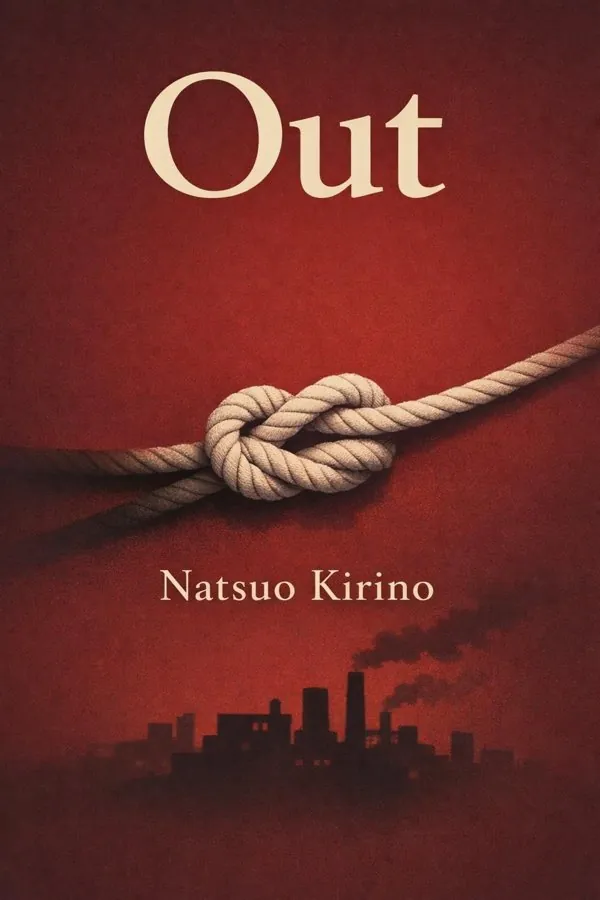
Out: Summary & Key Insights
 10 min8 chaptersAudio available
Key Takeaways from Out
The most frightening forms of despair are often the most ordinary.
A single decision can reveal who people already are beneath the surface.
Shared suffering does not automatically create loyalty.
Freedom without connection can become another form of emptiness.
The home is not always a place of safety; sometimes it is where desperation is trained to remain invisible.
What Is Out About?
Out by Natsuo Kirino is a bestsellers book spanning 4 pages. Out is a tense, unsettling, and brilliantly observed crime novel by Natsuo Kirino that begins with a single act of violence and grows into a devastating portrait of women trapped by poverty, loneliness, and social expectation. Set among four women working the night shift at a boxed-lunch factory in Tokyo, the story follows what happens after Yayoi, a young mother with an abusive and irresponsible husband, kills him in a moment of rage. Instead of turning away, her co-worker Masako helps her dispose of the body, pulling the group into a conspiracy that exposes each woman’s hidden desperation. What makes Out more than a thriller is the way Kirino uses crime to reveal the emotional and economic pressures shaping ordinary lives. The novel examines gender roles, dead-end work, debt, marriage, motherhood, and the quiet brutality of social exclusion. Kirino, one of Japan’s most acclaimed crime writers, brings psychological depth and social insight to every page. The result is a dark but unforgettable novel that asks what people become when survival leaves no room for innocence.
This FizzRead summary covers all 8 key chapters of Out in approximately 10 minutes, distilling the most important ideas, arguments, and takeaways from Natsuo Kirino's work. Also available as an audio summary and Key Quotes Podcast.
Out
Out is a tense, unsettling, and brilliantly observed crime novel by Natsuo Kirino that begins with a single act of violence and grows into a devastating portrait of women trapped by poverty, loneliness, and social expectation. Set among four women working the night shift at a boxed-lunch factory in Tokyo, the story follows what happens after Yayoi, a young mother with an abusive and irresponsible husband, kills him in a moment of rage. Instead of turning away, her co-worker Masako helps her dispose of the body, pulling the group into a conspiracy that exposes each woman’s hidden desperation. What makes Out more than a thriller is the way Kirino uses crime to reveal the emotional and economic pressures shaping ordinary lives. The novel examines gender roles, dead-end work, debt, marriage, motherhood, and the quiet brutality of social exclusion. Kirino, one of Japan’s most acclaimed crime writers, brings psychological depth and social insight to every page. The result is a dark but unforgettable novel that asks what people become when survival leaves no room for innocence.
Who Should Read Out?
This book is perfect for anyone interested in bestsellers and looking to gain actionable insights in a short read. Whether you're a student, professional, or lifelong learner, the key ideas from Out by Natsuo Kirino will help you think differently.
- ✓Readers who enjoy bestsellers and want practical takeaways
- ✓Professionals looking to apply new ideas to their work and life
- ✓Anyone who wants the core insights of Out in just 10 minutes
Want the full summary?
Get instant access to this book summary and 100K+ more with Fizz Moment.
Get Free SummaryAvailable on App Store • Free to download
Key Chapters
The most frightening forms of despair are often the most ordinary. Out opens not with glamorous crime or dramatic confession, but with repetitive factory labor under fluorescent lights, where four women spend their nights assembling boxed lunches for people they will never meet. That setting matters. Kirino shows how monotony can become its own kind of violence, slowly eroding self-worth while forcing people into mechanical routines that leave little room for hope. Masako, Yoshie, Kuniko, and Yayoi are linked by work, but what truly binds them is exhaustion: financial exhaustion, emotional exhaustion, and the fatigue of being unseen.
Each woman arrives at the factory carrying burdens that the outside world ignores. One is trapped in an abusive marriage. Another is crushed by debt and consumer fantasy. Another is suffocating under caregiving obligations. Masako herself lives with a profound emotional isolation that has emptied life of meaning. The night shift becomes a symbol of social invisibility. These women keep society running, yet society barely acknowledges them. In that environment, small frustrations accumulate until they become dangerous.
This idea extends well beyond the novel. Many people recognize some version of this life: repetitive work, hidden stress, and the pressure to appear functional while quietly unraveling. Kirino’s insight is that extreme actions do not emerge from nowhere; they grow in the cracks of ordinary hardship. When people are overworked, underpaid, and emotionally unsupported, the boundary between endurance and collapse grows thin.
A practical way to apply this insight is to pay attention to chronic forms of strain before they become crises. In workplaces, families, or friendships, the people who seem merely tired may actually be at a breaking point. Look past routine. Ask better questions. Notice what repetition is costing you or others. Actionable takeaway: do not dismiss ordinary misery as harmless—name the pressures shaping your daily life before they harden into desperation.
A single decision can reveal who people already are beneath the surface. After Yayoi kills her husband, panicked and overwhelmed, she calls Masako. What follows is one of the novel’s most shocking turns: Masako does not respond with moral outrage or sentimental comfort. She responds with composure, analysis, and a grim willingness to act. By helping Yayoi dispose of the body, she moves the story from private domestic violence into collective criminal complicity. The act is practical, horrifying, and strangely intimate. It creates a bond forged not by trust, but by shared guilt and necessity.
Masako’s leadership is central here. She becomes the organizer, the strategist, the person capable of doing what others cannot bear to imagine. Kirino uses this moment to ask whether leadership is always admirable. Masako is competent, but her competence is detached from conventional morality. She is not driven by cruelty exactly, but by a numbness that allows her to treat the unthinkable as a problem to be solved. This is what makes her such a compelling character: she is both frightening and understandable.
In real life, crises often expose hidden hierarchies. The calmest person in the room may become the leader, but calm does not guarantee wisdom or ethics. We often assume decisiveness is inherently good. Out challenges that assumption. Decisiveness can save, but it can also accelerate moral decline when it is separated from reflection.
A practical application is to examine how you behave under pressure. Do you default to action without considering consequences? Do you rely on the most competent person without asking whether their plan aligns with your values? In teams, families, or emergencies, process matters as much as speed. Actionable takeaway: when crisis demands action, pause long enough to ask not only what works, but what crossing that line will make possible next.
Shared suffering does not automatically create loyalty. At first, the women in Out seem joined by circumstance and secrecy, but Kirino refuses the comforting idea that hardship naturally produces sisterhood. Their alliance is unstable from the beginning because each woman brings her own needs, resentments, and fantasies into the arrangement. Kuniko is consumed by debt and appearance, eager for money and vulnerable to manipulation. Yoshie is practical but burdened by obligation. Yayoi wants escape without fully grasping the consequences. Masako seeks control more than closeness. The result is a fragile solidarity constantly threatened by greed, fear, and misunderstanding.
Kirino is especially sharp in showing how financial pressure distorts moral judgment. Debt in the novel is not just an economic condition; it is psychological. It creates urgency, shame, envy, and rationalization. People begin to see risk as opportunity and loyalty as negotiable. Once money enters the women’s conspiracy, their relationship changes. What began as desperate mutual aid turns into calculation. Secrets stop uniting them and start dividing them.
This dynamic is recognizable in many contexts. Business partnerships fail over unequal sacrifice. Families fracture over inheritance or unpaid loans. Friendships weaken when one person’s emergency becomes everyone else’s burden. Out demonstrates that solidarity requires more than shared pain; it requires trust, clear boundaries, and a willingness to confront selfish motives before they rot a relationship from within.
The practical lesson is to be honest about pressure points in any alliance. If money, fear, or resentment is involved, silence will not preserve unity. Better to surface tensions early than pretend they do not exist. Ask: who is risking what, who expects what, and who may feel trapped? Actionable takeaway: do not mistake a common problem for genuine trust—protect relationships by naming competing interests before they turn into betrayal.
Freedom without connection can become another form of emptiness. Masako is the emotional center of Out, not because she is the most innocent or the most expressive, but because she embodies the novel’s deepest paradox: the desire to escape dependence can harden into a life stripped of tenderness. She is intelligent, capable, and less constrained by illusion than the others. Yet that strength is inseparable from profound isolation. Her marriage is hollow, her family relationships are distant, and her work offers no dignity. When she enters the cover-up, she does more than solve a problem; she steps into a role that gives her power in a world where she has long felt powerless.
Kirino traces how power can seduce the emotionally abandoned. For Masako, control becomes a substitute for intimacy. Competence gives her identity. Risk gives her purpose. As events grow darker, she discovers that being feared or needed can feel more real than being loved. This is why her arc is so unsettling. She is not simply corrupted by crime; she is animated by it, because crime offers a form of agency ordinary life denied her.
This insight applies beyond fiction. People who feel unseen may become attached to situations that make them feel significant, even when those situations are destructive. A domineering manager, a manipulative partner, or a reckless fixer may all be acting from the same hunger: if they cannot belong, they will control. Power can mask loneliness, but it cannot heal it.
The practical application is to notice when effectiveness is becoming your only source of value. If your identity depends entirely on being the one who handles everything, you may be replacing connection with control. Build forms of meaning that do not require crisis or dominance. Actionable takeaway: ask whether your pursuit of independence is leading to genuine freedom—or simply deeper isolation disguised as strength.
A society reveals its values by deciding whose exhaustion counts. Out is often read as a crime novel, but it is equally a sharp critique of class inequality and precarious labor. The women at the center of the story occupy a social space that feels interchangeable, replaceable, and economically trapped. Their labor is necessary yet undervalued. Their time is consumed by work that offers survival but not mobility. Kirino portrays a world in which people on the margins are expected to absorb endless strain without complaint, and when they fail, their failure is treated as personal rather than structural.
The imagery of food production is especially telling. These women package convenience for others while living lives stripped of convenience themselves. They help feed the city, but their own emotional and financial needs go unmet. This contrast deepens the novel’s central bitterness: modern systems often run on the invisible labor of people denied stability, respect, and rest.
The idea is highly relevant today. Many workers in factories, warehouses, service jobs, and care sectors know what it means to be essential yet disregarded. Low wages, unpredictable schedules, and social invisibility can create not just hardship but alienation. Kirino’s insight is that crime in such a world cannot be separated from material conditions. Economic pressure does not excuse destructive acts, but it helps explain why some lives become more combustible than others.
The practical application is to think structurally as well as personally. When assessing burnout, conflict, or ethical collapse, ask what role economic conditions play. In organizations, examine whether workloads and compensation reflect actual human limits. In your own life, resist measuring worth solely by productivity. Actionable takeaway: pay attention to the systems that make people feel disposable, because disregard at scale eventually shapes individual choices in dangerous ways.
What people do to a body reveals what they believe about human value. In Out, the dismemberment and disposal of Yayoi’s husband is not included merely for shock. Kirino uses the body as a disturbing symbol of how modern life can turn even human remains into logistical problems, objects to be processed, hidden, or exchanged. The physical reality of the crime strips away abstraction. Readers are forced to confront matter, labor, and revulsion. This insistence on bodily detail prevents the story from becoming a neat moral puzzle. Crime here is not elegant; it is gruesome, manual, and contaminating.
At the same time, bodies in the novel are constantly evaluated through social and economic lenses. Women’s bodies are judged, used, exhausted, and threatened. Men seek control through physical force or sexual power. Criminal networks treat bodies as leverage. The result is a world where physical existence itself becomes vulnerable to exploitation. Kirino links this to consumer culture and social hierarchy: when people are valued instrumentally, it becomes easier to think of bodies as things.
This theme has practical significance. In many modern environments, people learn to detach from physical reality—working through pain, ignoring fatigue, using substances to stay functional, or viewing others primarily through usefulness or appearance. Out warns against that detachment. The body remembers what the mind rationalizes.
A useful application is to notice the language you use about yourself and others. Do you reduce people to what they produce, how they look, or what they can provide? Do you ignore your own physical limits until collapse forces attention? Respect for embodiment is a moral practice, not just a health principle. Actionable takeaway: resist any system, habit, or relationship that teaches you to treat human bodies—especially your own—as disposable tools rather than vulnerable lives.
All Chapters in Out
About the Author
Natsuo Kirino is a Japanese novelist widely known for her dark, psychologically rich crime fiction and incisive social commentary. Born in 1951 in Kanazawa, Japan, she worked in several jobs before establishing herself as a writer, an experience that helped shape her attention to labor, class, and the hidden pressures of everyday life. She gained major recognition with Out, a novel that won the Mystery Writers of Japan Award and earned international acclaim for its fearless portrayal of violence, gender inequality, and moral ambiguity. Kirino’s fiction often centers on women pushed to the margins by social expectation, economic strain, or emotional isolation. Across her body of work, she blends suspense with literary depth, making her one of the most important contemporary voices in Japanese crime and psychological fiction.
Get This Summary in Your Preferred Format
Read or listen to the Out summary by Natsuo Kirino anytime, anywhere. FizzRead offers multiple formats so you can learn on your terms — all free.
Available formats: App · Audio · PDF · EPUB — All included free with FizzRead
Download Out PDF and EPUB Summary
Key Quotes from Out
“The most frightening forms of despair are often the most ordinary.”
“A single decision can reveal who people already are beneath the surface.”
“Shared suffering does not automatically create loyalty.”
“Freedom without connection can become another form of emptiness.”
“The home is not always a place of safety; sometimes it is where desperation is trained to remain invisible.”
Frequently Asked Questions about Out
Out by Natsuo Kirino is a bestsellers book that explores key ideas across 8 chapters. Out is a tense, unsettling, and brilliantly observed crime novel by Natsuo Kirino that begins with a single act of violence and grows into a devastating portrait of women trapped by poverty, loneliness, and social expectation. Set among four women working the night shift at a boxed-lunch factory in Tokyo, the story follows what happens after Yayoi, a young mother with an abusive and irresponsible husband, kills him in a moment of rage. Instead of turning away, her co-worker Masako helps her dispose of the body, pulling the group into a conspiracy that exposes each woman’s hidden desperation. What makes Out more than a thriller is the way Kirino uses crime to reveal the emotional and economic pressures shaping ordinary lives. The novel examines gender roles, dead-end work, debt, marriage, motherhood, and the quiet brutality of social exclusion. Kirino, one of Japan’s most acclaimed crime writers, brings psychological depth and social insight to every page. The result is a dark but unforgettable novel that asks what people become when survival leaves no room for innocence.
More by Natsuo Kirino
You Might Also Like

The Godfather
Mario Puzo
10 min
The Handmaid's Tale
Margaret Atwood
10 min
The Hunger Games
Suzanne Collins
10 min
The Nightingale
Kristin Hannah
10 min
The Seven Husbands of Evelyn Hugo
Taylor Jenkins Reid
10 min
Backwater Justice
Fern Michaels
10 minBrowse by Category
Ready to read Out?
Get the full summary and 100K+ more books with Fizz Moment.