
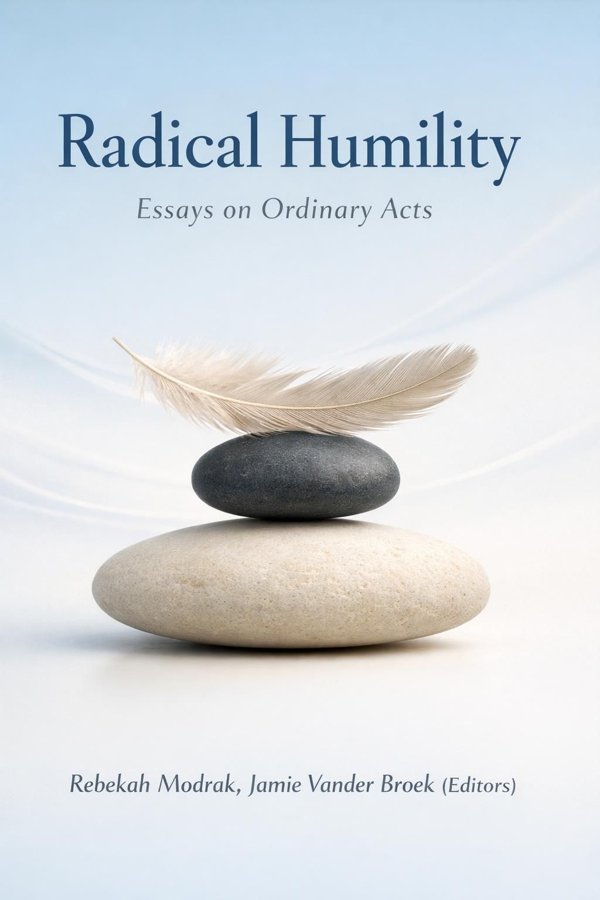
Radical Humility: Essays on Ordinary Acts: Summary & Key Insights
by Rebekah Modrak, Jamie Vander Broek (Editors)
 10 min10 chaptersAudio available
Key Takeaways from Radical Humility: Essays on Ordinary Acts
A culture that confuses loudness with strength often mistakes humility for weakness.
Many people imagine self-development as a process of expansion: more confidence, more mastery, more control.
Most conflicts are intensified by the same hidden assumption: that my view, my hurt, my interpretation, or my needs must define the whole situation.
Art matters not only because it expresses individuality, but because it can unsettle the self that assumes it already knows how to see.
Learning collapses when certainty hardens too early.
What Is Radical Humility: Essays on Ordinary Acts About?
Radical Humility: Essays on Ordinary Acts by Rebekah Modrak, Jamie Vander Broek (Editors) is a sociology book spanning 10 pages. What if humility is not weakness, politeness, or self-denial, but a powerful way of living differently in a culture obsessed with visibility, certainty, and personal branding? Radical Humility: Essays on Ordinary Acts explores that question through a rich collection of essays by scholars, artists, writers, and cultural thinkers. Rather than treating humility as a private moral trait, the book examines it as a social practice with consequences for relationships, education, leadership, activism, art, and public life. Across its varied perspectives, the collection argues that humility can help us resist ego-driven habits and create more attentive, ethical ways of being with others. The book matters because contemporary life often rewards performance over reflection and self-promotion over listening. In that environment, humility can seem outdated or even risky. The editors, Rebekah Modrak and Jamie Vander Broek, make a compelling case that humility is neither passivity nor submissiveness. It is a disciplined openness to limits, interdependence, and correction. Drawing on their backgrounds in art, writing, librarianship, and cultural criticism, they assemble a volume that is intellectually serious, accessible, and deeply relevant to social life today.
This FizzRead summary covers all 10 key chapters of Radical Humility: Essays on Ordinary Acts in approximately 10 minutes, distilling the most important ideas, arguments, and takeaways from Rebekah Modrak, Jamie Vander Broek (Editors)'s work. Also available as an audio summary and Key Quotes Podcast.
Radical Humility: Essays on Ordinary Acts
What if humility is not weakness, politeness, or self-denial, but a powerful way of living differently in a culture obsessed with visibility, certainty, and personal branding? Radical Humility: Essays on Ordinary Acts explores that question through a rich collection of essays by scholars, artists, writers, and cultural thinkers. Rather than treating humility as a private moral trait, the book examines it as a social practice with consequences for relationships, education, leadership, activism, art, and public life. Across its varied perspectives, the collection argues that humility can help us resist ego-driven habits and create more attentive, ethical ways of being with others.
The book matters because contemporary life often rewards performance over reflection and self-promotion over listening. In that environment, humility can seem outdated or even risky. The editors, Rebekah Modrak and Jamie Vander Broek, make a compelling case that humility is neither passivity nor submissiveness. It is a disciplined openness to limits, interdependence, and correction. Drawing on their backgrounds in art, writing, librarianship, and cultural criticism, they assemble a volume that is intellectually serious, accessible, and deeply relevant to social life today.
Who Should Read Radical Humility: Essays on Ordinary Acts?
This book is perfect for anyone interested in sociology and looking to gain actionable insights in a short read. Whether you're a student, professional, or lifelong learner, the key ideas from Radical Humility: Essays on Ordinary Acts by Rebekah Modrak, Jamie Vander Broek (Editors) will help you think differently.
- ✓Readers who enjoy sociology and want practical takeaways
- ✓Professionals looking to apply new ideas to their work and life
- ✓Anyone who wants the core insights of Radical Humility: Essays on Ordinary Acts in just 10 minutes
Want the full summary?
Get instant access to this book summary and 100K+ more with Fizz Moment.
Get Free SummaryAvailable on App Store • Free to download
Key Chapters
A culture that confuses loudness with strength often mistakes humility for weakness. One of the book’s central contributions is to clear away this misunderstanding. Humility, the contributors argue, is not about thinking less of yourself in a punitive or diminishing way. It is about seeing yourself more accurately: neither inflated nor degraded, neither superior nor uniquely unworthy. That distinction matters because false humility can be just as self-absorbed as arrogance. If a person constantly performs modesty, seeks praise for being unassuming, or hides their talents to appear virtuous, they are still trapped in self-centeredness.
The essays define humility as an honest relation to one’s abilities, limits, and dependence on others. A humble person can be highly competent, ambitious, and influential, but they do not treat their perspective as the only valid one. They recognize that every achievement is shaped by communities, histories, institutions, and luck. This reframing makes humility far more active than passive. It involves listening, self-correction, curiosity, and the willingness to learn.
In practical terms, this affects everyday behavior. In a workplace, humility means contributing expertise without dominating the room. In friendship, it means being able to apologize without collapsing into shame. In public discourse, it means holding convictions while remaining open to revision. By removing humility from the realm of self-negation, the book presents it as a realistic and liberating virtue.
Actionable takeaway: Practice describing one recent success by naming both your contribution and the people, conditions, and support systems that made it possible.
Many people imagine self-development as a process of expansion: more confidence, more mastery, more control. These essays suggest something more paradoxical. The self often becomes wiser not by escaping limits, but by acknowledging them. Humility begins when we stop treating finitude as failure. Human beings do not know everything, cannot do everything, and are never fully self-made. Accepting that reality does not diminish the self; it deepens it.
Several contributors explore humility as an inward practice of decentering. Instead of making the ego the measure of every situation, humility allows a person to encounter the world without constant self-protection. This can reduce defensiveness, perfectionism, and the need to always appear competent. The humble self is not empty; it is porous. It can admit uncertainty, absorb new information, and revise its story. That openness is especially important in a time when many people feel pressure to maintain a polished identity online and offline.
Psychologically, this means humility supports resilience. A person who can say, “I was wrong,” “I need help,” or “I don’t know yet,” is often stronger than the person who must always preserve an image of certainty. Existentially, humility frees us from impossible standards of self-sufficiency. It permits a more grounded identity based on participation rather than domination.
Everyday examples make this concrete. A student who asks clarifying questions learns more than one who pretends to understand. A manager who seeks feedback improves faster than one who guards status. A parent who admits mistakes models emotional maturity.
Actionable takeaway: This week, identify one area where you have been protecting an image of competence, and replace that performance with one honest admission of uncertainty or need.
Most conflicts are intensified by the same hidden assumption: that my view, my hurt, my interpretation, or my needs must define the whole situation. The book’s essays on relationships show how humility interrupts that pattern. In intimate, familial, and communal life, humility is the practice of making room for another person’s reality without immediately turning back to your own. This is not surrendering boundaries or tolerating harm. It is refusing to assume that your perspective is complete.
Humility in relationships begins with attention. To be humble is to listen for what another person is actually saying rather than preparing a defense, correction, or clever reply. It also means recognizing how often relationships are damaged not by dramatic cruelty but by ordinary self-importance: interrupting, dismissing, needing to win, insisting on being right, or expecting emotional labor without reciprocity. The collection treats these everyday habits seriously because they shape the moral texture of daily life.
The essays also suggest that humility creates conditions for repair. Apology requires more than saying the right words; it requires loosening one’s attachment to innocence. Likewise, forgiveness often becomes possible when people feel genuinely seen rather than managed. Humility therefore functions as a relational discipline that builds trust.
Practical applications are everywhere. In a disagreement with a partner, humility might mean asking, “What am I missing?” In friendship, it may mean resisting the urge to redirect every conversation back to yourself. In community life, it could involve recognizing whose voices are routinely ignored.
Actionable takeaway: In your next important conversation, ask one sincere question before offering your interpretation, and listen long enough to restate the other person’s view fairly.
Art matters not only because it expresses individuality, but because it can unsettle the self that assumes it already knows how to see. One of the collection’s most distinctive themes is the relationship between humility and artistic practice. The contributors explore how art can cultivate receptivity, patience, and a willingness to encounter complexity without rushing to mastery. In that sense, both making art and experiencing it can become exercises in humility.
For artists, humility may involve surrendering control over outcome, admitting influence, or accepting that meaning is co-created with audiences and contexts. It pushes against the myth of the isolated genius by emphasizing collaboration, inheritance, and experimentation. For audiences, humility means approaching art without demanding immediate clarity, utility, or personal affirmation. Instead of asking only, “Do I like this?” a humble encounter with art asks, “What is this work asking me to notice that I usually overlook?”
This has broader cultural relevance. In a fast, attention-fragmented society, art invites slow looking and interpretive restraint. It teaches us to remain with ambiguity rather than forcing instant conclusions. That habit can carry into social life, making people less reactive and more observant.
Examples abound. Visiting a museum without trying to consume every piece, reading a poem multiple times before judging it, or creating something imperfect without chasing applause all build the muscle of humble attention. Even collaborative design, teaching, or performance can model an ethic where contribution matters more than spotlight.
Actionable takeaway: Spend fifteen uninterrupted minutes with one artwork, text, or creative object and ask what it reveals only when you stop trying to master it immediately.
Learning collapses when certainty hardens too early. The essays on education argue that humility is not a decorative virtue added to knowledge; it is one of the conditions that make knowledge possible. Students who believe they already understand cannot inquire deeply. Teachers who confuse authority with infallibility stop learning from their students. Institutions that reward confidence more than curiosity can produce performance without wisdom.
The book reframes education as a shared practice of intellectual humility. This does not mean abandoning standards or expertise. On the contrary, true expertise includes awareness of complexity, ambiguity, and the limits of one’s field. A humble educator guides firmly while remaining open to surprise. A humble student pursues excellence while recognizing that misunderstanding is part of growth.
This approach has practical implications in classrooms, universities, and informal learning spaces. It encourages dialogue over posturing, questions over premature conclusions, and reflection over mere accumulation. It also has ethical significance. Humility in education makes room for marginalized forms of knowledge that dominant systems often dismiss. When people admit that official narratives may be incomplete, institutions become more capable of revision and justice.
In everyday academic life, this might mean a professor revising a syllabus after student feedback, a researcher acknowledging methodological blind spots, or a student choosing to ask for help instead of hiding confusion. Even outside formal education, book clubs, workplaces, and public discussions benefit from an atmosphere where people can think aloud without fear of humiliation.
Actionable takeaway: In your next learning environment, replace one statement meant to signal expertise with a genuine question that invites deeper understanding from others.
The more power a person or institution holds, the easier it becomes to mistake influence for correctness. A key insight in the collection is that humility is not most needed among the powerless, who are often already forced into self-limitation. It is most urgently needed by those who command resources, status, platforms, and decision-making authority. Without humility, power drifts toward paternalism, blindness, and self-justification.
These essays examine how humility can function as a check on domination. A humble person in power does not pretend to be powerless, nor do they use modest language to disguise control. Instead, they remain alert to the distortions power creates: insulation from criticism, overconfidence, and the temptation to speak for others. Humility here means accountability, transparency, and a willingness to be interrupted by perspectives that power tends to exclude.
This applies politically, professionally, and interpersonally. A supervisor can exercise authority while inviting dissent. A public official can make decisions while acknowledging uncertainty and listening to affected communities. A parent can set boundaries without assuming that obedience proves wisdom. The point is not to abandon leadership, but to practice it without entitlement.
The book also warns against symbolic humility. Leaders may perform vulnerability or use egalitarian rhetoric while keeping actual decision-making centralized. Genuine humility has structural consequences: it changes how information flows, how feedback is received, and who is allowed to shape outcomes.
Actionable takeaway: If you hold authority in any setting, identify one decision you normally make alone and create a real process for input from those most affected by it.
Activism often celebrates courage, conviction, and urgency, all of which matter. But the collection insists that justice work also requires humility. Without it, movements can reproduce the very domination they oppose through moral grandstanding, saviorism, purity politics, or refusal to learn from those most directly affected. Humility keeps activism grounded in solidarity rather than self-display.
The contributors do not argue for passivity or endless hesitation. Instead, they show that humility improves action by making it more accountable. It asks activists to examine their motives, positionality, and blind spots. Are they helping communities pursue their own goals, or turning struggle into a stage for their identity? Are they willing to be corrected by the people they claim to support? Can they distinguish between being centered and being useful?
This perspective is especially important in contemporary media environments, where visibility can distort moral action. Social causes can become opportunities for branding, and public declarations can replace difficult, sustained work. Humility redirects attention toward listening, coalition-building, and material support.
In practice, humility in justice work may look like following local leadership, sharing credit, doing unglamorous organizational labor, or admitting when one’s analysis is incomplete. It also includes patience with learning while maintaining urgency about harm. The goal is not to feel pure, but to become more responsible.
The essays suggest that durable movements are built not only on passion but on disciplined receptivity. People who can listen across difference, revise strategy, and resist ego investment are more likely to contribute to long-term change.
Actionable takeaway: Before joining or speaking for a cause, ask whose leadership already exists, what support is actually needed, and how you can contribute without centering yourself.
Digital life offers unprecedented opportunities for connection, but it also intensifies habits that humility tries to restrain. The book’s reflections on technology examine how online environments reward self-display, instant reaction, comparison, and certainty. Social media platforms encourage people to curate identities, monitor attention, and treat visibility as value. Under those conditions, humility becomes both more difficult and more necessary.
The problem is not simply vanity in an individual sense. Technology shapes social behavior structurally. Metrics such as likes, shares, followers, and engagement subtly train people to perform themselves for reward. This can narrow thought, discourage nuance, and make disagreement feel like existential threat. When identity becomes a public project of continuous management, admitting ignorance or changing one’s mind can feel costly.
Humility offers a counter-practice. It encourages slower judgment, more careful speech, and less dependence on applause. A humble digital presence does not require silence, but it does involve asking whether a post contributes understanding or merely displays opinion. It also means recognizing that online fragments rarely capture the full humanity of others.
Practical examples include pausing before reacting to provocative content, resisting the urge to comment on everything, crediting sources, and acknowledging uncertainty publicly when appropriate. Humility online also involves boundaries: not every thought needs publication, and not every argument deserves participation.
The essays suggest that technology becomes healthier when users bring ethical disciplines to it rather than surrendering to its incentives. Humility helps preserve attention, complexity, and relational care in spaces designed for speed.
Actionable takeaway: Before posting or responding online, ask three questions: Is it true, is it necessary, and is it shaped by a desire to contribute rather than perform?
Many leadership models are built on projection: confidence, decisiveness, expertise, command. Radical Humility does not reject these qualities entirely, but it insists they become dangerous when detached from self-questioning. The essays on leadership present humility as a practical capacity that strengthens rather than weakens leaders. A humble leader does not abdicate responsibility; they create conditions in which truth can reach them.
This matters because organizations often fail not from lack of intelligence but from blocked feedback. When leaders need to appear all-knowing, subordinates hide problems, innovation stalls, and mistakes compound. Humility interrupts that pattern by normalizing learning, admitting error, and distributing recognition. It makes leadership less theatrical and more relational.
The book highlights several dimensions of humble leadership. First, it involves epistemic openness: the awareness that one’s perspective is partial. Second, it includes ethical restraint: the refusal to exploit authority for self-glorification. Third, it requires institutional design: setting up teams, meetings, and decision processes that welcome candor rather than punishing it.
In practice, this can look like a leader acknowledging when a strategy failed, asking junior colleagues for critique, or publicly crediting collective effort instead of claiming personal brilliance. It also means communicating with clarity while leaving room for dissent. Humility is not indecision; it is decisiveness without arrogance.
This model has broad relevance across business, education, nonprofits, and civic life. People tend to trust leaders who combine competence with honesty about limits. Such leaders are better equipped to navigate complexity because they are less invested in preserving an image.
Actionable takeaway: If you lead others, invite anonymous feedback on one aspect of your leadership and respond by naming one concrete change you will make.
The book’s deepest argument may be its simplest: humility is radical precisely because it belongs to ordinary life. It is not reserved for saints, philosophers, or moments of dramatic self-sacrifice. It appears in everyday acts of patience, correction, gratitude, attention, and restraint. The collection’s spiritual and ethical reflections show that humility is less a single feeling than a way of inhabiting the world responsibly.
This ordinariness is easy to underestimate. Grand moral language often distracts from the small habits that shape character. Whether we interrupt, whether we thank people, whether we notice labor done by others, whether we can be corrected without retaliation, whether we act as if the world owes us recognition: these ordinary behaviors reveal how the self relates to others. Humility transforms them by weakening entitlement and strengthening care.
The essays also connect humility to wonder. To be humble is not only to know one’s limits, but to encounter life as something not fully possessed. This can have spiritual resonance, even for readers outside formal religion. It encourages gratitude, reverence, and ethical seriousness without self-importance. Humility helps people act with conviction while remembering that they are participants in a larger reality, not its center.
In daily practice, humility may mean thanking invisible workers, noticing when your convenience depends on others’ labor, or making space for another person’s dignity in routine encounters. These acts seem small, but the book argues that they accumulate into a different social world.
Actionable takeaway: Choose one ordinary setting today, such as a meeting, store, classroom, or family dinner, and practice humility through deliberate attention, gratitude, and one act of making space for someone else.
All Chapters in Radical Humility: Essays on Ordinary Acts
About the Authors
Rebekah Modrak and Jamie Vander Broek are the editors of Radical Humility: Essays on Ordinary Acts, a collection that brings together diverse voices to rethink humility in contemporary culture. Modrak is an artist, writer, and educator whose work often addresses consumer culture, media systems, labor, and social justice. Her projects are known for examining how identity and value are shaped by public images and institutions. Vander Broek is a librarian, writer, and cultural thinker with interests in literature, art, ethics, and public discourse. His background in research and curation complements the collection’s reflective, interdisciplinary approach. Together, they assembled this volume to explore humility not as passive modesty, but as a meaningful practice of attention, accountability, and shared human responsibility in an age of self-promotion.
Get This Summary in Your Preferred Format
Read or listen to the Radical Humility: Essays on Ordinary Acts summary by Rebekah Modrak, Jamie Vander Broek (Editors) anytime, anywhere. FizzRead offers multiple formats so you can learn on your terms — all free.
Available formats: App · Audio · PDF · EPUB — All included free with FizzRead
Download Radical Humility: Essays on Ordinary Acts PDF and EPUB Summary
Key Quotes from Radical Humility: Essays on Ordinary Acts
“A culture that confuses loudness with strength often mistakes humility for weakness.”
“Many people imagine self-development as a process of expansion: more confidence, more mastery, more control.”
“Most conflicts are intensified by the same hidden assumption: that my view, my hurt, my interpretation, or my needs must define the whole situation.”
“Art matters not only because it expresses individuality, but because it can unsettle the self that assumes it already knows how to see.”
“Learning collapses when certainty hardens too early.”
Frequently Asked Questions about Radical Humility: Essays on Ordinary Acts
Radical Humility: Essays on Ordinary Acts by Rebekah Modrak, Jamie Vander Broek (Editors) is a sociology book that explores key ideas across 10 chapters. What if humility is not weakness, politeness, or self-denial, but a powerful way of living differently in a culture obsessed with visibility, certainty, and personal branding? Radical Humility: Essays on Ordinary Acts explores that question through a rich collection of essays by scholars, artists, writers, and cultural thinkers. Rather than treating humility as a private moral trait, the book examines it as a social practice with consequences for relationships, education, leadership, activism, art, and public life. Across its varied perspectives, the collection argues that humility can help us resist ego-driven habits and create more attentive, ethical ways of being with others. The book matters because contemporary life often rewards performance over reflection and self-promotion over listening. In that environment, humility can seem outdated or even risky. The editors, Rebekah Modrak and Jamie Vander Broek, make a compelling case that humility is neither passivity nor submissiveness. It is a disciplined openness to limits, interdependence, and correction. Drawing on their backgrounds in art, writing, librarianship, and cultural criticism, they assemble a volume that is intellectually serious, accessible, and deeply relevant to social life today.
You Might Also Like

Between the World and Me
Ta-Nehisi Coates
10 min
Half the Sky
Nicholas D. Kristof, Sheryl WuDunn
10 min
Men Explain Things To Me
Rebecca Solnit
10 min
Rational Ritual
Michael Suk-Young Chwe
10 min
The New Jim Crow
Michelle Alexander
10 min
Beyond Culture
Edward T. Hall
10 minBrowse by Category
Ready to read Radical Humility: Essays on Ordinary Acts?
Get the full summary and 100K+ more books with Fizz Moment.