
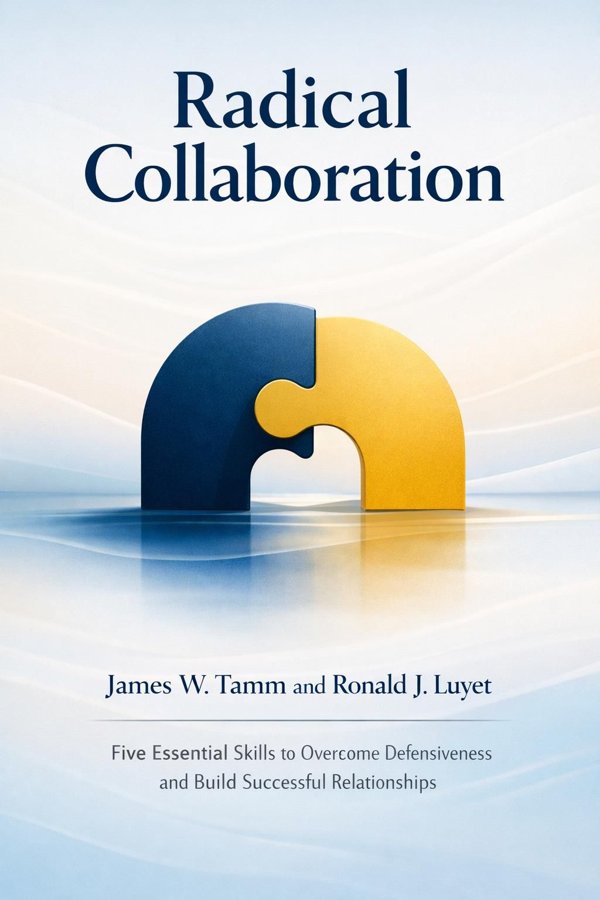
Radical Collaboration: Five Essential Skills to Overcome Defensiveness and Build Successful Relationships: Summary & Key Insights
by James W. Tamm, Ronald J. Luyet
 10 min10 chaptersAudio available
What Is Radical Collaboration: Five Essential Skills to Overcome Defensiveness and Build Successful Relationships About?
Radical Collaboration: Five Essential Skills to Overcome Defensiveness and Build Successful Relationships by James W. Tamm and Ronald J. Luyet is a communication book spanning 10 pages. Radical Collaboration is a guide to building trust and cooperation in workplaces and personal relationships. It teaches five core skills—creating a collaborative intention, truthfulness, self-accountability, awareness of defensiveness, and negotiation of interests—to help individuals and organizations reduce conflict and foster productive teamwork.
This FizzRead summary covers all 10 key chapters of Radical Collaboration: Five Essential Skills to Overcome Defensiveness and Build Successful Relationships in approximately 10 minutes, distilling the most important ideas, arguments, and takeaways from James W. Tamm and Ronald J. Luyet's work. Also available as an audio summary and Key Quotes Podcast.
Radical Collaboration: Five Essential Skills to Overcome Defensiveness and Build Successful Relationships
Radical Collaboration is a guide to building trust and cooperation in workplaces and personal relationships. It teaches five core skills—creating a collaborative intention, truthfulness, self-accountability, awareness of defensiveness, and negotiation of interests—to help individuals and organizations reduce conflict and foster productive teamwork.
Who Should Read Radical Collaboration: Five Essential Skills to Overcome Defensiveness and Build Successful Relationships?
This book is perfect for anyone interested in communication and looking to gain actionable insights in a short read. Whether you're a student, professional, or lifelong learner, the key ideas from Radical Collaboration: Five Essential Skills to Overcome Defensiveness and Build Successful Relationships by James W. Tamm and Ronald J. Luyet will help you think differently.
- ✓Readers who enjoy communication and want practical takeaways
- ✓Professionals looking to apply new ideas to their work and life
- ✓Anyone who wants the core insights of Radical Collaboration: Five Essential Skills to Overcome Defensiveness and Build Successful Relationships in just 10 minutes
Want the full summary?
Get instant access to this book summary and 100K+ more with Fizz Moment.
Get Free SummaryAvailable on App Store • Free to download
Key Chapters
Defensiveness is not a moral flaw; it’s a survival reflex. When you feel criticized, threatened, or devalued, the body and mind respond instinctively: tension rises, heart rate increases, and the primitive brain prepares for battle or escape. Over years of work, I came to understand defensiveness as an attempt to protect self‑worth. However, while it protects our ego in the short term, it destroys connection in the long run.
In organizational life, defensiveness shows up in subtle ways—people withholding information, pretending agreement, blaming others, or resisting feedback. These patterns create a culture of guardedness rather than innovation. When teams are defensive, everyone spends emotional energy hiding rather than contributing.
Ron and I saw leaders dismiss conflict as personality problems, but defensiveness is systemic. It spreads through an organization’s norms and policies. Once people stop feeling safe to express doubt or difference, intelligent cooperation collapses. Thus, our first challenge is not behavioral but emotional: you must acknowledge your defensive tendencies before you can transcend them.
Understanding defensiveness requires empathy for the human condition. We learned these reactions in childhood, often as necessary shields against authority or rejection. Yet adulthood demands a different skill set—an ability to confront rather than conceal fear, to feel worth without superiority, and to remain curious even under pressure. Recognizing the psychology behind defensiveness becomes the first door to collaboration.
Intention is everything. Collaboration begins not with technique but with mindset. When I speak of a collaborative intention, I mean a conscious commitment to seek mutual gains rather than victory over others. Most people claim they want cooperation, but their habitual thinking remains competitive. They focus on proving, persuading, and protecting instead of connecting.
Creating a collaborative intention changes the energy of every interaction. Before entering a negotiation or conversation, I ask myself: am I preparing to collaborate or to control? That question alone transforms how I listen and respond. Collaborative individuals view others not as obstacles but as partners in solving shared problems. They operate from curiosity rather than judgment.
In practice, cultivating intention may mean pausing before a meeting to center yourself, to recall your common purpose, and to let go of the need to be right. It may feel unnatural at first because the world often rewards defensiveness. But the power of intention lies in its subtle influence—it invites reciprocity. When others sense genuine openness, they mirror that energy.
During our seminars, we witnessed teams that had been at odds for years begin to shift simply by agreeing to a shared intention statement: “We will work to understand each other’s needs and find solutions that serve all parties.” That declaration became a psychological anchor. Collaborative intention is not naïve; it is strategic. When practiced with discipline, it makes communication more transparent, decisions faster, and outcomes more sustainable.
+ 8 more chapters — available in the FizzRead app
All Chapters in Radical Collaboration: Five Essential Skills to Overcome Defensiveness and Build Successful Relationships
About the Authors
James W. Tamm is a former judge and expert in collaborative negotiation and conflict resolution. Ronald J. Luyet is a psychotherapist and organizational consultant specializing in interpersonal communication and leadership development.
Get This Summary in Your Preferred Format
Read or listen to the Radical Collaboration: Five Essential Skills to Overcome Defensiveness and Build Successful Relationships summary by James W. Tamm and Ronald J. Luyet anytime, anywhere. FizzRead offers multiple formats so you can learn on your terms — all free.
Available formats: App · Audio · PDF · EPUB — All included free with FizzRead
Download Radical Collaboration: Five Essential Skills to Overcome Defensiveness and Build Successful Relationships PDF and EPUB Summary
Key Quotes from Radical Collaboration: Five Essential Skills to Overcome Defensiveness and Build Successful Relationships
“Defensiveness is not a moral flaw; it’s a survival reflex.”
“Collaboration begins not with technique but with mindset.”
Frequently Asked Questions about Radical Collaboration: Five Essential Skills to Overcome Defensiveness and Build Successful Relationships
Radical Collaboration: Five Essential Skills to Overcome Defensiveness and Build Successful Relationships by James W. Tamm and Ronald J. Luyet is a communication book that explores key ideas across 10 chapters. Radical Collaboration is a guide to building trust and cooperation in workplaces and personal relationships. It teaches five core skills—creating a collaborative intention, truthfulness, self-accountability, awareness of defensiveness, and negotiation of interests—to help individuals and organizations reduce conflict and foster productive teamwork.
You Might Also Like

Magic Words: The Science and Secrets Behind Seven Words That Motivate, Engage, and Influence
Tim David
10 min
Talking Across The Divide: How to Communicate with People You Disagree with and Maybe Even Change the World
Justin Lee
10 min
The Exceptional Presenter: A Proven Formula to Open Up! and Own the Room
Timothy J. Koegel
10 min
4 Essential Keys to Effective Communication in Love, Life, Work--Anywhere!: Including the 12-Day Communication Challenge!
Bento C. Leal III
10 min
Active Listening Techniques: 30 Practical Tools to Hone Your Communication Skills
Nisha Gupta
10 min
Bargaining for Advantage: Negotiation Strategies for Reasonable People
G. Richard Shell
10 minBrowse by Category
Ready to read Radical Collaboration: Five Essential Skills to Overcome Defensiveness and Build Successful Relationships?
Get the full summary and 100K+ more books with Fizz Moment.