
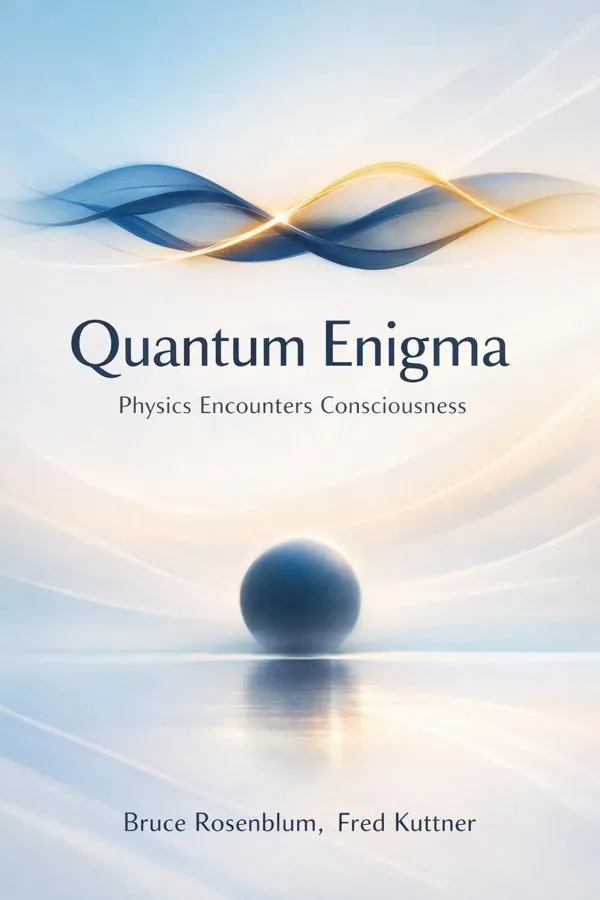
Quantum Enigma: Physics Encounters Consciousness: Summary & Key Insights
by Bruce Rosenblum, Fred Kuttner
 10 min8 chaptersAudio available
What Is Quantum Enigma: Physics Encounters Consciousness About?
Quantum Enigma: Physics Encounters Consciousness by Bruce Rosenblum, Fred Kuttner is a popular_sci book spanning 8 pages. Quantum Enigma: Physics Encounters Consciousness explores the puzzling relationship between quantum mechanics and human consciousness. The authors, both physicists, present the strange phenomena of quantum theory—such as superposition and entanglement—and discuss how these challenge our understanding of reality. The book aims to make complex physics accessible to general readers while addressing philosophical implications about observation, measurement, and the nature of mind.
This FizzRead summary covers all 8 key chapters of Quantum Enigma: Physics Encounters Consciousness in approximately 10 minutes, distilling the most important ideas, arguments, and takeaways from Bruce Rosenblum, Fred Kuttner's work. Also available as an audio summary and Key Quotes Podcast.
Quantum Enigma: Physics Encounters Consciousness
Quantum Enigma: Physics Encounters Consciousness explores the puzzling relationship between quantum mechanics and human consciousness. The authors, both physicists, present the strange phenomena of quantum theory—such as superposition and entanglement—and discuss how these challenge our understanding of reality. The book aims to make complex physics accessible to general readers while addressing philosophical implications about observation, measurement, and the nature of mind.
Who Should Read Quantum Enigma: Physics Encounters Consciousness?
This book is perfect for anyone interested in popular_sci and looking to gain actionable insights in a short read. Whether you're a student, professional, or lifelong learner, the key ideas from Quantum Enigma: Physics Encounters Consciousness by Bruce Rosenblum, Fred Kuttner will help you think differently.
- ✓Readers who enjoy popular_sci and want practical takeaways
- ✓Professionals looking to apply new ideas to their work and life
- ✓Anyone who wants the core insights of Quantum Enigma: Physics Encounters Consciousness in just 10 minutes
Want the full summary?
Get instant access to this book summary and 100K+ more with Fizz Moment.
Get Free SummaryAvailable on App Store • Free to download
Key Chapters
For centuries, physics offered a comforting picture of the world. Newton’s laws declared a universe of clockwork predictability, where every cause had an effect, and every effect could be traced back to its cause. Consciousness, if mentioned at all, held no physical significance—it was the domain of philosophy. We physicists dealt with mass, force, and motion. The observer was irrelevant, a passive record keeper of nature’s movement.
But around the dawn of the twentieth century, cracks appeared in this certainty. Experiments revealed that light could behave like particles, and particles like waves. Max Planck’s quantum proposal and Einstein’s explanation of the photoelectric effect introduced discreteness—nature’s refusal to be infinitely divisible. These anomalies did not fit into classical physics’s tidy model. By the time Schrödinger, Heisenberg, and Bohr presented their quantum formulations, the world no longer seemed mechanical. It seemed participatory.
In this historical shift, we physicists discovered humility. We realized that our instruments do not merely observe; they intervene. The mathematics was correct, but it pointed toward something unsettling: observation alters the observed. Quantum theory demanded that we include the observer within the description of physical phenomena. This was the seed of the enigma, planted by the empirical rigor of modern science itself. What began as a crisis of measurement grew into a challenge to our understanding of reality.
Consider the experiment so simple that high school students perform it with lasers, yet so profound that it still defies explanation. When light—or electrons, or atoms—passes through two slits and impacts a screen, it creates an interference pattern, as though each particle were a wave distributed across both slits simultaneously. However, the moment you ask, 'Through which slit did it go?' the pattern collapses into discrete impacts. What changes is not the apparatus but the act of observation.
In our lectures, Fred and I often reenacted this thought experiment. The beauty lies in its paradox: a particle behaves as a wave until a conscious mind decides to look. Quantum mechanics assures us that before measurement, the electron’s state is not unknown—it is undefined. Measuring assigns reality where before there was only probability. Every repetition of the experiment reinforces the same unsettling message: observation brings about the outcome.
This is not mysticism clothed as science; it is verified data. Yet the fact that knowing—not touching, not disturbing mechanically, but merely knowing—affects what is real forces us to ask whether knowledge itself is a physical process. The double-slit experiment is our entryway into quantum strangeness, the first undeniable clue that mind and matter participate in a single mysterious dance.
+ 6 more chapters — available in the FizzRead app
All Chapters in Quantum Enigma: Physics Encounters Consciousness
About the Authors
Bruce Rosenblum and Fred Kuttner are physicists at the University of California, Santa Cruz. They have taught quantum mechanics for decades and are known for their efforts to make the subject understandable to non-specialists. Their work focuses on the conceptual foundations of quantum theory and its intersection with consciousness.
Get This Summary in Your Preferred Format
Read or listen to the Quantum Enigma: Physics Encounters Consciousness summary by Bruce Rosenblum, Fred Kuttner anytime, anywhere. FizzRead offers multiple formats so you can learn on your terms — all free.
Available formats: App · Audio · PDF · EPUB — All included free with FizzRead
Download Quantum Enigma: Physics Encounters Consciousness PDF and EPUB Summary
Key Quotes from Quantum Enigma: Physics Encounters Consciousness
“For centuries, physics offered a comforting picture of the world.”
“Consider the experiment so simple that high school students perform it with lasers, yet so profound that it still defies explanation.”
Frequently Asked Questions about Quantum Enigma: Physics Encounters Consciousness
Quantum Enigma: Physics Encounters Consciousness by Bruce Rosenblum, Fred Kuttner is a popular_sci book that explores key ideas across 8 chapters. Quantum Enigma: Physics Encounters Consciousness explores the puzzling relationship between quantum mechanics and human consciousness. The authors, both physicists, present the strange phenomena of quantum theory—such as superposition and entanglement—and discuss how these challenge our understanding of reality. The book aims to make complex physics accessible to general readers while addressing philosophical implications about observation, measurement, and the nature of mind.
You Might Also Like

Structures: Or Why Things Don"t Fall Down
J.E. Gordon
10 min
The Road to Wigan Pier
George Orwell
10 min
Bonk: The Curious Coupling of Science and Sex
Mary Roach
10 min
First Bite: How We Learn to Eat
Bee Wilson
10 min
In Pursuit Of The Unknown: 17 Equations That Changed The World
Ian Stewart
10 min
Napoleon's Buttons: 17 Molecules That Changed History
Penny Le Couteur and Jay Burreson
10 minBrowse by Category
Ready to read Quantum Enigma: Physics Encounters Consciousness?
Get the full summary and 100K+ more books with Fizz Moment.