
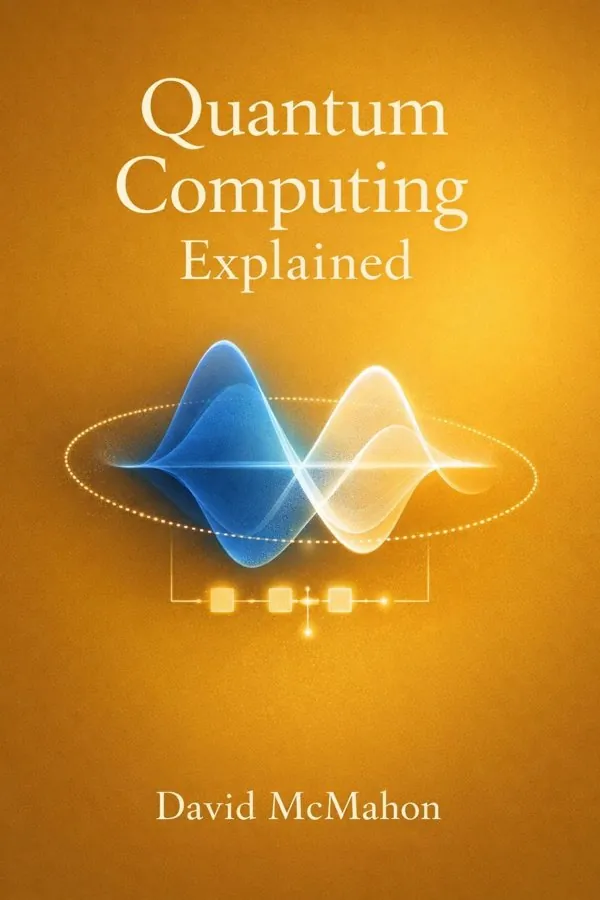
Quantum Computing Explained: Summary & Key Insights
 10 min6 chaptersAudio available
What Is Quantum Computing Explained About?
Quantum Computing Explained by David McMahon is a popular_sci book spanning 6 pages. This book provides a clear and accessible introduction to the principles of quantum computing. It explains the mathematical foundations, quantum algorithms, and physical implementation aspects in a way that is approachable for readers with a background in physics, mathematics, or computer science. The text covers key topics such as qubits, quantum gates, entanglement, and quantum error correction, making it a valuable resource for students and professionals seeking to understand the emerging field of quantum computation.
This FizzRead summary covers all 6 key chapters of Quantum Computing Explained in approximately 10 minutes, distilling the most important ideas, arguments, and takeaways from David McMahon's work. Also available as an audio summary and Key Quotes Podcast.
Quantum Computing Explained
This book provides a clear and accessible introduction to the principles of quantum computing. It explains the mathematical foundations, quantum algorithms, and physical implementation aspects in a way that is approachable for readers with a background in physics, mathematics, or computer science. The text covers key topics such as qubits, quantum gates, entanglement, and quantum error correction, making it a valuable resource for students and professionals seeking to understand the emerging field of quantum computation.
Who Should Read Quantum Computing Explained?
This book is perfect for anyone interested in popular_sci and looking to gain actionable insights in a short read. Whether you're a student, professional, or lifelong learner, the key ideas from Quantum Computing Explained by David McMahon will help you think differently.
- ✓Readers who enjoy popular_sci and want practical takeaways
- ✓Professionals looking to apply new ideas to their work and life
- ✓Anyone who wants the core insights of Quantum Computing Explained in just 10 minutes
Want the full summary?
Get instant access to this book summary and 100K+ more with Fizz Moment.
Get Free SummaryAvailable on App Store • Free to download
Key Chapters
When you venture into quantum computing, you first meet the conceptual world of quantum mechanics—strange but mathematically exact. The central ideas of superposition, measurement, and operators must be absorbed before any mention of algorithms makes sense. Superposition means a quantum system can exist in many possible states at once, described by a linear combination of basis states. This is what grants quantum computation its parallelism. Measurement collapses that superposition, turning probability into reality, and the operator framework dictates how states evolve.
In classical mechanics, motions and quantities are deterministic. In quantum mechanics, the wavefunction encodes all possibilities, and we manipulate it through linear transformations. When I teach this section, I emphasize that quantum computation rests on clear linear algebraic reasoning: vectors represent states, matrices represent transformations. A qubit lives in a two-dimensional complex vector space; an operator acts upon that space and must be unitary to conserve probability.
Think of superposition like a coin not just hovering between heads and tails—it holds both possibilities with amplitudes that can interfere constructively or destructively. Measurement forces you to look, collapsing one possibility into reality. The charm of quantum computing appears in how interference and measurement combine to allow algorithms like Grover’s to accelerate search or Shor’s to find hidden number structures. Every concept in this foundation—state vector, basis, inner product—sets the stage for constructing logic not in binary certainty, but in controlled probability.
Once the quantum mechanical background is firm, I introduce the main working element: the qubit. A qubit is represented by a two-dimensional state vector, usually written as a linear combination of |0⟩ and |1⟩. You can visualize this using the Bloch sphere—a geometric representation where every point corresponds to a distinct qubit state. The poles represent classical 0 and 1, while the surface represents all superpositions. Rotations on the sphere correspond to unitary transformations—these are our quantum gates.
Quantum gates are the building blocks of quantum circuits, performing operations analogous to logical gates in classical machines but governed by continuous transformations. A single-qubit gate might be represented by a 2×2 matrix; multi-qubit gates by higher-dimensional unitary matrices. The most common ones—the Pauli matrices, Hadamard, phase, and controlled-NOT gates—carry elegant mathematical meaning. For example, the Hadamard gate converts a basis state into an equal superposition state, allowing algorithms to exploit quantum parallelism.
Here I stress to the reader that quantum gates must not destroy information; unitarity guarantees reversibility. This is profoundly different from classical logic gates, where information can be lost. Every quantum calculation, even error correction, is crafted to maintain coherence. Students often struggle with how a rotation in complex space permits computation. I demonstrate that by treating gates as rotations on the Bloch sphere—controlled manipulations of amplitudes—a logic emerges that retains its physical interpretation.
+ 4 more chapters — available in the FizzRead app
All Chapters in Quantum Computing Explained
About the Author
David McMahon is a physicist and author known for his technical books on topics such as quantum mechanics, relativity, and computational methods. He has written several titles in the 'Explained' series, focusing on making complex scientific and mathematical subjects accessible to a broad audience.
Get This Summary in Your Preferred Format
Read or listen to the Quantum Computing Explained summary by David McMahon anytime, anywhere. FizzRead offers multiple formats so you can learn on your terms — all free.
Available formats: App · Audio · PDF · EPUB — All included free with FizzRead
Download Quantum Computing Explained PDF and EPUB Summary
Key Quotes from Quantum Computing Explained
“When you venture into quantum computing, you first meet the conceptual world of quantum mechanics—strange but mathematically exact.”
“Once the quantum mechanical background is firm, I introduce the main working element: the qubit.”
Frequently Asked Questions about Quantum Computing Explained
Quantum Computing Explained by David McMahon is a popular_sci book that explores key ideas across 6 chapters. This book provides a clear and accessible introduction to the principles of quantum computing. It explains the mathematical foundations, quantum algorithms, and physical implementation aspects in a way that is approachable for readers with a background in physics, mathematics, or computer science. The text covers key topics such as qubits, quantum gates, entanglement, and quantum error correction, making it a valuable resource for students and professionals seeking to understand the emerging field of quantum computation.
You Might Also Like

Structures: Or Why Things Don"t Fall Down
J.E. Gordon
10 min
The Road to Wigan Pier
George Orwell
10 min
Bonk: The Curious Coupling of Science and Sex
Mary Roach
10 min
First Bite: How We Learn to Eat
Bee Wilson
10 min
In Pursuit Of The Unknown: 17 Equations That Changed The World
Ian Stewart
10 min
Napoleon's Buttons: 17 Molecules That Changed History
Penny Le Couteur and Jay Burreson
10 minBrowse by Category
Ready to read Quantum Computing Explained?
Get the full summary and 100K+ more books with Fizz Moment.