
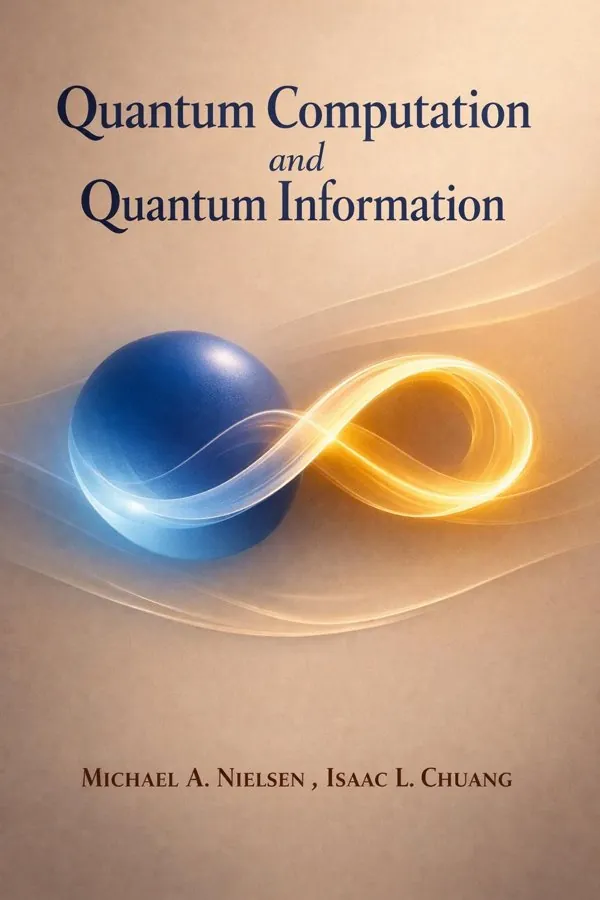
Quantum Computation and Quantum Information: Summary & Key Insights
by Michael A. Nielsen, Isaac L. Chuang
 10 min10 chaptersAudio available
Key Takeaways from Quantum Computation and Quantum Information
Every revolution in science begins by inventing the right language.
Information looks simple until physics gets involved.
Computation is ultimately about controlled transformation.
The most important question in quantum computing is not whether quantum systems are strange, but whether their strangeness can solve useful problems faster.
Some scientific moments change the trajectory of an entire discipline.
What Is Quantum Computation and Quantum Information About?
Quantum Computation and Quantum Information by Michael A. Nielsen, Isaac L. Chuang is a popular_sci book spanning 10 pages. Quantum Computation and Quantum Information is the book that defined an entire field. Often called the standard text for quantum computing, Michael A. Nielsen and Isaac L. Chuang’s landmark work explains how the counterintuitive laws of quantum mechanics can be harnessed to process information in radically new ways. The book moves from the mathematical foundations of quantum theory to qubits, quantum gates, algorithms, error correction, communication, cryptography, and the physical challenges of building real quantum machines. What makes this book matter is not just its scope, but its clarity. Quantum computing is often presented as a mixture of hype and mystery; Nielsen and Chuang replace that fog with a rigorous framework. They show why superposition, entanglement, and interference are not just exotic phenomena, but computational resources with measurable power. Along the way, they connect physics, computer science, and information theory into a unified intellectual structure. The authors write with unusual authority. Nielsen is a leading thinker in quantum information theory, and Chuang is one of the pioneers of experimental quantum computing. Together, they offer both theoretical depth and practical perspective, making this book essential for anyone who wants to understand the science behind the quantum revolution.
This FizzRead summary covers all 10 key chapters of Quantum Computation and Quantum Information in approximately 10 minutes, distilling the most important ideas, arguments, and takeaways from Michael A. Nielsen, Isaac L. Chuang's work. Also available as an audio summary and Key Quotes Podcast.
Quantum Computation and Quantum Information
Quantum Computation and Quantum Information is the book that defined an entire field. Often called the standard text for quantum computing, Michael A. Nielsen and Isaac L. Chuang’s landmark work explains how the counterintuitive laws of quantum mechanics can be harnessed to process information in radically new ways. The book moves from the mathematical foundations of quantum theory to qubits, quantum gates, algorithms, error correction, communication, cryptography, and the physical challenges of building real quantum machines.
What makes this book matter is not just its scope, but its clarity. Quantum computing is often presented as a mixture of hype and mystery; Nielsen and Chuang replace that fog with a rigorous framework. They show why superposition, entanglement, and interference are not just exotic phenomena, but computational resources with measurable power. Along the way, they connect physics, computer science, and information theory into a unified intellectual structure.
The authors write with unusual authority. Nielsen is a leading thinker in quantum information theory, and Chuang is one of the pioneers of experimental quantum computing. Together, they offer both theoretical depth and practical perspective, making this book essential for anyone who wants to understand the science behind the quantum revolution.
Who Should Read Quantum Computation and Quantum Information?
This book is perfect for anyone interested in popular_sci and looking to gain actionable insights in a short read. Whether you're a student, professional, or lifelong learner, the key ideas from Quantum Computation and Quantum Information by Michael A. Nielsen, Isaac L. Chuang will help you think differently.
- ✓Readers who enjoy popular_sci and want practical takeaways
- ✓Professionals looking to apply new ideas to their work and life
- ✓Anyone who wants the core insights of Quantum Computation and Quantum Information in just 10 minutes
Want the full summary?
Get instant access to this book summary and 100K+ more with Fizz Moment.
Get Free SummaryAvailable on App Store • Free to download
Key Chapters
Every revolution in science begins by inventing the right language. In quantum computation, that language is linear algebra. Nielsen and Chuang make an essential point early: if you do not understand vectors, matrices, complex amplitudes, inner products, eigenvalues, and tensor products, the rest of quantum computing will remain mystical rather than meaningful. Mathematics is not decoration here; it is the operating system of the subject.
The book carefully builds the formal machinery needed to describe quantum states and transformations. A qubit is represented as a vector in a two-dimensional complex vector space. Operations on qubits are represented by unitary matrices. Measurement is described by operators acting on these states, with probabilities derived from amplitudes. When multiple qubits are combined, tensor products capture the explosive growth of the state space. This framework explains both the power and the difficulty of quantum systems: adding one qubit doubles the dimension of the computational space.
A practical example is the Hadamard gate, which turns a simple basis state into a superposition. Written mathematically, this operation is compact and exact; without the math, it looks like magic. The same is true for entangled Bell states, which seem paradoxical until expressed in the formalism.
The broader lesson is that quantum computation is not built on vague philosophy but on precise structure. Readers who invest in the mathematical foundation gain a durable toolset for understanding algorithms, error correction, and information theory later in the book.
Actionable takeaway: before chasing advanced quantum ideas, make sure you are comfortable with linear algebra and tensor products, because they are the key that unlocks the entire field.
Information looks simple until physics gets involved. A classical bit can be either 0 or 1, but a qubit can exist in a superposition of both states at once, written as a|0⟩ + b|1⟩. This is the conceptual leap at the heart of the book: information is not an abstract thing floating above reality, but something embodied in physical systems, and quantum physics allows richer forms of embodiment than classical theory ever imagined.
Nielsen and Chuang explain that a qubit is not merely a probabilistic bit. A probability distribution says a system is secretly one value or the other, unknown to us. A quantum state is different: it contains amplitudes that can interfere. That interference is what gives quantum computing its distinctive power. The Bloch sphere offers an intuitive picture of this richness, showing that a single qubit can occupy infinitely many states, not just two discrete values.
This has practical implications. In quantum sensing, qubit states are manipulated with exquisite precision to detect tiny changes in magnetic or gravitational fields. In computation, superposition allows algorithms to explore many computational paths at once, though not in the simplistic “try everything simultaneously” way often described in popular media. The challenge is to design transformations so that useful answers are amplified and wrong ones cancel out.
The qubit also introduces fragility. Because quantum states are continuous and easily disturbed, storing and controlling them is much harder than flipping classical bits in silicon.
Actionable takeaway: whenever you hear claims about quantum advantage, ask how superposition and interference are being used, because those features—not vague parallelism—are what make qubits fundamentally different from classical bits.
Computation is ultimately about controlled transformation. In classical machines, logic gates manipulate bits through operations like AND, OR, and NOT. In quantum machines, gates manipulate amplitudes through reversible, unitary operations. Nielsen and Chuang show how this creates a new model of computing: one in which the architecture of algorithms is built from physically realizable transformations on qubits.
Single-qubit gates such as the Pauli operators, phase gates, and Hadamard gate rotate and reshape quantum states. Multi-qubit gates such as the controlled-NOT create correlations that have no classical equivalent, most notably entanglement. Quantum circuits chain these operations into sequences that prepare states, perform computation, and extract results through measurement. Importantly, because quantum evolution is reversible, most quantum logic differs sharply from standard irreversible classical logic.
A powerful insight from the book is universality. Just as a small set of classical gates can build any classical computation, a small set of quantum gates can approximate any unitary operation to arbitrary precision. This means the bewildering range of possible quantum processes can, in principle, be compiled into manageable instruction sets. That idea underlies real quantum programming frameworks today, where circuits are decomposed into hardware-native gates.
In practice, gate design matters enormously. A circuit that is elegant on paper may be unusable on noisy hardware if it requires too many operations. This is why optimizing gate depth and minimizing entangling operations has become central to quantum engineering.
Actionable takeaway: think of quantum computing not as mysterious black-box physics, but as circuit design under new rules—where mastering a few fundamental gates helps you understand how complex quantum programs are actually built.
The most important question in quantum computing is not whether quantum systems are strange, but whether their strangeness can solve useful problems faster. Nielsen and Chuang answer by presenting quantum algorithms as carefully engineered interference patterns. A successful quantum algorithm does not simply process all possibilities at once; it arranges amplitudes so right answers reinforce one another while wrong answers cancel out.
This idea becomes concrete in foundational examples such as Deutsch-Jozsa, Simon’s algorithm, Grover’s search, and other early algorithmic breakthroughs. These algorithms demonstrate different kinds of quantum advantage. Grover’s algorithm, for instance, offers a quadratic speedup for unstructured search, reducing the number of checks needed to find a marked item. That may sound modest compared with exponential claims, but it is broadly applicable and conceptually profound. It shows that even when quantum computers cannot perform miracles, they can still reshape computational cost.
The book is especially strong in separating hype from rigor. Some problems yield dramatic speedups; many do not. Quantum algorithms must be analyzed in terms of complexity, query models, and implementation constraints. This sober perspective is one reason the text remains so influential.
Real-world applications are emerging in optimization, simulation of quantum systems, and selected machine-learning subroutines, though many claimed use cases remain speculative. The key lesson is that quantum advantage is highly problem-specific.
Actionable takeaway: when evaluating any quantum algorithm, look for the mechanism of interference and the exact source of the speedup, rather than accepting broad claims that quantum computers are simply “faster” in general.
Some scientific moments change the trajectory of an entire discipline. For quantum computing, one of those moments was Peter Shor’s discovery that a quantum computer could factor large integers efficiently. Nielsen and Chuang explain why this result electrified both computer science and cryptography: it showed, with mathematical precision, that quantum machines could outperform classical ones on a problem of enormous practical importance.
At the core of Shor’s algorithm lies the quantum Fourier transform, a quantum analogue of the discrete Fourier transform that extracts periodic structure from amplitudes with remarkable efficiency. The algorithm reduces factoring to period finding, then uses quantum interference and the Fourier transform to reveal the hidden period of a modular arithmetic function. That period can then be translated into factors of the original integer.
This is far more than a clever trick. It demonstrates a general principle: quantum computers are especially powerful when problems can be reformulated as discovering hidden algebraic structure. The same insight appears in other algorithms dealing with symmetry, periodicity, and group structure.
The practical implications are enormous. Much of classical public-key cryptography, especially RSA, relies on the difficulty of factoring. A sufficiently powerful fault-tolerant quantum computer would threaten such systems, which is why the rise of post-quantum cryptography has become so urgent.
Actionable takeaway: understand the quantum Fourier transform as a pattern-finding tool, because it reveals the deeper reason some quantum algorithms achieve exponential speedups—by turning hidden mathematical structure into accessible computational information.
At first glance, quantum computing seems impossible. Quantum states are delicate, measurement disturbs them, and the no-cloning theorem says unknown quantum states cannot be copied. So how could anyone protect information long enough to perform a meaningful computation? One of the book’s most profound achievements is showing that quantum error correction answers this challenge without violating quantum principles.
Nielsen and Chuang explain that quantum error correction does not copy a qubit directly. Instead, it encodes logical information across entangled states of multiple physical qubits, distributing the information so that errors can be detected and corrected indirectly. Bit-flip and phase-flip errors, uniquely quantum in their combination, can both be handled through carefully designed codes such as the Shor code, Steane code, and stabilizer formalism.
This idea transformed the field. Error correction turned quantum computing from a beautiful theoretical possibility into an engineering discipline with a roadmap. It also led to the threshold theorem: if physical error rates can be pushed low enough, arbitrarily long quantum computations become possible through fault-tolerant techniques.
Today, this is central to all serious quantum hardware efforts. Companies and laboratories may demonstrate small noisy devices, but scalable quantum computing depends on logical qubits protected by error correction. The gap between physical and logical performance is one of the field’s defining engineering problems.
Actionable takeaway: if you want to judge the true progress of quantum computing, look beyond raw qubit counts and focus on error rates, logical qubits, and the architecture of fault tolerance, because reliability—not just scale—determines whether quantum machines become useful.
One of the deepest claims in the book is that information is not merely mathematical abstraction; it is constrained and empowered by the laws of physics. Quantum information theory extends Shannon’s classical framework by asking what happens when messages, correlations, and channels are quantum rather than classical. The answer is a radically enriched understanding of communication, uncertainty, and resource limits.
Nielsen and Chuang explore concepts such as density matrices, mixed states, von Neumann entropy, quantum channels, and measures of distinguishability. These tools become essential whenever a quantum system is noisy, partially observed, or entangled with an environment. In the classical world, uncertainty usually reflects ignorance. In the quantum world, uncertainty can also reflect irreducible physical structure.
A practical example is quantum data compression, known as Schumacher compression, which shows that quantum states can be compressed analogously to classical messages, but with quantum-specific limits. Another is the study of channel capacity: how much information can be transmitted, stored, or protected when decoherence and entanglement are part of the picture?
This area matters far beyond computing. It shapes our understanding of black hole physics, thermodynamics, many-body systems, and the foundations of measurement. Increasingly, quantum information has become not just an application of physics, but a framework for reinterpreting physics itself.
Actionable takeaway: treat quantum information theory as more than a technical appendix to computing—it is a powerful lens for understanding how nature stores, transforms, and limits information in every quantum system.
Security changes when the laws of physics become part of the protocol. Nielsen and Chuang show that quantum communication and cryptography do not merely offer faster ways to transmit data; they introduce capabilities that are impossible classically. The flagship example is quantum key distribution, where the act of eavesdropping necessarily disturbs the quantum states being transmitted, making interception detectable in principle.
Protocols such as BB84 illustrate how non-orthogonal quantum states can be used to establish shared secret keys between distant parties. Unlike conventional encryption, whose security often depends on assumptions about computational hardness, quantum cryptography can derive security from physical law. This is a conceptual shift of enormous significance.
The book also explores teleportation and superdense coding, two of the most striking applications of entanglement. Teleportation does not move matter instantaneously, but it does transfer an unknown quantum state using shared entanglement and classical communication. Superdense coding does the opposite kind of surprise: it allows two classical bits of information to be conveyed using a single qubit, provided entanglement is pre-shared.
These ideas are no longer purely theoretical. Quantum key distribution networks have been demonstrated over fiber and satellite links, while teleportation experiments now routinely transfer states across increasing distances. Still, engineering challenges remain substantial.
Actionable takeaway: when thinking about the future of secure communication, pay attention to where quantum protocols change the trust model itself—because their significance lies not just in new tools, but in new definitions of what secure communication can mean.
A brilliant theory means little if it cannot survive contact with reality. One of the strengths of Nielsen and Chuang is that they do not stop at elegant abstractions; they also confront the physical problem of implementing quantum computation. This reveals a hard truth: useful quantum machines will not emerge from one breakthrough alone, but from the coordinated mastery of control, materials, architecture, error suppression, and scalable design.
Different hardware approaches embody different tradeoffs. Trapped ions offer high-fidelity operations and long coherence times, but scaling presents engineering difficulties. Superconducting qubits integrate well with microfabrication and have advanced rapidly, though they face coherence and connectivity constraints. Photonic systems excel in communication and room-temperature operation but can struggle with deterministic interactions. Spins in semiconductors, neutral atoms, and topological approaches each offer their own promises and obstacles.
The book’s broader insight is that quantum information is inseparable from embodiment. Decoherence, noise, calibration drift, and thermal effects are not secondary annoyances; they define what architectures are possible. This is why modern quantum engineering looks increasingly like a full-stack discipline, spanning device physics, compilers, control electronics, and algorithm-hardware co-design.
A useful comparison is classical computing before integrated circuits: many ideas existed in principle, but practical dominance required manufacturing, standardization, and systems integration.
Actionable takeaway: to understand the future of quantum technology, evaluate hardware platforms not only by headline demonstrations, but by their path to scalability, error correction, manufacturability, and integration into complete computational systems.
The most unsettling feature of quantum theory may also be its most useful. Entanglement creates correlations between systems that cannot be reduced to independent local descriptions, and Nielsen and Chuang present it as both a physical phenomenon and a computational resource. Entanglement is what allows teleportation, powers many quantum algorithms, supports error correction, and reshapes our understanding of complexity.
But the book goes further than celebrating entanglement as exotic. It places entanglement within complexity theory, asking which problems quantum computers can solve efficiently, how quantum classes relate to classical ones, and where the true boundary of computational power lies. This is crucial because quantum computing is not just about speed; it is about mapping the structure of what is computationally possible.
A practical consequence is visible in quantum simulation. Many-body quantum systems are classically hard to describe precisely because entanglement grows too quickly for efficient classical representation. Quantum computers, being quantum systems themselves, may simulate such behavior more naturally. This could transform chemistry, materials science, and condensed matter physics.
At the same time, not all entanglement is useful, and not all quantum problems are tractable. The field demands careful distinctions between formal possibility, asymptotic efficiency, and practical implementation. That intellectual discipline is one of the book’s enduring strengths.
Actionable takeaway: use entanglement as a guiding question rather than a buzzword—ask what role it plays in a protocol or problem, because understanding how correlations scale often reveals both the promise and the limits of quantum computation.
All Chapters in Quantum Computation and Quantum Information
About the Authors
Michael A. Nielsen and Isaac L. Chuang are two of the most influential figures in quantum information science. Nielsen is a physicist, writer, and researcher known for major contributions to quantum computation, information theory, and scientific communication. Beyond academia, he has also become widely respected for his work on open science and the future of knowledge creation. Chuang is a pioneering experimental physicist and professor at the Massachusetts Institute of Technology, with important contributions to quantum computing, quantum control, and nuclear magnetic resonance-based quantum information processing. Together, they combined theoretical depth and experimental insight to write Quantum Computation and Quantum Information, the landmark text that helped define the field and educate generations of students, scientists, and engineers.
Get This Summary in Your Preferred Format
Read or listen to the Quantum Computation and Quantum Information summary by Michael A. Nielsen, Isaac L. Chuang anytime, anywhere. FizzRead offers multiple formats so you can learn on your terms — all free.
Available formats: App · Audio · PDF · EPUB — All included free with FizzRead
Download Quantum Computation and Quantum Information PDF and EPUB Summary
Key Quotes from Quantum Computation and Quantum Information
“Every revolution in science begins by inventing the right language.”
“Information looks simple until physics gets involved.”
“Computation is ultimately about controlled transformation.”
“The most important question in quantum computing is not whether quantum systems are strange, but whether their strangeness can solve useful problems faster.”
“Some scientific moments change the trajectory of an entire discipline.”
Frequently Asked Questions about Quantum Computation and Quantum Information
Quantum Computation and Quantum Information by Michael A. Nielsen, Isaac L. Chuang is a popular_sci book that explores key ideas across 10 chapters. Quantum Computation and Quantum Information is the book that defined an entire field. Often called the standard text for quantum computing, Michael A. Nielsen and Isaac L. Chuang’s landmark work explains how the counterintuitive laws of quantum mechanics can be harnessed to process information in radically new ways. The book moves from the mathematical foundations of quantum theory to qubits, quantum gates, algorithms, error correction, communication, cryptography, and the physical challenges of building real quantum machines. What makes this book matter is not just its scope, but its clarity. Quantum computing is often presented as a mixture of hype and mystery; Nielsen and Chuang replace that fog with a rigorous framework. They show why superposition, entanglement, and interference are not just exotic phenomena, but computational resources with measurable power. Along the way, they connect physics, computer science, and information theory into a unified intellectual structure. The authors write with unusual authority. Nielsen is a leading thinker in quantum information theory, and Chuang is one of the pioneers of experimental quantum computing. Together, they offer both theoretical depth and practical perspective, making this book essential for anyone who wants to understand the science behind the quantum revolution.
You Might Also Like

Structures: Or Why Things Don"t Fall Down
J.E. Gordon
10 min
The Road to Wigan Pier
George Orwell
10 min
Bonk: The Curious Coupling of Science and Sex
Mary Roach
10 min
First Bite: How We Learn to Eat
Bee Wilson
10 min
In Pursuit Of The Unknown: 17 Equations That Changed The World
Ian Stewart
10 min
Napoleon's Buttons: 17 Molecules That Changed History
Penny Le Couteur and Jay Burreson
10 minBrowse by Category
Ready to read Quantum Computation and Quantum Information?
Get the full summary and 100K+ more books with Fizz Moment.