
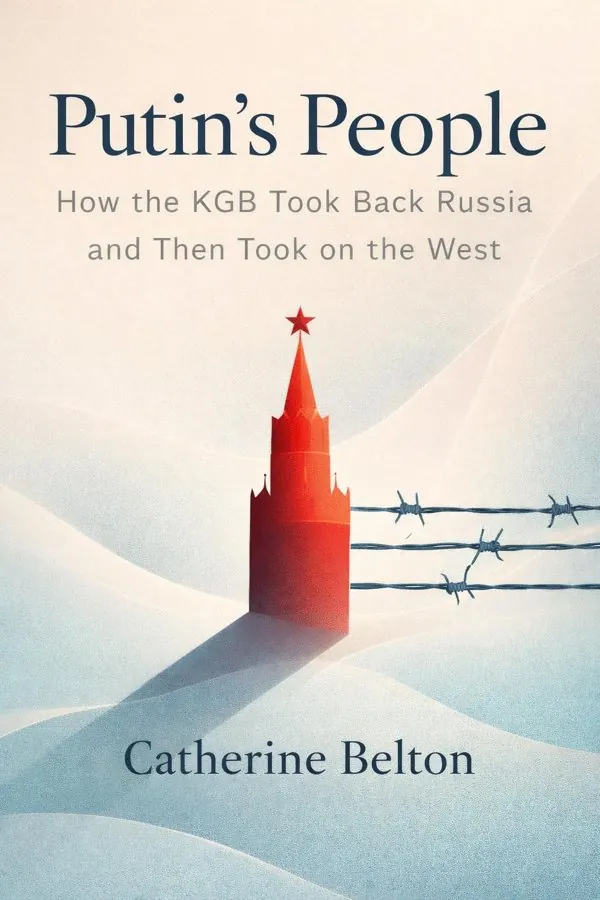
Putin's People: How the KGB Took Back Russia and Then Took on the West: Summary & Key Insights
 10 min7 chaptersAudio available
What Is Putin's People: How the KGB Took Back Russia and Then Took on the West About?
Putin's People: How the KGB Took Back Russia and Then Took on the West by Catherine Belton is a politics book spanning 7 pages. An investigative exposé detailing how Vladimir Putin and former KGB operatives rebuilt Russia’s power structure and extended their influence globally. Catherine Belton, a former Moscow correspondent for the Financial Times, traces the networks of money and power that underpin Putin’s regime and its reach into Western institutions.
This FizzRead summary covers all 7 key chapters of Putin's People: How the KGB Took Back Russia and Then Took on the West in approximately 10 minutes, distilling the most important ideas, arguments, and takeaways from Catherine Belton's work. Also available as an audio summary and Key Quotes Podcast.
Putin's People: How the KGB Took Back Russia and Then Took on the West
An investigative exposé detailing how Vladimir Putin and former KGB operatives rebuilt Russia’s power structure and extended their influence globally. Catherine Belton, a former Moscow correspondent for the Financial Times, traces the networks of money and power that underpin Putin’s regime and its reach into Western institutions.
Who Should Read Putin's People: How the KGB Took Back Russia and Then Took on the West?
This book is perfect for anyone interested in politics and looking to gain actionable insights in a short read. Whether you're a student, professional, or lifelong learner, the key ideas from Putin's People: How the KGB Took Back Russia and Then Took on the West by Catherine Belton will help you think differently.
- ✓Readers who enjoy politics and want practical takeaways
- ✓Professionals looking to apply new ideas to their work and life
- ✓Anyone who wants the core insights of Putin's People: How the KGB Took Back Russia and Then Took on the West in just 10 minutes
Want the full summary?
Get instant access to this book summary and 100K+ more with Fizz Moment.
Get Free SummaryAvailable on App Store • Free to download
Key Chapters
The fall of the Soviet Union was widely celebrated as the dawn of freedom, yet for those within the KGB, it was also a moment of strategy and adaptation. I found, through interviews and archival research, that even as the Communist Party disintegrated, its security apparatus refused to vanish. Instead, its members began transferring resources—both financial and structural—into private hands. This was a process not of dissolution but of controlled metamorphosis.
The 1990s were chaotic. Economic liberalization gutted state industries, producing oligarchs overnight from those able to manipulate insider deals. But behind this transformation, there survived networks of former intelligence officers who had quietly taken control of key financial flows, including oil, metals, and exports. Using offshore schemes and opaque companies, these elites protected and multiplied their wealth. When ordinary Russians saw disorder, these figures saw opportunity: the perfect environment to camouflage their reemergence.
In my conversations with former reformers, many confessed that the Western advisers who promoted privatization never fully grasped how deeply entrenched the old system remained. As democratic institutions faltered under pressure, ex-KGB operatives ensured their survival through shadowy ownership structures and strategic alliances with emerging business tycoons. It was in this crucible that the seeds of Putin’s future regime were sown—the convergence of intelligence loyalty with market ambition.
Tracing Vladimir Putin’s career in St. Petersburg reveals the blueprint for his later governance. As deputy mayor under Anatoly Sobchak, Putin operated at the crossroad of city politics, foreign trade, and commercial licensing. On paper, he managed foreign relations; in practice, he built alliances with businessmen and former comrades from the security services. These years formed what I call the St. Petersburg network—a core group of trusted associates who would later hold Russia’s most powerful corporate and political positions.
Putin’s approach was deliberate: maintain an image of bureaucratic competence while ensuring unfailing loyalty among his circle. Individuals like Igor Sechin and Yury Kovalchuk, who emerged from this environment, shared not only professional ties but deep ideological roots in the KGB’s mindset—order, control, and secrecy. They bonded over survival in post-Soviet uncertainty, seeing themselves as defenders of Russia’s threatened greatness.
Through the city’s Foreign Relations Committee, Putin oversaw deals that often blurred lines between public duty and private enrichment. His approval of barter arrangements and export schemes introduced him to the mechanisms that would later define Russia’s kleptocratic economy. Here, for the first time, the fusion of bureaucracy and business took concrete shape, giving birth to a governing model based on mutual benefit and absolute loyalty.
+ 5 more chapters — available in the FizzRead app
All Chapters in Putin's People: How the KGB Took Back Russia and Then Took on the West
About the Author
Catherine Belton is a British journalist and author. She served as the Moscow correspondent for the Financial Times and has written extensively on Russian politics, oligarchs, and corruption. Her work is recognized for its depth of research and insight into post-Soviet power dynamics.
Get This Summary in Your Preferred Format
Read or listen to the Putin's People: How the KGB Took Back Russia and Then Took on the West summary by Catherine Belton anytime, anywhere. FizzRead offers multiple formats so you can learn on your terms — all free.
Available formats: App · Audio · PDF · EPUB — All included free with FizzRead
Download Putin's People: How the KGB Took Back Russia and Then Took on the West PDF and EPUB Summary
Key Quotes from Putin's People: How the KGB Took Back Russia and Then Took on the West
“The fall of the Soviet Union was widely celebrated as the dawn of freedom, yet for those within the KGB, it was also a moment of strategy and adaptation.”
“Petersburg reveals the blueprint for his later governance.”
Frequently Asked Questions about Putin's People: How the KGB Took Back Russia and Then Took on the West
Putin's People: How the KGB Took Back Russia and Then Took on the West by Catherine Belton is a politics book that explores key ideas across 7 chapters. An investigative exposé detailing how Vladimir Putin and former KGB operatives rebuilt Russia’s power structure and extended their influence globally. Catherine Belton, a former Moscow correspondent for the Financial Times, traces the networks of money and power that underpin Putin’s regime and its reach into Western institutions.
You Might Also Like
Antifa: The Anti-Fascist Handbook
Mark Bray
10 min
Attack from Within: How Disinformation Is Sabotaging America
Barbara McQuade
10 min
Coercion, Capital, and European States, AD 990–1992
Charles Tilly
10 min
Digital Democracy: Concepts, Methodologies, Tools, and Applications
Various Authors
10 min
Fascism
Stanley G. Payne
10 min
Fire And Fury: Inside The Trump White House
Michael Wolff
10 minBrowse by Category
Ready to read Putin's People: How the KGB Took Back Russia and Then Took on the West?
Get the full summary and 100K+ more books with Fizz Moment.