
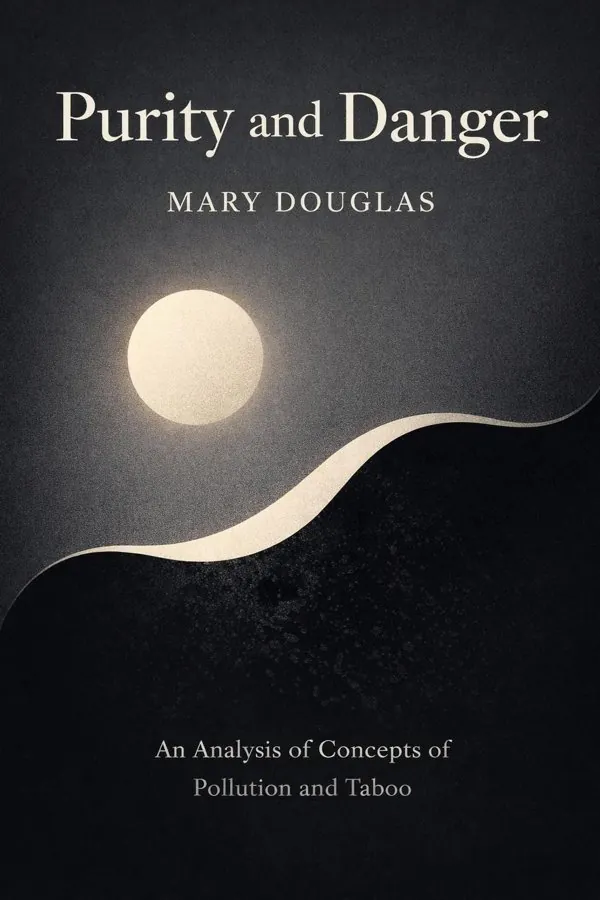
Purity and Danger: An Analysis of Concepts of Pollution and Taboo: Summary & Key Insights
by Mary Douglas
 10 min10 chaptersAudio available
What Is Purity and Danger: An Analysis of Concepts of Pollution and Taboo About?
Purity and Danger: An Analysis of Concepts of Pollution and Taboo by Mary Douglas is a sociology book spanning 10 pages. Purity and Danger is a seminal work in anthropology by Mary Douglas, first published in 1966. The book explores the concepts of purity, pollution, and taboo across cultures, arguing that ideas of cleanliness and contamination are deeply tied to social order and symbolic boundaries. Douglas examines how societies construct notions of danger and impurity to maintain cultural coherence and moral systems.
This FizzRead summary covers all 10 key chapters of Purity and Danger: An Analysis of Concepts of Pollution and Taboo in approximately 10 minutes, distilling the most important ideas, arguments, and takeaways from Mary Douglas's work. Also available as an audio summary and Key Quotes Podcast.
Purity and Danger: An Analysis of Concepts of Pollution and Taboo
Purity and Danger is a seminal work in anthropology by Mary Douglas, first published in 1966. The book explores the concepts of purity, pollution, and taboo across cultures, arguing that ideas of cleanliness and contamination are deeply tied to social order and symbolic boundaries. Douglas examines how societies construct notions of danger and impurity to maintain cultural coherence and moral systems.
Who Should Read Purity and Danger: An Analysis of Concepts of Pollution and Taboo?
This book is perfect for anyone interested in sociology and looking to gain actionable insights in a short read. Whether you're a student, professional, or lifelong learner, the key ideas from Purity and Danger: An Analysis of Concepts of Pollution and Taboo by Mary Douglas will help you think differently.
- ✓Readers who enjoy sociology and want practical takeaways
- ✓Professionals looking to apply new ideas to their work and life
- ✓Anyone who wants the core insights of Purity and Danger: An Analysis of Concepts of Pollution and Taboo in just 10 minutes
Want the full summary?
Get instant access to this book summary and 100K+ more with Fizz Moment.
Get Free SummaryAvailable on App Store • Free to download
Key Chapters
I begin with dirt, because dirt is the simplest and most effective entry point into understanding purity and pollution. Dirt, as I suggest, is not an intrinsic material substance. It is, rather, matter out of place. It represents disorder—something that violates a system of classification. Dust on the floor of a house becomes dirt because it is where it should not be, but the same dust outside, in the garden, is perfectly harmless, even expected. This distinction points us back to the structures of meaning that societies rely on. We constantly create order by deciding what belongs where. Dirt exists only in reference to this order.
When we regard impurity as an offense against cleanliness or morality, we are really expressing anxiety about the violation of boundaries. These boundaries might separate categories of life and death, sacred and profane, male and female, or edible and inedible. Thus, to understand pollution, we must look at the breaking of categories. The sense of danger that accompanies taboo or ritual uncleanliness is not due to the object itself but to its ambiguous position within our mental framework.
In this sense, to study dirt is to study the edges of culture—the points where classification falters. Dirt is thus symbolic. It plays a role in maintaining coherence by marking what must be excluded. The persistence of beliefs about impurity across vastly different societies shows how universal the need for symbolic order is. What varies is not the impulse but the system each culture creates to contain it.
Ritual is the most visible form of a society’s concern for maintenance and renewal of order. What is often dismissed by outsiders as mere ceremony is, in effect, a profound act of social housekeeping—a collective reaffirmation that things still reside in their proper places. Rituals of purification accomplish what ordinary cleaning does in the physical sphere: they restore the separation between states or categories that should not mix. Whether through washing, sacrifice, or confession, ritual validates the moral architecture on which society stands.
Every society, regardless of its complexity, engages in ritualized acts of purity. Through them, people not only cleanse themselves or their environment but symbolically renew their participation in the moral order. These acts have a psychological and communal power, for they reinstate the categories through which meaning is known. If the lines blur too far, society risks symbolic collapse. Thus, ritual operates as a self-correcting mechanism of culture, a drama in which the boundaries of the permissible are reaffirmed through controlled transgression and renewal.
+ 8 more chapters — available in the FizzRead app
All Chapters in Purity and Danger: An Analysis of Concepts of Pollution and Taboo
About the Author
Mary Douglas (1921–2007) was a British anthropologist known for her influential work on human culture, symbolism, and social structures. Educated at Oxford, she became one of the most prominent figures in social anthropology, with major contributions including 'Purity and Danger' and 'Natural Symbols'. Her research often focused on how societies use classification and ritual to create meaning and order.
Get This Summary in Your Preferred Format
Read or listen to the Purity and Danger: An Analysis of Concepts of Pollution and Taboo summary by Mary Douglas anytime, anywhere. FizzRead offers multiple formats so you can learn on your terms — all free.
Available formats: App · Audio · PDF · EPUB — All included free with FizzRead
Download Purity and Danger: An Analysis of Concepts of Pollution and Taboo PDF and EPUB Summary
Key Quotes from Purity and Danger: An Analysis of Concepts of Pollution and Taboo
“I begin with dirt, because dirt is the simplest and most effective entry point into understanding purity and pollution.”
“Ritual is the most visible form of a society’s concern for maintenance and renewal of order.”
Frequently Asked Questions about Purity and Danger: An Analysis of Concepts of Pollution and Taboo
Purity and Danger: An Analysis of Concepts of Pollution and Taboo by Mary Douglas is a sociology book that explores key ideas across 10 chapters. Purity and Danger is a seminal work in anthropology by Mary Douglas, first published in 1966. The book explores the concepts of purity, pollution, and taboo across cultures, arguing that ideas of cleanliness and contamination are deeply tied to social order and symbolic boundaries. Douglas examines how societies construct notions of danger and impurity to maintain cultural coherence and moral systems.
You Might Also Like
Between the World and Me
Ta-Nehisi Coates
10 min
Half the Sky
Nicholas D. Kristof, Sheryl WuDunn
10 min
Men Explain Things To Me
Rebecca Solnit
10 min
Rational Ritual
Michael Suk-Young Chwe
10 min
The New Jim Crow
Michelle Alexander
10 min
Beyond Culture
Edward T. Hall
10 minBrowse by Category
Ready to read Purity and Danger: An Analysis of Concepts of Pollution and Taboo?
Get the full summary and 100K+ more books with Fizz Moment.