
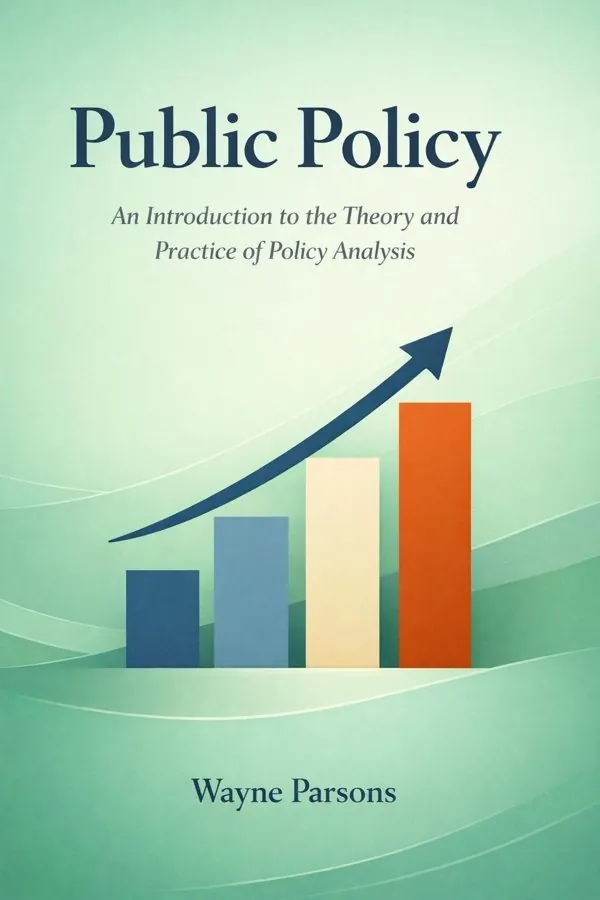
Public Policy: An Introduction to the Theory and Practice of Policy Analysis: Summary & Key Insights
 10 min10 chaptersAudio available
What Is Public Policy: An Introduction to the Theory and Practice of Policy Analysis About?
Public Policy: An Introduction to the Theory and Practice of Policy Analysis by Wayne Parsons is a politics book spanning 10 pages. This major textbook offers a comprehensive introduction to the study and practice of public policy analysis. Wayne Parsons examines the theoretical foundations, key models, and practical tools used in policy-making processes. The book explores how policies are formulated, implemented, and evaluated within political, social, and economic contexts, providing students and practitioners with a clear framework for understanding the complexities of public decision-making.
This FizzRead summary covers all 10 key chapters of Public Policy: An Introduction to the Theory and Practice of Policy Analysis in approximately 10 minutes, distilling the most important ideas, arguments, and takeaways from Wayne Parsons's work. Also available as an audio summary and Key Quotes Podcast.
Public Policy: An Introduction to the Theory and Practice of Policy Analysis
This major textbook offers a comprehensive introduction to the study and practice of public policy analysis. Wayne Parsons examines the theoretical foundations, key models, and practical tools used in policy-making processes. The book explores how policies are formulated, implemented, and evaluated within political, social, and economic contexts, providing students and practitioners with a clear framework for understanding the complexities of public decision-making.
Who Should Read Public Policy: An Introduction to the Theory and Practice of Policy Analysis?
This book is perfect for anyone interested in politics and looking to gain actionable insights in a short read. Whether you're a student, professional, or lifelong learner, the key ideas from Public Policy: An Introduction to the Theory and Practice of Policy Analysis by Wayne Parsons will help you think differently.
- ✓Readers who enjoy politics and want practical takeaways
- ✓Professionals looking to apply new ideas to their work and life
- ✓Anyone who wants the core insights of Public Policy: An Introduction to the Theory and Practice of Policy Analysis in just 10 minutes
Want the full summary?
Get instant access to this book summary and 100K+ more with Fizz Moment.
Get Free SummaryAvailable on App Store • Free to download
Key Chapters
The first task in understanding contemporary policy analysis is to recognize its historical lineage. The term ‘policy sciences’ was popularized by Harold Lasswell in the mid-twentieth century, during a period of optimism about the capacity of scientific methods to solve social problems. Lasswell envisioned policy analysis as a multidisciplinary endeavor aimed at integrating knowledge for the improvement of human welfare. His approach sought to transcend the fragmented academic boundaries that often prevented effective public decision-making.
In the decades that followed, policy studies evolved alongside the broader institutional expansion of democratic governance. The postwar welfare state generated unprecedented demand for expertise and administrative coordination. Governments increasingly turned to economists, sociologists, and political scientists for guidance on how to design more effective policies. Think tanks, research centers, and university departments emerged as institutional homes for this new field. Yet as the optimism of mid-century gave way to the pluralism and complexity of later decades, policy analysts came to realize that rational planning could never fully capture the messy realities of political negotiation and social diversity.
This historical narrative is not just descriptive—it tells us something vital about what policy analysis became. It began with a faith in rationality and scientific progress but matured into a recognition of uncertainty, complexity, and value conflict inherent in democratic life. Understanding this evolution is crucial for any analyst who seeks not only to predict outcomes but to engage responsibly with the ethical dimensions of public action.
Before we can analyze policy, we must know what we mean by the term. Policy, in my account, is not merely a government decision or a piece of legislation—it is a process, a system of interconnected activities spanning problem recognition, agenda formation, formulation, implementation, and evaluation. Policy has structure and dynamics; it involves actors, institutions, and information flows that interact over time.
To illuminate these dynamics, I emphasize the idea of a policy system. A policy system includes formal governmental institutions such as legislatures and bureaucracies, but also informal networks, advocacy groups, and media influences that shape perception and discourse. It is within these systems that decisions are made, contested, and revised. Policy processes, viewed systemically, appear less as linear progressions and more as cycles of feedback and adaptation.
By defining policy as both product and process, we grasp its dual character—it embodies decisions and actions aimed at achieving collective goals, yet it also reflects the struggles and negotiations that produce those goals. This conceptual foundation underpins the entire analytic enterprise: policy is never simply given, it is constructed, and understanding its construction is the analyst’s first responsibility.
+ 8 more chapters — available in the FizzRead app
All Chapters in Public Policy: An Introduction to the Theory and Practice of Policy Analysis
About the Author
Wayne Parsons is a British academic and policy analyst recognized for his contributions to the study of public policy and political science. He has taught at several universities in the United Kingdom and internationally, focusing on policy analysis, governance, and the relationship between theory and practice in public administration.
Get This Summary in Your Preferred Format
Read or listen to the Public Policy: An Introduction to the Theory and Practice of Policy Analysis summary by Wayne Parsons anytime, anywhere. FizzRead offers multiple formats so you can learn on your terms — all free.
Available formats: App · Audio · PDF · EPUB — All included free with FizzRead
Download Public Policy: An Introduction to the Theory and Practice of Policy Analysis PDF and EPUB Summary
Key Quotes from Public Policy: An Introduction to the Theory and Practice of Policy Analysis
“The first task in understanding contemporary policy analysis is to recognize its historical lineage.”
“Before we can analyze policy, we must know what we mean by the term.”
Frequently Asked Questions about Public Policy: An Introduction to the Theory and Practice of Policy Analysis
Public Policy: An Introduction to the Theory and Practice of Policy Analysis by Wayne Parsons is a politics book that explores key ideas across 10 chapters. This major textbook offers a comprehensive introduction to the study and practice of public policy analysis. Wayne Parsons examines the theoretical foundations, key models, and practical tools used in policy-making processes. The book explores how policies are formulated, implemented, and evaluated within political, social, and economic contexts, providing students and practitioners with a clear framework for understanding the complexities of public decision-making.
You Might Also Like
Antifa: The Anti-Fascist Handbook
Mark Bray
10 min
Attack from Within: How Disinformation Is Sabotaging America
Barbara McQuade
10 min
Coercion, Capital, and European States, AD 990–1992
Charles Tilly
10 min
Digital Democracy: Concepts, Methodologies, Tools, and Applications
Various Authors
10 min
Fascism
Stanley G. Payne
10 min
Fire And Fury: Inside The Trump White House
Michael Wolff
10 minBrowse by Category
Ready to read Public Policy: An Introduction to the Theory and Practice of Policy Analysis?
Get the full summary and 100K+ more books with Fizz Moment.