
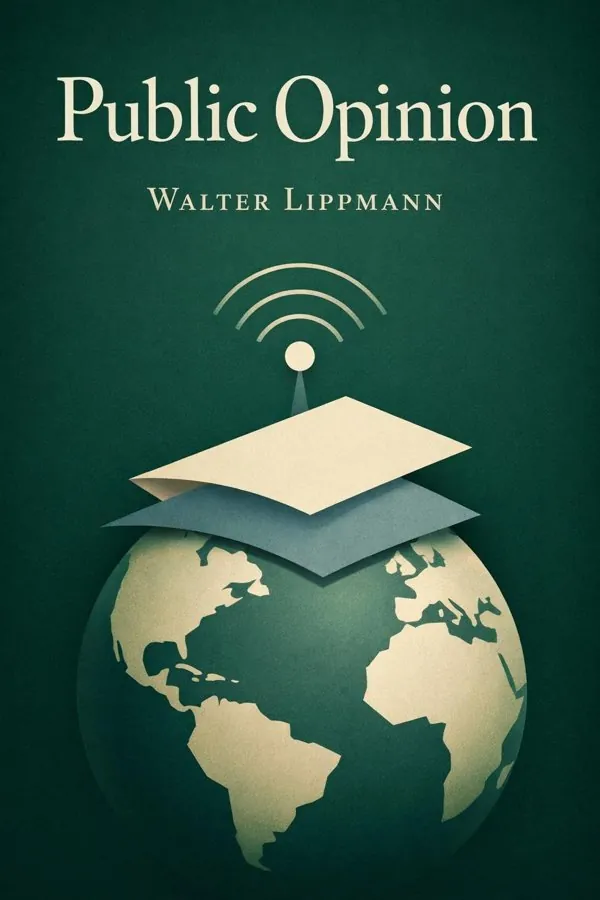
Public Opinion: Summary & Key Insights
 10 min11 chaptersAudio available
What Is Public Opinion About?
Public Opinion by Walter Lippmann is a politics book spanning 11 pages. Public Opinion es una obra fundamental de la teoría política y de la comunicación escrita por Walter Lippmann en 1922. El libro analiza cómo los medios de comunicación y las percepciones colectivas moldean la opinión pública y, por extensión, la democracia moderna. Lippmann introduce conceptos como el 'pseudoentorno' y la 'fabricación del consenso', argumentando que los ciudadanos rara vez tienen acceso directo a la realidad política, sino que dependen de representaciones mediadas.
This FizzRead summary covers all 11 key chapters of Public Opinion in approximately 10 minutes, distilling the most important ideas, arguments, and takeaways from Walter Lippmann's work. Also available as an audio summary and Key Quotes Podcast.
Public Opinion
Public Opinion es una obra fundamental de la teoría política y de la comunicación escrita por Walter Lippmann en 1922. El libro analiza cómo los medios de comunicación y las percepciones colectivas moldean la opinión pública y, por extensión, la democracia moderna. Lippmann introduce conceptos como el 'pseudoentorno' y la 'fabricación del consenso', argumentando que los ciudadanos rara vez tienen acceso directo a la realidad política, sino que dependen de representaciones mediadas.
Who Should Read Public Opinion?
This book is perfect for anyone interested in politics and looking to gain actionable insights in a short read. Whether you're a student, professional, or lifelong learner, the key ideas from Public Opinion by Walter Lippmann will help you think differently.
- ✓Readers who enjoy politics and want practical takeaways
- ✓Professionals looking to apply new ideas to their work and life
- ✓Anyone who wants the core insights of Public Opinion in just 10 minutes
Want the full summary?
Get instant access to this book summary and 100K+ more with Fizz Moment.
Get Free SummaryAvailable on App Store • Free to download
Key Chapters
The heart of the problem lies in the difference between the world as it is and the world as we perceive it. No one can fully witness the complex fabric of political, economic, and international reality. What each of us knows of the world comes to us filtered, condensed, and dramatized. Our minds create a smaller, more vivid version of it — what I call the pseudo-environment — which stands in for the real thing.
When a citizen reads about a war, they see only fragments: dispatches, photographs, speeches, slogans. They must imagine the rest. Yet it is this imagined world — not the actual battlefield — that shapes their judgments and emotions. The pseudo-environment functions as a map by which we navigate social reality. The danger arises when we mistake the map for the territory. The accuracy of our public actions, then, depends less on the events themselves and more on how faithfully our internal pictures reproduce them.
This recognition introduces a humbling truth: that no public opinion, however passionately felt, directly mirrors reality. It is always mediated by representation.
How we approach the world is never neutral. Each of us, from childhood, learns to interpret experience through preexisting categories — stereotypes. These are not necessarily malicious distortions; they are mental shortcuts that make an otherwise overwhelming world intelligible. The city dweller, the patriot, the reformer — each carries a set of fixed images that simplify life enough to act within it.
But simplicity comes at a cost. When we cling to inherited symbols, we often mistake familiarity for truth. Public discourse becomes the repetition of conventional pictures rather than the exploration of new realities. These stereotypes harden into collective myths, widely shared and emotionally charged, guiding nations into war or markets into panic. What we call 'public opinion' is thus largely the circulation of these habitual pictures within minds conditioned to accept them.
Understanding this process requires us to look not only at what people think, but how they have come to think — to study the machinery of thought itself.
+ 9 more chapters — available in the FizzRead app
All Chapters in Public Opinion
About the Author
Walter Lippmann (1889–1974) fue un periodista, comentarista político y filósofo estadounidense. Es considerado uno de los fundadores del periodismo moderno y de la teoría de la comunicación política. Su trabajo influyó profundamente en el pensamiento sobre la opinión pública, la democracia y el papel de los medios en la sociedad.
Get This Summary in Your Preferred Format
Read or listen to the Public Opinion summary by Walter Lippmann anytime, anywhere. FizzRead offers multiple formats so you can learn on your terms — all free.
Available formats: App · Audio · PDF · EPUB — All included free with FizzRead
Download Public Opinion PDF and EPUB Summary
Key Quotes from Public Opinion
“The heart of the problem lies in the difference between the world as it is and the world as we perceive it.”
“How we approach the world is never neutral.”
Frequently Asked Questions about Public Opinion
Public Opinion by Walter Lippmann is a politics book that explores key ideas across 11 chapters. Public Opinion es una obra fundamental de la teoría política y de la comunicación escrita por Walter Lippmann en 1922. El libro analiza cómo los medios de comunicación y las percepciones colectivas moldean la opinión pública y, por extensión, la democracia moderna. Lippmann introduce conceptos como el 'pseudoentorno' y la 'fabricación del consenso', argumentando que los ciudadanos rara vez tienen acceso directo a la realidad política, sino que dependen de representaciones mediadas.
You Might Also Like

Antifa: The Anti-Fascist Handbook
Mark Bray
10 min
Attack from Within: How Disinformation Is Sabotaging America
Barbara McQuade
10 min
Coercion, Capital, and European States, AD 990–1992
Charles Tilly
10 min
Digital Democracy: Concepts, Methodologies, Tools, and Applications
Various Authors
10 min
Fascism
Stanley G. Payne
10 min
Fire And Fury: Inside The Trump White House
Michael Wolff
10 minBrowse by Category
Ready to read Public Opinion?
Get the full summary and 100K+ more books with Fizz Moment.