
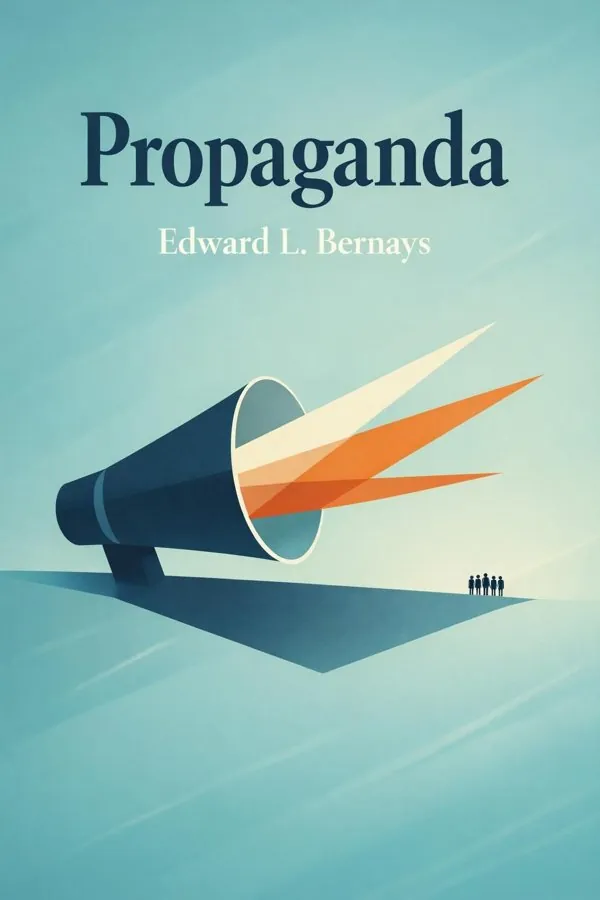
Propaganda: Summary & Key Insights
 10 min10 chaptersAudio available
Key Takeaways from Propaganda
The most provocative idea in Propaganda is that people rarely act as fully independent decision-makers, even when they believe they do.
One of Bernays’s boldest claims is that modern society depends on a class of invisible organizers whom he calls the new propagandists.
A central lesson of Propaganda is that persuasion succeeds when it speaks to motives beneath the surface of stated opinion.
Bernays insists that businesses cannot rely on producing goods alone; they must also create public understanding and acceptance around those goods.
Democracy is often imagined as a realm of open debate where citizens calmly weigh facts and choose leaders.
What Is Propaganda About?
Propaganda by Edward L. Bernays is a communication book spanning 10 pages. Edward L. Bernays’s Propaganda, first published in 1928, is one of the most influential and unsettling books ever written about communication, persuasion, and public opinion. Bernays argues that in modern mass society, people do not simply form opinions independently; their beliefs, tastes, and choices are constantly shaped by organized efforts operating behind the scenes. He calls this process propaganda—not merely in the narrow political sense, but as the broad management of ideas, images, and public consent. What makes the book so important is that Bernays does not treat propaganda as an abuse of democracy, but as one of its operating mechanisms. In a world crowded with information, he claims, invisible persuaders help structure attention, simplify complexity, and guide collective behavior. Bernays wrote with unusual authority: he is widely regarded as a founder of modern public relations, and his campaigns helped define how governments, businesses, and institutions influence the public. Whether you read this book as a manual, a warning, or both, Propaganda remains essential for understanding media, branding, politics, and the architecture of modern persuasion.
This FizzRead summary covers all 10 key chapters of Propaganda in approximately 10 minutes, distilling the most important ideas, arguments, and takeaways from Edward L. Bernays's work. Also available as an audio summary and Key Quotes Podcast.
Propaganda
Edward L. Bernays’s Propaganda, first published in 1928, is one of the most influential and unsettling books ever written about communication, persuasion, and public opinion. Bernays argues that in modern mass society, people do not simply form opinions independently; their beliefs, tastes, and choices are constantly shaped by organized efforts operating behind the scenes. He calls this process propaganda—not merely in the narrow political sense, but as the broad management of ideas, images, and public consent. What makes the book so important is that Bernays does not treat propaganda as an abuse of democracy, but as one of its operating mechanisms. In a world crowded with information, he claims, invisible persuaders help structure attention, simplify complexity, and guide collective behavior. Bernays wrote with unusual authority: he is widely regarded as a founder of modern public relations, and his campaigns helped define how governments, businesses, and institutions influence the public. Whether you read this book as a manual, a warning, or both, Propaganda remains essential for understanding media, branding, politics, and the architecture of modern persuasion.
Who Should Read Propaganda?
This book is perfect for anyone interested in communication and looking to gain actionable insights in a short read. Whether you're a student, professional, or lifelong learner, the key ideas from Propaganda by Edward L. Bernays will help you think differently.
- ✓Readers who enjoy communication and want practical takeaways
- ✓Professionals looking to apply new ideas to their work and life
- ✓Anyone who wants the core insights of Propaganda in just 10 minutes
Want the full summary?
Get instant access to this book summary and 100K+ more with Fizz Moment.
Get Free SummaryAvailable on App Store • Free to download
Key Chapters
One of Bernays’s boldest claims is that modern society depends on a class of invisible organizers whom he calls the new propagandists. These are not only politicians or newspaper editors. They include public relations counselors, advertisers, brand strategists, lobbyists, influencers, institutional spokespersons, and experts who interpret events for the public. Their role is to translate complexity into narratives that ordinary people can grasp and act upon.
Bernays does not present these figures as fringe manipulators. He sees them as necessary intermediaries in a society too large and complex for direct, individual understanding. No citizen can personally investigate every industry, policy, school, scientific issue, or cultural shift. Because of that, specialists arise to package information, frame priorities, and shape the terms of debate. These propagandists decide what becomes visible, what feels urgent, and what symbols attach to which ideas.
This insight feels even more relevant today. A technology company launches a product through carefully staged keynote events, expert reviews, social media amplification, and lifestyle storytelling. A nonprofit reshapes public concern through data reports, celebrity endorsements, and emotionally compelling case studies. A government builds support for policy through speeches, press briefings, and coordinated talking points. In each case, public reaction is not spontaneous; it is cultivated.
Bernays’s point is not merely descriptive. It is strategic. If influence already exists, those who understand the mechanics of influence will dominate public attention. The actionable takeaway: identify the interpreters in any field you care about. Ask who is framing the issue, whose interests they serve, and how their narrative shapes what people think is natural, urgent, or true.
A central lesson of Propaganda is that persuasion succeeds when it speaks to motives beneath the surface of stated opinion. Bernays argues that people do not respond mainly to dry facts. They respond to desires, fears, aspirations, habits, and symbolic meanings. Public relations therefore works best when it connects an idea to deep psychological drivers rather than trying to win by logic alone.
This is where Bernays’s thinking became revolutionary. Influenced in part by contemporary psychology, he treated communication as an exercise in understanding hidden motives. A person may say they buy a car for efficiency, but they may really be buying status, freedom, or masculinity. A citizen may support a policy not after reading the full proposal, but because the policy is framed as patriotic, modern, safe, or morally necessary. Facts matter, but they gain force only when placed inside emotionally resonant stories.
In practical terms, this means effective communicators do more than announce features or arguments. They research audiences, identify existing beliefs, and create messages that feel personally meaningful. A health campaign might emphasize protection of loved ones rather than abstract statistics. A school fundraiser may focus on community pride, future opportunity, and shared responsibility. A business leader introducing change can reduce resistance by linking change to identity and purpose, not just efficiency.
Bernays shows that public relations is less about broadcasting and more about emotional alignment. The best campaigns make people feel that acting in a certain way expresses who they already are—or who they want to become.
Actionable takeaway: when crafting or evaluating communication, look past stated reasons and ask, "What deeper desire, fear, or aspiration is this message speaking to?"
Bernays insists that businesses cannot rely on producing goods alone; they must also create public understanding and acceptance around those goods. In his view, a company that ignores public opinion leaves its success to chance. Markets are not driven purely by utility. They are shaped by attention, trust, perception, prestige, and cultural meaning. That makes communication a core business function, not an optional add-on.
He argues that modern corporations operate in a crowded landscape where consumers have too many choices and too little time. Under those conditions, products need identities. Companies must explain not only what they sell, but why it matters and how it fits into the consumer’s life. This is why Bernays saw public relations as a management discipline. It helps align the organization’s goals with the public’s attitudes by building favorable associations over time.
Examples are everywhere. Food brands do not sell ingredients; they sell family, comfort, and health. Financial firms do not merely offer services; they try to project stability and expertise. Tech companies position themselves as symbols of creativity or empowerment. Even industrial firms invest in storytelling about innovation, sustainability, and social benefit because public legitimacy influences regulators, investors, employees, and buyers alike.
Bernays also understood that business communication extends beyond customers. A company must maintain relationships with journalists, employees, community leaders, and policymakers. Its reputation becomes a strategic asset that can protect or damage performance.
The actionable takeaway: if you run a business, ask what story the public tells about your organization when you are not in the room. If that story is unclear, shape it intentionally before others do it for you.
Democracy is often imagined as a realm of open debate where citizens calmly weigh facts and choose leaders. Bernays offers a harder truth: political leadership depends heavily on the organized shaping of public opinion. In large societies, most voters cannot directly study every issue in depth, so political meaning is created through symbols, narratives, slogans, endorsements, images, and staged events. Leadership therefore involves not just decision-making, but interpretation.
Bernays does not see this as an occasional distortion of democracy; he sees it as built into democracy’s functioning. Because the public cannot focus on all matters at once, leaders and their communication specialists decide what topics receive attention and how those topics are framed. A policy can be presented as reform, rescue, freedom, security, fairness, or common sense. The frame influences whether the same underlying action is embraced or resisted.
This helps explain why successful politicians master theater as well as policy. They associate themselves with national values, trusted constituencies, and emotionally charged causes. They use ceremonies, radio, headlines, and now digital media to convert abstract programs into vivid public meaning. Elections become contests not only of proposals, but of images and emotional resonance.
For citizens, Bernays’s analysis is both useful and sobering. It reveals how democratic consent can be guided by those who understand communication better than their opponents. It also suggests that media literacy is a civic necessity.
Actionable takeaway: when you encounter political messaging, separate the symbolic frame from the policy substance. Ask what emotions, identities, and assumptions are being used to make a position feel acceptable or inevitable.
In discussing women’s activities, Bernays recognizes a major social shift of his time: women were becoming a more organized, visible, and economically influential force in public life. He understood that no modern communicator could ignore women as consumers, community leaders, reformers, cultural tastemakers, and voters. This was not merely a demographic observation; it was a strategic one. Groups that shape domestic life, consumption patterns, and moral norms often exercise broad influence over society.
Bernays saw that women’s organizations, clubs, civic groups, and social networks could mobilize opinion efficiently. Their influence spread through schools, households, charities, churches, and local institutions. As a result, campaigns in education, public health, politics, and commerce often gained traction by engaging women’s interests and leadership. In Bernays’s framework, influence flows through social channels that seem informal but are highly effective.
Today this idea extends beyond gender alone. It points to the importance of understanding who carries social credibility inside communities. Parenting creators can shape buying patterns. Professional networks can normalize workplace trends. Grassroots organizers can redefine local priorities. Cultural change often moves through trusted intermediaries long before it appears in official policy.
At the same time, this chapter reminds modern readers that public influence is tied to social structures. Those who are deeply embedded in everyday life often become powerful transmitters of values and behaviors, whether or not they hold formal authority.
Actionable takeaway: if you want to spread an idea, identify the communities and everyday influencers who convert private preference into public norm. Influence grows faster when trusted social connectors carry the message.
Bernays argues that education is never simply the neutral transfer of facts. It is also the shaping of attention, values, priorities, and social attitudes. Schools, universities, museums, and educational campaigns all select what deserves emphasis and how knowledge should be interpreted. In that sense, education itself participates in propaganda—understood not as crude deception, but as organized guidance of thought.
This claim is uncomfortable because education often presents itself as above persuasion. Bernays challenges that self-image. A curriculum reflects assumptions about citizenship, morality, history, progress, and authority. A public information campaign about sanitation, literacy, nutrition, or civic duty succeeds only when it makes people care, not when it merely hands them data. Effective education therefore combines content with framing, repetition, credibility, and social reinforcement.
Consider modern examples. Environmental education works better when students see local relevance and social identity in sustainable behavior. Financial literacy programs are more effective when they connect good habits to independence and future security. Corporate training changes behavior only when leaders model values and reward compliance, not when employees sit through a slideshow.
Bernays’s point is that learning and persuasion are often intertwined. If you want people to adopt new knowledge, you must also address incentives, emotions, and social meaning. Facts need a pathway into habits.
The actionable takeaway: whenever you teach, communicate, or train, do not assume information alone creates change. Design the surrounding environment—symbols, examples, social proof, and repetition—so the desired belief or behavior becomes easier to adopt and sustain.
Bernays presents propaganda as a discipline that combines analytical method with creative execution. It is a science because it studies audiences, social structures, media channels, and psychological triggers. It is an art because successful influence requires timing, taste, imagination, symbolism, and intuitive judgment. Data can reveal what people say or do, but crafting a message that captures attention and changes behavior remains a creative act.
This dual nature explains why some campaigns fail despite careful planning. Influence is not mechanical. A message can be factually sound and strategically targeted yet still feel lifeless, mistimed, or culturally tone-deaf. Conversely, a campaign with emotional clarity and symbolic power can transform public behavior rapidly because it gives people a simple, vivid way to understand themselves and the world.
Bernays stresses the importance of coordination. Effective propaganda aligns words, events, endorsements, visuals, institutions, and media repetition around a single objective. A company launch, for example, may combine expert validation, news coverage, aspirational imagery, and social proof. A public campaign may blend statistics, personal stories, community leaders, and educational materials. The pieces work because they reinforce one another.
For modern communicators, the lesson is that influence should be designed as a system. Research tells you where resistance and opportunity lie. Creativity turns strategy into something memorable. Distribution sustains momentum.
Actionable takeaway: when planning communication, do not separate insight from execution. Pair audience research with strong narrative, symbolic clarity, and coordinated delivery so your message is not only accurate, but compelling and hard to ignore.
Bernays ends with a forward-looking argument: propaganda will not disappear as societies become more modern; it will become more central. As populations grow, institutions multiply, and media channels expand, the struggle for public attention intensifies. People face more information than they can process, which increases their dependence on intermediaries who filter and frame reality. In that environment, organized persuasion becomes a permanent feature of democratic life.
This forecast has proven strikingly accurate. Today, brands, governments, movements, platforms, and individuals compete continuously to shape narratives. Social media accelerates the process by rewarding emotion, simplicity, identity, and repetition—the very ingredients Bernays identified. Algorithmic feeds may seem new, but they amplify an old principle: what gains attention gains influence, and what is strategically framed often feels natural or self-evident.
Yet Bernays’s vision raises ethical questions he never fully resolves. If consent can be engineered, how can citizens remain genuinely free? If experts and communicators guide mass opinion, who guides them? The book forces readers to confront a tension at the heart of modern democracy: societies need coordination and narrative order, but those tools can also manipulate, distort, and exploit.
That is why Propaganda still matters. It teaches both how influence works and why influence should be examined critically. To read Bernays well is not to accept every claim, but to become harder to fool.
Actionable takeaway: treat persuasion as an unavoidable part of modern life. Build two skills at once—ethical communication if you seek to influence others, and disciplined skepticism if you seek to protect your own judgment.
All Chapters in Propaganda
About the Author
Edward L. Bernays (1891–1995) was one of the founders of modern public relations and a major influence on twentieth-century communication strategy. Born in Vienna and raised in the United States, he became known for applying ideas from psychology, sociology, and mass behavior to the shaping of public opinion. He advised corporations, governments, nonprofits, and cultural institutions, helping develop techniques that would later define advertising, media campaigns, and reputation management. Bernays was also the nephew of Sigmund Freud, a connection often noted because of his interest in unconscious motives and emotional persuasion. His writing, especially Propaganda, helped establish the intellectual framework for modern PR. Though admired for his originality and strategic insight, he remains controversial for openly defending the organized engineering of consent in democratic societies.
Get This Summary in Your Preferred Format
Read or listen to the Propaganda summary by Edward L. Bernays anytime, anywhere. FizzRead offers multiple formats so you can learn on your terms — all free.
Available formats: App · Audio · PDF · EPUB — All included free with FizzRead
Download Propaganda PDF and EPUB Summary
Key Quotes from Propaganda
“The most provocative idea in Propaganda is that people rarely act as fully independent decision-makers, even when they believe they do.”
“One of Bernays’s boldest claims is that modern society depends on a class of invisible organizers whom he calls the new propagandists.”
“A central lesson of Propaganda is that persuasion succeeds when it speaks to motives beneath the surface of stated opinion.”
“Bernays insists that businesses cannot rely on producing goods alone; they must also create public understanding and acceptance around those goods.”
“Democracy is often imagined as a realm of open debate where citizens calmly weigh facts and choose leaders.”
Frequently Asked Questions about Propaganda
Propaganda by Edward L. Bernays is a communication book that explores key ideas across 10 chapters. Edward L. Bernays’s Propaganda, first published in 1928, is one of the most influential and unsettling books ever written about communication, persuasion, and public opinion. Bernays argues that in modern mass society, people do not simply form opinions independently; their beliefs, tastes, and choices are constantly shaped by organized efforts operating behind the scenes. He calls this process propaganda—not merely in the narrow political sense, but as the broad management of ideas, images, and public consent. What makes the book so important is that Bernays does not treat propaganda as an abuse of democracy, but as one of its operating mechanisms. In a world crowded with information, he claims, invisible persuaders help structure attention, simplify complexity, and guide collective behavior. Bernays wrote with unusual authority: he is widely regarded as a founder of modern public relations, and his campaigns helped define how governments, businesses, and institutions influence the public. Whether you read this book as a manual, a warning, or both, Propaganda remains essential for understanding media, branding, politics, and the architecture of modern persuasion.
More by Edward L. Bernays

You Might Also Like

Magic Words: The Science and Secrets Behind Seven Words That Motivate, Engage, and Influence
Tim David
10 min
Talking Across The Divide: How to Communicate with People You Disagree with and Maybe Even Change the World
Justin Lee
10 min
The Exceptional Presenter: A Proven Formula to Open Up! and Own the Room
Timothy J. Koegel
10 min
4 Essential Keys to Effective Communication in Love, Life, Work--Anywhere!: Including the 12-Day Communication Challenge!
Bento C. Leal III
10 min
Active Listening Techniques: 30 Practical Tools to Hone Your Communication Skills
Nisha Gupta
10 min
Bargaining for Advantage: Negotiation Strategies for Reasonable People
G. Richard Shell
10 minBrowse by Category
Ready to read Propaganda?
Get the full summary and 100K+ more books with Fizz Moment.