
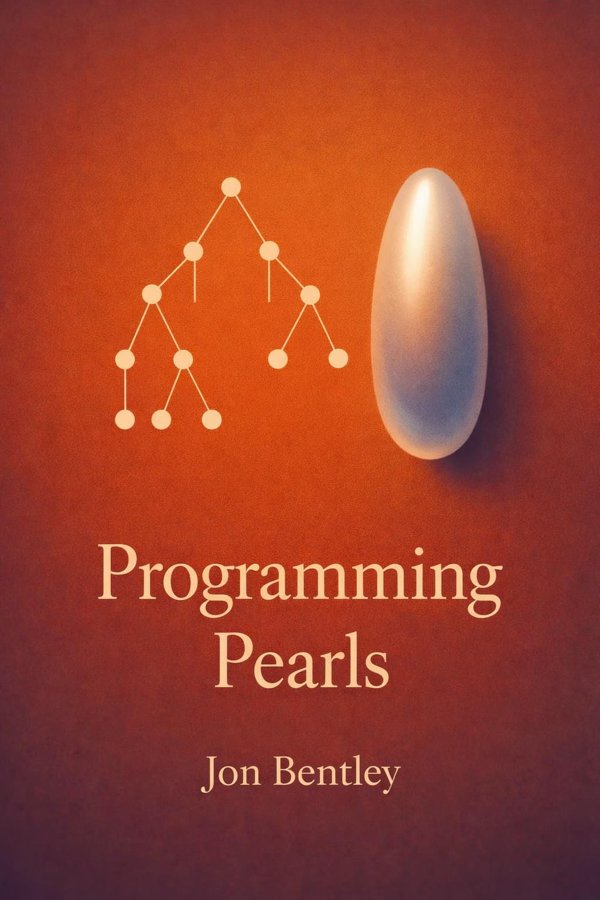
Programming Pearls: Summary & Key Insights
by Jon Bentley
 10 min5 chaptersAudio available
What Is Programming Pearls About?
Programming Pearls by Jon Bentley is a programming book spanning 5 pages. Programming Pearls is a collection of essays that explore the art and craft of programming through practical examples and elegant problem-solving techniques. The book emphasizes thinking about algorithms, data structures, and performance optimization, offering insights into how expert programmers approach complex challenges. It is widely regarded as a classic in computer science education and software engineering.
This FizzRead summary covers all 5 key chapters of Programming Pearls in approximately 10 minutes, distilling the most important ideas, arguments, and takeaways from Jon Bentley's work. Also available as an audio summary and Key Quotes Podcast.
Programming Pearls
Programming Pearls is a collection of essays that explore the art and craft of programming through practical examples and elegant problem-solving techniques. The book emphasizes thinking about algorithms, data structures, and performance optimization, offering insights into how expert programmers approach complex challenges. It is widely regarded as a classic in computer science education and software engineering.
Who Should Read Programming Pearls?
This book is perfect for anyone interested in programming and looking to gain actionable insights in a short read. Whether you're a student, professional, or lifelong learner, the key ideas from Programming Pearls by Jon Bentley will help you think differently.
- ✓Readers who enjoy programming and want practical takeaways
- ✓Professionals looking to apply new ideas to their work and life
- ✓Anyone who wants the core insights of Programming Pearls in just 10 minutes
Want the full summary?
Get instant access to this book summary and 100K+ more with Fizz Moment.
Get Free SummaryAvailable on App Store • Free to download
Key Chapters
A program’s soul lies in its data. The way you represent information shapes not only your algorithm but the entire structure of your thinking. I’ve long argued that the first step in solving a problem is not to think about how to compute something, but how best to represent it. Choosing the right data structures is a form of design elegance—it enables algorithms to flow naturally, minimizes complexity, and often transforms an intractable problem into a simple one.
In this section, I explore how representation dictates power. Consider the problem of bit vectors—a humble structure that can, through clever use, solve large-scale set membership tests with breathtaking efficiency. By representing millions of integers as bits rather than words, we suddenly compress memory and accelerate performance. This is not magic; it’s design. The representation reflects an understanding of the underlying domain and the constraints at play.
But representation is not only about optimization—it’s also about clarity. Poorly chosen data structures lead to fragile systems. The beauty emerges when representation aligns with intention. A well-crafted structure becomes both a model of thought and a map of computation. Through case studies and examples, I show how reorganizing data can yield orders-of-magnitude performance gains, and how examining data early—the kernel of every algorithmic decision—helps prevent wasted complexity later on.
To master this art, think less about the machinery and more about the meaning of data. Ask: What is the essence of the problem? What natural structure captures it succinctly? Once you answer those questions, your code will follow effortlessly, and performance will often take care of itself.
Algorithm design is where programming transforms from implementation into artistry. When I teach algorithmic thinking, I start with the practice of decomposition: break problems into smaller, understandable pieces, and refine each piece until clarity and performance emerge hand in hand.
The secret to a thriving algorithm isn’t complexity—it’s simplicity, precisely chiseled through thought. In *Programming Pearls*, I emphasize stepwise refinement as a discipline that allows programmers to control chaos. Begin with the broad picture: What’s the goal? Then step inward, layer by layer, reshaping the idea until you arrive at a crisp and efficient set of operations. The act is akin to carving sculpture—removing excess until the essence remains.
I’ve seen countless engineers jump into coding before understanding the problem’s structure, and they often drown in details. Algorithmic refinement demands patience: sketch, experiment, reason, and only then codify. Through examples such as searching, sorting, and text processing, I demonstrate how good algorithms emerge through questioning: What if we changed the structure? What if we exploited properties of the data? What if the constraints shifted? Each refinement invites creativity.
One lesson that reverberates throughout this section is that theory and practice must coalesce. Algorithms don’t exist in vacuum—they live within memory, processor caches, and data flows. The master programmer navigates those realities with elegance, aware that every line of code impacts both efficiency and maintainability. Therefore, effective design requires not only knowledge of formal algorithmic complexity but also sensitivity to the nuances of the computational environment.
As I often remind readers: don’t worship cleverness—pursue clarity. The most ingenious algorithms are those that remain transparent, whose logic persists in the mind long after the code is gone.
+ 3 more chapters — available in the FizzRead app
All Chapters in Programming Pearls
About the Author
Jon Bentley is an American computer scientist known for his contributions to programming methodology and algorithm design. He worked at Bell Labs and is recognized for his influential writings on programming practices and problem-solving.
Get This Summary in Your Preferred Format
Read or listen to the Programming Pearls summary by Jon Bentley anytime, anywhere. FizzRead offers multiple formats so you can learn on your terms — all free.
Available formats: App · Audio · PDF · EPUB — All included free with FizzRead
Download Programming Pearls PDF and EPUB Summary
Key Quotes from Programming Pearls
“The way you represent information shapes not only your algorithm but the entire structure of your thinking.”
“Algorithm design is where programming transforms from implementation into artistry.”
Frequently Asked Questions about Programming Pearls
Programming Pearls by Jon Bentley is a programming book that explores key ideas across 5 chapters. Programming Pearls is a collection of essays that explore the art and craft of programming through practical examples and elegant problem-solving techniques. The book emphasizes thinking about algorithms, data structures, and performance optimization, offering insights into how expert programmers approach complex challenges. It is widely regarded as a classic in computer science education and software engineering.
You Might Also Like

ANSI Common Lisp
Paul Graham
10 min
Automate the Boring Stuff with Python: Practical Programming for Total Beginners
Al Sweigart
10 min
Black Hat Python: Python Programming for Hackers and Pentesters
Justin Seitz
10 min
Building Microservices: Designing Fine-Grained Systems
Sam Newman
10 min
C++ Primer
Stanley B. Lippman, Josée Lajoie, Barbara E. Moo
10 min
Clean Code: A Handbook of Agile Software Craftsmanship
Robert C. Martin
10 minBrowse by Category
Ready to read Programming Pearls?
Get the full summary and 100K+ more books with Fizz Moment.