
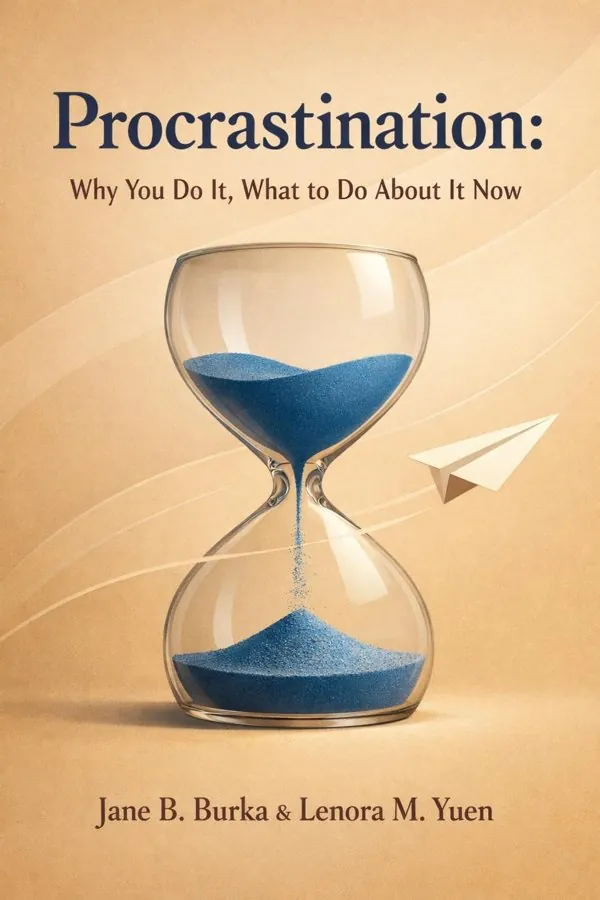
Procrastination: Why You Do It, What to Do About It Now: Summary & Key Insights
by Jane B. Burka, Lenora M. Yuen
 10 min9 chaptersAudio available
Key Takeaways from Procrastination: Why You Do It, What to Do About It Now
Most procrastination is not a scheduling problem but a self-protection strategy.
The trap of procrastination is that it works—at least for a moment.
Not all procrastinators avoid for the same reason, and the book is especially helpful in showing that procrastination has different psychological flavors.
One of the book’s most powerful ideas is that procrastination often protects a fragile sense of self-worth.
Procrastination is fueled not only by emotion but by interpretation.
What Is Procrastination: Why You Do It, What to Do About It Now About?
Procrastination: Why You Do It, What to Do About It Now by Jane B. Burka, Lenora M. Yuen is a psychology book spanning 9 pages. Why do intelligent, capable people delay the very tasks they know matter most? In Procrastination: Why You Do It, What to Do About It Now, psychologists Jane B. Burka and Lenora M. Yuen argue that procrastination is rarely about poor time management or simple laziness. At its core, it is an emotional and psychological struggle tied to fear, self-worth, perfectionism, and the pressure of expectations. Their book helps readers look beneath the surface of avoidance and understand why starting can feel so threatening, even when the consequences of delay are obvious. What makes this book enduringly valuable is its blend of compassion and practicality. Burka and Yuen draw on decades of clinical work, workshops, and research to show how procrastination becomes a protective habit—one that shields us from discomfort in the short term while creating bigger problems over time. They explore the hidden beliefs and emotional patterns that fuel delay, then offer realistic cognitive and behavioral strategies for changing them. The result is a deeply humane guide for students, professionals, creatives, and anyone who has ever wondered why they keep getting in their own way.
This FizzRead summary covers all 9 key chapters of Procrastination: Why You Do It, What to Do About It Now in approximately 10 minutes, distilling the most important ideas, arguments, and takeaways from Jane B. Burka, Lenora M. Yuen's work. Also available as an audio summary and Key Quotes Podcast.
Procrastination: Why You Do It, What to Do About It Now
Why do intelligent, capable people delay the very tasks they know matter most? In Procrastination: Why You Do It, What to Do About It Now, psychologists Jane B. Burka and Lenora M. Yuen argue that procrastination is rarely about poor time management or simple laziness. At its core, it is an emotional and psychological struggle tied to fear, self-worth, perfectionism, and the pressure of expectations. Their book helps readers look beneath the surface of avoidance and understand why starting can feel so threatening, even when the consequences of delay are obvious.
What makes this book enduringly valuable is its blend of compassion and practicality. Burka and Yuen draw on decades of clinical work, workshops, and research to show how procrastination becomes a protective habit—one that shields us from discomfort in the short term while creating bigger problems over time. They explore the hidden beliefs and emotional patterns that fuel delay, then offer realistic cognitive and behavioral strategies for changing them. The result is a deeply humane guide for students, professionals, creatives, and anyone who has ever wondered why they keep getting in their own way.
Who Should Read Procrastination: Why You Do It, What to Do About It Now?
This book is perfect for anyone interested in psychology and looking to gain actionable insights in a short read. Whether you're a student, professional, or lifelong learner, the key ideas from Procrastination: Why You Do It, What to Do About It Now by Jane B. Burka, Lenora M. Yuen will help you think differently.
- ✓Readers who enjoy psychology and want practical takeaways
- ✓Professionals looking to apply new ideas to their work and life
- ✓Anyone who wants the core insights of Procrastination: Why You Do It, What to Do About It Now in just 10 minutes
Want the full summary?
Get instant access to this book summary and 100K+ more with Fizz Moment.
Get Free SummaryAvailable on App Store • Free to download
Key Chapters
The trap of procrastination is that it works—at least for a moment. When you avoid a difficult task, anxiety drops immediately. That temporary relief teaches your brain that delay is rewarding, even though the task still remains. Burka and Yuen explain that procrastination is sustained by this emotional loop: anxiety about the task leads to avoidance, avoidance brings short-term relief, relief is followed by guilt and self-criticism, and guilt then makes the task feel even heavier the next time.
This cycle helps explain why procrastinators often feel exhausted without having done much. They are not resting; they are carrying a background burden of unfinished obligations. The mind keeps returning to what has not been done, producing mental clutter and chronic tension. A person may spend an entire weekend “taking a break” while feeling increasingly panicked about a report due Monday. By Sunday night, they are more drained than if they had spent an hour starting on Friday.
The authors urge readers to recognize that procrastination is emotionally expensive. The cost is not only missed deadlines but also lost peace of mind, reduced confidence, and a fractured relationship with work. Breaking the pattern requires interrupting the reward structure. Instead of waiting for motivation, commit to tiny starts that reduce dread without triggering overwhelm.
For example, open the document, write one bad paragraph, sort one bill, or spend ten minutes outlining. The goal is not brilliance; it is breaking the emotional spell of avoidance. Actionable takeaway: when you notice yourself delaying, focus on reducing task-entry friction with a five- or ten-minute start rather than waiting to feel ready.
Not all procrastinators avoid for the same reason, and the book is especially helpful in showing that procrastination has different psychological flavors. Some people are perfectionists who delay because nothing feels good enough. Others are dreamers who enjoy imagining success more than enduring the imperfect process of execution. Some are worriers, paralyzed by possible mistakes, while others are crisis-makers who rely on deadline pressure to generate adrenaline and focus. Still others feel defiant, using delay as an unconscious rebellion against demands they experience as controlling.
Understanding your style matters because the wrong solution can make things worse. Telling a perfectionist to “just work harder” may intensify their fear. Advising a rebel to become more disciplined may trigger even more resistance. A crisis-maker may misinterpret panic-fueled productivity as proof that they work best under pressure, while ignoring the damage to health, quality, and relationships.
Burka and Yuen encourage self-observation rather than self-condemnation. Notice what you say to yourself when a task appears. Do you think, “I have to do this flawlessly”? “I still have plenty of time”? “No one can make me”? “I’ll do it when I feel inspired”? These internal scripts reveal the emotional logic behind delay.
Once you identify your pattern, you can match the intervention to the problem. Perfectionists need permission to do mediocre first drafts. Worriers need evidence that mistakes are survivable. Crisis-makers need earlier checkpoints. Defiant procrastinators need a sense of choice and ownership. Actionable takeaway: identify your dominant procrastination style and design one strategy that addresses its specific emotional trigger rather than using generic productivity advice.
One of the book’s most powerful ideas is that procrastination often protects a fragile sense of self-worth. If you unconsciously believe that your value depends on how well you perform, every task becomes a test of identity. A paper is no longer just a paper; it is proof of whether you are smart. A job application is evidence of whether you are worthy. A conversation is a test of whether you are likable. Under those conditions, delay becomes understandable. Avoiding the task means postponing judgment.
Burka and Yuen describe how many procrastinators grew up with mixed messages: high expectations, praise tied to achievement, criticism that felt personal, or emotional environments where success and love became linked. As adults, they may appear capable while privately feeling that any imperfection exposes inadequacy. This creates an unstable inner life. Success may bring relief, but not security, because the next task becomes the next test.
A healthier approach separates who you are from what you do. Competence can rise and fall. Performance can be improved. But neither defines your basic worth. This shift is not sentimental; it is practical. People work more steadily when mistakes are information rather than verdicts.
Imagine a manager preparing for a difficult meeting. If they believe a poor performance means they are incompetent, they may overprepare, freeze, or postpone. If they believe it is simply a skill challenge, they can prepare, learn, and adapt. The same task becomes less threatening.
Actionable takeaway: when facing a delayed task, finish the sentence “If this goes badly, it means I am…” Then challenge that identity statement and replace it with a skill-based interpretation.
Procrastination is fueled not only by emotion but by interpretation. Burka and Yuen show that the thoughts surrounding a task often make it feel unbearable: “I must do this perfectly.” “I should already know how.” “If I start, I have to finish everything.” “There’s no point unless I can do it brilliantly.” These beliefs create pressure, inflate the size of the task, and make beginning feel dangerous. Cognitive change means learning to catch these distortions and replace them with more accurate, workable thoughts.
This does not mean repeating empty affirmations. It means testing the assumptions that keep you stuck. If you think, “I have to be in the right mood,” ask whether that has actually helped you in the past. If you think, “This will take forever,” estimate the first step rather than the whole project. If you think, “A rough start means I’m bad at this,” remind yourself that all complex work begins awkwardly.
The authors encourage language shifts that reduce internal pressure. “I have to” becomes “I choose to” or “It would help me if.” “Finish the report” becomes “Draft the opening section.” “Do it perfectly” becomes “Do a workable first version.” Such reframing restores agency and shrinks emotional resistance.
For example, someone avoiding exercise might tell themselves, “I need to get back in shape.” That broad and shame-laden goal can be reframed as, “I’m taking a ten-minute walk today to rebuild consistency.” The new thought invites action rather than perfection.
Actionable takeaway: write down the thought that appears right before you procrastinate, then rewrite it in a way that is specific, realistic, and choice-based.
A major contribution of the book is its insistence that action often comes before motivation, not after it. Procrastinators commonly believe they need confidence, clarity, energy, or inspiration before they can begin. Burka and Yuen challenge this assumption by showing that momentum is usually built through behavior. You do not wait to feel different and then act; you act in small, manageable ways and feelings gradually follow.
Behavioral strategies matter because they reduce the abstract dread that surrounds avoided tasks. Large projects should be broken into visible, concrete steps. Deadlines should be translated into interim milestones. Time should be planned realistically, with awareness of how long tasks actually take rather than how long you hope they will take. The authors also stress the value of structure: designated work periods, environmental cues, accountability, and routines that make starting easier.
Practical examples are straightforward but powerful. A student working on a thesis might set a daily goal of thirty minutes of source review rather than “work on thesis.” A homeowner overwhelmed by finances might sort bills into categories before attempting a full budget. A writer might commit to 300 words a day instead of waiting for a free weekend and a perfect idea.
These methods may seem modest, but they are effective because they lower emotional resistance while creating evidence of capability. Each completed step weakens the identity of “someone who can’t get started.”
Actionable takeaway: choose one avoided project and reduce it to the smallest visible next action, then schedule that action at a specific time within the next 24 hours.
Many people assume the answer to procrastination is stronger willpower. Burka and Yuen argue instead that emotional regulation is often the missing skill. If tasks trigger shame, fear, boredom, resentment, or overwhelm, then productivity depends partly on the ability to tolerate uncomfortable feelings without escaping into avoidance. In this sense, overcoming procrastination is less about becoming harsher with yourself and more about becoming steadier in the presence of discomfort.
The authors encourage self-acceptance as a practical tool, not a soft indulgence. Harsh self-criticism tends to deepen paralysis because it makes the task emotionally louder. A kinder response—“This is hard for me, but I can do one part of it”—reduces threat and preserves energy. Techniques like pausing before reacting, taking a breath, noticing bodily tension, or labeling an emotion can create enough distance to choose action rather than retreat.
Consider someone postponing a difficult phone call. The problem may not be the call itself but the wave of anticipatory discomfort it brings. If they can say, “I’m feeling anxious and exposed right now, but I can handle two minutes of discomfort,” the task becomes more manageable. Emotional naming often lowers intensity because it transforms a vague state into something recognizable.
The book also highlights the importance of realistic expectations. You do not need to feel calm, enthusiastic, or confident in order to begin. You only need to be willing to start while imperfectly regulated.
Actionable takeaway: the next time you procrastinate, pause and identify the exact emotion present—fear, shame, resentment, boredom, or overwhelm—then choose one small action while allowing that emotion to remain in the background.
Procrastination is often treated as a private habit, but Burka and Yuen show that it is deeply relational. Delays can strain marriages, friendships, workplaces, and family systems. A missed deadline may burden coworkers. Avoided decisions may frustrate partners. Unpaid bills or postponed repairs can create conflict at home. At the same time, relationships themselves can fuel procrastination through pressure, dependency, fear of disapproval, or subtle power struggles.
Some people procrastinate because tasks are entangled with other people’s expectations. If an assignment feels imposed, delay may serve as a hidden form of resistance: “You can’t make me.” Others rely on more organized partners to rescue them, which preserves avoidance while creating resentment on both sides. In families, procrastination may also become part of an identity role—the irresponsible one, the pressured achiever, the competent rescuer—that keeps old dynamics alive.
The authors encourage readers to examine how interpersonal patterns reinforce delay. Are you postponing because you fear disappointing someone? Because you resent being controlled? Because someone else will step in if you do nothing? Awareness creates the possibility of more direct behavior: setting boundaries, asking for help clearly, negotiating expectations, or taking ownership instead of waiting for rescue.
For example, instead of vaguely promising a partner that you will “handle it later,” you can agree on a specific deadline and a concrete task. Instead of silently resisting a supervisor’s request, you can discuss priorities and workload openly. Better communication reduces the emotional charge that drives avoidance.
Actionable takeaway: identify one recurring procrastination issue that involves another person and replace implicit tension with an explicit conversation about expectations, roles, or timing.
The deepest lesson of the book is that overcoming procrastination is not a one-time productivity fix but a long-term psychological shift. Burka and Yuen do not promise a life free of avoidance. Instead, they help readers build a new relationship with work, time, and self-evaluation. Sustainable change happens when you stop seeing yourself as a hopeless procrastinator and start becoming someone who can notice resistance, understand it, and act anyway.
This identity shift is built through repeated experiences, not dramatic breakthroughs. Each time you begin before you feel ready, tolerate imperfection, recover from a lapse without self-attack, or complete a small commitment, you create new evidence about who you are. The process is gradual and uneven. Relapses are normal, especially during stress or transition. What matters is learning to return more quickly, with less shame and more skill.
The authors emphasize that progress requires patience. Years of avoidance are rarely undone by a single planner, app, or burst of motivation. Change becomes real when insight and behavior reinforce each other: you understand your fears, challenge your assumptions, build supportive structures, and practice self-respect while doing difficult things.
This long view is liberating because it replaces the fantasy of total transformation with the discipline of steady improvement. A person who once delayed every major task may still feel resistance, but they no longer obey it automatically. That is real freedom.
Actionable takeaway: define success not as “never procrastinating again” but as “starting sooner, recovering faster, and treating myself more constructively when I slip.”
All Chapters in Procrastination: Why You Do It, What to Do About It Now
About the Authors
Jane B. Burka and Lenora M. Yuen are psychologists, educators, and longtime specialists in the study of procrastination. Through clinical practice, workshops, and public speaking, they have spent decades helping people understand the emotional and psychological dynamics behind chronic delay. Their work has been especially influential in showing that procrastination is not simply laziness or poor time management, but often a response to fear, perfectionism, self-doubt, and pressure tied to performance. By combining psychological insight with practical tools, they helped bring a more compassionate and effective approach to the topic. Their book remains a widely recommended resource for readers seeking both a deeper explanation of procrastination and realistic strategies for lasting change.
Get This Summary in Your Preferred Format
Read or listen to the Procrastination: Why You Do It, What to Do About It Now summary by Jane B. Burka, Lenora M. Yuen anytime, anywhere. FizzRead offers multiple formats so you can learn on your terms — all free.
Available formats: App · Audio · PDF · EPUB — All included free with FizzRead
Download Procrastination: Why You Do It, What to Do About It Now PDF and EPUB Summary
Key Quotes from Procrastination: Why You Do It, What to Do About It Now
“Most procrastination is not a scheduling problem but a self-protection strategy.”
“The trap of procrastination is that it works—at least for a moment.”
“Not all procrastinators avoid for the same reason, and the book is especially helpful in showing that procrastination has different psychological flavors.”
“One of the book’s most powerful ideas is that procrastination often protects a fragile sense of self-worth.”
“Procrastination is fueled not only by emotion but by interpretation.”
Frequently Asked Questions about Procrastination: Why You Do It, What to Do About It Now
Procrastination: Why You Do It, What to Do About It Now by Jane B. Burka, Lenora M. Yuen is a psychology book that explores key ideas across 9 chapters. Why do intelligent, capable people delay the very tasks they know matter most? In Procrastination: Why You Do It, What to Do About It Now, psychologists Jane B. Burka and Lenora M. Yuen argue that procrastination is rarely about poor time management or simple laziness. At its core, it is an emotional and psychological struggle tied to fear, self-worth, perfectionism, and the pressure of expectations. Their book helps readers look beneath the surface of avoidance and understand why starting can feel so threatening, even when the consequences of delay are obvious. What makes this book enduringly valuable is its blend of compassion and practicality. Burka and Yuen draw on decades of clinical work, workshops, and research to show how procrastination becomes a protective habit—one that shields us from discomfort in the short term while creating bigger problems over time. They explore the hidden beliefs and emotional patterns that fuel delay, then offer realistic cognitive and behavioral strategies for changing them. The result is a deeply humane guide for students, professionals, creatives, and anyone who has ever wondered why they keep getting in their own way.
You Might Also Like
The Body Keeps the Score
Bessel van der Kolk
10 min
Surrounded by Idiots
Thomas Erikson
10 min
Emotional Intelligence
Daniel Goleman
10 min
Attached
Amir Levine
10 min
Why Does He Do That
Lundy Bancroft
10 min
Women Who Run with the Wolves
Clarissa Pinkola Estés
10 minBrowse by Category
Ready to read Procrastination: Why You Do It, What to Do About It Now?
Get the full summary and 100K+ more books with Fizz Moment.