
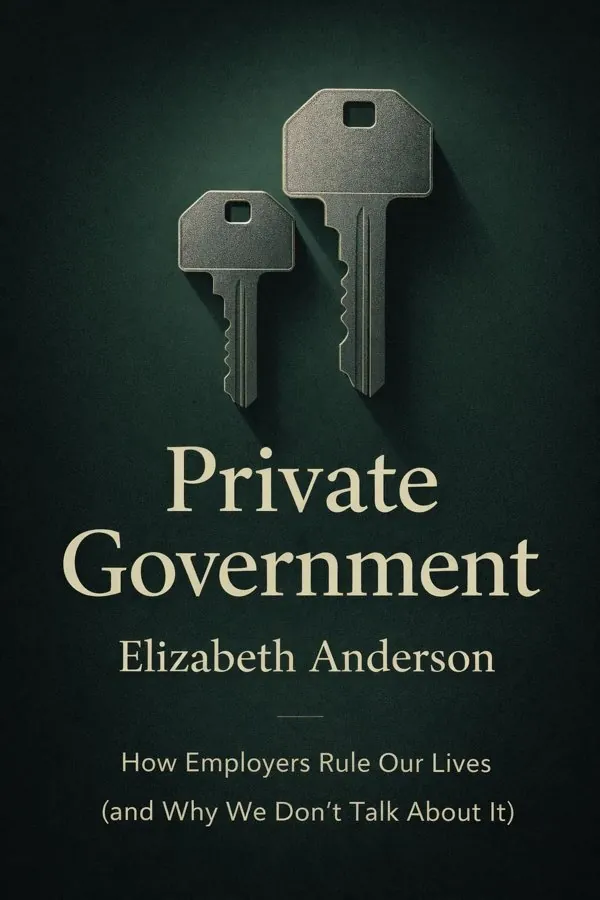
Private Government: How Employers Rule Our Lives (and Why We Don’t Talk About It): Summary & Key Insights
 10 min9 chaptersAudio available
What Is Private Government: How Employers Rule Our Lives (and Why We Don’t Talk About It) About?
Private Government: How Employers Rule Our Lives (and Why We Don’t Talk About It) by Elizabeth Anderson is a politics book spanning 9 pages. In this influential work, philosopher Elizabeth Anderson explores the concept of 'private government'—the idea that employers exercise a form of governance over workers that is often hidden from public scrutiny. She argues that the workplace functions as a private government where employees are subject to arbitrary authority, challenging the assumption that free markets guarantee freedom. The book calls for renewed democratic debate about the moral and political dimensions of work and economic life.
This FizzRead summary covers all 9 key chapters of Private Government: How Employers Rule Our Lives (and Why We Don’t Talk About It) in approximately 10 minutes, distilling the most important ideas, arguments, and takeaways from Elizabeth Anderson's work. Also available as an audio summary and Key Quotes Podcast.
Private Government: How Employers Rule Our Lives (and Why We Don’t Talk About It)
In this influential work, philosopher Elizabeth Anderson explores the concept of 'private government'—the idea that employers exercise a form of governance over workers that is often hidden from public scrutiny. She argues that the workplace functions as a private government where employees are subject to arbitrary authority, challenging the assumption that free markets guarantee freedom. The book calls for renewed democratic debate about the moral and political dimensions of work and economic life.
Who Should Read Private Government: How Employers Rule Our Lives (and Why We Don’t Talk About It)?
This book is perfect for anyone interested in politics and looking to gain actionable insights in a short read. Whether you're a student, professional, or lifelong learner, the key ideas from Private Government: How Employers Rule Our Lives (and Why We Don’t Talk About It) by Elizabeth Anderson will help you think differently.
- ✓Readers who enjoy politics and want practical takeaways
- ✓Professionals looking to apply new ideas to their work and life
- ✓Anyone who wants the core insights of Private Government: How Employers Rule Our Lives (and Why We Don’t Talk About It) in just 10 minutes
Want the full summary?
Get instant access to this book summary and 100K+ more with Fizz Moment.
Get Free SummaryAvailable on App Store • Free to download
Key Chapters
Let me begin with history, for the roots of today’s workplace governments lie in the shift of meaning that accompanied liberal thought over the past three centuries. Early liberals like Adam Smith and Thomas Paine understood economic freedom as a condition of independence. The free worker was someone who owned their own tools, controlled their own labor, and answered to no master. In Smith’s time, the social ideal of the masterless man stood at the center of liberty. Yet by the nineteenth century, with the Industrial Revolution and the proliferation of wage labor, this meaning changed. Freedom came to be equated with the mere ability to choose among employers – not with autonomy once employed.
This historical shift marks the decline of what I call republican equality in economic life. In classical republican thought, freedom meant not being subject to arbitrary power. But as economic relations became increasingly mediated by contracts, liberal theorists began treating all voluntary exchanges as inherently free, regardless of the power imbalances they created. Once one signed away their right to independent labor, the resulting subordination was no longer viewed as political. Workplaces were seen as private entities — outside the realms of democracy or civic participation.
We inherited from that period the notion that the employer’s authority is fundamentally private, shielded from scrutiny. Yet in essence, employers govern: they issue rules, monitor compliance, enforce discipline, and sometimes dismiss dissenters. Recognizing this historical transition is critical because it reveals how our concept of freedom became narrow and depoliticized. What our ancestors fought to abolish — arbitrary mastery — returned dressed in a different garment, that of corporate management. Understanding this journey allows us to see why our economic arrangements feel natural and inevitable today, and why they continue reproducing inequality under the banner of choice.
With industrial capitalism came a transformation of work that redefined human relationships. The factory system concentrated workers under hierarchical control. The autonomy of artisans gave way to the regimented pace of wage labor. This evolution brought greater productivity, but at a moral and political cost. The new discipline of industry subordinated the individual not to the market directly, but to the employer. The promise of self-directed work was replaced by compliance with corporate rules.
For many, the rise of capitalism was accompanied by a rhetoric of liberation. The merchant replaced the lord, the contract replaced the command. But the lived reality often contradicted the ideal. Within factories and offices, employees followed detailed commands governing their behavior, speech, and even beliefs. Loyalty departments monitored political expressions. Some employers dictated what workers could say on social media, whom they could date, or whether they could campaign for certain causes. This authority reaches far beyond production itself.
In tracing this evolution, I have argued that the workplace became a microcosm of governance without accountability. An employer can fire workers for reasons unrelated to performance — for their opinions, their gender identity, or their domestic choices. In political theory, such power would be considered tyrannical. Yet in the private sphere, it is normalized. Industrial capitalism thus did not deliver equal citizenship; it merely relocated the old hierarchies. Freedom exited the gates of the factory and entered only the realm of consumption, where choice meant little compared to subjection endured at work.
Recognizing this historical process helps us see that the problem is not merely economic inequality but political inequality within the structures of production. The market, far from guaranteeing autonomy, enabled new modes of domination that became invisible under the name of private enterprise.
+ 7 more chapters — available in the FizzRead app
All Chapters in Private Government: How Employers Rule Our Lives (and Why We Don’t Talk About It)
About the Author
Elizabeth Anderson is an American philosopher and professor at the University of Michigan. Her research focuses on moral and political philosophy, feminist theory, and social epistemology. She is known for her work on equality, ethics, and the philosophy of economics.
Get This Summary in Your Preferred Format
Read or listen to the Private Government: How Employers Rule Our Lives (and Why We Don’t Talk About It) summary by Elizabeth Anderson anytime, anywhere. FizzRead offers multiple formats so you can learn on your terms — all free.
Available formats: App · Audio · PDF · EPUB — All included free with FizzRead
Download Private Government: How Employers Rule Our Lives (and Why We Don’t Talk About It) PDF and EPUB Summary
Key Quotes from Private Government: How Employers Rule Our Lives (and Why We Don’t Talk About It)
“Let me begin with history, for the roots of today’s workplace governments lie in the shift of meaning that accompanied liberal thought over the past three centuries.”
“With industrial capitalism came a transformation of work that redefined human relationships.”
Frequently Asked Questions about Private Government: How Employers Rule Our Lives (and Why We Don’t Talk About It)
Private Government: How Employers Rule Our Lives (and Why We Don’t Talk About It) by Elizabeth Anderson is a politics book that explores key ideas across 9 chapters. In this influential work, philosopher Elizabeth Anderson explores the concept of 'private government'—the idea that employers exercise a form of governance over workers that is often hidden from public scrutiny. She argues that the workplace functions as a private government where employees are subject to arbitrary authority, challenging the assumption that free markets guarantee freedom. The book calls for renewed democratic debate about the moral and political dimensions of work and economic life.
You Might Also Like
Antifa: The Anti-Fascist Handbook
Mark Bray
10 min
Attack from Within: How Disinformation Is Sabotaging America
Barbara McQuade
10 min
Coercion, Capital, and European States, AD 990–1992
Charles Tilly
10 min
Digital Democracy: Concepts, Methodologies, Tools, and Applications
Various Authors
10 min
Fascism
Stanley G. Payne
10 min
Fire And Fury: Inside The Trump White House
Michael Wolff
10 minBrowse by Category
Ready to read Private Government: How Employers Rule Our Lives (and Why We Don’t Talk About It)?
Get the full summary and 100K+ more books with Fizz Moment.