
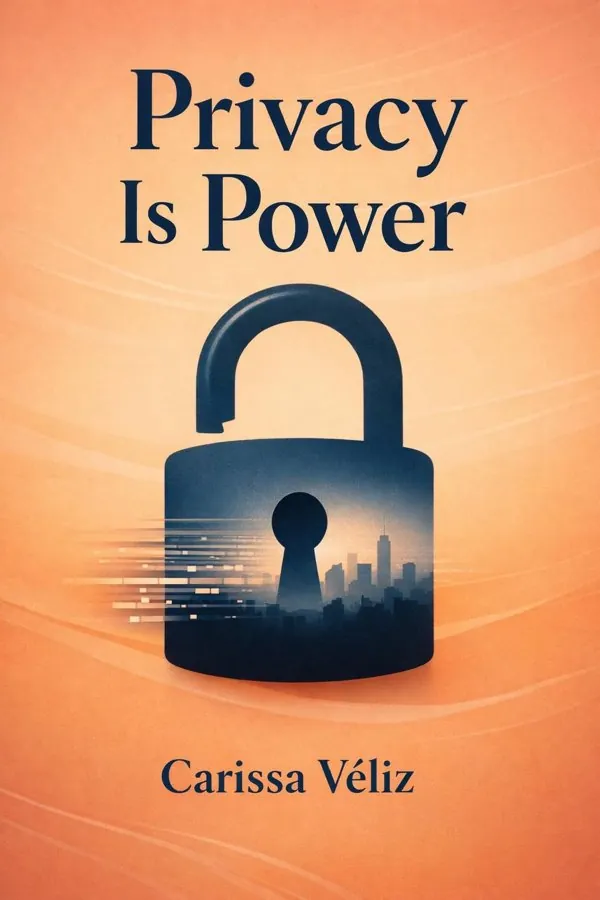
Privacy Is Power: Why and How You Should Take Back Control of Your Data: Summary & Key Insights
 10 min6 chaptersAudio available
What Is Privacy Is Power: Why and How You Should Take Back Control of Your Data About?
Privacy Is Power: Why and How You Should Take Back Control of Your Data by Carissa Véliz is a ethics book spanning 6 pages. In this thought-provoking book, philosopher Carissa Véliz argues that privacy is not just a personal right but a collective good essential to democracy and freedom. She explores how the data economy exploits personal information, the ethical implications of surveillance capitalism, and offers practical steps for individuals and policymakers to reclaim control over digital privacy.
This FizzRead summary covers all 6 key chapters of Privacy Is Power: Why and How You Should Take Back Control of Your Data in approximately 10 minutes, distilling the most important ideas, arguments, and takeaways from Carissa Véliz's work. Also available as an audio summary and Key Quotes Podcast.
Privacy Is Power: Why and How You Should Take Back Control of Your Data
In this thought-provoking book, philosopher Carissa Véliz argues that privacy is not just a personal right but a collective good essential to democracy and freedom. She explores how the data economy exploits personal information, the ethical implications of surveillance capitalism, and offers practical steps for individuals and policymakers to reclaim control over digital privacy.
Who Should Read Privacy Is Power: Why and How You Should Take Back Control of Your Data?
This book is perfect for anyone interested in ethics and looking to gain actionable insights in a short read. Whether you're a student, professional, or lifelong learner, the key ideas from Privacy Is Power: Why and How You Should Take Back Control of Your Data by Carissa Véliz will help you think differently.
- ✓Readers who enjoy ethics and want practical takeaways
- ✓Professionals looking to apply new ideas to their work and life
- ✓Anyone who wants the core insights of Privacy Is Power: Why and How You Should Take Back Control of Your Data in just 10 minutes
Want the full summary?
Get instant access to this book summary and 100K+ more with Fizz Moment.
Get Free SummaryAvailable on App Store • Free to download
Key Chapters
In the early days of the internet, data collection was a minor aspect of innovation — a way to improve products and services. Today, it has become the beating heart of the global economy. Your search queries, fitness metrics, facial expressions, and even pauses while typing are turned into data points traded for profit. In *Privacy Is Power*, I describe this transformation as a shift from an economy of goods to an economy of attention and surveillance. What makes the data economy so insidious is its invisibility: collection happens silently, behind interfaces designed to feel neutral and harmless.
Companies justify this process as a form of personalization. They tell you it’s about convenience — better recommendations, easier navigation, smarter tools — but beneath the rhetoric lies an extractive model reminiscent of colonial resource plunder. Except, instead of minerals or land, the exploited resource is our digital selves. Data brokers, the hidden intermediaries, traffic in enormous amounts of personal data, most of which we never knowingly consented to share. Governments join in, leveraging the same infrastructure for surveillance in the name of security.
The result is a system where privacy becomes a luxury and opacity becomes a privilege. The asymmetry is staggering: a small number of corporations know everything about billions of people, while users know remarkably little about how that data is mined, categorized, and commodified. This lack of transparency does not occur by accident — it is designed. The more obscure the process, the more compliant the user becomes.
From my perspective as a philosopher, this economic structure violates one of the core principles of morality: respect for persons as ends in themselves, not merely as means to profit. The data economy treats individuals not as citizens but as datasets, reducing identity to behavioral patterns ripe for monetization. To resist this commodification, we must first see it for what it is — a radical inversion of democratic values. Privacy cannot survive in an economy that rewards intrusion. Changing the system requires rethinking the incentives that make data exploitation profitable in the first place.
You are told you have control over your data. You see the word “consent” at every turn — in user agreements, cookie banners, app permissions. But this consent is an illusion, a legal fiction propped up by design and psychology. Most consent forms are crafted to be unreadable, labyrinthine documents of corporate self-protection. They exploit what I describe as ‘consent fatigue’: our inability to process the volume of decisions demanded of us online. In practice, consent becomes coerced compliance.
The design of these interfaces is not neutral. Every button, color, and phrase is engineered to nudge you toward yes. To refuse is often more difficult than to accept — a violation of autonomy masked as choice. This means that when we think we are exercising free will online, we are often submitting to carefully calculated manipulation. Digital platforms have mastered the art of behavioral micro-sculpting, tweaking the environment so that our choices conform to their profit models.
In *Privacy Is Power*, I argue that genuine consent requires understanding, voluntariness, and fairness — qualities absent in the digital status quo. Without these, what passes for consent is an abdication of responsibility by those in power. When the system is built to maximize data extraction, consent cannot be meaningful. This realization should shift our moral frame: it is not enough to “read the fine print”; the system itself must be redesigned to align with human values.
When I speak of taking back control, I do not mean it as a slogan but as an ethical demand. True empowerment comes from reducing the situations where consent is exploited, not from multiplying deceptive choices. We need laws that default to privacy, platforms that minimize data collection, and a cultural shift that treats privacy as non-negotiable — not as an optional preference but as an expression of respect.
+ 4 more chapters — available in the FizzRead app
All Chapters in Privacy Is Power: Why and How You Should Take Back Control of Your Data
About the Author
Carissa Véliz is an associate professor of philosophy at the University of Oxford and a fellow at Hertford College. Her research focuses on digital ethics, privacy, and the moral implications of artificial intelligence and data technology.
Get This Summary in Your Preferred Format
Read or listen to the Privacy Is Power: Why and How You Should Take Back Control of Your Data summary by Carissa Véliz anytime, anywhere. FizzRead offers multiple formats so you can learn on your terms — all free.
Available formats: App · Audio · PDF · EPUB — All included free with FizzRead
Download Privacy Is Power: Why and How You Should Take Back Control of Your Data PDF and EPUB Summary
Key Quotes from Privacy Is Power: Why and How You Should Take Back Control of Your Data
“In the early days of the internet, data collection was a minor aspect of innovation — a way to improve products and services.”
“You are told you have control over your data.”
Frequently Asked Questions about Privacy Is Power: Why and How You Should Take Back Control of Your Data
Privacy Is Power: Why and How You Should Take Back Control of Your Data by Carissa Véliz is a ethics book that explores key ideas across 6 chapters. In this thought-provoking book, philosopher Carissa Véliz argues that privacy is not just a personal right but a collective good essential to democracy and freedom. She explores how the data economy exploits personal information, the ethical implications of surveillance capitalism, and offers practical steps for individuals and policymakers to reclaim control over digital privacy.
You Might Also Like

What We Owe the Future
William MacAskill
10 min
Abortion
David Boonin
10 min
Blind Spots: Why We Fail to Do What's Right and What to Do About It
Max H. Bazerman, Ann E. Tenbrunsel
10 min
Digital Ethics: Research and Practice
Christopher Burr, Luciano Floridi (Editors)
10 min
Doing Good Better: Effective Altruism and a Radical New Way to Make a Difference
William MacAskill
10 min
Eating Animals
Jonathan Safran Foer
10 minBrowse by Category
Ready to read Privacy Is Power: Why and How You Should Take Back Control of Your Data?
Get the full summary and 100K+ more books with Fizz Moment.