
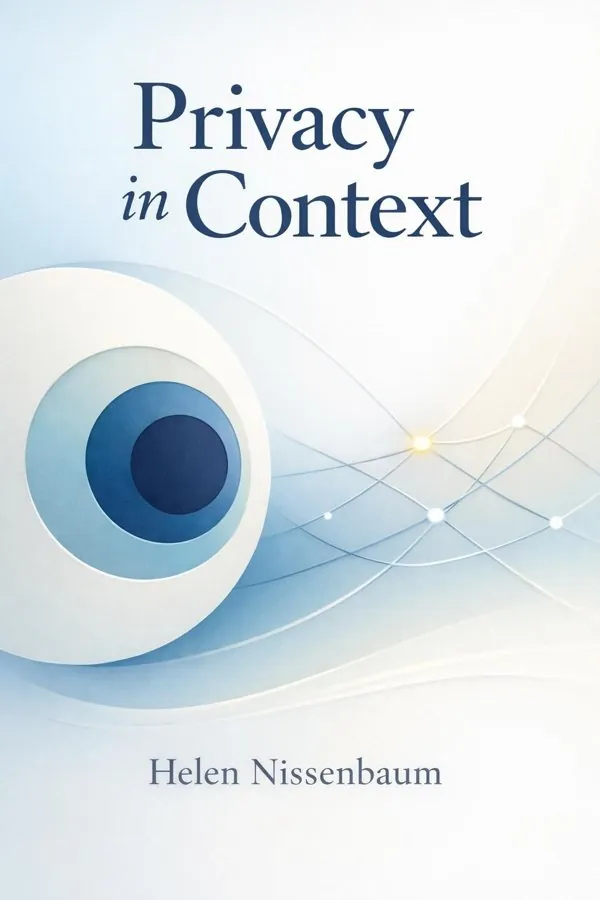
Privacy in Context: Technology, Policy, and the Integrity of Social Life: Summary & Key Insights
 10 min10 chaptersAudio available
What Is Privacy in Context: Technology, Policy, and the Integrity of Social Life About?
Privacy in Context: Technology, Policy, and the Integrity of Social Life by Helen Nissenbaum is a ethics book spanning 10 pages. Este libro examina cómo la privacidad debe entenderse en relación con los contextos sociales y las normas que los rigen. Nissenbaum propone el concepto de 'integridad contextual' como marco para evaluar las prácticas de información en la era digital, argumentando que la privacidad no se trata de ocultar información, sino de respetar las expectativas sociales sobre su flujo y uso.
This FizzRead summary covers all 10 key chapters of Privacy in Context: Technology, Policy, and the Integrity of Social Life in approximately 10 minutes, distilling the most important ideas, arguments, and takeaways from Helen Nissenbaum's work. Also available as an audio summary and Key Quotes Podcast.
Privacy in Context: Technology, Policy, and the Integrity of Social Life
Este libro examina cómo la privacidad debe entenderse en relación con los contextos sociales y las normas que los rigen. Nissenbaum propone el concepto de 'integridad contextual' como marco para evaluar las prácticas de información en la era digital, argumentando que la privacidad no se trata de ocultar información, sino de respetar las expectativas sociales sobre su flujo y uso.
Who Should Read Privacy in Context: Technology, Policy, and the Integrity of Social Life?
This book is perfect for anyone interested in ethics and looking to gain actionable insights in a short read. Whether you're a student, professional, or lifelong learner, the key ideas from Privacy in Context: Technology, Policy, and the Integrity of Social Life by Helen Nissenbaum will help you think differently.
- ✓Readers who enjoy ethics and want practical takeaways
- ✓Professionals looking to apply new ideas to their work and life
- ✓Anyone who wants the core insights of Privacy in Context: Technology, Policy, and the Integrity of Social Life in just 10 minutes
Want the full summary?
Get instant access to this book summary and 100K+ more with Fizz Moment.
Get Free SummaryAvailable on App Store • Free to download
Key Chapters
To understand what privacy means today, we must first examine what it has meant through history. The liberal tradition, inspired by John Stuart Mill and the early formulation by Warren and Brandeis, cast privacy as *the right to be let alone*. This perspective made sense in an era when threats came from journalists with cameras or neighbors prying through windows. Privacy was a shield for the autonomous individual, protecting against unwanted intrusion.
Later frameworks, including utilitarian and rights-based theories, shaped the modern era of policy and law. Philosophers such as Judith Jarvis Thomson argued that privacy could be derived from other rights—property, personhood, or consent—while others insisted that privacy was a distinct good, necessary for dignity and autonomy. These debates gave privacy an aura of moral gravity, yet they never fully resolved what privacy is *for*.
In the digital environment, these abstractions buckle. Information does not remain local or bounded; it travels through systems of exchange, algorithmic inference, and institutional data sharing. Individual consent, once heralded as the guardian of autonomy, collapses under the weight of complexity. Traditional models cannot capture the relational and contextual character of privacy as it actually functions in everyday life.
What I draw from this genealogy is not that these theories are obsolete, but that they are incomplete. They emphasize the individual to the exclusion of the *social*. Privacy, after all, is not only about protecting selfhood; it is about maintaining the integrity of the contexts that sustain social trust. Communities rely on predictable norms of who may know what. That reliance is what gives meaning to institutions like doctor–patient confidentiality, teacher–student discretion, or journalist–source trust. Without recognizing these norms, we cannot understand why privacy matters beyond individual preference.
In contemporary policy and law, privacy has been captured by two dominant paradigms: the *secrecy/control* model and the *public/private* dichotomy. Both are inadequate. The first, secrecy/control, imagines that if a person willingly reveals information or fails to keep it secret, their privacy interest evaporates. The second divides the world into public and private spheres, assuming that once information enters the public realm, it is fair game.
These frameworks are deeply flawed. Consider online behavior: we routinely disclose data to obtain services, engage socially, or perform simple transactions. To interpret these disclosures as abandonment of privacy is to misread the complexity of our expectations. A patient filling out medical forms expects her data to circulate among doctors and insurers but not to marketers or employers. A student trusts her university to hold academic records for educational purposes, not for commercial profiling. We do not lose our privacy when we share information; we lose it when the *flow* of that information breaks the expectations embedded in a particular context.
Existing legal instruments struggle with this distinction. Data protection statutes, privacy notices, and consent frameworks rely on rigid definitions of personally identifiable information or assume uniform notions of harm. Yet the moral significance of a privacy breach often lies in the *mismatch* between the flow of information and the social norms of the context, not in the mere fact of disclosure.
This mismatch—between social reality and regulatory philosophy—is what I seek to correct. As digital infrastructures penetrate every domain, we need a model that can capture the contextual nature of information practices. Only then can privacy become more than a procedural checkbox; it can regain its ethical force.
+ 8 more chapters — available in the FizzRead app
All Chapters in Privacy in Context: Technology, Policy, and the Integrity of Social Life
About the Author
Helen Nissenbaum es profesora de medios, cultura y comunicación en la Universidad de Nueva York. Su trabajo se centra en la ética de la tecnología, la privacidad y la política de la información. Es reconocida por desarrollar el concepto de integridad contextual, influyente en debates sobre privacidad digital y diseño ético.
Get This Summary in Your Preferred Format
Read or listen to the Privacy in Context: Technology, Policy, and the Integrity of Social Life summary by Helen Nissenbaum anytime, anywhere. FizzRead offers multiple formats so you can learn on your terms — all free.
Available formats: App · Audio · PDF · EPUB — All included free with FizzRead
Download Privacy in Context: Technology, Policy, and the Integrity of Social Life PDF and EPUB Summary
Key Quotes from Privacy in Context: Technology, Policy, and the Integrity of Social Life
“To understand what privacy means today, we must first examine what it has meant through history.”
“In contemporary policy and law, privacy has been captured by two dominant paradigms: the *secrecy/control* model and the *public/private* dichotomy.”
Frequently Asked Questions about Privacy in Context: Technology, Policy, and the Integrity of Social Life
Privacy in Context: Technology, Policy, and the Integrity of Social Life by Helen Nissenbaum is a ethics book that explores key ideas across 10 chapters. Este libro examina cómo la privacidad debe entenderse en relación con los contextos sociales y las normas que los rigen. Nissenbaum propone el concepto de 'integridad contextual' como marco para evaluar las prácticas de información en la era digital, argumentando que la privacidad no se trata de ocultar información, sino de respetar las expectativas sociales sobre su flujo y uso.
You Might Also Like

What We Owe the Future
William MacAskill
10 min
Abortion
David Boonin
10 min
Blind Spots: Why We Fail to Do What's Right and What to Do About It
Max H. Bazerman, Ann E. Tenbrunsel
10 min
Digital Ethics: Research and Practice
Christopher Burr, Luciano Floridi (Editors)
10 min
Doing Good Better: Effective Altruism and a Radical New Way to Make a Difference
William MacAskill
10 min
Eating Animals
Jonathan Safran Foer
10 minBrowse by Category
Ready to read Privacy in Context: Technology, Policy, and the Integrity of Social Life?
Get the full summary and 100K+ more books with Fizz Moment.