
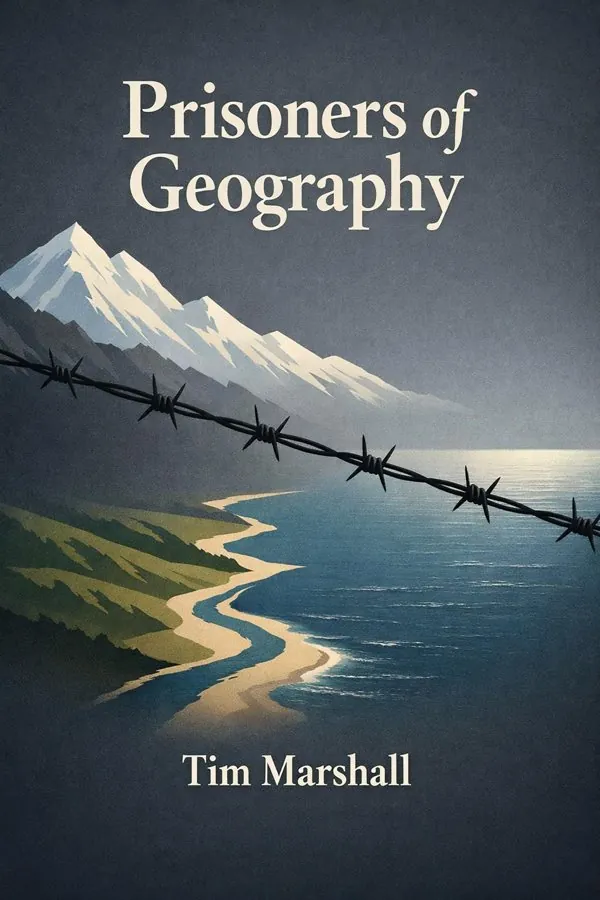
Prisoners of Geography: Ten Maps That Explain Everything About the World: Summary & Key Insights
by Tim Marshall
 10 min10 chaptersAudio available
Key Takeaways from Prisoners of Geography: Ten Maps That Explain Everything About the World
A country can possess enormous size and still feel dangerously exposed.
Great powers often look unified on a map, but China is better understood as a civilization held together by geography as much as by government.
Some countries struggle first for survival; the United States was unusually positioned to pursue expansion and wealth.
Western Europe’s political complexity is not an accident of culture alone; it is written into the land.
A map can become a source of instability when it reflects colonial convenience rather than geographic and human reality.
What Is Prisoners of Geography: Ten Maps That Explain Everything About the World About?
Prisoners of Geography: Ten Maps That Explain Everything About the World by Tim Marshall is a politics book spanning 10 pages. Why do some nations seem permanently anxious, expansionist, divided, or hard to conquer? In Prisoners of Geography, Tim Marshall argues that the answer often begins not with ideology or personality, but with the map. Mountains, rivers, deserts, plains, coastlines, and ice do not determine history entirely, but they set powerful limits on what leaders can do and what states feel they must do. Through ten regional case studies, Marshall shows how geography has shaped military strategy, economic development, political identity, and international conflict from Russia’s vulnerable flatlands to the contested sea lanes of East Asia and the emerging strategic value of the Arctic. What makes the book so compelling is its clarity. Marshall, a veteran British foreign affairs journalist who reported from conflict zones and covered global power politics for decades, translates geopolitics into vivid, accessible storytelling. He helps readers understand why borders are rarely arbitrary, why some rivalries endure, and why global events that seem sudden are often rooted in physical realities that have existed for centuries. The book matters because it gives readers a durable framework for interpreting world affairs beyond headlines, slogans, and temporary political drama.
This FizzRead summary covers all 10 key chapters of Prisoners of Geography: Ten Maps That Explain Everything About the World in approximately 10 minutes, distilling the most important ideas, arguments, and takeaways from Tim Marshall's work. Also available as an audio summary and Key Quotes Podcast.
Prisoners of Geography: Ten Maps That Explain Everything About the World
Why do some nations seem permanently anxious, expansionist, divided, or hard to conquer? In Prisoners of Geography, Tim Marshall argues that the answer often begins not with ideology or personality, but with the map. Mountains, rivers, deserts, plains, coastlines, and ice do not determine history entirely, but they set powerful limits on what leaders can do and what states feel they must do. Through ten regional case studies, Marshall shows how geography has shaped military strategy, economic development, political identity, and international conflict from Russia’s vulnerable flatlands to the contested sea lanes of East Asia and the emerging strategic value of the Arctic.
What makes the book so compelling is its clarity. Marshall, a veteran British foreign affairs journalist who reported from conflict zones and covered global power politics for decades, translates geopolitics into vivid, accessible storytelling. He helps readers understand why borders are rarely arbitrary, why some rivalries endure, and why global events that seem sudden are often rooted in physical realities that have existed for centuries. The book matters because it gives readers a durable framework for interpreting world affairs beyond headlines, slogans, and temporary political drama.
Who Should Read Prisoners of Geography: Ten Maps That Explain Everything About the World?
This book is perfect for anyone interested in politics and looking to gain actionable insights in a short read. Whether you're a student, professional, or lifelong learner, the key ideas from Prisoners of Geography: Ten Maps That Explain Everything About the World by Tim Marshall will help you think differently.
- ✓Readers who enjoy politics and want practical takeaways
- ✓Professionals looking to apply new ideas to their work and life
- ✓Anyone who wants the core insights of Prisoners of Geography: Ten Maps That Explain Everything About the World in just 10 minutes
Want the full summary?
Get instant access to this book summary and 100K+ more with Fizz Moment.
Get Free SummaryAvailable on App Store • Free to download
Key Chapters
A country can possess enormous size and still feel dangerously exposed. That is one of Tim Marshall’s central insights about Russia: its vast territory does not automatically create security because much of its western frontier lies across open plains with few natural barriers. Historically, invaders such as Napoleon and Hitler moved across this geography with devastating effect, reinforcing a deep Russian fear of encirclement. From the Kremlin’s perspective, buffer zones are not luxuries but necessities.
Marshall explains that Russia’s political instincts cannot be understood without this landscape. The lack of mountains or seas protecting its core population centers has encouraged the state to push outward whenever possible, seeking strategic depth in Eastern Europe, the Caucasus, and Central Asia. Geography also shapes Russia’s maritime ambitions. Much of its coastline is frozen or constrained, so access to warm-water ports has long been a strategic obsession. This helps explain Russian behavior in Crimea, the Black Sea, and beyond.
The book does not excuse Russian aggression, but it helps explain why Russia repeatedly acts as though survival depends on control of neighboring territory. This geographic mindset influences NATO relations, energy pipelines, military deployments, and the politics of former Soviet republics. Even domestic authoritarian tendencies can be connected partly to the demands of ruling a huge and vulnerable landmass from a centralized core.
A practical way to use this idea is to read Russian foreign policy through the lens of insecurity rather than simple ideology. When evaluating events in Ukraine, Belarus, or the Baltic region, ask: what strategic depth is Russia trying to preserve or regain? Actionable takeaway: before judging any Russian move, look at the terrain around it and identify the security gap Moscow believes it is trying to close.
Great powers often look unified on a map, but China is better understood as a civilization held together by geography as much as by government. Marshall shows that China’s historic core lies in its eastern river valleys and fertile plains, especially around the Yellow and Yangtze rivers, where agriculture, population, and state power concentrated. This productive heartland enabled imperial continuity and modern economic growth, but it also created a permanent challenge: securing the vast, difficult frontier regions surrounding it.
To the west and north, China faces deserts, high plateaus, and mountains; to the east, it meets the sea. Regions such as Tibet and Xinjiang are not merely distant provinces but strategic buffers between the Han core and external powers. Their terrain limits integration but increases military importance. Meanwhile, China’s coastline has been both gateway and vulnerability. Trade and development flowed through coastal cities, yet maritime exposure also invited foreign intervention in earlier centuries and now generates tensions in the South China Sea and around Taiwan.
Marshall’s framework helps explain why China pursues both internal consolidation and external projection. Infrastructure, surveillance, naval expansion, island-building, and Belt and Road investments are not random expressions of ambition; they are linked to the problem of securing access, supply routes, and vulnerable edges. Geography also contributes to China’s uneven development, with the prosperous east often pulling away from inland regions.
Readers can apply this insight by examining how domestic and foreign policy connect. For example, policies in Xinjiang, Tibet, Hong Kong, Taiwan, and the South China Sea all reflect concerns about cohesion, access, and control. Actionable takeaway: when following Chinese strategy, separate the fertile eastern core from the contested periphery and ask how Beijing is trying to bind the two together.
Some countries struggle first for survival; the United States was unusually positioned to pursue expansion and wealth. Marshall emphasizes that America’s geography is among the most favorable in the world. It enjoys vast stretches of arable land, a dense network of navigable rivers, abundant natural resources, and long coastlines protected by two major oceans. To the north and south sit relatively weaker neighbors, not great powers capable of sustained invasion. This combination gave the United States extraordinary internal cohesion and external security.
The river system, especially the Mississippi basin, helped connect inland producers to markets at low cost, accelerating economic growth and political integration. Fertile land supported large-scale agriculture, while coastal access opened trade routes to Europe and Asia. Because the homeland faced fewer existential threats than European or Asian states, the United States could focus on commerce, industry, and eventually global power projection. Over time, that geographic advantage encouraged a strategic culture of confidence: America came to expect security at home and influence abroad.
Marshall also shows that oceans are no longer perfect walls, but they remain major advantages. The United States can intervene globally while remaining hard to attack directly. This helps explain why it became a naval superpower and why freedom of navigation matters so much to Washington. It also clarifies why the U.S. can afford internal political turbulence that might destabilize more vulnerable countries.
A practical application is to understand current U.S. debates about trade, immigration, military alliances, and China not as signs of decline alone, but as arguments within a still exceptionally protected power. Actionable takeaway: when analyzing American policy, start by asking how geographic security gives the U.S. room to choose strategies that other nations cannot.
Western Europe’s political complexity is not an accident of culture alone; it is written into the land. Marshall points out that Europe has many navigable rivers, productive plains, and accessible coasts, which historically encouraged trade, urban growth, and interaction. At the same time, mountain ranges such as the Alps and Pyrenees, along with peninsulas and fragmented borders, helped produce separate political identities. Europe’s geography therefore created both connection and competition.
This duality helps explain why Europe generated prosperous states, frequent wars, and eventually ambitious projects of integration. Rivers like the Rhine linked economies across borders, while the North European Plain exposed countries such as France and Germany to repeated conflict. No single power could dominate the continent permanently without overextending itself, yet no state could ignore its neighbors. Geography pushed Europe toward a constant balancing act.
Marshall uses this map to illuminate the origins of the European Union as well as its limits. The EU is partly an attempt to tame geographic rivalry by turning old battlegrounds into shared economic space. Yet national differences persist because mountains, coastlines, energy routes, and migration paths still matter. Southern Europe faces different pressures than the north; eastern Europe worries more about Russia; island Britain historically developed a distinct strategic outlook from continental powers.
This idea is useful whenever European politics seem contradictory. Why can Europe be deeply integrated economically yet divided over defense, migration, or fiscal policy? Geography helps explain why common interests coexist with local pressures. Actionable takeaway: when reading European news, identify whether the issue is shaped more by Europe’s connecting features, like rivers and trade corridors, or by its dividing features, like mountains, frontiers, and differing exposure to threats.
A map can become a source of instability when it reflects colonial convenience rather than geographic and human reality. Marshall argues that Africa’s difficulties are not caused by geography alone, but geography has magnified the consequences of arbitrary borders, environmental constraints, and weak internal connectivity. Many African states were drawn by outside powers with little regard for ethnic groups, ecological zones, trade patterns, or defensible frontiers. The result was countries containing rival communities, awkward shapes, and long borders that were hard to govern.
Geography compounds the problem. Compared with Europe or North America, Africa has fewer navigable rivers that connect deep inland regions to global markets. Some rivers are interrupted by rapids or waterfalls, limiting transport. Deserts, tropical forests, and vast distances make integration expensive. In many places, people historically traded outward to coasts or across local zones rather than forming unified national economies. That legacy remains visible in infrastructure gaps, uneven state authority, and regional separatism.
Marshall’s point is not fatalistic. Africa has enormous resources, a young population, and growing cities. But durable progress often requires working with geographic realities rather than pretending inherited borders alone create functional states. Development strategies must account for transport corridors, water access, urban hubs, and cross-border economic cooperation. Security challenges in the Sahel, the Horn of Africa, and the Great Lakes region also make more sense when seen through terrain and state reach.
Readers can apply this by questioning simplistic narratives of governance failure. Ask how roads, rivers, climate, and colonial borders affect what governments can actually control. Actionable takeaway: to understand any African conflict or development issue, compare the political border with the physical and ethnic landscape beneath it.
In the Middle East, politics is never far from the realities of desert, water, and location. Marshall shows that the region’s instability is shaped not only by religion, ideology, and outside intervention, but also by the physical pressures of arid land, limited fresh water, strategic chokepoints, and artificial borders. In many states, the struggle for power is inseparable from the struggle to control scarce resources and vital routes.
Much of the region is desert, which concentrates populations near rivers, coasts, and a few viable urban centers. That concentration makes places like the Nile Valley, the Tigris-Euphrates basin, and the Jordan River system disproportionately important. Water scarcity affects agriculture, population growth, and interstate tension. Meanwhile, oil and gas reserves transformed some deserts into globally significant territory, drawing foreign powers deeply into regional politics. Control of passages such as the Suez Canal, the Strait of Hormuz, and the Bab el-Mandeb elevates the region’s importance even further.
Marshall also highlights how many borders were drawn with limited regard for local realities after the decline of empires. That has left states wrestling with internal fragmentation and legitimacy problems. Geography does not cause every war, but it creates the setting in which sectarian, tribal, and strategic rivalries become explosive.
This lens is practical for interpreting headlines about Syria, Iraq, Iran, Israel, Saudi Arabia, or Yemen. Instead of seeing each conflict as isolated, look for recurring geographic themes: water, trade routes, buffer zones, and vulnerable population centers. Actionable takeaway: when analyzing the Middle East, ask first which scarce resource or strategic corridor lies underneath the political argument.
In Northeast Asia, the sea protects, enriches, and endangers at the same time. Marshall groups Korea and Japan together to show how maritime geography shapes very different national experiences. Japan, as an island nation with limited natural resources, historically relied on the sea for trade, fishing, and strategic insulation. Its insularity helped preserve cultural continuity and delayed invasion, but resource scarcity also pushed it outward in search of security and supply, especially in the modern era.
Korea’s situation is harsher. It is a peninsula attached to the Asian mainland, exposed to larger neighboring powers such as China, Russia, and historically Japan. That has made Korea a strategic bridge and battleground. The Korean Peninsula lacks the full protection of island geography yet cannot escape maritime dependence. North and South Korea today reflect different political systems, but both remain constrained by the same terrain, neighboring giants, and the unresolved military division across a narrow strip of land.
Marshall uses this chapter to explain why regional tensions involving North Korea, Japan’s defense posture, U.S. alliances, and Chinese naval ambitions are tightly linked. Sea lanes, missile ranges, island chains, and peninsular exposure all shape behavior. Japan worries about imported energy and maritime security; South Korea worries about immediate land-based threats; North Korea exploits mountainous terrain and strategic unpredictability.
A practical application is to view East Asian security not just through ideology or leadership personalities but through chokepoints, coastlines, and distance. Actionable takeaway: when assessing tensions in Northeast Asia, map the sea lanes and island chains first, then consider how each country’s strategy follows from those constraints.
Natural wealth does not automatically become national power when geography keeps people and markets apart. Marshall argues that Latin America’s development has long been constrained by formidable physical barriers: the Andes, the Amazon rainforest, vast distances, poor internal river connectivity compared with North America, and coastal orientations that encourage outward trade more than regional integration. The result is a continent with immense resources and cultural vitality but persistent fragmentation.
The Andes create narrow coastal strips, isolated highland communities, and difficult east-west transport. The Amazon basin, though enormous, has historically been more obstacle than connector for large-scale state formation. Many countries developed around export enclaves facing Europe or North America rather than integrated domestic markets. This geography contributed to uneven development, centralized capitals, weak links between regions, and recurring political tension between coast and interior.
Marshall’s lens helps explain why Latin America often struggles to convert potential into sustained influence. Regional organizations have been inconsistent partly because the physical landscape makes infrastructure expensive and coordination difficult. Political cycles, inequality, and external dependence matter too, but geography remains a silent force behind them. Countries such as Brazil, Chile, Argentina, Mexico, and Colombia each face distinct versions of the same challenge: how to govern and connect difficult terrain at scale.
This insight is useful for understanding issues from Amazon policy to drug trafficking routes to infrastructure initiatives. Actionable takeaway: when looking at Latin American politics or economics, trace how mountains, forests, and distance shape where power, investment, and conflict concentrate.
Sometimes geography changes not because the land moves, but because climate and technology alter what geography means. Marshall’s chapter on the Arctic shows how a region once treated as remote and frozen is becoming increasingly important as ice melts, shipping routes open, and access to hydrocarbons and minerals improves. The top of the world is no longer a blank white space on the map; it is an emerging arena of competition among major powers.
The Arctic touches Russia, the United States, Canada, Denmark via Greenland, and Norway, while also drawing in outside actors such as China. Russia, with the longest Arctic coastline, sees the region as central to its security and economic future. It has invested heavily in military bases, icebreakers, and northern infrastructure. For North America and Europe, the Arctic matters for defense warning systems, navigation, energy, and sovereignty claims. As sea ice recedes, routes like the Northern Sea Route may shorten trade between Europe and Asia, though seasonal limits and harsh conditions remain.
Marshall uses the Arctic to illustrate that geopolitics is not static. Physical constraints endure, but their strategic implications evolve. A frozen barrier can become a corridor; an inaccessible seabed can become an energy prize. Environmental change therefore has direct political consequences.
Readers can apply this idea by treating climate change not only as an ecological issue but also as a geopolitical one. Watch how states build ports, patrol routes, and legal claims in the far north. Actionable takeaway: add the Arctic to your mental map of world affairs, because future competition over trade, resources, and military access will increasingly run through the polar region.
All Chapters in Prisoners of Geography: Ten Maps That Explain Everything About the World
About the Author
Tim Marshall is a British journalist, broadcaster, and author specializing in foreign affairs and geopolitics. He built his reputation through decades of reporting on international conflict, diplomacy, and global power struggles, including work as foreign affairs editor for Sky News. Over the course of his career, he has reported from more than 30 countries and covered major events such as wars in the Balkans, the Middle East, and Afghanistan. Marshall is known for translating complex international issues into clear, engaging language for general readers. His books focus on how geography, borders, history, and strategy shape world events, with Prisoners of Geography becoming his most widely recognized work. His blend of firsthand reporting experience and big-picture analysis has made him one of the most accessible popular writers on geopolitics.
Get This Summary in Your Preferred Format
Read or listen to the Prisoners of Geography: Ten Maps That Explain Everything About the World summary by Tim Marshall anytime, anywhere. FizzRead offers multiple formats so you can learn on your terms — all free.
Available formats: App · Audio · PDF · EPUB — All included free with FizzRead
Download Prisoners of Geography: Ten Maps That Explain Everything About the World PDF and EPUB Summary
Key Quotes from Prisoners of Geography: Ten Maps That Explain Everything About the World
“A country can possess enormous size and still feel dangerously exposed.”
“Great powers often look unified on a map, but China is better understood as a civilization held together by geography as much as by government.”
“Some countries struggle first for survival; the United States was unusually positioned to pursue expansion and wealth.”
“Western Europe’s political complexity is not an accident of culture alone; it is written into the land.”
“A map can become a source of instability when it reflects colonial convenience rather than geographic and human reality.”
Frequently Asked Questions about Prisoners of Geography: Ten Maps That Explain Everything About the World
Prisoners of Geography: Ten Maps That Explain Everything About the World by Tim Marshall is a politics book that explores key ideas across 10 chapters. Why do some nations seem permanently anxious, expansionist, divided, or hard to conquer? In Prisoners of Geography, Tim Marshall argues that the answer often begins not with ideology or personality, but with the map. Mountains, rivers, deserts, plains, coastlines, and ice do not determine history entirely, but they set powerful limits on what leaders can do and what states feel they must do. Through ten regional case studies, Marshall shows how geography has shaped military strategy, economic development, political identity, and international conflict from Russia’s vulnerable flatlands to the contested sea lanes of East Asia and the emerging strategic value of the Arctic. What makes the book so compelling is its clarity. Marshall, a veteran British foreign affairs journalist who reported from conflict zones and covered global power politics for decades, translates geopolitics into vivid, accessible storytelling. He helps readers understand why borders are rarely arbitrary, why some rivalries endure, and why global events that seem sudden are often rooted in physical realities that have existed for centuries. The book matters because it gives readers a durable framework for interpreting world affairs beyond headlines, slogans, and temporary political drama.
You Might Also Like

Antifa: The Anti-Fascist Handbook
Mark Bray
10 min
Attack from Within: How Disinformation Is Sabotaging America
Barbara McQuade
10 min
Coercion, Capital, and European States, AD 990–1992
Charles Tilly
10 min
Digital Democracy: Concepts, Methodologies, Tools, and Applications
Various Authors
10 min
Fascism
Stanley G. Payne
10 min
Fire And Fury: Inside The Trump White House
Michael Wolff
10 minBrowse by Category
Ready to read Prisoners of Geography: Ten Maps That Explain Everything About the World?
Get the full summary and 100K+ more books with Fizz Moment.