
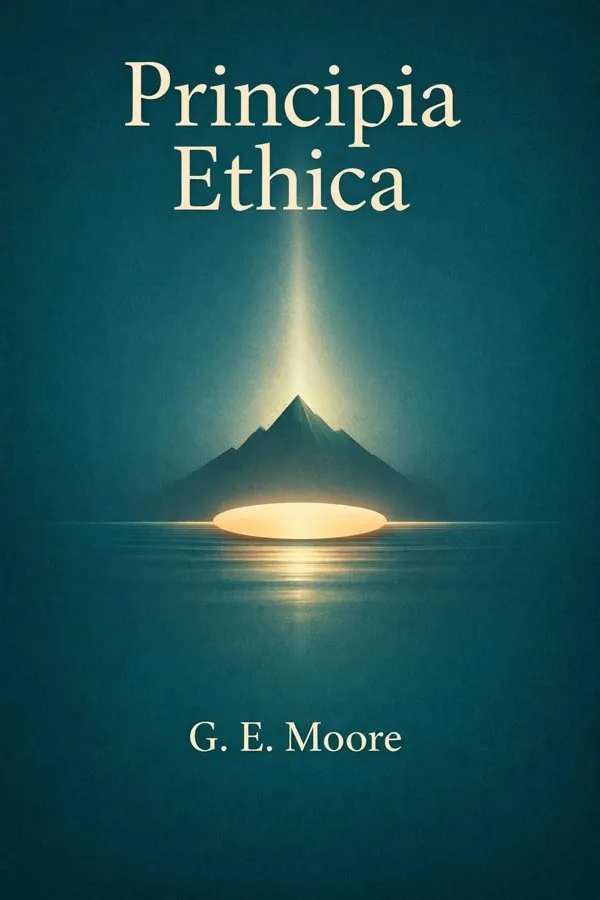
Principia Ethica: Summary & Key Insights
by G. E. Moore
 10 min9 chaptersAudio available
Key Takeaways from Principia Ethica
A great deal of moral confusion begins when we assume that goodness must be identical to some observable feature of the world.
If goodness were truly definable, moral inquiry would become strangely trivial.
Some of the most important things we know cannot be broken down into simpler definitions.
Much of ethical error comes from confusing what is valuable in itself with what is valuable as a means.
Pleasure matters, but Moore denies that it is the whole of the good life.
What Is Principia Ethica About?
Principia Ethica by G. E. Moore is a western_phil book spanning 8 pages. First published in 1903, Principia Ethica is one of the foundational works of modern moral philosophy. In this influential book, G. E. Moore asks a deceptively simple question: What do we really mean when we call something good? His answer reshaped the field. Moore argues that goodness cannot be reduced to pleasure, desire, evolutionary fitness, or any other natural property. Instead, “good” names a basic, irreducible quality that we recognize but cannot define. From that starting point, he builds a far-reaching account of intrinsic value, moral judgment, and the structure of ethical reasoning. The book matters because it forced philosophers to separate descriptive facts from evaluative claims with far greater precision. Moore’s critique of ethical naturalism, especially through his famous open question argument, became a turning point in analytic philosophy. It also influenced generations of thinkers beyond philosophy, including Bertrand Russell, John Maynard Keynes, and members of the Bloomsbury Group. Moore wrote with unusual rigor and conceptual exactness, and his work remains essential for anyone who wants to understand how twentieth-century ethics came to focus on language, value, and the limits of definition.
This FizzRead summary covers all 9 key chapters of Principia Ethica in approximately 10 minutes, distilling the most important ideas, arguments, and takeaways from G. E. Moore's work. Also available as an audio summary and Key Quotes Podcast.
Principia Ethica
First published in 1903, Principia Ethica is one of the foundational works of modern moral philosophy. In this influential book, G. E. Moore asks a deceptively simple question: What do we really mean when we call something good? His answer reshaped the field. Moore argues that goodness cannot be reduced to pleasure, desire, evolutionary fitness, or any other natural property. Instead, “good” names a basic, irreducible quality that we recognize but cannot define. From that starting point, he builds a far-reaching account of intrinsic value, moral judgment, and the structure of ethical reasoning.
The book matters because it forced philosophers to separate descriptive facts from evaluative claims with far greater precision. Moore’s critique of ethical naturalism, especially through his famous open question argument, became a turning point in analytic philosophy. It also influenced generations of thinkers beyond philosophy, including Bertrand Russell, John Maynard Keynes, and members of the Bloomsbury Group. Moore wrote with unusual rigor and conceptual exactness, and his work remains essential for anyone who wants to understand how twentieth-century ethics came to focus on language, value, and the limits of definition.
Who Should Read Principia Ethica?
This book is perfect for anyone interested in western_phil and looking to gain actionable insights in a short read. Whether you're a student, professional, or lifelong learner, the key ideas from Principia Ethica by G. E. Moore will help you think differently.
- ✓Readers who enjoy western_phil and want practical takeaways
- ✓Professionals looking to apply new ideas to their work and life
- ✓Anyone who wants the core insights of Principia Ethica in just 10 minutes
Want the full summary?
Get instant access to this book summary and 100K+ more with Fizz Moment.
Get Free SummaryAvailable on App Store • Free to download
Key Chapters
A great deal of moral confusion begins when we assume that goodness must be identical to some observable feature of the world. Moore’s first major move is to challenge this assumption. Ethical naturalism, as he uses the term, is the view that “good” can be defined by reference to a natural property such as pleasure, desire-satisfaction, health, survival, or social progress. Many moral theories do exactly this. A hedonist says the good is pleasure. An evolutionist says the good is what promotes development. A social reformer might say the good is whatever produces stability or welfare.
Moore argues that these views make a category mistake. They treat goodness as if it were one more factual property among others, like being red, useful, or biologically adaptive. But in ordinary moral life, we constantly distinguish between facts and value. A policy may increase wealth, and we can still reasonably ask whether that makes it good. A life may be full of pleasure, and we can still wonder whether it is admirable or worthwhile.
This matters outside philosophy. In business, leaders often equate what is profitable with what is right. In politics, what is efficient gets treated as what is morally justified. In personal life, people may identify what they strongly want with what is actually good for them. Moore’s point is not that pleasure, desire, or welfare never matter. It is that none of them automatically defines goodness.
His critique teaches intellectual discipline: never let a moral conclusion hide inside a factual description. Actionable takeaway: whenever someone says something is good, ask what they mean—and whether they are quietly substituting a fact, preference, or outcome for a genuine moral judgment.
If goodness were truly definable, moral inquiry would become strangely trivial. Moore’s famous open question argument is designed to show why it is not. Suppose someone says, “Good means pleasurable.” If that were a genuine definition, then asking “Is pleasure good?” would be no more informative than asking “Is pleasure pleasurable?” But the first question remains meaningful, debatable, and open. We can sensibly ask whether every pleasure is good, whether some pleasures are corrupting, or whether painful sacrifice can be noble. That shows, Moore says, that “good” and “pleasurable” are not identical.
The same pattern applies to every proposed definition. If someone claims that good means desired, we can still ask, “Are all desired things really good?” If good means what promotes evolution, we can still ask, “Is what promotes evolution always good?” These questions are not confused or empty. They are genuine moral questions, which means the definitions fail.
Moore’s argument is less about winning a verbal dispute and more about protecting the uniqueness of ethical thought. Moral language does not collapse neatly into psychology, biology, or economics. That insight remains useful today. Consider debates over social media, artificial intelligence, or public policy. Even if a technology increases engagement, efficiency, or growth, the question “But is it good?” remains open. That openness is exactly Moore’s point.
Critics have challenged the argument, but its enduring power lies in the warning it issues: do not confuse explaining how people behave with answering how they ought to live. Actionable takeaway: when evaluating any moral claim, test it with an open question—if the question still makes sense, the definition is probably too narrow.
Some of the most important things we know cannot be broken down into simpler definitions. Moore believes goodness is one of them. After rejecting naturalistic definitions, he argues that “good” is a simple, indefinable property. By simple, he means it has no component parts that can be analyzed into something more basic. We can recognize it, think about it, and discuss it, but we cannot define it in the way we define a triangle or a bachelor.
Moore compares goodness to a color such as yellow. You can point to yellow things, distinguish yellow from blue, and learn to identify it accurately. But if someone had never experienced yellow, a verbal definition alone would not fully capture it. In the same way, goodness is directly apprehended rather than analytically reduced. This does not make ethics irrational. It means moral understanding begins with a kind of recognition, not with a dictionary formula.
This claim helps explain why moral life often resists simplification. People search for one master metric—happiness, income, authenticity, efficiency, loyalty—but the deepest moral judgments usually involve something more basic than any single measure. A beautiful friendship, an act of courage, or a truthful conversation may be good even when they do not maximize pleasure or advantage.
The practical implication is humility. If goodness cannot be fully captured by one formula, then moral reasoning must remain careful, attentive, and plural in its evidence. We should be wary of ideologies that promise to reduce all ethics to a single scorecard. Actionable takeaway: stop looking for a perfect one-line definition of the good, and instead practice recognizing value through careful reflection on real cases, relationships, and experiences.
Much of ethical error comes from confusing what is valuable in itself with what is valuable as a means. Moore insists on this distinction. Something has intrinsic value if it is good in itself, not merely because it leads to something else. Money, for example, is typically valuable instrumentally: we value it because of what it can buy. Friendship, beauty, and knowledge, by contrast, seem to many people valuable even apart from further consequences.
To investigate intrinsic value, Moore proposes what is often called the method of isolation. Imagine a thing existing entirely on its own, stripped of its usual effects and associations. Would it still seem good? This thought experiment helps us separate ends from means. A medicine may be useful because it produces health, but viewed in isolation it does not seem valuable for its own sake. A state of appreciation for beauty, however, may still strike us as inherently worthwhile even when considered apart from practical benefits.
This method can sharpen everyday choices. People often organize their lives around career prestige, productivity, or possessions as if these were final goods. Moore encourages us to ask whether these things matter only because they produce security, recognition, or opportunities for richer experiences. The same test applies to institutions: is a school valuable merely for job placement, or also for cultivating understanding and character?
The method of isolation is not mechanical, but it disciplines our attention. It forces us to ask what we are ultimately trying to achieve, not just what we happen to chase. Actionable takeaway: make a short list of things you value most and ask of each, “Would this still matter if it led to nothing else?” Your answer reveals whether you are dealing with a means or an end.
Pleasure matters, but Moore denies that it is the whole of the good life. One of his most influential criticisms is directed at hedonism, the view that only pleasure is intrinsically good. Hedonism has intuitive appeal because pleasure is obviously valuable and pain obviously matters. Yet Moore argues that reducing all value to pleasurable experience leaves too much out. We care not only about how life feels, but also about what life contains.
He points to goods such as friendship, affection, beauty, and the contemplation of truth. A world containing deep personal love and appreciation of beauty seems better, he suggests, than a world with the same amount of pleasure but none of those higher qualities. In other words, the content and quality of experience matter, not just its pleasantness. A fake world of shallow amusement may be enjoyable, yet still less valuable than a world rich in understanding and meaningful relationships.
This is highly relevant in modern culture. Many systems optimize for short-term satisfaction: entertainment platforms maximize attention, workplaces reward convenience, and consumer culture often equates comfort with success. Moore’s challenge is to ask whether a pleasant life can still be impoverished if it lacks depth, truth, love, or beauty. The answer for him is yes.
That does not mean pleasure is unimportant. It means moral judgment must rank a wider range of intrinsic goods. A fulfilling education, a beautiful public space, or a loyal friendship may deserve protection even when they do not produce the greatest immediate enjoyment. Actionable takeaway: when making major life decisions, evaluate not just what will feel good, but what will be genuinely worth having in your life.
One of Moore’s most subtle contributions is the principle of organic unities: the value of a whole is not always equal to the sum of the values of its parts. A thing may change moral significance depending on the context in which it appears. This means ethics cannot always be done by simple addition.
Consider indignation at injustice. Indignation is an unpleasant feeling, and unpleasant feelings often seem bad. Yet indignation at cruelty may be better than cheerful indifference to it. Likewise, punishment involves pain, but in some contexts the whole situation may be better than one in which serious wrongdoing is ignored. The value of the response depends on its relation to the situation as a whole.
This insight corrects simplistic moral arithmetic. We cannot evaluate every action by assigning isolated scores to pleasure and pain. Human situations are structured, relational, and often layered. Grief is painful, yet grief at the loss of someone deeply loved may belong to a life of great value. Honest criticism may sting, yet it can be part of genuine care. Even sacrifice can be good when it expresses loyalty or justice.
In practical decision-making, the principle warns against fragmented thinking. Managers who optimize each department separately may damage the organization as a whole. Parents who avoid all discomfort for children may undermine long-term character. Citizens who pursue isolated freedoms without regard to shared institutions may weaken public life.
Moore’s lesson is that moral evaluation must consider patterns, contexts, and wholes. Actionable takeaway: before judging any experience or policy by its parts alone, ask what kind of whole it creates—and whether that whole has a value that cannot be seen in isolated fragments.
Not every important truth can be proved from something simpler, and Moore believes this is especially true in ethics. Since “good” is indefinable, our knowledge of intrinsic value cannot come from deduction alone. Moore is therefore associated with ethical intuitionism: the view that some moral truths are known directly rather than inferred from more basic non-moral facts.
This idea is often misunderstood. Moore is not saying that every gut feeling is morally authoritative. He does not celebrate impulse, prejudice, or emotional certainty. Rather, he thinks careful reflection can disclose self-evident truths about value, much as reasoning can disclose self-evident truths in logic. The point is that ethical thinking eventually reaches foundational judgments that are not derivable from scientific description.
In everyday life, this resembles moments when we see clearly that some things are worth preserving even if no spreadsheet can prove it. We judge that humiliating a person for amusement is wrong, that sincere friendship has worth, or that beauty enriches human life. These judgments may be debated, but they are not merely reports of private taste.
At the same time, Moore’s view invites caution. If ethical insight is direct, then we must train ourselves in honesty, clarity, and self-criticism. People can mistake convention for intuition. That is why moral reflection should involve dialogue, comparison of cases, and willingness to revise hasty judgments.
The enduring practical value of Moore’s position is balance: respect moral experience without surrendering to dogmatism. Actionable takeaway: treat your strongest moral convictions neither as infallible commands nor as meaningless feelings; test them through patient reflection, clear language, and conversation with others.
A moral theory becomes dangerous when it quietly assumes that one perspective exhausts all value. Moore challenges both egoism and simplified forms of utilitarianism for this reason. Egoism claims that one ought always to pursue one’s own good. Moore rejects this because the fact that something benefits me does not by itself show that it is what ought to be done. Other people’s goods matter too, and ethical reflection cannot begin and end with self-interest.
His criticism of utilitarianism is more nuanced. Moore is often linked to consequentialist thinking because he cares deeply about producing the best outcomes. But he rejects the idea that outcomes can be measured solely by pleasure. For him, what we ought to do depends on which available action is likely to produce the greatest total good, understood broadly to include goods like friendship, beauty, love, and knowledge.
This broader outlook has practical force. In public policy, it warns against reducing social success to income or satisfaction surveys alone. In personal life, it pushes back against the belief that “doing what is best for me” is automatically justified. A decision about work, family, or citizenship should account for a wider field of value and a wider community of persons.
Moore also recognizes uncertainty. We often cannot know with confidence which act will produce the best overall consequences. That limitation should make us modest and attentive rather than morally lazy.
His position encourages outward-looking ethics without collapsing value into a single metric. Actionable takeaway: before acting, ask not only “What benefits me?” or “What maximizes comfort?” but “What choice best promotes the richest overall good for everyone affected?”
Moore’s final achievement is methodological: he shows that ethics is not a marginal branch of philosophy but a discipline that forces philosophy to become clearer. By asking what “good” means, what kinds of things have value, and how we can know moral truths, he exposes the importance of precision in concepts that people often use carelessly. Ethical thought, for Moore, requires both analysis and seriousness about lived experience.
This helps explain the book’s lasting influence. Principia Ethica did not merely offer a list of moral rules. It changed how philosophers approached moral language, definition, and argument. It also affected literature, politics, and culture by legitimizing the thought that certain experiences—friendship, aesthetic appreciation, intellectual honesty—deserve respect as ends in themselves.
For ordinary readers, Moore’s wider message is liberating. He invites us to resist inherited formulas and to inspect our moral assumptions. Is success really the same as goodness? Is social approval a mark of value? Does measurable output capture what matters most? His answer is consistently no. Ethics begins when we refuse these shortcuts and ask more carefully what is genuinely worth wanting.
In a world saturated with metrics, incentives, and competing ideologies, that stance remains powerful. Moore reminds us that moral life cannot be outsourced to trends, institutions, or technical expertise alone. We must think.
Actionable takeaway: use ethical reflection as a tool of clarification—when faced with a difficult decision, define the terms, separate facts from values, identify intrinsic goods, and refuse to let convenience masquerade as moral truth.
All Chapters in Principia Ethica
About the Author
George Edward Moore (1873–1958) was a British philosopher and one of the founding figures of analytic philosophy. Educated at Cambridge, he became known for his exceptional clarity, close argumentation, and resistance to vague metaphysical systems. Moore made major contributions to ethics, epistemology, and the defense of common sense, but he is especially remembered for Principia Ethica, which helped redefine twentieth-century moral philosophy. In that work, he challenged ethical naturalism and argued that goodness is a simple, indefinable quality. Moore also taught at the University of Cambridge and later edited the influential journal Mind. His work shaped contemporaries such as Bertrand Russell and influenced broader intellectual circles, including the Bloomsbury Group. He remains a central reference point in discussions of value, moral language, and philosophical method.
Get This Summary in Your Preferred Format
Read or listen to the Principia Ethica summary by G. E. Moore anytime, anywhere. FizzRead offers multiple formats so you can learn on your terms — all free.
Available formats: App · Audio · PDF · EPUB — All included free with FizzRead
Download Principia Ethica PDF and EPUB Summary
Key Quotes from Principia Ethica
“A great deal of moral confusion begins when we assume that goodness must be identical to some observable feature of the world.”
“If goodness were truly definable, moral inquiry would become strangely trivial.”
“Some of the most important things we know cannot be broken down into simpler definitions.”
“Much of ethical error comes from confusing what is valuable in itself with what is valuable as a means.”
“Pleasure matters, but Moore denies that it is the whole of the good life.”
Frequently Asked Questions about Principia Ethica
Principia Ethica by G. E. Moore is a western_phil book that explores key ideas across 9 chapters. First published in 1903, Principia Ethica is one of the foundational works of modern moral philosophy. In this influential book, G. E. Moore asks a deceptively simple question: What do we really mean when we call something good? His answer reshaped the field. Moore argues that goodness cannot be reduced to pleasure, desire, evolutionary fitness, or any other natural property. Instead, “good” names a basic, irreducible quality that we recognize but cannot define. From that starting point, he builds a far-reaching account of intrinsic value, moral judgment, and the structure of ethical reasoning. The book matters because it forced philosophers to separate descriptive facts from evaluative claims with far greater precision. Moore’s critique of ethical naturalism, especially through his famous open question argument, became a turning point in analytic philosophy. It also influenced generations of thinkers beyond philosophy, including Bertrand Russell, John Maynard Keynes, and members of the Bloomsbury Group. Moore wrote with unusual rigor and conceptual exactness, and his work remains essential for anyone who wants to understand how twentieth-century ethics came to focus on language, value, and the limits of definition.
You Might Also Like
A Little History of Philosophy
Nigel Warburton
10 min
Areopagitica
John Milton
10 min
How To Think Like A Philosopher: Essential Principles For Clear Thinking
Peter Cave
10 min
Language, Truth and Logic
A. J. Ayer
10 min
The Age of Reason
Thomas Paine
10 min
The Essays
Michel De Montaigne
10 minBrowse by Category
Ready to read Principia Ethica?
Get the full summary and 100K+ more books with Fizz Moment.