
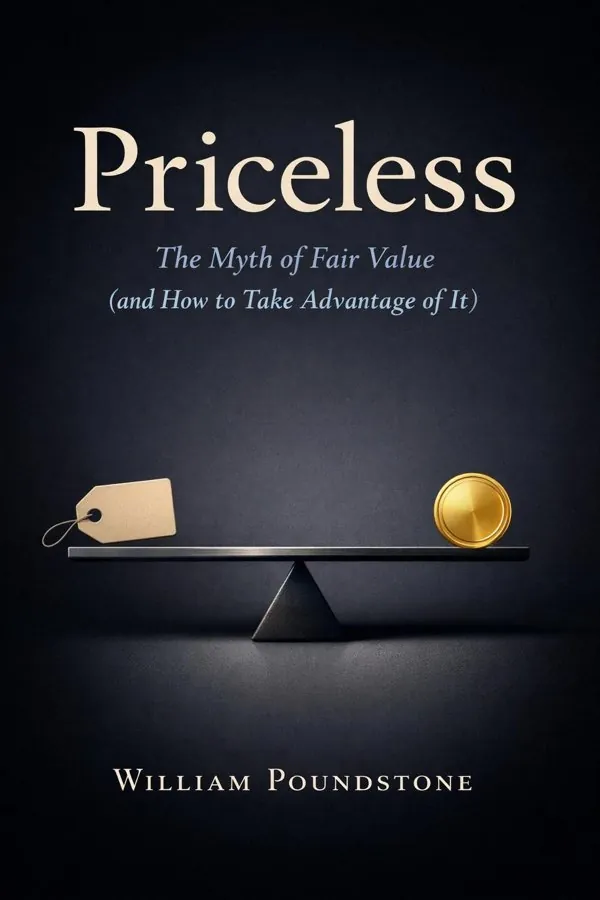
Priceless: The Myth of Fair Value (and How to Take Advantage of It): Summary & Key Insights
 10 min9 chaptersAudio available
What Is Priceless: The Myth of Fair Value (and How to Take Advantage of It) About?
Priceless: The Myth of Fair Value (and How to Take Advantage of It) by William Poundstone is a economics book spanning 9 pages. In this book, William Poundstone explores the psychology behind pricing and value perception. Drawing on behavioral economics and cognitive science, he reveals how consumers are influenced by marketing tactics and psychological biases that distort their sense of fair value. Through engaging examples and research, Poundstone demonstrates how prices are not objective measures but psychological constructs shaped by context and manipulation.
This FizzRead summary covers all 9 key chapters of Priceless: The Myth of Fair Value (and How to Take Advantage of It) in approximately 10 minutes, distilling the most important ideas, arguments, and takeaways from William Poundstone's work. Also available as an audio summary and Key Quotes Podcast.
Priceless: The Myth of Fair Value (and How to Take Advantage of It)
In this book, William Poundstone explores the psychology behind pricing and value perception. Drawing on behavioral economics and cognitive science, he reveals how consumers are influenced by marketing tactics and psychological biases that distort their sense of fair value. Through engaging examples and research, Poundstone demonstrates how prices are not objective measures but psychological constructs shaped by context and manipulation.
Who Should Read Priceless: The Myth of Fair Value (and How to Take Advantage of It)?
This book is perfect for anyone interested in economics and looking to gain actionable insights in a short read. Whether you're a student, professional, or lifelong learner, the key ideas from Priceless: The Myth of Fair Value (and How to Take Advantage of It) by William Poundstone will help you think differently.
- ✓Readers who enjoy economics and want practical takeaways
- ✓Professionals looking to apply new ideas to their work and life
- ✓Anyone who wants the core insights of Priceless: The Myth of Fair Value (and How to Take Advantage of It) in just 10 minutes
Want the full summary?
Get instant access to this book summary and 100K+ more with Fizz Moment.
Get Free SummaryAvailable on App Store • Free to download
Key Chapters
Through decades of experiments, behavioral economists like Daniel Kahneman and Amos Tversky revealed that people rarely evaluate prices logically. Instead, we rely on cognitive heuristics. Experiments showing that slight changes in framing—a glass half full versus half empty—can alter decisions also apply to money: prices framed in certain ways shift perceptions of worth. In laboratory settings, people bid drastically different amounts for identical goods depending on context, comparison, and priming. The famous 'anchoring' experiments illustrate this perfectly. When subjects are first exposed to a random high number, say the digits of their social security number, their subsequent willingness to pay for an item rises. This demonstrates how our internal sense of value is never calibrated in isolation—it is always relative to an anchor, often arbitrary.
+ 7 more chapters — available in the FizzRead app
All Chapters in Priceless: The Myth of Fair Value (and How to Take Advantage of It)
About the Author
William Poundstone is an American author and science writer known for his works on psychology, economics, and game theory. His books, including 'Fortune's Formula' and 'Gaming the Vote', combine rigorous research with accessible storytelling to explain complex ideas in human decision-making and rationality.
Get This Summary in Your Preferred Format
Read or listen to the Priceless: The Myth of Fair Value (and How to Take Advantage of It) summary by William Poundstone anytime, anywhere. FizzRead offers multiple formats so you can learn on your terms — all free.
Available formats: App · Audio · PDF · EPUB — All included free with FizzRead
Download Priceless: The Myth of Fair Value (and How to Take Advantage of It) PDF and EPUB Summary
Key Quotes from Priceless: The Myth of Fair Value (and How to Take Advantage of It)
“The belief in 'fair value' has not always existed.”
“Through decades of experiments, behavioral economists like Daniel Kahneman and Amos Tversky revealed that people rarely evaluate prices logically.”
Frequently Asked Questions about Priceless: The Myth of Fair Value (and How to Take Advantage of It)
Priceless: The Myth of Fair Value (and How to Take Advantage of It) by William Poundstone is a economics book that explores key ideas across 9 chapters. In this book, William Poundstone explores the psychology behind pricing and value perception. Drawing on behavioral economics and cognitive science, he reveals how consumers are influenced by marketing tactics and psychological biases that distort their sense of fair value. Through engaging examples and research, Poundstone demonstrates how prices are not objective measures but psychological constructs shaped by context and manipulation.
More by William Poundstone
You Might Also Like
Business Adventures
John Brooks
10 min
Nudge
Richard H. Thaler, Cass R. Sunstein
10 min
The Hitchhiker"s Guide to the Galaxy
Douglas Adams
10 minThe Muqaddimah
Ibn Khaldun
10 minThe Outsiders
William N. Thorndike
10 min
A Little History of Economics
Niall Kishtainy
10 minBrowse by Category
Ready to read Priceless: The Myth of Fair Value (and How to Take Advantage of It)?
Get the full summary and 100K+ more books with Fizz Moment.