
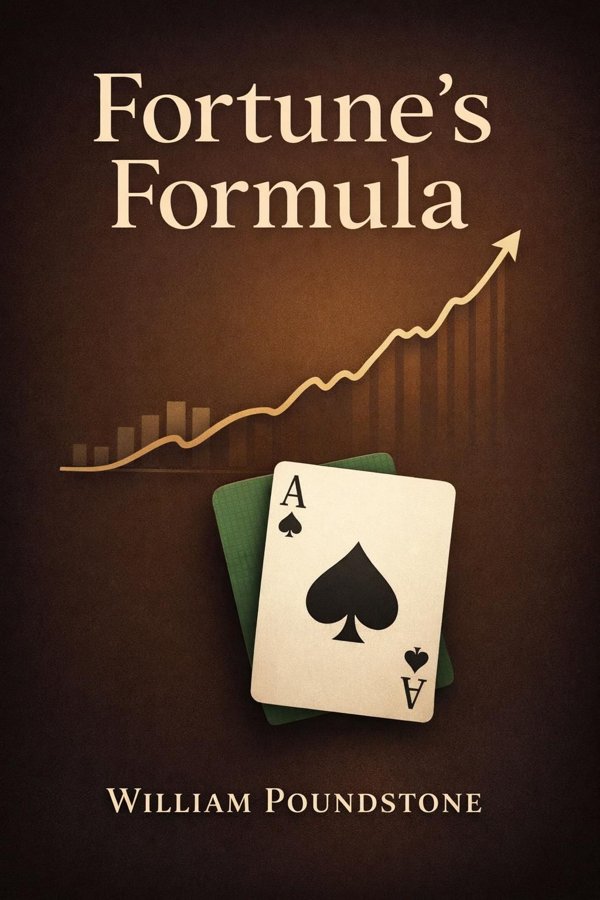
Fortune’s Formula: The Untold Story of the Scientific Betting System That Beat the Casinos and Wall Street: Summary & Key Insights
 10 min9 chaptersAudio available
Key Takeaways from Fortune’s Formula: The Untold Story of the Scientific Betting System That Beat the Casinos and Wall Street
Great fortunes often begin with a strange insight: uncertainty can be measured.
Being right is not enough; the size of your bet determines whether being right will actually make you rich.
A theory becomes truly dangerous when someone proves it works.
Financial markets may look more respectable than racetracks, but Poundstone argues that both are arenas where prices reflect crowd beliefs under uncertainty.
At the deepest level, Fortune’s Formula is about building a rational way to act when the future cannot be known.
What Is Fortune’s Formula: The Untold Story of the Scientific Betting System That Beat the Casinos and Wall Street About?
Fortune’s Formula: The Untold Story of the Scientific Betting System That Beat the Casinos and Wall Street by William Poundstone is a finance book spanning 6 pages. Fortune’s Formula is a gripping exploration of one of the most powerful ideas ever developed about risk: the Kelly criterion, a mathematical rule for deciding how much to bet when the odds are in your favor. In William Poundstone’s hands, this is far more than a technical history. It becomes a story about brilliant minds, hidden systems, casinos, horse tracks, hedge funds, and the enduring human dream of turning uncertainty into profit. The book follows the idea from Bell Labs and Claude Shannon’s information theory to John Kelly’s breakthrough formula and Edward Thorp’s real-world triumphs in blackjack and investing. Along the way, Poundstone shows how a concept born in telecommunications reshaped gambling, portfolio strategy, and modern thinking about wealth. What makes the book matter is its central lesson: success is not just about being right, but about sizing your risks intelligently so you can survive long enough to compound gains. Poundstone, known for making complex scientific and mathematical ideas accessible, brings authority, narrative energy, and clarity to a subject that sits at the crossroads of finance, probability, and human behavior.
This FizzRead summary covers all 9 key chapters of Fortune’s Formula: The Untold Story of the Scientific Betting System That Beat the Casinos and Wall Street in approximately 10 minutes, distilling the most important ideas, arguments, and takeaways from William Poundstone's work. Also available as an audio summary and Key Quotes Podcast.
Fortune’s Formula: The Untold Story of the Scientific Betting System That Beat the Casinos and Wall Street
Fortune’s Formula is a gripping exploration of one of the most powerful ideas ever developed about risk: the Kelly criterion, a mathematical rule for deciding how much to bet when the odds are in your favor. In William Poundstone’s hands, this is far more than a technical history. It becomes a story about brilliant minds, hidden systems, casinos, horse tracks, hedge funds, and the enduring human dream of turning uncertainty into profit. The book follows the idea from Bell Labs and Claude Shannon’s information theory to John Kelly’s breakthrough formula and Edward Thorp’s real-world triumphs in blackjack and investing. Along the way, Poundstone shows how a concept born in telecommunications reshaped gambling, portfolio strategy, and modern thinking about wealth. What makes the book matter is its central lesson: success is not just about being right, but about sizing your risks intelligently so you can survive long enough to compound gains. Poundstone, known for making complex scientific and mathematical ideas accessible, brings authority, narrative energy, and clarity to a subject that sits at the crossroads of finance, probability, and human behavior.
Who Should Read Fortune’s Formula: The Untold Story of the Scientific Betting System That Beat the Casinos and Wall Street?
This book is perfect for anyone interested in finance and looking to gain actionable insights in a short read. Whether you're a student, professional, or lifelong learner, the key ideas from Fortune’s Formula: The Untold Story of the Scientific Betting System That Beat the Casinos and Wall Street by William Poundstone will help you think differently.
- ✓Readers who enjoy finance and want practical takeaways
- ✓Professionals looking to apply new ideas to their work and life
- ✓Anyone who wants the core insights of Fortune’s Formula: The Untold Story of the Scientific Betting System That Beat the Casinos and Wall Street in just 10 minutes
Want the full summary?
Get instant access to this book summary and 100K+ more with Fizz Moment.
Get Free SummaryAvailable on App Store • Free to download
Key Chapters
Great fortunes often begin with a strange insight: uncertainty can be measured. Fortune’s Formula starts with Claude Shannon, the Bell Labs genius who transformed communication by showing that information is something quantifiable, not just abstract meaning. Shannon’s information theory explained how messages move through noisy channels and how signals can be encoded efficiently without losing essential content. That sounds far removed from investing or gambling, but Poundstone shows that this was the intellectual foundation for a revolution in decision-making under uncertainty.
Shannon’s work mattered because gambling and investing are both information problems. A bettor tries to determine whether the odds offered by the market differ from the true odds of an outcome. An investor tries to identify when an asset’s price does not fully reflect reality. In both cases, success depends on having an informational edge and using it correctly. Shannon himself was fascinated by applying mathematics to games of chance, and his playful experiments hinted at a larger truth: if information can be measured, then advantage can be measured too.
Poundstone uses Shannon’s world at Bell Labs to illustrate how scientific breakthroughs often emerge in unexpected settings. A telecommunications problem gave rise to ideas that eventually shaped blackjack strategy, hedge fund management, and portfolio theory. The broader implication is that powerful tools often travel across disciplines. Concepts built for engineering can transform finance; theories designed for machines can illuminate human behavior.
A practical application is simple: whenever you face uncertainty, ask what information edge you truly have. Are you acting on data, skill, or just emotion? Before making a financial decision, separate signal from noise and identify whether your advantage is real. Actionable takeaway: do not risk money until you can clearly state what informational edge, if any, justifies the bet.
Being right is not enough; the size of your bet determines whether being right will actually make you rich. That is the heart of John Kelly’s 1956 breakthrough. Working from ideas rooted in information theory, Kelly developed a formula for determining the optimal fraction of capital to wager when the odds are favorable. The goal was not merely to maximize expected winnings in a single round, but to maximize long-term capital growth over many repeated opportunities.
This was a profound shift. Most people think about betting in absolute terms: Should I play or not? Kelly reframed the question: If I have an edge, how much should I risk? Bet too little and you squander advantage. Bet too much and you expose yourself to ruin, even when your strategy is sound. The Kelly criterion balances these forces by finding the growth-maximizing fraction. It effectively answers the central problem of risk-taking: how to pursue gains without blowing up.
Poundstone makes this idea vivid by connecting it to coin flips, horse racing, and investments. Imagine a game where a biased coin lands in your favor more often than chance, but not always. Going all in is reckless because losing even once destroys you. Betting a small, calculated fraction allows your capital to survive losses and compound through wins. That is why Kelly matters in both casinos and markets. It is a formula for endurance as much as for aggression.
In practical life, the pure formula may be hard to apply exactly because probabilities are uncertain. Even so, its principle is invaluable. Actionable takeaway: whenever you believe you have an edge, focus first on position sizing. A good opportunity becomes dangerous when the stake is too large for your bankroll, portfolio, or emotional resilience.
A theory becomes truly dangerous when someone proves it works. Edward Thorp was the person who carried mathematical betting out of the lab and into the real world. Poundstone presents Thorp as one of the book’s most compelling figures: a disciplined, inventive thinker who used probability, computing, and nerve to beat blackjack and later Wall Street. His story turns abstract equations into lived strategy.
Thorp first gained fame by showing that blackjack was not a game of pure luck. By tracking cards and adjusting bets when the remaining deck shifted the odds, he demonstrated that a player could obtain a real edge over the house. Just as important, he paired this with Kelly-style betting logic. Having an advantage was only the first half of the problem; the second half was deciding how much to bet when the count was favorable. That combination of edge detection and bet sizing created a repeatable system.
What makes Thorp especially important is that he later applied similar thinking to finance. In markets, he sought mispriced securities, including warrants and convertible bonds, and constructed hedged strategies that limited downside while preserving upside. This was not gambling in the casual sense. It was disciplined exploitation of favorable probabilities. Poundstone uses Thorp’s career to show that casinos and Wall Street are often governed by the same mathematics.
The practical lesson is that successful risk-taking requires more than boldness. It requires process, data, and emotional control. Most people fail not because edge is impossible, but because they cannot execute consistently under uncertainty. Actionable takeaway: if you want better investment or decision results, build a repeatable system that identifies advantage, limits downside, and prevents emotion from dictating the size of your bets.
Financial markets may look more respectable than racetracks, but Poundstone argues that both are arenas where prices reflect crowd beliefs under uncertainty. That is why ideas from gambling migrated so naturally into finance. Once thinkers like Thorp and others recognized that mispriced odds in sports and casinos resembled mispriced assets in markets, the Kelly criterion became more than a betting tool. It became a framework for portfolio construction and capital allocation.
The key connection is this: in both betting and investing, the central problem is not predicting every outcome perfectly, but managing exposure to favorable opportunities over time. A portfolio is essentially a collection of bets. Some have positive expected value, some negative, and many uncertain. The investor’s challenge is to allocate capital in a way that maximizes long-run growth while avoiding catastrophic loss. Kelly offered a mathematically elegant answer to that challenge, especially for repeated opportunities with known probabilities.
Poundstone also shows the limits of direct translation. In casinos, the rules are fixed and probabilities can often be estimated with precision. On Wall Street, the odds are murkier, correlations shift, and human behavior constantly changes the game. That means applying Kelly in finance demands caution. Even so, its influence has been deep, especially among quantitative investors, traders, and hedge fund managers who think in terms of edge, volatility, and compounding.
A practical example is portfolio concentration. If an investor is highly confident in one opportunity, Kelly logic may justify a larger allocation than traditional diversification would suggest. But if confidence is overstated, concentration becomes dangerous. Actionable takeaway: treat every investment as a probabilistic bet, and size positions based not only on upside potential but on the reliability of your assumptions and your ability to survive being wrong.
At the deepest level, Fortune’s Formula is about building a rational way to act when the future cannot be known. Poundstone connects Kelly’s formula to broader ideas about entropy, probability, and the structure of decision-making. Entropy, in information theory, measures uncertainty. The more uncertainty there is, the less predictable a system becomes. In betting and finance, profits often come from reducing uncertainty better than others do.
This is why the book is intellectually richer than a simple story about gambling systems. Kelly’s formula emerges from the same conceptual universe as Shannon’s entropy. Both deal with uncertainty and optimal use of information. If you know something about the odds that the market has not fully priced in, that informational difference has value. But the value only becomes real when translated into action. Kelly provides the bridge from knowledge to stake.
Poundstone’s treatment also highlights that decision-making is architectural. Good results do not come from one brilliant prediction; they come from a system that can repeatedly process uncertain information, adjust exposure, and avoid self-destruction. This has applications far beyond money. Career choices, business expansion, negotiation strategy, and even personal commitments all involve uncertain outcomes with asymmetric payoffs.
For example, an entrepreneur launching new products should not blindly invest all resources into one idea, even with strong conviction. Better is to allocate more capital to higher-confidence opportunities while preserving enough reserves to continue learning. This is Kelly-like thinking applied to business strategy.
Actionable takeaway: design your decisions as a system. When facing uncertainty, ask three questions: what is the probability, what is the payoff, and how much can I risk while still staying in the game if I am wrong?
One of the book’s most sobering lessons is that intelligence alone does not protect anyone from ruin. In fact, many highly intelligent people fail precisely because they overestimate their edge and overbet. Poundstone repeatedly returns to the unforgiving arithmetic of compounding: large losses are disproportionately hard to recover from, and a strategy with positive expected value can still end in disaster if the stakes are too big.
This is where the Kelly criterion reveals its moral as well as its mathematics. It is not a formula for greed. It is a discipline of restraint. Many gamblers and investors understand odds reasonably well, yet still go broke because they cannot resist the temptation to press their advantage too aggressively. The problem is intensified by emotion. Winning creates overconfidence; losing triggers desperation. Both states push people toward oversized bets.
Poundstone’s narrative makes clear that risk management is not the opposite of ambition. It is what makes durable ambition possible. In practice, this is why many professionals use half-Kelly or other reduced betting fractions rather than the full theoretical amount. They know that probabilities are estimates, not certainties, and that model error can be fatal. The mathematically optimal strategy under perfect knowledge may be too dangerous in the real world.
The principle extends well beyond gambling. In personal finance, borrowing heavily to invest may amplify gains, but it can also permanently impair your capital. In business, hiring too quickly or expanding too fast can destroy a promising enterprise. Actionable takeaway: leave a margin for error. Even when the numbers favor you, scale back enough that surprises, bad luck, or flawed assumptions will not knock you out of the game.
The strongest system in the world can still fail when it meets human psychology. Poundstone does not present Kelly-style reasoning as a magical solution that removes emotion from life. Instead, he shows how difficult it is for actual people to follow rational risk strategies consistently. The mathematics may be elegant, but living by it is hard.
Why? Because human beings do not experience risk as equations. We feel fear during drawdowns, envy when others seem to be getting rich faster, and regret when a cautious strategy misses a windfall. Kelly can tell you the optimal percentage to bet, but it cannot make you emotionally comfortable with volatility. A mathematically sound strategy may still produce losing streaks, years of underperformance, or social embarrassment. Those psychological costs matter.
This helps explain why many people reject optimal strategies even when they understand them. Some prefer certainty to growth. Others chase jackpots rather than sustainable compounding. Still others cannot tolerate the boredom of disciplined execution. Poundstone suggests that successful application of these ideas requires not only intelligence but temperament. You must choose a strategy you can actually stick with.
A practical application is portfolio design. Two investors with the same capital and beliefs may need different allocations because one can tolerate volatility and the other cannot. A theoretically optimal plan that you abandon in panic is inferior to a slightly less optimal one you can maintain.
Actionable takeaway: align your strategy with your psychology. Do not adopt a level of risk just because a formula says it is optimal. Choose a path that is mathematically sound and emotionally sustainable over the long run.
Every elegant formula carries a hidden assumption: that the world resembles the model. Poundstone is careful to show that the Kelly criterion is powerful but not omniscient. Its success depends on knowing the odds with reasonable accuracy, and that is often the hardest part. In gambling, probabilities may be estimated from rules and data. In markets, they are tangled with changing regimes, incomplete information, and feedback from other participants.
This creates a central tension in the book. The formula is exact, but the inputs are not. If you overestimate your edge, Kelly can instruct you to bet too much. If conditions shift, yesterday’s optimal sizing may become today’s reckless exposure. This is why real-world practitioners often modify the theory, use conservative estimates, and diversify across independent opportunities.
Poundstone’s broader point is that mathematical finance is most useful when paired with humility. Numbers clarify thinking, but they do not abolish uncertainty. The smartest investors and gamblers are not those who worship formulas blindly. They are the ones who know when the model applies, when it does not, and how to protect themselves from their own estimation errors.
In everyday life, this matters whenever you make decisions based on forecasts. Sales projections, startup growth assumptions, and personal income expectations are all uncertain inputs. Building plans as if your forecasts are exact invites trouble. Better to treat estimates as ranges and keep reserves for surprises.
Actionable takeaway: use models as guides, not guarantees. Whenever you make a probabilistic decision, discount your confidence, stress-test your assumptions, and reduce your exposure when the odds are less certain than they appear.
The most important victory in risky environments is not winning big once; it is staying alive long enough for gains to compound. This is the philosophical core of Fortune’s Formula. Poundstone shows that the Kelly criterion matters because it aligns decision-making with the mathematics of long-term growth. Instead of chasing maximum short-term profit, it prioritizes the rate at which wealth can expand across many repeated bets.
This idea cuts against common instincts. People are drawn to dramatic success stories, concentrated gambles, and life-changing windfalls. But systems built on occasional jackpots are often fragile. A strategy that doubles your money quickly but has a high chance of ruin is inferior to one that grows steadily and survives adversity. Kelly’s framework formalizes this by recognizing that wealth growth is multiplicative. Losses reduce the base from which future gains must compound, so avoiding ruin becomes paramount.
Poundstone’s narrative makes this lesson concrete through gamblers, scientists, and investors who understood that patience and survival beat spectacle. It also explains why many enduring fortunes arise from disciplined accumulation rather than constant heroic risk. In investing, this can mean preferring a robust strategy with manageable volatility over one promising extraordinary returns with hidden tail risks.
The practical implication is widely relevant. Saving, investing, career building, and business growth all benefit from preserving optionality and compounding small edges over time. You do not need a perfect system. You need one that can be repeated consistently without catastrophic failure.
Actionable takeaway: judge opportunities by their effect on long-term compounding, not by how exciting they look today. Favor strategies that let you survive setbacks, reinvest gains, and keep playing the game for decades.
All Chapters in Fortune’s Formula: The Untold Story of the Scientific Betting System That Beat the Casinos and Wall Street
About the Author
William Poundstone is an American author, journalist, and skeptical thinker known for writing about science, mathematics, economics, and human behavior for general audiences. He has built a reputation for turning difficult concepts into engaging narratives without losing their intellectual rigor. His books often explore logic, probability, decision-making, and the hidden systems that shape everyday life. Among his well-known works are Labyrinths of Reason, How Would You Move Mount Fuji?, and Priceless. In Fortune’s Formula, Poundstone combines historical reporting, financial insight, and scientific explanation to illuminate how a mathematical betting rule influenced both gambling and investing. His writing is valued for its clarity, curiosity, and ability to reveal the surprising connections between abstract theory and real-world choices.
Get This Summary in Your Preferred Format
Read or listen to the Fortune’s Formula: The Untold Story of the Scientific Betting System That Beat the Casinos and Wall Street summary by William Poundstone anytime, anywhere. FizzRead offers multiple formats so you can learn on your terms — all free.
Available formats: App · Audio · PDF · EPUB — All included free with FizzRead
Download Fortune’s Formula: The Untold Story of the Scientific Betting System That Beat the Casinos and Wall Street PDF and EPUB Summary
Key Quotes from Fortune’s Formula: The Untold Story of the Scientific Betting System That Beat the Casinos and Wall Street
“Great fortunes often begin with a strange insight: uncertainty can be measured.”
“Being right is not enough; the size of your bet determines whether being right will actually make you rich.”
“A theory becomes truly dangerous when someone proves it works.”
“Financial markets may look more respectable than racetracks, but Poundstone argues that both are arenas where prices reflect crowd beliefs under uncertainty.”
“At the deepest level, Fortune’s Formula is about building a rational way to act when the future cannot be known.”
Frequently Asked Questions about Fortune’s Formula: The Untold Story of the Scientific Betting System That Beat the Casinos and Wall Street
Fortune’s Formula: The Untold Story of the Scientific Betting System That Beat the Casinos and Wall Street by William Poundstone is a finance book that explores key ideas across 9 chapters. Fortune’s Formula is a gripping exploration of one of the most powerful ideas ever developed about risk: the Kelly criterion, a mathematical rule for deciding how much to bet when the odds are in your favor. In William Poundstone’s hands, this is far more than a technical history. It becomes a story about brilliant minds, hidden systems, casinos, horse tracks, hedge funds, and the enduring human dream of turning uncertainty into profit. The book follows the idea from Bell Labs and Claude Shannon’s information theory to John Kelly’s breakthrough formula and Edward Thorp’s real-world triumphs in blackjack and investing. Along the way, Poundstone shows how a concept born in telecommunications reshaped gambling, portfolio strategy, and modern thinking about wealth. What makes the book matter is its central lesson: success is not just about being right, but about sizing your risks intelligently so you can survive long enough to compound gains. Poundstone, known for making complex scientific and mathematical ideas accessible, brings authority, narrative energy, and clarity to a subject that sits at the crossroads of finance, probability, and human behavior.
More by William Poundstone
You Might Also Like


Browse by Category
Ready to read Fortune’s Formula: The Untold Story of the Scientific Betting System That Beat the Casinos and Wall Street?
Get the full summary and 100K+ more books with Fizz Moment.