
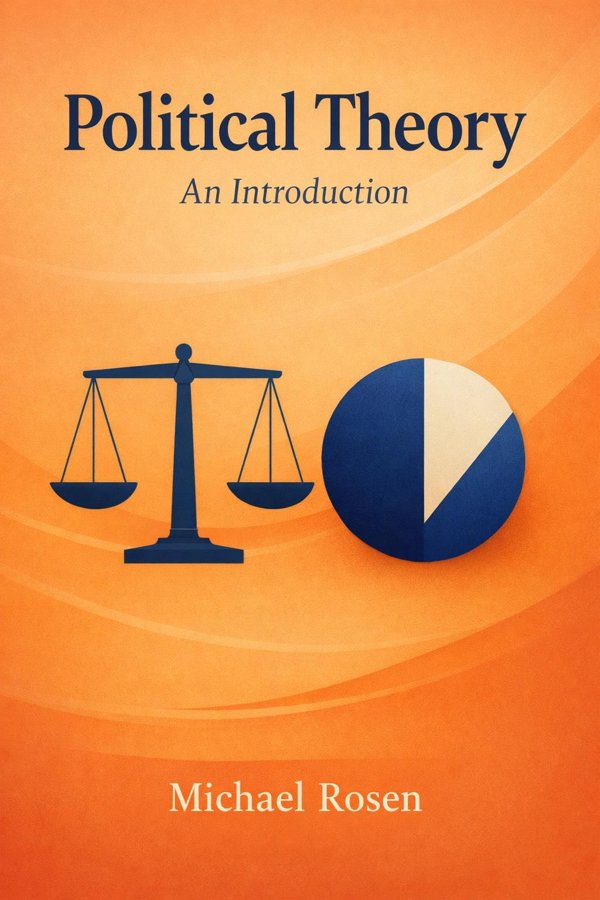
Political Theory: An Introduction: Summary & Key Insights
 10 min9 chaptersAudio available
Key Takeaways from Political Theory: An Introduction
Every political argument hides a moral argument beneath it.
No political theory appears out of nowhere; every doctrine is shaped by the world it tries to understand or transform.
A society reveals its moral character by what it treats as just.
People praise freedom constantly, but they often mean very different things by it.
Treating everyone the same can still produce profoundly unequal lives.
What Is Political Theory: An Introduction About?
Political Theory: An Introduction by Michael Rosen is a politics book spanning 11 pages. Political life is full of urgent arguments: Who should rule? What makes power legitimate? How much freedom can a society protect while still pursuing equality, order, and justice? In Political Theory: An Introduction, Michael Rosen offers a clear and intellectually rich guide to the ideas behind those questions. Rather than treating politics as a set of institutions or events alone, Rosen shows that political theory is the disciplined attempt to understand how collective life ought to be organized, justified, and criticized. The book matters because modern political disputes—about rights, democracy, markets, identity, inequality, and state authority—are all shaped by deeper philosophical assumptions. Rosen helps readers uncover those assumptions and compare competing answers from major traditions such as liberalism, Marxism, and communitarianism. He also places these debates in historical context, showing how political ideas arise from real conflicts and changing social conditions. Rosen is especially well suited to this task. A distinguished political philosopher known for his work on Hegel, Marx, and modern European thought, he combines scholarly authority with unusual clarity. The result is an accessible introduction that invites readers not just to learn political theory, but to think politically with greater depth and precision.
This FizzRead summary covers all 9 key chapters of Political Theory: An Introduction in approximately 10 minutes, distilling the most important ideas, arguments, and takeaways from Michael Rosen's work. Also available as an audio summary and Key Quotes Podcast.
Political Theory: An Introduction
Political life is full of urgent arguments: Who should rule? What makes power legitimate? How much freedom can a society protect while still pursuing equality, order, and justice? In Political Theory: An Introduction, Michael Rosen offers a clear and intellectually rich guide to the ideas behind those questions. Rather than treating politics as a set of institutions or events alone, Rosen shows that political theory is the disciplined attempt to understand how collective life ought to be organized, justified, and criticized.
The book matters because modern political disputes—about rights, democracy, markets, identity, inequality, and state authority—are all shaped by deeper philosophical assumptions. Rosen helps readers uncover those assumptions and compare competing answers from major traditions such as liberalism, Marxism, and communitarianism. He also places these debates in historical context, showing how political ideas arise from real conflicts and changing social conditions.
Rosen is especially well suited to this task. A distinguished political philosopher known for his work on Hegel, Marx, and modern European thought, he combines scholarly authority with unusual clarity. The result is an accessible introduction that invites readers not just to learn political theory, but to think politically with greater depth and precision.
Who Should Read Political Theory: An Introduction?
This book is perfect for anyone interested in politics and looking to gain actionable insights in a short read. Whether you're a student, professional, or lifelong learner, the key ideas from Political Theory: An Introduction by Michael Rosen will help you think differently.
- ✓Readers who enjoy politics and want practical takeaways
- ✓Professionals looking to apply new ideas to their work and life
- ✓Anyone who wants the core insights of Political Theory: An Introduction in just 10 minutes
Want the full summary?
Get instant access to this book summary and 100K+ more with Fizz Moment.
Get Free SummaryAvailable on App Store • Free to download
Key Chapters
Every political argument hides a moral argument beneath it. Debates about taxes, immigration, censorship, welfare, policing, or climate policy are never only technical disagreements; they are also disagreements about what people owe one another and what governments are justified in doing. Rosen begins by clarifying that political theory is concerned with these normative questions. It does not simply ask how political systems work, but whether they are legitimate, fair, and defensible.
This distinction matters because modern politics often presents itself as practical management. Leaders speak in the language of efficiency, security, or necessity, as if political decisions were neutral solutions to objective problems. Political theory resists that illusion. It reminds us that institutions are built on values, and that citizens should be able to evaluate those values rather than merely submit to them.
Rosen also shows that political theory is not detached from reality. It is a way of making sense of conflict, obligation, and collective purpose. For example, when a government restricts speech to combat misinformation, the real issue is not only whether the policy works, but how we balance freedom, truth, and public harm. When a city expands welfare benefits, the deeper question is whether justice requires redistribution or merely equal legal rights.
Political theory therefore trains judgment. It gives readers a vocabulary for asking better questions: What is freedom for? When is authority justified? What makes inequality acceptable, if ever? Instead of accepting inherited assumptions, it encourages critical reflection.
Actionable takeaway: The next time you encounter a political dispute, ask not only what policy is proposed, but what moral principle is being assumed and whether that principle deserves your support.
No political theory appears out of nowhere; every doctrine is shaped by the world it tries to understand or transform. Rosen emphasizes that political thought develops in conversation with historical experience. Plato wrote in response to instability in the Greek polis, Hobbes against the background of civil war, Locke amid disputes over authority and property, Marx during the rise of industrial capitalism, and modern democratic theory in the shadow of mass politics and expanding citizenship.
Seeing theory historically helps readers avoid two mistakes. The first is treating classic thinkers as timeless oracles whose words can simply be applied unchanged to the present. The second is dismissing them as obsolete because their societies differed from ours. Rosen instead encourages a middle path: understand what problems thinkers were addressing, then ask what remains illuminating today.
This historical lens makes political theory more concrete. Social contract theory, for instance, was not only an abstract thought experiment; it was also a way to explain why political authority should rest on consent rather than divine right. Marx’s critique of capitalism was rooted in exploitation, class conflict, and alienation produced by industrial labor, but it still resonates in contemporary debates about gig work, automation, and concentrated corporate power.
History also reveals that political concepts evolve. Democracy once referred to direct self-rule by a restricted body of citizens; now it often means representative institutions, universal suffrage, constitutional rights, and public accountability. Equality has expanded from legal status to social opportunity, anti-discrimination norms, and debates over structural injustice.
Actionable takeaway: When studying any political idea, ask two questions: what historical problem gave rise to it, and what current problem makes it still relevant or in need of revision?
A society reveals its moral character by what it treats as just. Rosen presents justice as one of the central concerns of political theory because it addresses how benefits, burdens, rights, punishments, and opportunities should be distributed. Justice asks what people deserve, what institutions owe citizens, and how social arrangements can be justified to those who live under them.
One reason justice is so difficult is that it combines several dimensions. There is distributive justice, which concerns wealth, income, education, healthcare, and opportunity. There is legal justice, which concerns fair procedures, equal treatment, and impartial rules. There is also corrective justice, which addresses wrongdoing and compensation. Political disagreement often arises because people emphasize one dimension over another. Some argue that justice means rewarding merit and effort. Others insist that outcomes shaped by birth, class, race, or inherited advantage cannot be just, no matter how legal they are.
Rosen helps readers see that theories of justice depend on deeper assumptions about persons and society. If individuals are viewed primarily as self-owning agents, justice may mean protecting rights and voluntary exchange. If society is seen as a cooperative venture shaped by luck and interdependence, justice may require redistribution and social provision.
These issues are visible everywhere. Debates over progressive taxation ask whether the successful are unfairly burdened or whether they owe more because institutions made their success possible. Arguments over affirmative action ask whether justice is best served by formal neutrality or by correcting entrenched disadvantage.
Actionable takeaway: When judging whether something is just, look beyond whether rules were followed and ask whether the underlying social arrangement can be reasonably defended to those most disadvantaged by it.
People praise freedom constantly, but they often mean very different things by it. Rosen shows that freedom is not one simple political value but a cluster of related ideas that can support conflicting conclusions. One common understanding sees freedom as non-interference: I am free when others, especially the state, do not obstruct my choices. Another sees freedom as self-mastery or autonomy: I am free when I can govern myself rather than being driven by addiction, ignorance, domination, or dependence. A further view links freedom to social conditions, arguing that severe poverty, fear, or lack of education can make legal liberty hollow.
These distinctions matter in practice. A worker may be legally free to leave a job, yet if losing that job means losing healthcare, housing, or legal status, that freedom is limited in substance. A citizen may enjoy formal free speech rights, but if media power is highly concentrated, public discourse may still be skewed. Conversely, a government that censors speech or heavily regulates private life may claim to be promoting moral freedom while actually reducing personal liberty.
Rosen’s treatment encourages readers to avoid slogans. Political actors often invoke freedom selectively: market defenders celebrate consumer choice but may ignore workplace coercion; paternalistic reformers defend restrictions for citizens’ own good but may underestimate the danger of overreach. Political theory forces these tensions into the open.
A mature account of freedom therefore asks free for what, from what, and under what conditions. The value of freedom is undeniable, but its meaning depends on how we understand human agency and social power.
Actionable takeaway: Whenever someone appeals to freedom, ask what kind of freedom is meant—freedom from interference, freedom to develop one’s capacities, or freedom from domination—and what trade-offs are being hidden.
Treating everyone the same can still produce profoundly unequal lives. Rosen explores equality as a political ideal that goes far beyond identical rules or abstract declarations of equal worth. At its core, equality asks how a society should respond to differences in wealth, status, power, and opportunity, especially when those differences are shaped by structures people did not choose.
Political theory distinguishes between several forms of equality. Formal equality means that the law applies in the same way to all. Equality of opportunity seeks to ensure that social positions are open fairly, not reserved for privileged groups. Equality of outcome is more controversial, but it raises the question of how much inequality can exist before equal citizenship is undermined. There is also relational equality, which focuses not only on distribution but on whether people stand to one another as social equals rather than as superiors and inferiors.
These distinctions illuminate current debates. Access to education may be formally open to all, yet if one child grows up with stable housing, private tutoring, and family networks while another does not, the resulting competition is hardly equal. Likewise, a society may reject aristocratic titles while tolerating such extreme economic gaps that some citizens effectively dominate others in political influence and social standing.
Rosen does not reduce equality to envy or uniformity. Instead, he shows why democratic societies must decide what kinds of inequality are acceptable and which are corrosive. Markets may reward innovation, but unchecked disparities can weaken solidarity, distort politics, and deny people the material basis for independence.
Actionable takeaway: Evaluate inequality not only by asking whether rules are impartial, but by asking whether the resulting social hierarchy allows all citizens to participate with dignity and genuine independence.
A political system is not fully democratic just because elections occur. Rosen treats democracy as both an institutional arrangement and a moral ideal grounded in political equality, public justification, and citizen participation. Voting matters, but democracy also depends on whether people have meaningful opportunities to influence decisions, hold leaders accountable, and regard themselves as co-authors of collective life.
This broader view helps explain why democracies can become shallow. If citizens vote every few years but are excluded from informed debate, overwhelmed by misinformation, or convinced that elites ignore them regardless of outcomes, democratic legitimacy weakens. Rosen’s discussion highlights the tension between democracy’s promise of popular rule and the practical complexities of large modern states, where technical expertise, bureaucracy, party competition, and media systems mediate public power.
Political theory asks difficult questions here. Should democracy be understood mainly as majority rule, or must it be constrained by rights and constitutional protections? How should minority interests be protected? Does democracy require civic virtue and active engagement, or is peaceful electoral competition enough? These are not merely academic issues. They arise in arguments over campaign finance, voter suppression, citizens’ assemblies, judicial review, and digital platforms’ role in shaping opinion.
Rosen also suggests that democratic participation has ethical importance beyond outcomes. Participation can cultivate responsibility, mutual recognition, and a sense that politics belongs to citizens rather than to rulers. Yet participation can also be unequal if time, education, and confidence are distributed unevenly.
Actionable takeaway: Judge democracy by asking not only whether leaders are elected, but whether citizens can realistically understand, influence, and contest the decisions made in their name.
The most revealing political theories often begin from different pictures of what a human being is. Rosen uses major traditions such as liberalism, Marxism, and communitarianism to show how competing visions of the person lead to competing visions of politics. Liberalism emphasizes individual rights, personal freedom, toleration, and limits on state power. It is powerful because it protects pluralism in societies where people disagree deeply about the good life. But critics argue that liberalism can picture individuals too abstractly, as if they were detached from history, class, culture, and social dependence.
Marxism shifts attention from rights and formal equality to material structures, class power, and exploitation. It asks whether legal freedom means much when economic life is organized around deep inequalities and dependence on wage labor. Its enduring strength lies in showing how politics is shaped by economic arrangements. Yet Marxist theory faces its own challenges, especially regarding political pluralism, individual liberty, and the historical record of regimes claiming its name.
Communitarianism responds to liberal individualism by stressing that people are formed within communities, traditions, and shared moral worlds. It argues that political life cannot be sustained by rights alone; citizens also need belonging, civic trust, and common purposes. Still, communitarian politics can drift toward conformity or exclusion if shared values become tools for policing difference.
Rosen does not force a winner. Instead, he shows that each tradition identifies something essential: liberalism protects the person, Marxism unmasks structural domination, and communitarianism reminds us that no one lives outside social ties.
Actionable takeaway: When assessing any political issue, consider what each tradition would highlight—individual rights, economic power, and social belonging—and use the tension among them to deepen your judgment.
Ideas become politically serious when they are tested against institutions, conflicts, and imperfect human behavior. Rosen insists that political theory should not float above the world as pure abstraction. Its task is not only to define ideals, but also to illuminate what can be demanded, reformed, resisted, or justified under real conditions. This means theory must engage with law, public policy, social movements, and the messy compromises of governance.
That does not mean abandoning principles. On the contrary, theory gives us standards for criticizing reality. But Rosen shows that principles require interpretation when applied. Consider freedom of speech: in theory, it protects open discussion and dissent; in practice, societies must decide how to handle hate speech, disinformation, incitement, and private platforms that shape public discourse. Consider equality: a commitment to equal respect sounds clear, but policy choices about schools, healthcare, housing, and labor rights involve hard trade-offs, budget constraints, and conflicting values.
Rosen’s approach encourages a productive tension between ideal and non-ideal thinking. Ideal theory asks what a just society would look like. Non-ideal theory asks what should be done in unjust societies marked by prejudice, scarcity, and institutional inertia. Both matter. Without ideals, politics becomes opportunistic. Without attention to practice, ideals become empty.
This chapter has practical force for activists, policymakers, and citizens alike. It suggests that good political judgment combines moral clarity with contextual intelligence. Reform requires not only knowing what ought to happen, but understanding who has power, what obstacles exist, and which changes are feasible without surrendering principle.
Actionable takeaway: When evaluating a political proposal, ask two questions together: is it morally defensible in principle, and is it a realistic step toward a more just political order?
The best test of political theory is whether it helps us think through new conditions without losing sight of enduring values. Rosen concludes by showing that classical concepts such as justice, freedom, equality, authority, and democracy remain indispensable in contemporary debates, even as the issues themselves evolve. Globalization weakens the neat fit between nation, sovereignty, and political responsibility. Digital technology transforms surveillance, speech, and public opinion. Identity politics raises urgent questions about recognition, historical injustice, and the limits of universalism. Environmental crisis forces political thought to consider obligations across generations and borders.
These developments do not make earlier theory irrelevant; they make interpretation more demanding. For instance, if freedom includes protection from domination, what does domination mean in a world of data harvesting and algorithmic decision-making? If justice concerns fair distribution, how should burdens of climate adaptation be shared between rich and poor countries? If democracy requires public participation, what happens when online platforms amplify outrage, manipulation, and fragmentation rather than deliberation?
Rosen’s broader lesson is that political theory is not a closed canon but an ongoing practice of argument. New realities generate new problems, but they also reactivate old questions in sharper form. Citizens still need ways to justify power, criticize hierarchy, and define the common good.
This makes political theory especially valuable in periods of uncertainty. It helps readers resist both cynicism and simplification. Instead of accepting that politics is merely a struggle for advantage, theory asks what forms of power can be made answerable to reason and moral judgment.
Actionable takeaway: Use classical political concepts as tools for diagnosing contemporary problems, but be willing to revise inherited assumptions when new forms of power, vulnerability, and interdependence emerge.
All Chapters in Political Theory: An Introduction
About the Author
Michael Rosen is a British political philosopher known for his work in political theory, moral philosophy, and the history of modern European thought. He has written extensively on major thinkers including Hegel and Marx, and his scholarship often explores freedom, obligation, dignity, and the moral foundations of political life. Rosen has held academic positions at leading institutions such as University College London and Harvard University, where he has taught generations of students how to engage seriously with complex political ideas. He is respected not only for the depth of his scholarship but also for his ability to explain difficult concepts with clarity and balance. In Political Theory: An Introduction, Rosen brings those strengths together, offering readers a concise yet intellectually rich pathway into the central debates of political philosophy.
Get This Summary in Your Preferred Format
Read or listen to the Political Theory: An Introduction summary by Michael Rosen anytime, anywhere. FizzRead offers multiple formats so you can learn on your terms — all free.
Available formats: App · Audio · PDF · EPUB — All included free with FizzRead
Download Political Theory: An Introduction PDF and EPUB Summary
Key Quotes from Political Theory: An Introduction
“Every political argument hides a moral argument beneath it.”
“No political theory appears out of nowhere; every doctrine is shaped by the world it tries to understand or transform.”
“A society reveals its moral character by what it treats as just.”
“People praise freedom constantly, but they often mean very different things by it.”
“Treating everyone the same can still produce profoundly unequal lives.”
Frequently Asked Questions about Political Theory: An Introduction
Political Theory: An Introduction by Michael Rosen is a politics book that explores key ideas across 9 chapters. Political life is full of urgent arguments: Who should rule? What makes power legitimate? How much freedom can a society protect while still pursuing equality, order, and justice? In Political Theory: An Introduction, Michael Rosen offers a clear and intellectually rich guide to the ideas behind those questions. Rather than treating politics as a set of institutions or events alone, Rosen shows that political theory is the disciplined attempt to understand how collective life ought to be organized, justified, and criticized. The book matters because modern political disputes—about rights, democracy, markets, identity, inequality, and state authority—are all shaped by deeper philosophical assumptions. Rosen helps readers uncover those assumptions and compare competing answers from major traditions such as liberalism, Marxism, and communitarianism. He also places these debates in historical context, showing how political ideas arise from real conflicts and changing social conditions. Rosen is especially well suited to this task. A distinguished political philosopher known for his work on Hegel, Marx, and modern European thought, he combines scholarly authority with unusual clarity. The result is an accessible introduction that invites readers not just to learn political theory, but to think politically with greater depth and precision.
You Might Also Like
Antifa: The Anti-Fascist Handbook
Mark Bray
10 min
Attack from Within: How Disinformation Is Sabotaging America
Barbara McQuade
10 min
Coercion, Capital, and European States, AD 990–1992
Charles Tilly
10 min
Digital Democracy: Concepts, Methodologies, Tools, and Applications
Various Authors
10 min
Fascism
Stanley G. Payne
10 min
Fire And Fury: Inside The Trump White House
Michael Wolff
10 minBrowse by Category
Ready to read Political Theory: An Introduction?
Get the full summary and 100K+ more books with Fizz Moment.