
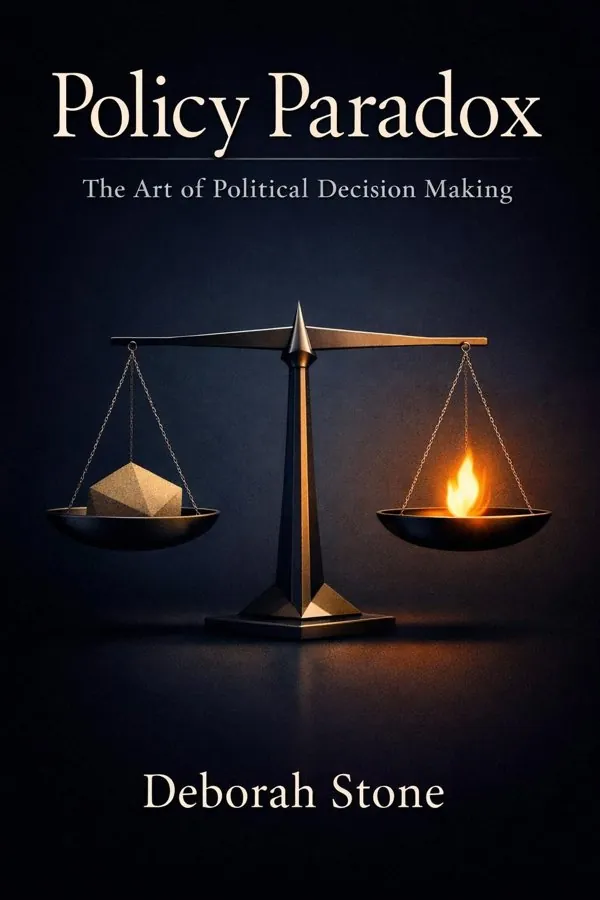
Policy Paradox: The Art of Political Decision Making: Summary & Key Insights
 10 min11 chaptersAudio available
What Is Policy Paradox: The Art of Political Decision Making About?
Policy Paradox: The Art of Political Decision Making by Deborah Stone is a politics book spanning 11 pages. Policy Paradox: The Art of Political Decision Making es una obra fundamental en el campo de la política pública. Deborah Stone argumenta que las políticas públicas no son el resultado de decisiones racionales puras, sino de procesos políticos cargados de valores, símbolos y conflictos de interpretación. A través de ejemplos y análisis, la autora muestra cómo los conceptos de equidad, eficiencia, seguridad y libertad se utilizan de manera estratégica en el debate político para justificar diferentes posiciones y decisiones.
This FizzRead summary covers all 11 key chapters of Policy Paradox: The Art of Political Decision Making in approximately 10 minutes, distilling the most important ideas, arguments, and takeaways from Deborah Stone's work. Also available as an audio summary and Key Quotes Podcast.
Policy Paradox: The Art of Political Decision Making
Policy Paradox: The Art of Political Decision Making es una obra fundamental en el campo de la política pública. Deborah Stone argumenta que las políticas públicas no son el resultado de decisiones racionales puras, sino de procesos políticos cargados de valores, símbolos y conflictos de interpretación. A través de ejemplos y análisis, la autora muestra cómo los conceptos de equidad, eficiencia, seguridad y libertad se utilizan de manera estratégica en el debate político para justificar diferentes posiciones y decisiones.
Who Should Read Policy Paradox: The Art of Political Decision Making?
This book is perfect for anyone interested in politics and looking to gain actionable insights in a short read. Whether you're a student, professional, or lifelong learner, the key ideas from Policy Paradox: The Art of Political Decision Making by Deborah Stone will help you think differently.
- ✓Readers who enjoy politics and want practical takeaways
- ✓Professionals looking to apply new ideas to their work and life
- ✓Anyone who wants the core insights of Policy Paradox: The Art of Political Decision Making in just 10 minutes
Want the full summary?
Get instant access to this book summary and 100K+ more with Fizz Moment.
Get Free SummaryAvailable on App Store • Free to download
Key Chapters
In the rational model of the market, society is imagined as a collection of autonomous individuals seeking to maximize their own welfare through voluntary exchange. In this vision, decisions are made through calculation, and outcomes are optimal when no one can be made better off without making someone else worse off. But policy-making takes place not in that idealized market, but in what I call the polis—the realm of community, interdependence, and symbolic action.
In the polis, self-interest and altruism intertwine. People act not merely to satisfy personal desires but to secure recognition, loyalty, justice, and belonging. The polis is bound by relationships and norms, not just prices. Power is exercised through persuasion, promises, information, and identity—tools that rarely appear in market equations. Moreover, the polis is built upon the idea of collective will. Citizens often sacrifice for the common good, and yet they disagree on what that good should be.
The distinction between market and polis helps us understand why political problems resist purely technical solutions. In the market, efficiency is an uncontested goal; in the polis, every goal is contested because it carries moral meaning. When we recognize this, we stop searching for an impossible neutrality and instead begin to interpret political decisions as moral arguments enacted through policy.
Public policy debates revolve around a few central goals—equity, efficiency, security, and liberty. These are not objective ends but symbolic values that embody different visions of the good society. Each can be defined, measured, and prioritized in multiple ways, depending on who tells the story.
Take equity, for instance. What is fair distribution? Equal shares, equal outcomes, or equal opportunity? Every policy distributes something—resources, rights, risks, burdens—and every distribution reflects an underlying story about who is deserving. Efficiency, in turn, is often presented as neutral and technical, but it hides judgments about which benefits count, for whom, and at what cost.
Security refers to freedom from harm, yet harm can be physical, economic, or emotional. The very act of defining what needs protection is political. Finally, liberty is never absolute; it always exists in tension with collective obligation. Policies that promote security may constrain liberty, and those that exalt liberty may increase insecurity. Understanding these goals as contested and interdependent allows us to see policy-making not as a linear process of choosing preferences, but as a continual negotiation of moral meaning.
+ 9 more chapters — available in the FizzRead app
All Chapters in Policy Paradox: The Art of Political Decision Making
About the Author
Deborah A. Stone es una politóloga estadounidense reconocida por sus contribuciones al estudio de la política pública y la teoría política. Ha sido profesora en instituciones como el Massachusetts Institute of Technology (MIT) y la Brandeis University. Su trabajo se centra en la intersección entre política, valores y formulación de políticas públicas.
Get This Summary in Your Preferred Format
Read or listen to the Policy Paradox: The Art of Political Decision Making summary by Deborah Stone anytime, anywhere. FizzRead offers multiple formats so you can learn on your terms — all free.
Available formats: App · Audio · PDF · EPUB — All included free with FizzRead
Download Policy Paradox: The Art of Political Decision Making PDF and EPUB Summary
Key Quotes from Policy Paradox: The Art of Political Decision Making
“In the rational model of the market, society is imagined as a collection of autonomous individuals seeking to maximize their own welfare through voluntary exchange.”
“Public policy debates revolve around a few central goals—equity, efficiency, security, and liberty.”
Frequently Asked Questions about Policy Paradox: The Art of Political Decision Making
Policy Paradox: The Art of Political Decision Making by Deborah Stone is a politics book that explores key ideas across 11 chapters. Policy Paradox: The Art of Political Decision Making es una obra fundamental en el campo de la política pública. Deborah Stone argumenta que las políticas públicas no son el resultado de decisiones racionales puras, sino de procesos políticos cargados de valores, símbolos y conflictos de interpretación. A través de ejemplos y análisis, la autora muestra cómo los conceptos de equidad, eficiencia, seguridad y libertad se utilizan de manera estratégica en el debate político para justificar diferentes posiciones y decisiones.
You Might Also Like
Antifa: The Anti-Fascist Handbook
Mark Bray
10 min
Attack from Within: How Disinformation Is Sabotaging America
Barbara McQuade
10 min
Coercion, Capital, and European States, AD 990–1992
Charles Tilly
10 min
Digital Democracy: Concepts, Methodologies, Tools, and Applications
Various Authors
10 min
Fascism
Stanley G. Payne
10 min
Fire And Fury: Inside The Trump White House
Michael Wolff
10 minBrowse by Category
Ready to read Policy Paradox: The Art of Political Decision Making?
Get the full summary and 100K+ more books with Fizz Moment.