
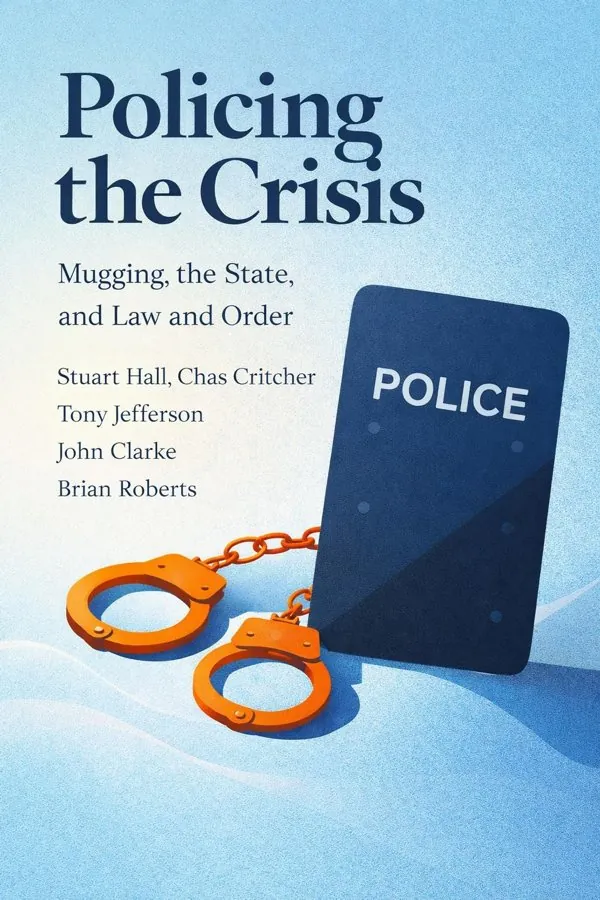
Policing the Crisis: Mugging, the State, and Law and Order: Summary & Key Insights
by Stuart Hall, Chas Critcher, Tony Jefferson, John Clarke, Brian Roberts
 10 min10 chaptersAudio available
What Is Policing the Crisis: Mugging, the State, and Law and Order About?
Policing the Crisis: Mugging, the State, and Law and Order by Stuart Hall, Chas Critcher, Tony Jefferson, John Clarke, Brian Roberts is a sociology book spanning 10 pages. Originally published in 1978, this landmark study by Stuart Hall and his colleagues at the Centre for Contemporary Cultural Studies (CCCS) examines the moral panic surrounding 'mugging' in 1970s Britain. The authors analyze how media, politics, and law enforcement constructed a crisis of law and order that reflected deeper social anxieties about race, class, and economic change. The book is a foundational text in cultural studies and criminology, offering a critical framework for understanding the relationship between crime, ideology, and state power.
This FizzRead summary covers all 10 key chapters of Policing the Crisis: Mugging, the State, and Law and Order in approximately 10 minutes, distilling the most important ideas, arguments, and takeaways from Stuart Hall, Chas Critcher, Tony Jefferson, John Clarke, Brian Roberts's work. Also available as an audio summary and Key Quotes Podcast.
Policing the Crisis: Mugging, the State, and Law and Order
Originally published in 1978, this landmark study by Stuart Hall and his colleagues at the Centre for Contemporary Cultural Studies (CCCS) examines the moral panic surrounding 'mugging' in 1970s Britain. The authors analyze how media, politics, and law enforcement constructed a crisis of law and order that reflected deeper social anxieties about race, class, and economic change. The book is a foundational text in cultural studies and criminology, offering a critical framework for understanding the relationship between crime, ideology, and state power.
Who Should Read Policing the Crisis: Mugging, the State, and Law and Order?
This book is perfect for anyone interested in sociology and looking to gain actionable insights in a short read. Whether you're a student, professional, or lifelong learner, the key ideas from Policing the Crisis: Mugging, the State, and Law and Order by Stuart Hall, Chas Critcher, Tony Jefferson, John Clarke, Brian Roberts will help you think differently.
- ✓Readers who enjoy sociology and want practical takeaways
- ✓Professionals looking to apply new ideas to their work and life
- ✓Anyone who wants the core insights of Policing the Crisis: Mugging, the State, and Law and Order in just 10 minutes
Want the full summary?
Get instant access to this book summary and 100K+ more with Fizz Moment.
Get Free SummaryAvailable on App Store • Free to download
Key Chapters
As observers of British public life in the early 1970s, we watched the idea of a ‘law and order crisis’ take shape almost overnight. What had once been framed as discrete questions of crime control began to be narrated as evidence of a general breakdown in social discipline. Speeches by leading politicians warned that ordinary citizens were no longer safe on their own streets, and that permissiveness—supposedly born of the 1960s—had eroded traditional respect for authority. The media echoed and amplified this refrain, producing daily stories that merged acts of vandalism, student unrest, industrial strikes, and violent crime into a unified image of chaos.
But behind this construction lay a deeper political logic. Britain was experiencing an economic downturn, deepening inflation, and mounting industrial conflict. The promise of postwar prosperity was evaporating, and with it the social compromises that had underpinned the welfare state. By dramatizing a ‘crisis of law and order,’ the political establishment could rally public support around the restoration of state authority. The anxiety about crime was, in this sense, an index of a larger legitimacy crisis. The language of moral decline—of streets taken over by delinquents and immigrants—became a vocabulary for talking about the erosion of confidence in the old political order.
The term ‘mugging’ was imported almost wholesale from the United States, where it described a particularly violent form of street robbery. British police statistics had never used the term; they had long relied on categories such as robbery and assault with intent to rob. Yet beginning in the early 1970s, newspapers and politicians began speaking of ‘muggings’ as if they were a distinct and menacing new phenomenon. In this linguistic shift lay a profound act of cultural translation. ‘Mugging’ became a symbol of a new kind of urban danger, one that drew upon images of American ghettoes and racialized violence.
Our research showed that the numerical evidence for a ‘mugging wave’ simply did not exist. The crime data revealed fluctuations typical for urban settings, but not the epidemic that public discourse described. The power of ‘mugging’ resided not in its empirical grounding, but in its ideological resonance. It combined fear of violent disorder with anxiety about social difference. Borrowing an American word allowed Britain to project its own tensions about race and inequality onto a supposedly foreign menace, even as those tensions were in fact rooted in domestic transformations.
+ 8 more chapters — available in the FizzRead app
All Chapters in Policing the Crisis: Mugging, the State, and Law and Order
About the Authors
Stuart Hall (1932–2014) was a Jamaican-born British cultural theorist and sociologist, widely regarded as one of the founding figures of British Cultural Studies. He served as Director of the Centre for Contemporary Cultural Studies at the University of Birmingham and later as Professor of Sociology at the Open University. His work explored issues of race, identity, media, and power, profoundly shaping contemporary social theory.
Get This Summary in Your Preferred Format
Read or listen to the Policing the Crisis: Mugging, the State, and Law and Order summary by Stuart Hall, Chas Critcher, Tony Jefferson, John Clarke, Brian Roberts anytime, anywhere. FizzRead offers multiple formats so you can learn on your terms — all free.
Available formats: App · Audio · PDF · EPUB — All included free with FizzRead
Download Policing the Crisis: Mugging, the State, and Law and Order PDF and EPUB Summary
Key Quotes from Policing the Crisis: Mugging, the State, and Law and Order
“As observers of British public life in the early 1970s, we watched the idea of a ‘law and order crisis’ take shape almost overnight.”
“The term ‘mugging’ was imported almost wholesale from the United States, where it described a particularly violent form of street robbery.”
Frequently Asked Questions about Policing the Crisis: Mugging, the State, and Law and Order
Policing the Crisis: Mugging, the State, and Law and Order by Stuart Hall, Chas Critcher, Tony Jefferson, John Clarke, Brian Roberts is a sociology book that explores key ideas across 10 chapters. Originally published in 1978, this landmark study by Stuart Hall and his colleagues at the Centre for Contemporary Cultural Studies (CCCS) examines the moral panic surrounding 'mugging' in 1970s Britain. The authors analyze how media, politics, and law enforcement constructed a crisis of law and order that reflected deeper social anxieties about race, class, and economic change. The book is a foundational text in cultural studies and criminology, offering a critical framework for understanding the relationship between crime, ideology, and state power.
You Might Also Like

Between the World and Me
Ta-Nehisi Coates
10 min
Half the Sky
Nicholas D. Kristof, Sheryl WuDunn
10 min
Men Explain Things To Me
Rebecca Solnit
10 min
Rational Ritual
Michael Suk-Young Chwe
10 min
The New Jim Crow
Michelle Alexander
10 min
Beyond Culture
Edward T. Hall
10 minBrowse by Category
Ready to read Policing the Crisis: Mugging, the State, and Law and Order?
Get the full summary and 100K+ more books with Fizz Moment.