
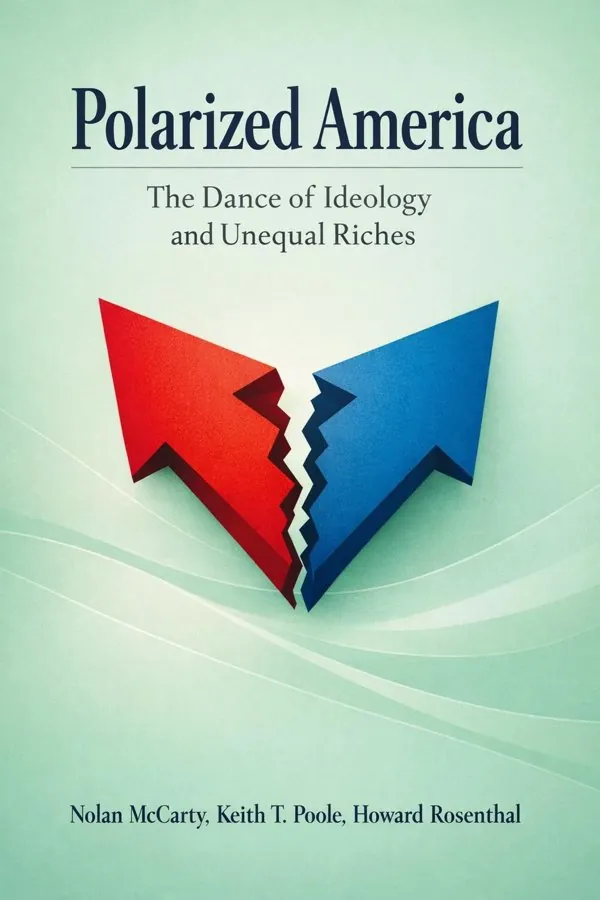
Polarized America: The Dance of Ideology and Unequal Riches: Summary & Key Insights
by Nolan McCarty, Keith T. Poole, Howard Rosenthal
 10 min11 chaptersAudio available
What Is Polarized America: The Dance of Ideology and Unequal Riches About?
Polarized America: The Dance of Ideology and Unequal Riches by Nolan McCarty, Keith T. Poole, Howard Rosenthal is a politics book spanning 11 pages. This book examines the growing ideological polarization in the United States and its relationship to economic inequality. Using extensive data analysis, the authors show how shifts in wealth distribution have contributed to partisan divisions and how these divisions, in turn, reinforce inequality. The work provides a comprehensive look at the interplay between political ideology, income disparity, and legislative behavior in modern American democracy.
This FizzRead summary covers all 11 key chapters of Polarized America: The Dance of Ideology and Unequal Riches in approximately 10 minutes, distilling the most important ideas, arguments, and takeaways from Nolan McCarty, Keith T. Poole, Howard Rosenthal's work. Also available as an audio summary and Key Quotes Podcast.
Polarized America: The Dance of Ideology and Unequal Riches
This book examines the growing ideological polarization in the United States and its relationship to economic inequality. Using extensive data analysis, the authors show how shifts in wealth distribution have contributed to partisan divisions and how these divisions, in turn, reinforce inequality. The work provides a comprehensive look at the interplay between political ideology, income disparity, and legislative behavior in modern American democracy.
Who Should Read Polarized America: The Dance of Ideology and Unequal Riches?
This book is perfect for anyone interested in politics and looking to gain actionable insights in a short read. Whether you're a student, professional, or lifelong learner, the key ideas from Polarized America: The Dance of Ideology and Unequal Riches by Nolan McCarty, Keith T. Poole, Howard Rosenthal will help you think differently.
- ✓Readers who enjoy politics and want practical takeaways
- ✓Professionals looking to apply new ideas to their work and life
- ✓Anyone who wants the core insights of Polarized America: The Dance of Ideology and Unequal Riches in just 10 minutes
Want the full summary?
Get instant access to this book summary and 100K+ more with Fizz Moment.
Get Free SummaryAvailable on App Store • Free to download
Key Chapters
In the middle decades of the twentieth century, roughly between the 1930s and the late 1960s, American political life exhibited a kind of pragmatic centrism. Economic inequality declined sharply during this period as New Deal and postwar policies strengthened labor, expanded education, and promoted shared prosperity. This egalitarian trend coincided with a Congress that, while far from harmonious, made room for cross-party cooperation. Southern Democrats and moderate Republicans often voted together to shape key legislation on infrastructure, defense, and welfare policy. Ideological differences existed, but they frequently crossed party lines rather than defining them.
From our vantage point as political scientists analyzing long historical series of roll-call votes, we can see this moderation clearly in our primary data. Using spatial models of congressional behavior, we observe that the distance between the median Democrat and the median Republican in ideological space was relatively small throughout the postwar decades. The parties were themselves internally diverse—Southern conservatives shared some preferences with Northern Republicans, while Northern liberals sometimes aligned with progressive Democrats. This overlap permitted compromise. The result was a governing equilibrium that mirrored a society with a broad middle class, modest disparities of wealth, and widely shared expectations of upward mobility.
The economic tranquility of the mid-century era was disrupted in the 1970s. Real wages stagnated, productivity gains decoupled from compensation, and income at the top began to accelerate. Technological change and globalization restructured the labor market, diminishing returns to industrial labor and amplifying rewards for capital and skill. Tax policy, deregulation, and an erosion of union power further contributed to the widening of the income distribution. By the dawn of the twenty-first century, the United States had returned to levels of inequality not seen since the Gilded Age.
This economic transformation mattered politically because it generated both material and perceptual divides. As the affluent gained more resources, they also increased their capacity to influence political outcomes. Lower and middle-income citizens, meanwhile, experienced insecurity and declining trust in political institutions. The connection between government and broad-based welfare weakened. Yet the key dynamic lies not only in wealth but in how it translates into political behavior—who votes, who contributes, and who holds office. Our data show that as inequality increased, the ideological composition of both parties shifted in a direction consistent with the preferences of their dominant economic constituencies. The affluent tilted Republican, the poor disengaged, and the result was a polarized electorate nested within a polarized economy.
+ 9 more chapters — available in the FizzRead app
All Chapters in Polarized America: The Dance of Ideology and Unequal Riches
About the Authors
Nolan McCarty, Keith T. Poole, and Howard Rosenthal are prominent American political scientists known for their quantitative research on political polarization, voting behavior, and economic inequality. They have collectively contributed to the development of spatial models of voting and the study of Congress through data-driven approaches.
Get This Summary in Your Preferred Format
Read or listen to the Polarized America: The Dance of Ideology and Unequal Riches summary by Nolan McCarty, Keith T. Poole, Howard Rosenthal anytime, anywhere. FizzRead offers multiple formats so you can learn on your terms — all free.
Available formats: App · Audio · PDF · EPUB — All included free with FizzRead
Download Polarized America: The Dance of Ideology and Unequal Riches PDF and EPUB Summary
Key Quotes from Polarized America: The Dance of Ideology and Unequal Riches
“In the middle decades of the twentieth century, roughly between the 1930s and the late 1960s, American political life exhibited a kind of pragmatic centrism.”
“The economic tranquility of the mid-century era was disrupted in the 1970s.”
Frequently Asked Questions about Polarized America: The Dance of Ideology and Unequal Riches
Polarized America: The Dance of Ideology and Unequal Riches by Nolan McCarty, Keith T. Poole, Howard Rosenthal is a politics book that explores key ideas across 11 chapters. This book examines the growing ideological polarization in the United States and its relationship to economic inequality. Using extensive data analysis, the authors show how shifts in wealth distribution have contributed to partisan divisions and how these divisions, in turn, reinforce inequality. The work provides a comprehensive look at the interplay between political ideology, income disparity, and legislative behavior in modern American democracy.
You Might Also Like
Antifa: The Anti-Fascist Handbook
Mark Bray
10 min
Attack from Within: How Disinformation Is Sabotaging America
Barbara McQuade
10 min
Coercion, Capital, and European States, AD 990–1992
Charles Tilly
10 min
Digital Democracy: Concepts, Methodologies, Tools, and Applications
Various Authors
10 min
Fascism
Stanley G. Payne
10 min
Fire And Fury: Inside The Trump White House
Michael Wolff
10 minBrowse by Category
Ready to read Polarized America: The Dance of Ideology and Unequal Riches?
Get the full summary and 100K+ more books with Fizz Moment.