
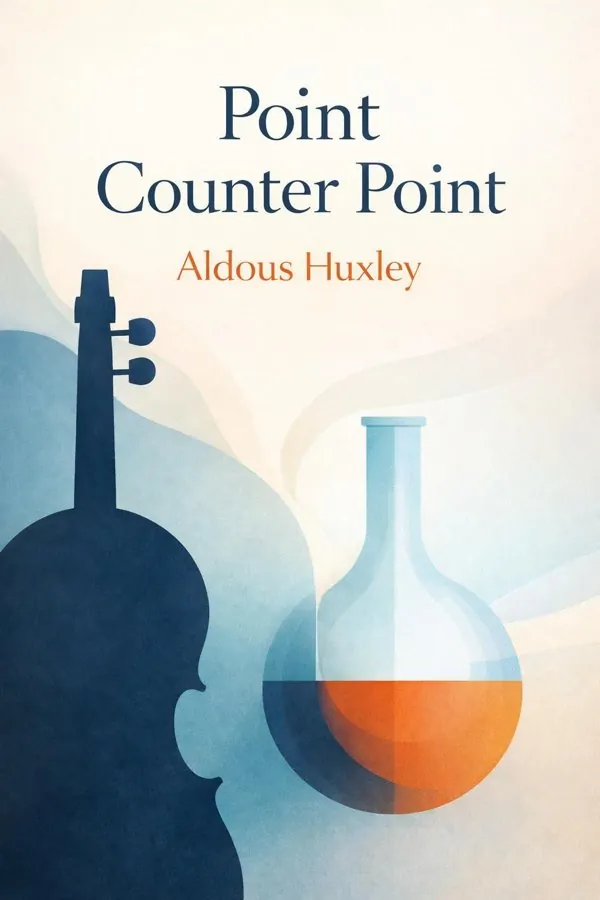
Point Counter Point: Summary & Key Insights
 10 min9 chaptersAudio available
Key Takeaways from Point Counter Point
One of Huxley’s boldest insights is that modern life cannot be captured through a single point of view.
A society can appear lively on the surface while inwardly running on emptiness.
Huxley shows that emotional chaos often begins not with evil intention but with weakness.
Intelligence does not always deepen life; sometimes it protects us from living it.
One of Huxley’s darkest claims is that when people cease to believe in truth or goodness, they may begin to experiment with cruelty simply to feel intensity.
What Is Point Counter Point About?
Point Counter Point by Aldous Huxley is a classics book spanning 13 pages. Aldous Huxley’s Point Counter Point is not a conventional novel so much as a social symphony: a many-voiced portrait of postwar England in which love affairs, intellectual debates, moral failures, and spiritual longings all sound at once. Published in 1928, the book follows a wide ensemble of writers, scientists, socialites, cynics, idealists, and drifters as their lives intersect across drawing rooms, bedrooms, and salons in London. Rather than centering one hero, Huxley builds the novel like a piece of music, with themes and counterthemes unfolding through contrasting personalities and competing worldviews. What makes the novel matter is its astonishing range. It is at once a satire of fashionable society, a meditation on modernity, and a diagnosis of the emotional and moral confusion that followed the First World War. Huxley probes the tensions between intellect and instinct, science and art, sensuality and ethics, detachment and commitment. Few novelists of his time matched his ability to turn conversation into philosophy without losing dramatic force. Point Counter Point remains essential because it captures a society brilliant in mind yet uncertain in soul—a condition that still feels strikingly modern.
This FizzRead summary covers all 9 key chapters of Point Counter Point in approximately 10 minutes, distilling the most important ideas, arguments, and takeaways from Aldous Huxley's work. Also available as an audio summary and Key Quotes Podcast.
Point Counter Point
Aldous Huxley’s Point Counter Point is not a conventional novel so much as a social symphony: a many-voiced portrait of postwar England in which love affairs, intellectual debates, moral failures, and spiritual longings all sound at once. Published in 1928, the book follows a wide ensemble of writers, scientists, socialites, cynics, idealists, and drifters as their lives intersect across drawing rooms, bedrooms, and salons in London. Rather than centering one hero, Huxley builds the novel like a piece of music, with themes and counterthemes unfolding through contrasting personalities and competing worldviews.
What makes the novel matter is its astonishing range. It is at once a satire of fashionable society, a meditation on modernity, and a diagnosis of the emotional and moral confusion that followed the First World War. Huxley probes the tensions between intellect and instinct, science and art, sensuality and ethics, detachment and commitment. Few novelists of his time matched his ability to turn conversation into philosophy without losing dramatic force. Point Counter Point remains essential because it captures a society brilliant in mind yet uncertain in soul—a condition that still feels strikingly modern.
Who Should Read Point Counter Point?
This book is perfect for anyone interested in classics and looking to gain actionable insights in a short read. Whether you're a student, professional, or lifelong learner, the key ideas from Point Counter Point by Aldous Huxley will help you think differently.
- ✓Readers who enjoy classics and want practical takeaways
- ✓Professionals looking to apply new ideas to their work and life
- ✓Anyone who wants the core insights of Point Counter Point in just 10 minutes
Want the full summary?
Get instant access to this book summary and 100K+ more with Fizz Moment.
Get Free SummaryAvailable on App Store • Free to download
Key Chapters
One of Huxley’s boldest insights is that modern life cannot be captured through a single point of view. Point Counter Point is structured contrapuntally, meaning it resembles a musical composition in which different melodies unfold simultaneously, sometimes harmonizing and sometimes clashing. Instead of following one central protagonist, the novel assembles many characters whose conversations, affairs, ideas, and conflicts create a pattern of social and philosophical tension.
This structure matters because it reflects the fragmented nature of modern experience. In Huxley’s London, people do not live by one stable moral code or shared worldview. Scientists reduce life to mechanism, artists aestheticize suffering, lovers confuse desire with devotion, and intellectuals use ideas to protect themselves from feeling. The novel’s form mirrors this confusion: truth emerges not from one voice, but from the friction between voices.
Readers can see this in how scenes often feel less like plot points than thematic variations. A flirtation echoes a philosophical debate; a dinner conversation parallels a moral collapse; a private crisis reveals the emptiness of public sophistication. Huxley is inviting us to read comparatively, noticing the resonance between characters rather than waiting for a straightforward storyline.
In practical terms, the book trains us to think relationally. In real life, workplaces, families, and societies also function like counterpoint: multiple motives operate at once, and understanding depends on hearing competing perspectives together. When evaluating a conflict, ask not only who is right, but what deeper values are colliding.
Actionable takeaway: read the novel as an ensemble performance, and in your own life practice listening for the competing “melodies” inside any complex situation.
A society can appear lively on the surface while inwardly running on emptiness. Huxley’s London is full of parties, wit, affairs, publication gossip, and intellectual glamour, yet beneath that polish lies fatigue, cynicism, and postwar disillusionment. The Great War has not only shattered lives; it has weakened confidence in inherited beliefs, leaving behind a culture that is highly articulate but spiritually uncertain.
This setting is not mere background. It explains why Huxley’s characters drift toward irony, sensation, and abstraction. They live in a world where old moral certainties seem naive, but no convincing replacement has taken hold. The result is a climate of emotional brittleness. People speak brilliantly yet fail to connect deeply. They seek novelty because conviction feels out of reach. They pursue desire without trust and ideas without wisdom.
Huxley’s satire is sharp because it recognizes how sophisticated societies can become detached from meaning. A cultured conversation, he suggests, is not proof of moral health. A community may produce criticism, science, and art while still suffering from a basic inability to live well. That diagnosis extends far beyond the 1920s. Today’s hyperconnected, overstimulated culture often displays the same pattern: endless commentary, little clarity; strong opinions, weak inner grounding.
A practical application is to distinguish stimulation from nourishment. Social busyness, media consumption, and clever debate can create the illusion of fullness while leaving deeper needs unmet. Huxley asks us to examine what our environment rewards: performance or sincerity, novelty or depth, intelligence or wisdom.
Actionable takeaway: periodically audit your cultural diet and ask whether the people, media, and conversations around you deepen your life or merely distract you from emptiness.
Huxley shows that emotional chaos often begins not with evil intention but with weakness. Walter Bidlake’s involvement with Marjorie Carling illustrates this vividly. Walter is not a melodramatic seducer; he is indecisive, vain, and morally soft. He slips into an affair less from passion than from passivity, telling himself stories about romance while avoiding responsibility for the consequences. Marjorie, in turn, becomes trapped in emotional dependence, and what looks at first like modern freedom reveals itself as mutual confusion.
The key point is that unmanaged desire becomes destructive when it is not anchored by character. Huxley is not simply condemning sexuality or romance. He is exposing self-deception: the habit of mistaking appetite for destiny, excitement for depth, and private impulse for moral exemption. Walter wants the pleasures of intimacy without the burdens of commitment, honesty, or courage. That split is deeply modern. Many people do not choose badly from conviction; they slide into bad choices because they do not want to choose clearly at all.
This dynamic extends beyond love. In careers, friendships, and family life, drift creates damage. A person avoids a difficult conversation, postpones a decision, indulges an ego, and then acts surprised when the situation becomes painful. Huxley reminds us that inaction is also action. Weakness has consequences.
Practically, the novel encourages moral clarity before emotional involvement. Before entering or continuing any intimate relationship, ask hard questions: What do I want? What am I promising, explicitly or implicitly? Am I acting out of love, boredom, loneliness, vanity, or fear? Honest self-scrutiny is kinder than elegant rationalization.
Actionable takeaway: when desire and responsibility diverge, stop drifting and make a conscious choice before your indecision becomes someone else’s wound.
Intelligence does not always deepen life; sometimes it protects us from living it. Through Philip Quarles, the novelist of ideas, Huxley examines the temptation to convert experience into analysis before it can truly be felt. Philip is brilliant, observant, and endlessly reflective. He sees patterns everywhere, including in his own marriage and in the material of the novel itself. But his gift for interpretation also creates distance. He can turn pain into theory, conflict into form, and intimacy into documentation.
This self-referential tendency is one of the novel’s most modern features. Huxley anticipates a culture in which people become spectators of their own experience, forever framing, commenting, and curating rather than surrendering to direct encounter. Philip represents the danger of living one level above life, where everything becomes material for thought and very little becomes matter for transformation.
Huxley does not mock intelligence itself. He is too intellectual for that. Instead, he warns that intellect without vulnerability becomes sterile. A person may understand jealousy, grief, desire, and fear in exquisite conceptual detail while remaining emotionally underdeveloped. The same is true in daily life. We can analyze our habits, consume psychological insight, or discuss relationships fluently while still failing to apologize, commit, listen, or change.
The practical lesson is to notice when explanation is replacing encounter. If every feeling is immediately categorized, defended, or narrated, there may be no room left for honesty. Reflection is useful only if it leads back to life, not away from it.
Actionable takeaway: when facing an emotional difficulty, spend less time interpreting it at first and more time naming what you actually feel, what you fear, and what concrete response is required.
One of Huxley’s darkest claims is that when people cease to believe in truth or goodness, they may begin to experiment with cruelty simply to feel intensity. The character of Spandrell embodies this danger. He is fascinated by corruption, provocation, and the theatrical possibilities of evil. His manipulations are not driven merely by greed or lust; they arise from a deeper spiritual vacancy. Having dismissed ordinary morality as illusion, he seeks extremity as a substitute for meaning.
Spandrell is more than a villain. He is Huxley’s portrait of the nihilist aesthete, the person who treats human lives as material for experience. This becomes especially disturbing when he orchestrates violence and treats suffering as if it might produce revelation. The novel asks whether transcendence can be forced through shock, sin, or destruction. Huxley’s answer is devastating: attempts to manufacture meaning through violation only intensify moral emptiness.
This theme remains relevant because cynicism often disguises itself as sophistication. People who sneer at sincerity may appear hardheaded, but chronic disbelief can erode empathy. In organizations, online culture, or private relationships, once everything is reduced to power, performance, or irony, it becomes easier to justify manipulation. Meaninglessness does not remain neutral for long; it invites experimentation with harm.
A practical application is to treat contempt as a warning sign. When someone consistently mocks love, duty, or conscience, they may not be free-minded but spiritually unmoored. Likewise, if your own detachment is turning into amusement at other people’s pain, it is time to reexamine your moral center.
Actionable takeaway: resist the glamour of cynicism by choosing one concrete act of responsibility or compassion whenever detachment starts to feel more elegant than care.
Huxley was deeply interested in science, but Point Counter Point refuses to let scientific rationalism become a total philosophy of life. Several characters represent the modern intelligentsia’s confidence that biology, psychology, and mechanism can explain human behavior. Their perspective has real power: it cuts through sentimentality, exposes illusion, and insists on evidence. Yet Huxley also shows its limits. To describe the machinery of life is not the same as knowing how to live.
The novel’s recurring tension between scientific detachment and human fullness is one of its richest themes. Rational analysis can clarify motives, diagnose social systems, and discipline thought, but it cannot by itself generate meaning, tenderness, moral purpose, or reverence. A person may understand the physiological basis of desire and still remain incapable of fidelity. A society may increase knowledge while decreasing wisdom. This is not anti-science; it is anti-reductionism.
Mark Rampion, with his vitalist philosophy, serves as a counterweight. He argues for wholeness against fragmentation, urging a life in which body, feeling, intellect, art, and ethics are integrated rather than separated into specialized compartments. Huxley does not present this as a neat doctrine, but as a necessary challenge to overintellectualized modernity.
In practical life, the lesson is visible everywhere. Metrics matter, but not everything meaningful can be measured. Data can guide decisions, but it cannot tell us what kind of person to become. In education, leadership, health, and relationships, technique must be joined to humanity.
Actionable takeaway: when making an important decision, use analysis fully—but also ask what choice preserves wholeness, dignity, and the kind of life you would respect, not merely the one you can justify statistically.
Intimacy fails when two people guard themselves more carefully than they love each other. Through Elinor and Philip Quarles, and through the broader web of marriages and affairs in the novel, Huxley studies emotional sterility within relationships that remain outwardly civilized. These unions are rarely destroyed by dramatic hatred alone. More often, they decay through restraint, indirectness, pride, and the substitution of performance for candor.
Elinor’s suffering highlights the cost of emotional distance. She is not simply neglected in obvious ways; she is stranded within a marriage where consciousness has become overdeveloped and spontaneous tenderness underdeveloped. Huxley understands that sophisticated people often know how to maintain appearances while starving a relationship of warmth. They discuss, infer, and interpret, yet do not truly meet.
The novel also exposes social hypocrisy through figures like Helen Carling and the circles around her. Public respectability coexists with private compromise. Society condemns scandal selectively, often ignoring the deeper harms of insincerity, emotional exploitation, and spiritual dishonesty. What matters is less virtue than manageability.
This is one reason the novel still resonates. Modern relationships are often rich in communication tools but poor in truthful communication. Partners explain boundaries, histories, and preferences, but may still avoid direct vulnerability: “I am hurt,” “I am afraid,” “I need you,” “I cannot continue like this.” Huxley suggests that intimacy requires more than compatibility or intelligence; it requires courage.
A practical use of this insight is to assess not only whether a relationship is functioning, but whether it is alive. Are difficult truths spoken early? Is affection expressed plainly? Are both people using intellect to understand each other, or to avoid exposure?
Actionable takeaway: choose one important relationship and replace one polished, indirect conversation with a direct, respectful statement of what you actually feel and need.
A culture does not fall apart only through external crisis; it can erode internally when its members no longer share any convincing account of the good life. Across Point Counter Point, Huxley presents a society of fragments: sensualists without discipline, thinkers without conviction, moralists without force, and reformers without spiritual depth. The characters are not united by a common world but merely coexisting within the same fashionable milieu.
This fragmentation produces the novel’s climactic mood of dissonance and futility. Conversations proliferate, but no synthesis emerges. Affairs ignite, but love remains elusive. Violence intrudes, not as a meaningful rupture that restores order, but as proof that disorder was already everywhere. By the conclusion, there is less resolution than exhaustion. The social performance continues, yet the reader feels that something essential has dissolved.
Huxley’s contribution here is diagnostic rather than prescriptive. He does not pretend that one ideology can neatly repair modernity. Instead, he demonstrates what life looks like when relativism, appetite, abstraction, and social performance replace inner orientation. The result is not freedom in any deep sense, but confusion. People become available to impulse, fashion, and manipulation precisely because they lack rooted judgment.
This theme applies beyond literature. Teams, institutions, and families also become unstable when they share procedures but not principles. Efficiency cannot replace trust; tolerance cannot replace moral seriousness; diversity of perspective cannot function without some common commitment to truthfulness and human dignity.
Actionable takeaway: in any group you belong to, identify and articulate the few core values that actually guide decisions—because without shared principles, complexity eventually turns into drift.
What makes Point Counter Point endure is not just its cleverness but its prophetic realism. Huxley saw early that modern people would struggle less with ignorance than with division of the self. We become specialized, overstimulated, self-conscious, and ideologically fragmented. We know more and feel less integrated. We speak constantly yet find it hard to mean what we say. The novel’s many voices anticipate the pressures of contemporary life, where identity is performed, relationships are negotiated under cultural strain, and irony often replaces conviction.
Huxley’s answer is not nostalgia for an idealized past. He knows old certainties cannot simply be restored. Instead, he points toward integration: a life in which intellect serves rather than dominates experience, desire is disciplined by character, science is balanced by humane values, and social brilliance does not crowd out moral seriousness. Mark Rampion comes closest to embodying this aspiration, though even he is not offered as a simplistic solution. The point is not perfection, but wholeness.
For modern readers, the book can function as a diagnostic mirror. Are you turning life into content, ideas into identity, and relationships into arenas for self-expression without responsibility? Are you informed but inwardly scattered? Huxley’s satire stings because it identifies patterns still active in educated, urban, ambitious cultures today.
The practical application is to seek integration deliberately. That may mean reading deeply instead of skimming endlessly, choosing embodied habits over abstract intentions, limiting cynical media diets, or building relationships around truth rather than image.
Actionable takeaway: pick one area of life—work, love, health, or thought—where you feel fragmented, and create one regular practice that reconnects action, feeling, and principle.
All Chapters in Point Counter Point
About the Author
Aldous Huxley (1894–1963) was an English novelist, essayist, critic, and public intellectual whose work ranged across literature, science, philosophy, religion, and politics. Born into a prominent intellectual family, he was educated at Eton and Oxford and emerged as one of the most incisive literary voices of the interwar period. His early novels, including Crome Yellow, Antic Hay, and Point Counter Point, satirized modern society with wit and psychological insight. He later achieved worldwide fame with Brave New World, his dystopian classic about technological control and manufactured happiness. In his later years, Huxley became increasingly interested in mysticism, consciousness, and the possibilities of human transformation. His writing is distinguished by its unusual blend of narrative intelligence, cultural criticism, and philosophical seriousness.
Get This Summary in Your Preferred Format
Read or listen to the Point Counter Point summary by Aldous Huxley anytime, anywhere. FizzRead offers multiple formats so you can learn on your terms — all free.
Available formats: App · Audio · PDF · EPUB — All included free with FizzRead
Download Point Counter Point PDF and EPUB Summary
Key Quotes from Point Counter Point
“One of Huxley’s boldest insights is that modern life cannot be captured through a single point of view.”
“A society can appear lively on the surface while inwardly running on emptiness.”
“Huxley shows that emotional chaos often begins not with evil intention but with weakness.”
“Intelligence does not always deepen life; sometimes it protects us from living it.”
“One of Huxley’s darkest claims is that when people cease to believe in truth or goodness, they may begin to experiment with cruelty simply to feel intensity.”
Frequently Asked Questions about Point Counter Point
Point Counter Point by Aldous Huxley is a classics book that explores key ideas across 9 chapters. Aldous Huxley’s Point Counter Point is not a conventional novel so much as a social symphony: a many-voiced portrait of postwar England in which love affairs, intellectual debates, moral failures, and spiritual longings all sound at once. Published in 1928, the book follows a wide ensemble of writers, scientists, socialites, cynics, idealists, and drifters as their lives intersect across drawing rooms, bedrooms, and salons in London. Rather than centering one hero, Huxley builds the novel like a piece of music, with themes and counterthemes unfolding through contrasting personalities and competing worldviews. What makes the novel matter is its astonishing range. It is at once a satire of fashionable society, a meditation on modernity, and a diagnosis of the emotional and moral confusion that followed the First World War. Huxley probes the tensions between intellect and instinct, science and art, sensuality and ethics, detachment and commitment. Few novelists of his time matched his ability to turn conversation into philosophy without losing dramatic force. Point Counter Point remains essential because it captures a society brilliant in mind yet uncertain in soul—a condition that still feels strikingly modern.
More by Aldous Huxley
You Might Also Like


Browse by Category
Ready to read Point Counter Point?
Get the full summary and 100K+ more books with Fizz Moment.