
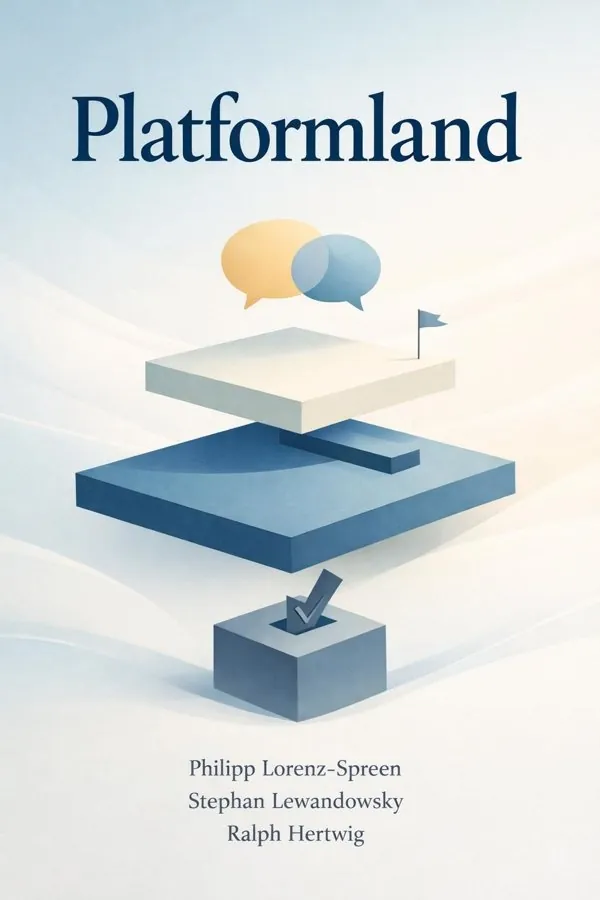
Platformland: Summary & Key Insights
by Philipp Lorenz-Spreen, Stephan Lewandowsky, Ralph Hertwig
 10 min11 chaptersAudio available
What Is Platformland About?
Platformland by Philipp Lorenz-Spreen, Stephan Lewandowsky, Ralph Hertwig is a digital_culture book spanning 11 pages. Platformland explores how digital platforms shape human behavior, public discourse, and democracy. The authors, experts in cognitive science and behavioral research, analyze the mechanisms of online influence and propose ways to design digital environments that promote informed decision-making and collective well-being.
This FizzRead summary covers all 11 key chapters of Platformland in approximately 10 minutes, distilling the most important ideas, arguments, and takeaways from Philipp Lorenz-Spreen, Stephan Lewandowsky, Ralph Hertwig's work. Also available as an audio summary and Key Quotes Podcast.
Platformland
Platformland explores how digital platforms shape human behavior, public discourse, and democracy. The authors, experts in cognitive science and behavioral research, analyze the mechanisms of online influence and propose ways to design digital environments that promote informed decision-making and collective well-being.
Who Should Read Platformland?
This book is perfect for anyone interested in digital_culture and looking to gain actionable insights in a short read. Whether you're a student, professional, or lifelong learner, the key ideas from Platformland by Philipp Lorenz-Spreen, Stephan Lewandowsky, Ralph Hertwig will help you think differently.
- ✓Readers who enjoy digital_culture and want practical takeaways
- ✓Professionals looking to apply new ideas to their work and life
- ✓Anyone who wants the core insights of Platformland in just 10 minutes
Want the full summary?
Get instant access to this book summary and 100K+ more with Fizz Moment.
Get Free SummaryAvailable on App Store • Free to download
Key Chapters
When we speak of Platformland’s origins, we’re describing the story of the past two decades of human history, in which digital platforms ascended to become both the interface and infrastructure of modern life. The migration of attention—from television and print media to online social networks—was not just a technological revolution; it was a transformation in how societies coordinate and perceive reality. Early internet culture celebrated decentralization and openness, but soon, the connective power of networks fused with the economic logic of scale and data extraction. Facebook, Google, Twitter, TikTok, YouTube—these companies didn’t merely mediate interaction; they built ecosystems whose prosperity depends upon sustained user engagement.
The rise, then, was not accidental—it was structural. Platforms monopolized the channels of attention by exploiting network effects: the more people joined, the more valuable they became to everyone else. Over time, this gravitational pull concentrated social and economic power in a handful of entities that act as de facto governors of public life. Yet what differentiates the twenty-first-century platform economy from previous media monopolies is its dynamic personalization. Every individual inhabits a slightly different Platformland, shaped by algorithmic predictions and behavioral feedback loops. The same collective infrastructure, but an atomized experience.
Tracing this evolution allows us to grasp the stakes: our informational commons are now private property. The gatekeepers of public discourse are no longer editors or broadcasters but opaque algorithms optimized for click-through rates. Platformland emerged precisely because these architectures were efficient, profitable, and humanly irresistible. Recognizing this lineage is the first step toward imagining alternatives.
In Platformland, attention is currency. Platforms are not passive conduits of content; they are behavioral laboratories. Having backgrounds in cognitive and behavioral science, we sought to expose the mechanisms through which design captures the mind. Every notification, infinite scroll, or variable reward structure reflects an experiment in applied psychology. These design choices borrow from behavioral economics and conditioning science to ensure that users return, linger, and generate data.
The architecture of attention works by exploiting core features of human cognition: novelty-seeking, social validation, intermittent reinforcement. This is why likes and shares don’t merely measure engagement; they induce it. The result is a competition not for truth, but for time—an economic race to monopolize the finite resource of human attention. When every platform optimizes for engagement, the system collectively steers toward arousal and outrage. Complex deliberation loses to emotional immediacy because algorithms learn that what provokes keeps us present.
Understanding this doesn’t mean withdrawing from digital life. It means reclaiming sovereignty over our attentional capacities. Behavioral design is not inherently manipulative—it can be used to foster reflection, learning, or cooperation. The challenge we pose in *Platformland* is how to realign these mechanisms from extraction toward empowerment. A healthier architecture of attention could still employ design insights, but with a new metric of success: not how long we stay online, but how clearly we think once we leave.
+ 9 more chapters — available in the FizzRead app
All Chapters in Platformland
About the Authors
Philipp Lorenz-Spreen is a behavioral scientist at the Max Planck Institute for Human Development. Stephan Lewandowsky is a cognitive scientist at the University of Bristol. Ralph Hertwig is a director at the Max Planck Institute for Human Development, specializing in decision science.
Get This Summary in Your Preferred Format
Read or listen to the Platformland summary by Philipp Lorenz-Spreen, Stephan Lewandowsky, Ralph Hertwig anytime, anywhere. FizzRead offers multiple formats so you can learn on your terms — all free.
Available formats: App · Audio · PDF · EPUB — All included free with FizzRead
Download Platformland PDF and EPUB Summary
Key Quotes from Platformland
“The migration of attention—from television and print media to online social networks—was not just a technological revolution; it was a transformation in how societies coordinate and perceive reality.”
“Platforms are not passive conduits of content; they are behavioral laboratories.”
Frequently Asked Questions about Platformland
Platformland by Philipp Lorenz-Spreen, Stephan Lewandowsky, Ralph Hertwig is a digital_culture book that explores key ideas across 11 chapters. Platformland explores how digital platforms shape human behavior, public discourse, and democracy. The authors, experts in cognitive science and behavioral research, analyze the mechanisms of online influence and propose ways to design digital environments that promote informed decision-making and collective well-being.
You Might Also Like

An Ugly Truth: Inside Facebook’s Battle for Domination
Sheera Frenkel, Cecilia Kang
10 min
Cyber Citizens
Ian Goodfellow
10 min
Digital Minimalism: Choosing a Focused Life in a Noisy World
Cal Newport
10 min
E‑Books & Beyond
Various Authors
10 min
The Future of Media
Various Authors
10 min
This Is Why We Can't Have Nice Things
Whitney Phillips
10 minBrowse by Category
Ready to read Platformland?
Get the full summary and 100K+ more books with Fizz Moment.