
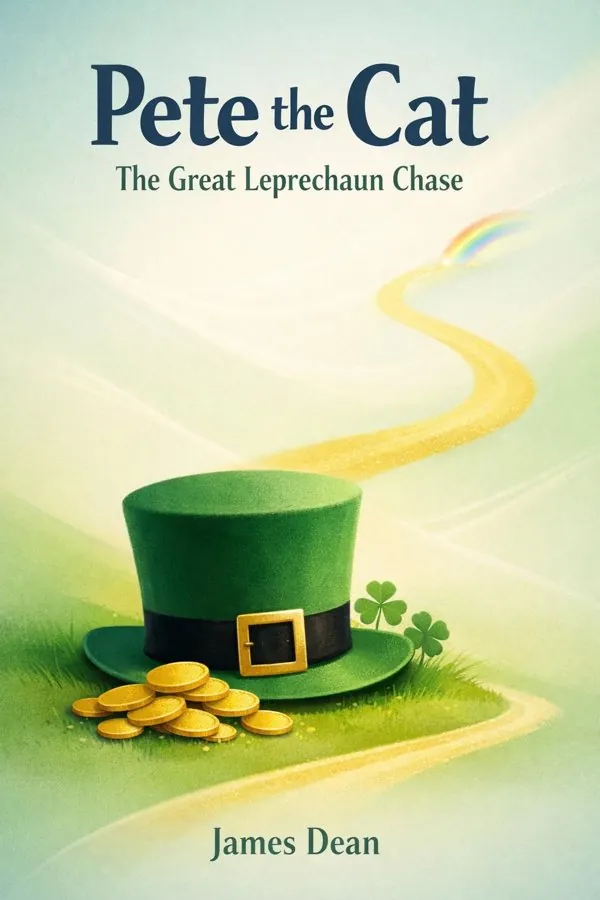
Pete the Cat: The Great Leprechaun Chase: Summary & Key Insights
by James Dean
 10 min8 chaptersAudio available
Key Takeaways from Pete the Cat: The Great Leprechaun Chase
Excitement is often the beginning of learning.
Ideas become meaningful when they move from thought into action.
The moment imagination meets reality is where growth begins.
A failed attempt is not the end of a story; it is often the point where the real lesson begins.
Many adventures become more successful the moment they stop being solo efforts.
What Is Pete the Cat: The Great Leprechaun Chase About?
Pete the Cat: The Great Leprechaun Chase by James Dean is a bestsellers book spanning 5 pages. St. Patrick’s Day often brings with it a playful question: can luck be found, or is it something we create? In Pete the Cat: The Great Leprechaun Chase, James Dean turns that question into a bright, energetic adventure for young readers. Pete wakes up surrounded by green decorations, festive excitement, and stories of leprechauns hiding treasure at the end of the rainbow. Inspired by the holiday magic, he sets out to catch Clover the Leprechaun and claim a bit of that famous luck for himself. But as Pete quickly discovers, chasing luck is not as simple as setting a trap. Beneath its cheerful illustrations and humorous turns, this picture book offers an accessible lesson about effort, imagination, resilience, and friendship. Pete’s journey shows children that setbacks are part of every adventure and that creativity often matters more than perfection. James Dean, the creator of the wildly popular Pete the Cat series, brings his signature warmth and lively artwork to a story that feels both festive and meaningful. The result is a read-aloud that entertains while gently teaching that the best kind of luck may come from trying, learning, and helping others.
This FizzRead summary covers all 8 key chapters of Pete the Cat: The Great Leprechaun Chase in approximately 10 minutes, distilling the most important ideas, arguments, and takeaways from James Dean's work. Also available as an audio summary and Key Quotes Podcast.
Pete the Cat: The Great Leprechaun Chase
St. Patrick’s Day often brings with it a playful question: can luck be found, or is it something we create? In Pete the Cat: The Great Leprechaun Chase, James Dean turns that question into a bright, energetic adventure for young readers. Pete wakes up surrounded by green decorations, festive excitement, and stories of leprechauns hiding treasure at the end of the rainbow. Inspired by the holiday magic, he sets out to catch Clover the Leprechaun and claim a bit of that famous luck for himself. But as Pete quickly discovers, chasing luck is not as simple as setting a trap.
Beneath its cheerful illustrations and humorous turns, this picture book offers an accessible lesson about effort, imagination, resilience, and friendship. Pete’s journey shows children that setbacks are part of every adventure and that creativity often matters more than perfection. James Dean, the creator of the wildly popular Pete the Cat series, brings his signature warmth and lively artwork to a story that feels both festive and meaningful. The result is a read-aloud that entertains while gently teaching that the best kind of luck may come from trying, learning, and helping others.
Who Should Read Pete the Cat: The Great Leprechaun Chase?
This book is perfect for anyone interested in bestsellers and looking to gain actionable insights in a short read. Whether you're a student, professional, or lifelong learner, the key ideas from Pete the Cat: The Great Leprechaun Chase by James Dean will help you think differently.
- ✓Readers who enjoy bestsellers and want practical takeaways
- ✓Professionals looking to apply new ideas to their work and life
- ✓Anyone who wants the core insights of Pete the Cat: The Great Leprechaun Chase in just 10 minutes
Want the full summary?
Get instant access to this book summary and 100K+ more with Fizz Moment.
Get Free SummaryAvailable on App Store • Free to download
Key Chapters
Excitement is often the beginning of learning. One of the first things this story captures is the way a special day can transform an ordinary morning into a world of possibility. Pete wakes up on St. Patrick’s Day and notices that everything seems touched by celebration: green decorations, clovers, rainbows, and the buzz of stories about leprechauns and pots of gold. That setting matters because it shows how children naturally respond to rituals, holidays, and shared traditions. A festive atmosphere gives them permission to wonder, invent, and ask big questions.
Pete’s reaction is especially important. He does not simply observe the holiday from a distance. He enters into it with curiosity and enthusiasm. This is a powerful model for young readers because it validates imaginative participation. Children often learn best when they feel invited into a theme rather than instructed about it. The story uses St. Patrick’s Day not just as decoration, but as a launchpad for inquiry: What is luck? Can it be found? What would you do if you wanted to catch something magical?
In practical terms, this idea applies far beyond the holiday itself. Parents, teachers, and caregivers can use special events as opportunities for creative thinking. A themed day can inspire drawing, pretend play, storytelling, scavenger hunts, or simple problem-solving games. The lesson is that wonder is useful. It motivates action and opens the door to learning experiences that feel joyful rather than forced.
Pete’s festive morning reminds us that imagination often begins with attention. When children notice the world around them, they begin building stories within it. Actionable takeaway: use holidays and everyday moments alike as invitations to ask, imagine, and create something new.
Ideas become meaningful when they move from thought into action. After being swept up in the excitement of St. Patrick’s Day, Pete decides he is not just going to think about leprechauns, he is going to catch one. That shift is central to the story. Pete starts his own leprechaun-catching business, gathers supplies, and creates a sign, turning a playful dream into a concrete project. For young readers, this is an early and accessible example of initiative.
What makes this moment so effective is that Pete does not wait for someone else to organize the adventure for him. He takes ownership of his goal. That models a powerful mindset: if something interests you, you can make a plan and start. The plan may be simple, imperfect, or even a little silly, but the act of beginning matters. Pete demonstrates that problem-solving often starts with preparation, experimentation, and a willingness to try.
This idea can be applied in everyday life with children through small independent projects. A child who wants to build a fort can gather blankets and clips. A child interested in bugs can make a notebook and start observing outside. A classroom might set up a pretend detective office, invention lab, or celebration station. These projects help children connect imagination with execution. They also strengthen organizational habits in a low-pressure way.
At a deeper level, Pete’s business reflects confidence. He believes his idea is worth acting on. That belief is a crucial part of learning because it encourages persistence before success appears. The story does not suggest that every plan will work perfectly. Instead, it highlights the value of designing a first attempt.
Actionable takeaway: when curiosity strikes, help turn it into a simple project with a goal, materials, and a first step.
The moment imagination meets reality is where growth begins. When Pete encounters Clover the Leprechaun, the story shifts from preparation to true challenge. Up to this point, chasing a leprechaun has been an exciting idea. But meeting Clover reveals that magical goals are rarely as easy to capture as we expect. Clover is clever, quick, and hard to outsmart, which transforms Pete’s mission from a fantasy into a test of adaptability.
This encounter matters because it teaches children that wanting something and understanding it are not the same. Pete may have pictured a straightforward capture, but Clover introduces unpredictability. In life, many goals work this way. Making a friend, learning to ride a bike, building something from blocks, or finishing a puzzle all seem simple until obstacles appear. The story gently normalizes that gap between expectation and experience.
Clover also represents the idea that mystery has value. Rather than being reduced to a prize, the leprechaun remains a lively character with agency and personality. That helps children see others, even imagined others, as more than objects to win. The chase becomes richer because it includes interaction, surprise, and perspective. In read-aloud settings, adults can pause here to ask children how Clover might feel and whether catching him is really the only goal.
This part of the story can inspire conversations about flexibility. What do you do when your plan changes? How do you respond when something is harder than expected? Children benefit from hearing that adjustment is not failure. It is part of the adventure.
Actionable takeaway: when plans meet reality, encourage children to stay curious, observe carefully, and adapt instead of giving up.
A failed attempt is not the end of a story; it is often the point where the real lesson begins. As Pete tries to catch Clover, he discovers that success does not arrive on the first try. His traps, ideas, and strategies do not unfold exactly as planned. Yet the book never frames these setbacks as reasons to quit. Instead, they become evidence that effort is a valuable part of the process.
This is one of the most useful messages for children. Many young readers live in a world where they are still learning how to tolerate frustration. A tower falls. A drawing does not look right. A game is lost. A shoe cannot be tied. Stories like this help children develop emotional resilience by showing a character who keeps going with a calm, open attitude. Pete’s persistence reflects the broader spirit of the series: stay groovy, stay steady, and keep moving.
Practical applications of this idea are everywhere. At home, adults can praise revision and effort rather than only outcomes: “You kept trying different ways,” or “You didn’t stop when it got tricky.” In classrooms, teachers can use trial-and-error activities such as simple engineering challenges, art experiments, or treasure hunts where children revise their approach. These experiences mirror Pete’s journey and help normalize productive struggle.
The story also quietly teaches that persistence does not have to look dramatic. It can be cheerful, patient, and creative. Pete is not conquering the problem through force. He is staying engaged. That is an important distinction. Persistence is less about stubbornness and more about staying in relationship with a challenge long enough to learn from it.
Actionable takeaway: when something does not work the first time, name the attempt as progress and encourage one new strategy before stopping.
Many adventures become more successful the moment they stop being solo efforts. As Pete’s leprechaun chase unfolds, the value of teamwork and shared creativity becomes increasingly clear. Whether through support, ideas, or participation, others help widen the possibilities of the mission. This shift matters because it moves the story beyond individual determination and toward community problem-solving.
Children often hear messages about independence, but this book reminds them that asking for help is also a strength. Pete’s enthusiasm may launch the adventure, yet collaboration helps sustain it. Teamwork introduces new perspectives, and new perspectives often lead to better solutions. One character may notice details another misses. One may supply encouragement when someone else feels discouraged. In this way, cooperation is not merely practical; it is emotional support as well.
This concept has immediate real-world application. A sibling treasure hunt, a classroom craft, or a family holiday project all become richer when each participant contributes something. One child can design signs, another can set up clues, another can decorate, and another can tell the story afterward. Collaborative efforts teach listening, turn-taking, and respect for different ideas. They also help children discover that collective success can feel more satisfying than individual victory.
In the context of the story, teamwork also reduces the pressure of having one perfect plan. If an idea fails, someone else may bring a new one. That dynamic encourages flexibility and shared ownership. It teaches children that being part of a group means both giving and receiving support.
Ultimately, the chase becomes less about proving what Pete can do alone and more about enjoying what can happen when creativity is shared. Actionable takeaway: invite children to solve playful problems with others and highlight how each person’s contribution improves the result.
What if luck is not something you find, but something you build? That question sits at the heart of the story’s deeper message. Pete begins the adventure chasing a traditional symbol of luck: a leprechaun and the treasure associated with him. But as events unfold, the meaning of luck changes. Good fortune starts to look less like magical reward and more like the outcome of courage, preparation, persistence, and openness.
This reinterpretation is especially powerful for children because it shifts them from passivity to agency. If luck is only accidental, then there is little a child can do except hope. But if luck can be influenced by effort, kindness, and a positive mindset, then children have real power. They can create opportunities by showing up, trying again, staying cheerful, and treating others well.
Adults can reinforce this idea with everyday language. Instead of saying, “You’re lucky you got that right,” they might say, “Your practice helped you do that,” or “You made a good choice and it worked out.” This does not erase chance, but it teaches children to recognize their own role in positive outcomes. A student who studies, a child who shares, or a friend who includes someone new may all experience the kind of “luck” that grows from action.
Pete’s lesson is not that magic is false. The story keeps its holiday wonder alive. Rather, it suggests that the best kind of magic often appears when determination meets joy. Children can hold onto fantasy while also learning responsibility.
Actionable takeaway: help children identify moments when their effort, attitude, or kindness created a good result, and call that the luck they made themselves.
Stories can teach emotional skills best when children do not feel they are being taught. One of the quiet strengths of Pete the Cat: The Great Leprechaun Chase is that its lessons are embedded in play. The chase, the surprises, the holiday setting, and the humor all keep the tone light, but beneath that lightness is a valuable model of emotional flexibility. Pete experiences anticipation, disappointment, determination, and delight without becoming overwhelmed by any one feeling.
This matters because children are constantly learning how to move through emotions. A rigid response to frustration can stop play and block learning. Pete offers another route. He stays engaged when things do not go his way. He adjusts. He keeps the experience fun. That does not mean he ignores obstacles; it means he does not let them define the whole adventure.
This concept can be practiced through everyday routines. During games, adults can model phrases like, “That didn’t work, let’s try another way,” or “I feel disappointed, but I’m not done yet.” During crafts or building activities, they can celebrate revisions as part of creativity. Even holiday activities can become chances to practice flexibility when schedules change, decorations fall, or plans need to be adjusted.
The emotional tone of the Pete the Cat series is one reason it resonates so widely. Pete embodies calm confidence. He shows children that excitement and steadiness can coexist. You can aim high without panicking when things get messy. You can want something and still smile through the process.
Actionable takeaway: use playful challenges to help children practice responding to setbacks with calm language, curiosity, and one more try.
The best picture books do more than entertain in the moment; they create opportunities for conversation afterward. Pete the Cat: The Great Leprechaun Chase works especially well as a read-aloud because it combines a simple, engaging plot with themes that invite discussion. Children can enjoy the surface adventure of trying to catch a leprechaun, while adults can draw out bigger ideas about planning, frustration, teamwork, and what luck really means.
That layered quality is one reason the book matters. It respects the intelligence of young readers without making the lesson heavy-handed. A preschooler may focus on the green holiday fun and the silly chase. An early elementary reader may begin to notice the patterns of trying, failing, and learning. A parent or teacher can use both levels at once by asking open-ended questions. What would your trap look like? Was Pete lucky, or did he work for his outcome? What would you do differently?
The story also lends itself to extension activities. Children can design their own leprechaun traps from craft supplies, write a list of “lucky” things they helped create, or go on a classroom clover hunt. These activities reinforce comprehension while keeping the tone playful. Because the book is short and visually appealing, it is also ideal for repeated reading, which helps young children build confidence and memory.
James Dean’s approachable storytelling and vivid art make the book easy to revisit. Each rereading can reveal a slightly different lesson depending on the child’s age and mood. That is a hallmark of strong children’s literature.
Actionable takeaway: after reading, ask one imaginative question and do one simple themed activity to help the story’s lesson stick.
All Chapters in Pete the Cat: The Great Leprechaun Chase
About the Author
James Dean is an American artist, author, and illustrator best known as the creator of Pete the Cat, one of the most popular characters in contemporary children’s books. Before dedicating himself fully to art, he worked as an electrical engineer, a background that makes his creative journey especially memorable. His bright colors, expressive illustrations, and easygoing storytelling style helped turn Pete the Cat into a bestselling series beloved by children, parents, teachers, and librarians. Dean’s books often blend humor, music, and simple life lessons about confidence, resilience, and curiosity. Through Pete, he has created a world that feels playful and reassuring, encouraging young readers to stay calm, keep trying, and enjoy the journey. His work continues to be a staple in homes, classrooms, and libraries around the world.
Get This Summary in Your Preferred Format
Read or listen to the Pete the Cat: The Great Leprechaun Chase summary by James Dean anytime, anywhere. FizzRead offers multiple formats so you can learn on your terms — all free.
Available formats: App · Audio · PDF · EPUB — All included free with FizzRead
Download Pete the Cat: The Great Leprechaun Chase PDF and EPUB Summary
Key Quotes from Pete the Cat: The Great Leprechaun Chase
“Excitement is often the beginning of learning.”
“Ideas become meaningful when they move from thought into action.”
“The moment imagination meets reality is where growth begins.”
“A failed attempt is not the end of a story; it is often the point where the real lesson begins.”
“Many adventures become more successful the moment they stop being solo efforts.”
Frequently Asked Questions about Pete the Cat: The Great Leprechaun Chase
Pete the Cat: The Great Leprechaun Chase by James Dean is a bestsellers book that explores key ideas across 8 chapters. St. Patrick’s Day often brings with it a playful question: can luck be found, or is it something we create? In Pete the Cat: The Great Leprechaun Chase, James Dean turns that question into a bright, energetic adventure for young readers. Pete wakes up surrounded by green decorations, festive excitement, and stories of leprechauns hiding treasure at the end of the rainbow. Inspired by the holiday magic, he sets out to catch Clover the Leprechaun and claim a bit of that famous luck for himself. But as Pete quickly discovers, chasing luck is not as simple as setting a trap. Beneath its cheerful illustrations and humorous turns, this picture book offers an accessible lesson about effort, imagination, resilience, and friendship. Pete’s journey shows children that setbacks are part of every adventure and that creativity often matters more than perfection. James Dean, the creator of the wildly popular Pete the Cat series, brings his signature warmth and lively artwork to a story that feels both festive and meaningful. The result is a read-aloud that entertains while gently teaching that the best kind of luck may come from trying, learning, and helping others.
More by James Dean
You Might Also Like

The Godfather
Mario Puzo
10 min
The Handmaid's Tale
Margaret Atwood
10 min
The Hunger Games
Suzanne Collins
10 min
The Nightingale
Kristin Hannah
10 min
The Seven Husbands of Evelyn Hugo
Taylor Jenkins Reid
10 min
Backwater Justice
Fern Michaels
10 minBrowse by Category
Ready to read Pete the Cat: The Great Leprechaun Chase?
Get the full summary and 100K+ more books with Fizz Moment.