
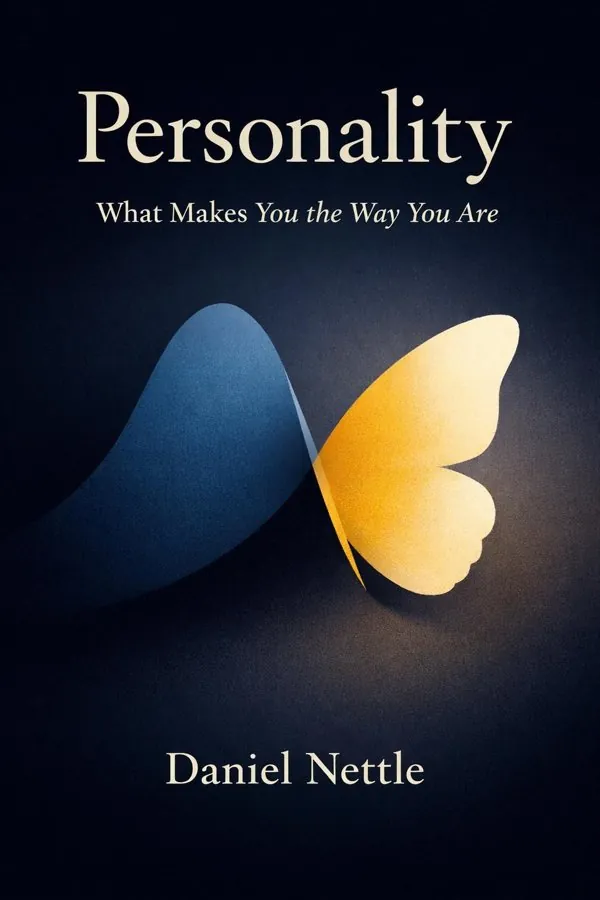
Personality: What Makes You the Way You Are: Summary & Key Insights
 10 min9 chaptersAudio available
Key Takeaways from Personality: What Makes You the Way You Are
A useful map does not capture every detail, but it helps us navigate reality.
What looks like confidence on the surface often reflects a deeper sensitivity to reward.
Anxiety is not always a flaw; sometimes it is an alarm system working exactly as designed.
Talent gets attention, but reliability often determines outcomes.
Society depends not only on intelligence or ambition, but on the ability to get along.
What Is Personality: What Makes You the Way You Are About?
Personality: What Makes You the Way You Are by Daniel Nettle is a psychology book spanning 9 pages. Why are some people energized by crowds while others are drained by them? Why does one person stay calm under pressure while another worries constantly? In Personality: What Makes You the Way You Are, Daniel Nettle tackles these questions with a clear, scientific, and deeply human approach. The book explores the structure of personality through the Big Five traits—extraversion, neuroticism, conscientiousness, agreeableness, and openness—and shows how these dimensions shape behavior, relationships, work, health, and happiness. What makes Nettle’s book especially valuable is that it avoids both simplistic labeling and vague self-help clichés. Instead, it draws from psychology, behavioral genetics, and evolutionary theory to explain not just what personality traits are, but why they exist and why variation persists. Nettle argues that no personality profile is universally best; each trait offers advantages and costs depending on context. As a respected British behavioral scientist and professor, he brings academic rigor while writing in an accessible, engaging style. The result is a compact but powerful guide to understanding why people differ—and how those differences influence nearly every part of life.
This FizzRead summary covers all 9 key chapters of Personality: What Makes You the Way You Are in approximately 10 minutes, distilling the most important ideas, arguments, and takeaways from Daniel Nettle's work. Also available as an audio summary and Key Quotes Podcast.
Personality: What Makes You the Way You Are
Why are some people energized by crowds while others are drained by them? Why does one person stay calm under pressure while another worries constantly? In Personality: What Makes You the Way You Are, Daniel Nettle tackles these questions with a clear, scientific, and deeply human approach. The book explores the structure of personality through the Big Five traits—extraversion, neuroticism, conscientiousness, agreeableness, and openness—and shows how these dimensions shape behavior, relationships, work, health, and happiness.
What makes Nettle’s book especially valuable is that it avoids both simplistic labeling and vague self-help clichés. Instead, it draws from psychology, behavioral genetics, and evolutionary theory to explain not just what personality traits are, but why they exist and why variation persists. Nettle argues that no personality profile is universally best; each trait offers advantages and costs depending on context. As a respected British behavioral scientist and professor, he brings academic rigor while writing in an accessible, engaging style. The result is a compact but powerful guide to understanding why people differ—and how those differences influence nearly every part of life.
Who Should Read Personality: What Makes You the Way You Are?
This book is perfect for anyone interested in psychology and looking to gain actionable insights in a short read. Whether you're a student, professional, or lifelong learner, the key ideas from Personality: What Makes You the Way You Are by Daniel Nettle will help you think differently.
- ✓Readers who enjoy psychology and want practical takeaways
- ✓Professionals looking to apply new ideas to their work and life
- ✓Anyone who wants the core insights of Personality: What Makes You the Way You Are in just 10 minutes
Want the full summary?
Get instant access to this book summary and 100K+ more with Fizz Moment.
Get Free SummaryAvailable on App Store • Free to download
Key Chapters
A useful map does not capture every detail, but it helps us navigate reality. That is exactly what the Big Five model does for personality. Rather than treating personality as a collection of vague labels, modern psychology organizes human differences into five broad dimensions: extraversion, neuroticism, conscientiousness, agreeableness, and openness to experience. Nettle presents this framework as the most reliable scientific way to describe how people typically think, feel, and behave.
The power of the Big Five lies in its balance between simplicity and depth. Extraversion captures sociability and reward-seeking. Neuroticism reflects emotional sensitivity and proneness to distress. Conscientiousness concerns self-control, order, and reliability. Agreeableness measures warmth, trust, and cooperativeness. Openness describes curiosity, imagination, and attraction to novelty. These traits are not rigid boxes. They are dimensions, meaning people fall somewhere along a continuum rather than fitting into neat categories.
This matters because personality influences everything from career fit to relationship style. A highly conscientious person may excel in structured work, while a highly open person may thrive in creative environments. Someone low in extraversion may prefer deep one-on-one conversations over large gatherings, and that is a difference, not a defect.
The Big Five also give us a common language for self-understanding. Instead of saying “I’m just bad with people” or “I’m weird,” we can describe ourselves more precisely. That precision helps reduce shame and improve decision-making.
Actionable takeaway: Reflect on where you fall on each of the Big Five traits and use that profile as a practical guide for choosing environments, habits, and relationships that suit your natural tendencies.
What looks like confidence on the surface often reflects a deeper sensitivity to reward. Nettle explains extraversion as more than being talkative or social. At its core, extraversion is a tendency to pursue stimulation, status, pleasure, and connection. Highly extraverted people are often energized by activity, drawn to social engagement, and more willing to take risks in pursuit of rewards.
This trait has clear benefits. Extraverts may build wider social networks, seize opportunities more quickly, and bring enthusiasm into teams. They often find it easier to initiate friendships, speak up in groups, and recover quickly from social setbacks. In a workplace, they may appear charismatic and proactive. In relationships, they may add spontaneity and emotional expressiveness.
But Nettle also emphasizes the trade-offs. The same reward sensitivity that fuels sociability can also encourage impulsiveness. Extraverts may overcommit, seek excessive stimulation, or underestimate risks. Introverts, by contrast, are not simply shy extraverts. They may be more comfortable with lower stimulation, more reflective, and more selective in their social lives.
A practical example is networking. An extravert may thrive at a large industry event, meeting dozens of people. An introvert may do better by arranging a few meaningful conversations in advance. Both strategies can work if aligned with personality.
Nettle’s broader point is that extraversion is adaptive in some contexts and costly in others. It is neither inherently better nor worse than introversion.
Actionable takeaway: Instead of trying to become more outgoing in every situation, design your social and professional life around the level of stimulation that helps you perform at your best.
Anxiety is not always a flaw; sometimes it is an alarm system working exactly as designed. Nettle treats neuroticism with unusual balance, showing that it is not simply a negative trait but a form of heightened sensitivity to threat, uncertainty, and loss. People high in neuroticism are more likely to worry, anticipate problems, and react strongly to stress. While this can lead to distress, it may also provide advantages in dangerous or unstable environments.
From an evolutionary perspective, a person who notices potential risks early may avoid harm. In modern life, that same vigilance can appear as careful planning, sensitivity to social dynamics, or strong awareness of consequences. Someone high in neuroticism might double-check travel plans, notice changes in a partner’s mood, or prepare thoroughly for an important meeting.
The cost is that the alarm system can become overactive. When the mind constantly scans for danger, everyday life feels heavier. Minor setbacks may trigger disproportionate worry. This can affect sleep, relationships, and physical health. A person may avoid useful opportunities because imagined risks feel too intense.
Nettle’s insight is that neuroticism persists because it is not pointless. It offers protective benefits, even if those benefits come bundled with emotional strain. The goal is not to shame the trait away, but to manage it wisely.
For example, a highly neurotic student might transform worry into a structured study schedule rather than endless rumination. A manager who anticipates problems can become excellent at contingency planning if they do not let fear dominate decisions.
Actionable takeaway: If you score high in neuroticism, convert worry into preparation by asking, “What specific action can I take right now?” rather than letting concern remain vague and consuming.
Talent gets attention, but reliability often determines outcomes. Nettle presents conscientiousness as the trait most closely tied to discipline, planning, persistence, and self-control. Highly conscientious people tend to be organized, punctual, dependable, and capable of delaying gratification. They are more likely to follow through on intentions rather than simply making them.
This trait matters enormously in everyday life. At school, conscientious students usually perform better not only because of ability, but because they prepare consistently and manage deadlines. At work, conscientious employees tend to be trusted with responsibility because they complete tasks and anticipate obligations. In health behavior, conscientiousness supports exercise, medication adherence, and safer long-term choices.
Yet Nettle avoids turning conscientiousness into a moral trophy. Excessive conscientiousness can become rigidity, perfectionism, or overcontrol. Someone may become so focused on order that flexibility disappears. They may struggle with spontaneity, judge others harshly for being less structured, or experience guilt whenever they are not productive.
At the lower end, less conscientious people may bring creativity, adaptability, or comfort with ambiguity, but they often pay a price in inconsistency. Bills go unpaid, goals remain vague, and opportunities slip away through avoidable disorganization.
A practical example is personal finance. A conscientious person might automate savings and track spending, creating long-term security through routine. A less conscientious person might earn well yet repeatedly feel stressed because planning never becomes a habit.
Nettle’s message is that conscientiousness is powerful because modern life rewards sustained self-regulation. But it works best when paired with realism and flexibility.
Actionable takeaway: Strengthen conscientiousness behaviorally by creating small external systems—calendars, checklists, automatic reminders—rather than relying on willpower alone.
Society depends not only on intelligence or ambition, but on the ability to get along. Nettle describes agreeableness as the tendency toward kindness, empathy, trust, and cooperation. Highly agreeable people are more likely to be considerate, forgiving, and motivated to maintain social harmony. They often avoid unnecessary conflict and care deeply about the feelings of others.
This trait is essential for families, friendships, and communities. Agreeable people often make supportive partners, attentive friends, and collaborative colleagues. In teams, they reduce friction and help groups function smoothly. In caregiving roles, agreeableness can be an enormous strength because it supports patience and responsiveness.
But again, every trait involves trade-offs. Too much agreeableness can make it hard to set boundaries, negotiate firmly, or confront harmful behavior. A highly agreeable employee may take on extra work to avoid disappointing others. A highly agreeable partner may suppress important needs in order to keep the peace. Meanwhile, people lower in agreeableness may be more competitive, skeptical, or blunt, which can be useful in adversarial settings such as negotiation, litigation, or high-stakes decision-making.
Nettle’s perspective is refreshing because it treats agreeableness not as simple niceness, but as part of a strategic social balance. Human groups need both cooperators and challengers. The question is not whether agreeableness is good, but when it helps and when it hinders.
In practice, someone high in agreeableness may need to learn assertive communication so compassion does not turn into self-erasure. Someone lower in agreeableness may need to practice perspective-taking to avoid needless conflict.
Actionable takeaway: Use agreeableness wisely by pairing empathy with clear boundaries—ask not only “How can I help?” but also “What is fair and sustainable?”
Progress often begins with a mind willing to entertain what does not yet fit. Nettle portrays openness to experience as the trait linked to imagination, intellectual curiosity, aesthetic sensitivity, and attraction to novelty. Highly open people are often drawn to ideas, art, exploration, experimentation, and unconventional perspectives. They are comfortable with complexity and less threatened by ambiguity.
This trait is especially visible in creative and intellectual life. A person high in openness may enjoy literature, travel, philosophy, music, or scientific inquiry. They are more likely to question assumptions, seek out new experiences, and combine ideas in original ways. In changing environments, this flexibility can be a major advantage because it encourages adaptation and innovation.
Still, openness has costs. A strong appetite for novelty can make routine feel stifling. Highly open individuals may generate more possibilities than they can execute. They may become fascinated by exploration but neglect practical constraints. Someone lower in openness, by contrast, may prefer familiarity, tradition, and tested methods. This can seem unimaginative, but it often supports stability and reliability.
A practical example appears in problem-solving. In a company facing stagnation, open employees may propose bold new directions and challenge outdated assumptions. But those ideas become effective only when combined with the conscientiousness to implement them and the agreeableness to bring others along.
Nettle’s wider point is that openness persists because human groups benefit from variation. Some people preserve what works; others imagine what might work better.
Actionable takeaway: If you are high in openness, channel your curiosity into one concrete experiment at a time so inspiration becomes action rather than endless possibility.
People often ask whether personality is inherited or learned, but Nettle shows that this is the wrong question. Personality develops through the constant interaction of genes and environment. Research in behavioral genetics suggests that personality traits are partly heritable, meaning that biological differences do contribute to consistent patterns in temperament and behavior. Yet inheritance does not mean destiny. Life experiences, family dynamics, culture, stress, and opportunity all influence how traits are expressed.
This interaction explains why siblings raised in the same home can be strikingly different. They share genes and much of their environment, but not all of either. They also interpret experiences differently. One child may experience parental strictness as structure; another may experience it as pressure. The same event can shape two personalities in different ways because each child brings a different temperament to it.
Nettle’s approach helps us avoid two common mistakes: blaming people entirely for their personalities, or assuming they cannot change. A person who is naturally more anxious may never become effortlessly calm, but they can learn coping strategies, choose stabilizing environments, and build habits that reduce suffering. Likewise, someone naturally impulsive can create structure that improves outcomes without pretending their baseline temperament does not exist.
This has practical implications for parenting, education, and leadership. Effective support starts with recognizing individual differences rather than imposing a one-size-fits-all standard.
Actionable takeaway: Stop asking whether your personality is fixed or flexible; instead, identify which of your tendencies are stable and then shape your environment so those tendencies work for you rather than against you.
If some traits create obvious difficulties, why has evolution not eliminated them? Nettle’s answer is one of the book’s most important contributions: personality variation persists because different traits can be advantageous in different contexts. Evolution does not produce one perfect personality. It favors strategies that can succeed under particular conditions, and human life has always involved changing environments, shifting social structures, and competing demands.
For example, high extraversion may help in gaining allies, mates, or status, but it can also increase exposure to danger. High neuroticism may heighten suffering, yet it can improve vigilance and caution. High agreeableness supports cooperation, but low agreeableness may help in competition. High openness promotes innovation, while lower openness can preserve traditions and routines that keep groups stable.
This perspective radically changes how we think about personality. Traits that seem maladaptive in one environment may be useful in another. A highly cautious person may struggle in a fast-moving sales culture but excel in safety-critical work. A bold risk-taker may fail in one setting and thrive in entrepreneurship or exploration.
Nettle does not claim every personality outcome is optimal. Rather, he shows that diversity itself is functional. Human groups benefit when individuals bring different strengths, sensitivities, and strategies. This evolutionary view also encourages humility: your preferred style is not the universal standard.
In daily life, this insight can reduce interpersonal frustration. Instead of wondering why others are not more like you, you begin to see that their dispositions may solve problems you overlook.
Actionable takeaway: When a trait in yourself or others feels inconvenient, ask in what context that trait might actually be useful; this reframing can turn irritation into understanding.
Many life outcomes that seem random are quietly shaped by personality. Nettle shows that traits affect education, work, relationships, health behavior, and subjective well-being. This does not mean personality determines fate, but it does tilt the odds. Some people repeatedly move toward certain opportunities and away from others because of their habitual ways of responding to the world.
Conscientiousness, for instance, is often associated with academic and occupational success because it supports planning and persistence. Extraversion can contribute to social connectedness and positive emotion, while neuroticism is linked to greater vulnerability to stress and mental health difficulties. Agreeableness may improve relationship quality, and openness can enrich creativity and intellectual life.
The key insight is that outcomes are rarely caused by one trait alone. Personality interacts with context. An extravert in a relationship-centered profession may flourish, while an introvert in the same role may feel depleted unless they adapt the job to suit them. A highly open person may find meaning in artistic exploration but struggle in rigid institutions. A conscientious person may prosper in structured environments but feel trapped if rules become excessive.
This idea is practical because it shifts the focus from self-judgment to person-environment fit. Instead of asking, “Why am I not succeeding like someone else?” we can ask, “What environments reward my strengths and expose my vulnerabilities?” That question leads to smarter decisions about work, habits, and partnerships.
Nettle ultimately encourages realistic self-knowledge. Personality is not an excuse, but it is a crucial piece of the puzzle.
Actionable takeaway: Review one major area of your life—career, health, or relationships—and ask whether your current environment fits your personality profile or continually fights against it.
All Chapters in Personality: What Makes You the Way You Are
About the Author
Daniel Nettle is a British behavioral scientist, author, and professor of psychology at Newcastle University. His work focuses on personality, human behavior, evolutionary psychology, and the ways biology and environment interact to shape individual differences. Trained as an interdisciplinary thinker, Nettle is known for connecting psychology with anthropology, genetics, and evolutionary theory to explain everyday human behavior in clear, accessible terms. His writing stands out for combining academic seriousness with readability, making complex ideas understandable for general audiences without sacrificing nuance. In Personality: What Makes You the Way You Are, he brings this strength to one of psychology’s most enduring questions: why people differ so consistently from one another. Nettle has written several influential books and articles on human nature, cooperation, well-being, and the evolution of behavior.
Get This Summary in Your Preferred Format
Read or listen to the Personality: What Makes You the Way You Are summary by Daniel Nettle anytime, anywhere. FizzRead offers multiple formats so you can learn on your terms — all free.
Available formats: App · Audio · PDF · EPUB — All included free with FizzRead
Download Personality: What Makes You the Way You Are PDF and EPUB Summary
Key Quotes from Personality: What Makes You the Way You Are
“A useful map does not capture every detail, but it helps us navigate reality.”
“What looks like confidence on the surface often reflects a deeper sensitivity to reward.”
“Anxiety is not always a flaw; sometimes it is an alarm system working exactly as designed.”
“Talent gets attention, but reliability often determines outcomes.”
“Society depends not only on intelligence or ambition, but on the ability to get along.”
Frequently Asked Questions about Personality: What Makes You the Way You Are
Personality: What Makes You the Way You Are by Daniel Nettle is a psychology book that explores key ideas across 9 chapters. Why are some people energized by crowds while others are drained by them? Why does one person stay calm under pressure while another worries constantly? In Personality: What Makes You the Way You Are, Daniel Nettle tackles these questions with a clear, scientific, and deeply human approach. The book explores the structure of personality through the Big Five traits—extraversion, neuroticism, conscientiousness, agreeableness, and openness—and shows how these dimensions shape behavior, relationships, work, health, and happiness. What makes Nettle’s book especially valuable is that it avoids both simplistic labeling and vague self-help clichés. Instead, it draws from psychology, behavioral genetics, and evolutionary theory to explain not just what personality traits are, but why they exist and why variation persists. Nettle argues that no personality profile is universally best; each trait offers advantages and costs depending on context. As a respected British behavioral scientist and professor, he brings academic rigor while writing in an accessible, engaging style. The result is a compact but powerful guide to understanding why people differ—and how those differences influence nearly every part of life.
You Might Also Like
The Body Keeps the Score
Bessel van der Kolk
10 min
Surrounded by Idiots
Thomas Erikson
10 min
Emotional Intelligence
Daniel Goleman
10 min
Attached
Amir Levine
10 min
Why Does He Do That
Lundy Bancroft
10 min
Women Who Run with the Wolves
Clarissa Pinkola Estés
10 minBrowse by Category
Ready to read Personality: What Makes You the Way You Are?
Get the full summary and 100K+ more books with Fizz Moment.