
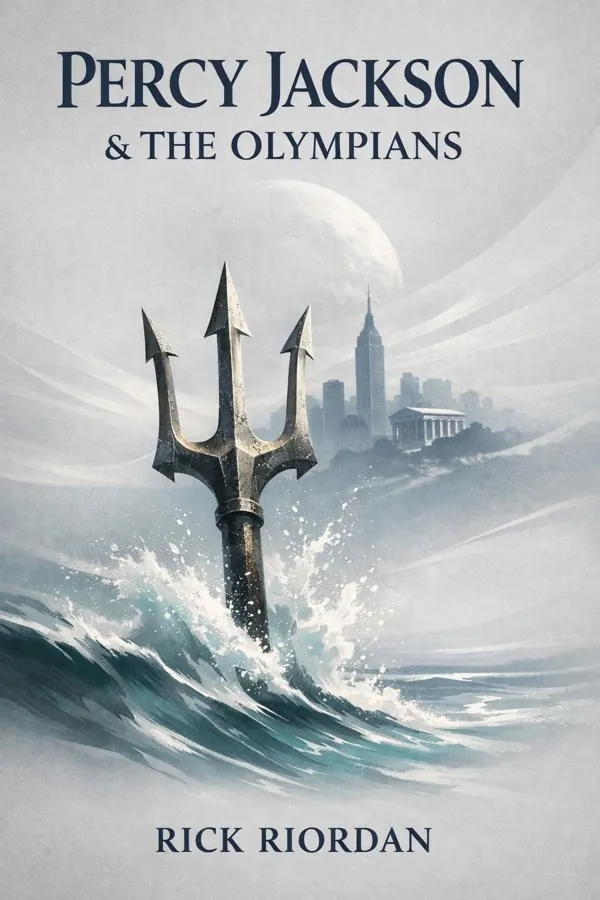
Percy Jackson & The Olympians: Summary & Key Insights
by Rick Riordan
 10 min8 chaptersAudio available
Key Takeaways from Percy Jackson & The Olympians
Sometimes the traits that make a person seem difficult in one world are exactly what make them extraordinary in another.
Reality becomes more exciting the moment we suspect it contains more than we can see.
Heroes rarely succeed alone, and Percy Jackson makes that truth both thrilling and deeply personal.
A journey becomes meaningful when every obstacle reveals character.
The most painful dangers are often the ones that come from people we believed in.
What Is Percy Jackson & The Olympians About?
Percy Jackson & The Olympians by Rick Riordan is a bestsellers book spanning 6 pages. What if the struggles that make a child feel out of place were actually signs of hidden power? Percy Jackson & The Olympians begins with that irresistible premise and builds it into one of the most beloved fantasy series of the modern era. Rick Riordan reimagines Greek mythology not as a distant collection of ancient stories, but as a living force pulsing beneath the surface of contemporary America. At the center is Percy Jackson, a twelve-year-old boy who learns that he is the son of Poseidon and that monsters, prophecies, and gods are all frighteningly real. The series matters because it does more than entertain. It gives young readers a hero who feels messy, impulsive, confused, and deeply human. It turns dyslexia, ADHD, and social alienation into signs of a different kind of intelligence and destiny. It also explores loyalty, courage, family, and the burden of choice in ways that resonate far beyond middle-grade fantasy. Riordan brings unusual authority to this world through his background as a teacher and storyteller, crafting adventures that are fast-paced, emotionally grounded, and accessible while introducing readers to timeless myths through humor, heart, and unforgettable quests.
This FizzRead summary covers all 8 key chapters of Percy Jackson & The Olympians in approximately 10 minutes, distilling the most important ideas, arguments, and takeaways from Rick Riordan's work. Also available as an audio summary and Key Quotes Podcast.
Percy Jackson & The Olympians
What if the struggles that make a child feel out of place were actually signs of hidden power? Percy Jackson & The Olympians begins with that irresistible premise and builds it into one of the most beloved fantasy series of the modern era. Rick Riordan reimagines Greek mythology not as a distant collection of ancient stories, but as a living force pulsing beneath the surface of contemporary America. At the center is Percy Jackson, a twelve-year-old boy who learns that he is the son of Poseidon and that monsters, prophecies, and gods are all frighteningly real.
The series matters because it does more than entertain. It gives young readers a hero who feels messy, impulsive, confused, and deeply human. It turns dyslexia, ADHD, and social alienation into signs of a different kind of intelligence and destiny. It also explores loyalty, courage, family, and the burden of choice in ways that resonate far beyond middle-grade fantasy. Riordan brings unusual authority to this world through his background as a teacher and storyteller, crafting adventures that are fast-paced, emotionally grounded, and accessible while introducing readers to timeless myths through humor, heart, and unforgettable quests.
Who Should Read Percy Jackson & The Olympians?
This book is perfect for anyone interested in bestsellers and looking to gain actionable insights in a short read. Whether you're a student, professional, or lifelong learner, the key ideas from Percy Jackson & The Olympians by Rick Riordan will help you think differently.
- ✓Readers who enjoy bestsellers and want practical takeaways
- ✓Professionals looking to apply new ideas to their work and life
- ✓Anyone who wants the core insights of Percy Jackson & The Olympians in just 10 minutes
Want the full summary?
Get instant access to this book summary and 100K+ more with Fizz Moment.
Get Free SummaryAvailable on App Store • Free to download
Key Chapters
Sometimes the traits that make a person seem difficult in one world are exactly what make them extraordinary in another. Percy Jackson begins life feeling like a problem to be solved. He struggles in school, gets labeled as a troublemaker, and moves from one institution to another without ever finding stability. His dyslexia and ADHD make ordinary expectations feel punishing, and his inability to fit neatly into the classroom leaves him believing something is wrong with him.
Riordan turns this familiar experience on its head. Percy’s differences are not failures of character or intelligence; they are signs that he is built for another reality. His dyslexia is linked to a brain wired for ancient Greek, and his ADHD becomes an asset in battle, sharpening his reflexes and instincts. This reinterpretation gives emotional force to the series. Percy’s story tells readers that identity is not something imposed by institutions, grades, or labels. It is something discovered through experience, courage, and context.
This idea has practical power beyond fantasy. Many people, especially young readers, internalize the message that if they do not thrive under conventional systems, they must be inadequate. Percy’s journey offers a more generous possibility: perhaps the environment is the mismatch, not the person. A child who fidgets may be energetic and alert. A student who struggles with standard teaching may learn differently, not poorly.
The deeper lesson is that self-understanding often begins where social judgment ends. Instead of asking, “Why am I not like everyone else?” Percy learns to ask, “What am I uniquely made for?” Actionable takeaway: rethink one personal “weakness” as a potential strength that needs the right setting to emerge.
Heroes rarely succeed alone, and Percy Jackson makes that truth both thrilling and deeply personal. Once Percy enters the world of demigods, he quickly learns that bravery is not enough. He needs allies who challenge him, protect him, and help him grow. Annabeth Chase brings intelligence, strategy, and ambition. Grover Underwood brings loyalty, empathy, and persistence. Together, they become more than travel companions. They become the emotional center of the story.
This friendship matters because each character carries wounds and hopes that shape the group dynamic. Annabeth longs to prove herself and wrestles with pride, insecurity, and her complicated relationship with her divine mother. Grover feels the weight of past failures and his own fear, yet keeps moving forward because he cares deeply for his friends. Percy is impulsive, courageous, and often uncertain, and his friendships help convert raw instinct into moral action.
Riordan shows that meaningful friendship is not built on sameness. Percy, Annabeth, and Grover disagree, misread one another, and bring very different strengths to the quest. That diversity is exactly what makes them effective. One sees patterns, another sees danger, and another sees people. In practical life, strong teams often work the same way. The best collaborators do not duplicate each other; they compensate for each other.
The series also reminds readers that trust develops through repeated acts of loyalty. Friendship is not sentiment alone. It is staying, listening, risking, forgiving, and showing up when circumstances become frightening. That is why these relationships feel so memorable. They are tested under pressure and made stronger by it.
Actionable takeaway: identify one close relationship in your life and ask what strength that person adds to you that you could never create alone.
A journey becomes meaningful when every obstacle reveals character. Percy’s cross-country quest to recover Zeus’s stolen lightning bolt is more than a race against time. It is the structure through which he learns who he is, what he values, and what kind of hero he wants to become. As Percy, Annabeth, and Grover move from New York to the Underworld and beyond, they confront monsters, temptations, and puzzles that test not just their power, but their judgment.
Each stop on the quest works on two levels. On the surface, there is action: Medusa’s trap, the Lotus Casino, Ares’s interference, and the descent into the realm of Hades. Beneath that action, Riordan explores a classic heroic truth: every challenge tempts the hero to surrender something essential. Sometimes it is attention. Sometimes it is courage. Sometimes it is moral clarity. The Lotus Casino, for example, is not dangerous because it attacks the heroes outright. It is dangerous because it offers comfort, distraction, and forgetfulness. That makes it one of the series’ most modern ideas.
Readers can apply this lesson easily. Most people are not dodging mythological monsters, but they do face distractions that delay purpose, authorities that manipulate fear, and choices that reveal priorities. The quest teaches that progress requires both movement and memory. You must know what you are trying to protect, or you will lose yourself in what feels pleasurable or urgent.
The brilliance of the journey is that Percy does not become heroic all at once. He becomes heroic decision by decision. That is encouraging because real growth happens the same way.
Actionable takeaway: when facing a difficult goal, define your “lightning bolt” clearly so distractions do not pull you away from what matters most.
The most painful dangers are often the ones that come from people we believed in. One of the most powerful turns in Percy Jackson & The Olympians is the revelation that the conflict surrounding the stolen master bolt is connected to betrayal from within the demigod world. Luke, who initially appears charismatic, capable, and sympathetic, is ultimately revealed as someone who has turned against Olympus and chosen a darker path.
This twist matters because it complicates the moral universe of the story. Until that point, Percy’s enemies often look like monsters from legend. Luke shows that resentment, disillusionment, and manipulation can be more dangerous than any beast. He is not evil in a simplistic way. He is wounded by the failures of the gods, especially their neglect of their children. His anger makes emotional sense, which is exactly why his betrayal is so unsettling. Riordan suggests that injustice left unaddressed can become a doorway to destruction.
For Percy, this is a coming-of-age moment. He learns that trust must be earned carefully and that appearances are unreliable. Strength, charm, and intelligence do not guarantee integrity. At the same time, the series does not encourage paranoia. Instead, it asks readers to become morally discerning. The answer to betrayal is not to trust no one. It is to pair trust with wisdom.
This idea applies widely. In school, work, or relationships, people often place confidence in those who seem most polished rather than those who consistently act with honesty. Luke’s betrayal reminds us to pay attention to patterns, motives, and character over image.
The story also raises a harder question: what systems create bitterness so deep that people become vulnerable to destructive causes? That question gives the series moral depth.
Actionable takeaway: trust people for their repeated actions, not their first impression or strongest charisma.
Identity is not handed to Percy as a finished answer; it is forged through painful recognition and chosen responsibility. By the end of the first arc and across the series, Percy no longer sees himself as a confused outsider waiting for life to explain itself. He begins to accept that being Poseidon’s son comes with gifts, burdens, and expectations. More importantly, he learns that lineage matters less than the choices he makes with it.
This distinction is crucial. In many fantasy stories, special heritage can feel like a shortcut to greatness. Riordan resists that simplification. Percy’s divine parentage explains some of his abilities, but it does not solve his emotional conflicts, guarantee good decisions, or spare him from suffering. He still has to develop discipline, loyalty, and moral courage. He still has to decide whether he will be ruled by anger, pride, fear, or compassion.
The practical lesson is powerful. Many people search for identity in labels alone: family background, diagnosis, talent, social role, or external recognition. Percy’s journey suggests that identity has two dimensions. One is inherited or discovered. The other is built. Knowing where you come from can be important, but becoming who you are requires action.
This is especially meaningful for young readers. Adolescence often feels like waiting for a defining truth to appear. Percy shows that selfhood emerges through relationships, decisions, failures, and commitment. You may discover something special about yourself, but that discovery becomes meaningful only when it is translated into responsibility.
In the end, Percy’s growth is not about becoming less flawed. It is about becoming more conscious, more faithful, and more willing to stand for what is right even when the cost is high.
Actionable takeaway: define yourself not only by what you are given, but by one responsibility you are willing to carry consistently.
Authority becomes dangerous when it demands reverence without earning trust. One of the most compelling features of Percy Jackson & The Olympians is its portrayal of the Greek gods not as perfect beings, but as powerful, vain, emotional, and often irresponsible figures. Zeus is proud and quick to anger. Poseidon is distant, though not uncaring. Athena is brilliant but severe. Ares is driven by conflict. The gods shape events, but they do not model wisdom consistently.
This matters because the series refuses to romanticize power. The Olympians are awe-inspiring, yet their flaws create many of the problems their children must endure. Demigods suffer neglect, rivalry, and danger partly because the gods are inconsistent parents and unstable rulers. Riordan thereby transforms ancient mythology into a reflection on modern authority: leaders can be impressive and still fail morally.
For readers, this introduces a healthy skepticism. Respect for power should not erase critical thinking. Percy and his friends learn that even divine commands must be interpreted with conscience. Obedience alone is not virtue. Sometimes real courage means serving a larger good rather than flattering the powerful.
This dynamic has practical relevance in everyday life. Teachers, bosses, institutions, celebrities, and political leaders may hold influence, but influence does not equal infallibility. Mature judgment requires separating title from character. At the same time, the series does not slide into cynicism. The gods are flawed, yet the world still contains loyalty, courage, and justice because individuals choose to embody them.
The central insight is liberating: even when authority fails, you are not excused from moral responsibility. In fact, your responsibility may become greater.
Actionable takeaway: when evaluating authority, ask not only who has power, but how they use it and what values your own conscience must still uphold.
Knowing that fate exists does not remove the burden of choice; it intensifies it. Prophecy hangs over Percy Jackson & The Olympians as both a promise and a threat. Demigods live with the knowledge that ancient predictions may shape their futures, and Percy himself becomes entangled in larger destinies involving gods, war, and the possibility of catastrophic outcomes.
Riordan handles prophecy in a nuanced way. It does not function like a rigid script that erases freedom. Instead, it creates tension between what may happen and how characters respond. A prophecy can point toward danger, but it cannot dictate a person’s integrity. It can describe consequences, but not replace judgment. This is why the series remains dramatically alive. If destiny were mechanical, heroism would be unnecessary. What matters is not only what is foretold, but who someone becomes while confronting it.
That idea translates well to real life. People often feel bound by expectations from family, culture, background, or even their own past behavior. They may think, “This is just who I will become,” or “This is what my life is heading toward.” Percy’s world argues for a more complex truth. Circumstances shape us, but they do not eliminate agency. Pressure is real. Patterns are real. But decisions still matter.
This perspective is especially useful when facing labels or predictions. A student told they are unlikely to succeed can still choose discipline. A person from a difficult background can still choose integrity. Fate may define the battlefield, but character defines how one fights on it.
By making prophecy a burden rather than a shortcut, Riordan preserves what readers most need from a hero story: the belief that courage has meaning precisely because the future is not simple.
Actionable takeaway: when you feel trapped by expectations, separate what is influencing you from what you still have the power to choose.
All Chapters in Percy Jackson & The Olympians
About the Author
Rick Riordan is an American author whose mythology-based fiction has become a global phenomenon. Before writing full time, he taught middle school English and history, an experience that shaped his lively, accessible storytelling style and his strong understanding of young readers. He rose to international fame with Percy Jackson & The Olympians, a series that reimagines Greek mythology in the modern world through humor, action, and emotional insight. Riordan later expanded his mythological universe with bestselling series such as The Heroes of Olympus, The Kane Chronicles, and Magnus Chase and the Gods of Asgard. His books have been translated into many languages and have sold millions of copies worldwide. He is especially admired for making ancient myths feel fresh, inclusive, and deeply relevant to contemporary readers.
Get This Summary in Your Preferred Format
Read or listen to the Percy Jackson & The Olympians summary by Rick Riordan anytime, anywhere. FizzRead offers multiple formats so you can learn on your terms — all free.
Available formats: App · Audio · PDF · EPUB — All included free with FizzRead
Download Percy Jackson & The Olympians PDF and EPUB Summary
Key Quotes from Percy Jackson & The Olympians
“Sometimes the traits that make a person seem difficult in one world are exactly what make them extraordinary in another.”
“Reality becomes more exciting the moment we suspect it contains more than we can see.”
“Heroes rarely succeed alone, and Percy Jackson makes that truth both thrilling and deeply personal.”
“A journey becomes meaningful when every obstacle reveals character.”
“The most painful dangers are often the ones that come from people we believed in.”
Frequently Asked Questions about Percy Jackson & The Olympians
Percy Jackson & The Olympians by Rick Riordan is a bestsellers book that explores key ideas across 8 chapters. What if the struggles that make a child feel out of place were actually signs of hidden power? Percy Jackson & The Olympians begins with that irresistible premise and builds it into one of the most beloved fantasy series of the modern era. Rick Riordan reimagines Greek mythology not as a distant collection of ancient stories, but as a living force pulsing beneath the surface of contemporary America. At the center is Percy Jackson, a twelve-year-old boy who learns that he is the son of Poseidon and that monsters, prophecies, and gods are all frighteningly real. The series matters because it does more than entertain. It gives young readers a hero who feels messy, impulsive, confused, and deeply human. It turns dyslexia, ADHD, and social alienation into signs of a different kind of intelligence and destiny. It also explores loyalty, courage, family, and the burden of choice in ways that resonate far beyond middle-grade fantasy. Riordan brings unusual authority to this world through his background as a teacher and storyteller, crafting adventures that are fast-paced, emotionally grounded, and accessible while introducing readers to timeless myths through humor, heart, and unforgettable quests.
More by Rick Riordan

You Might Also Like

The Godfather
Mario Puzo
10 min
The Handmaid's Tale
Margaret Atwood
10 min
The Hunger Games
Suzanne Collins
10 min
The Nightingale
Kristin Hannah
10 min
The Seven Husbands of Evelyn Hugo
Taylor Jenkins Reid
10 min
Backwater Justice
Fern Michaels
10 minBrowse by Category
Ready to read Percy Jackson & The Olympians?
Get the full summary and 100K+ more books with Fizz Moment.