
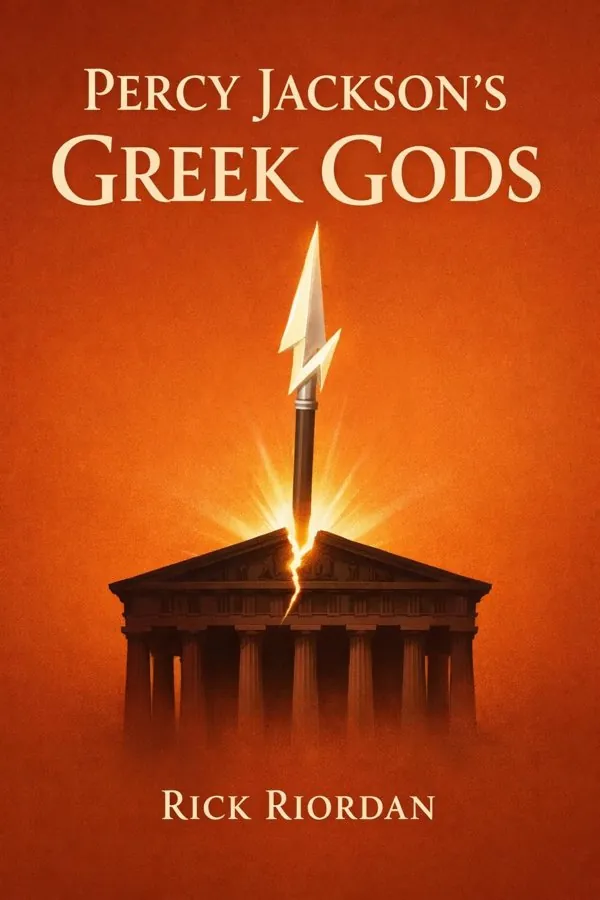
Percy Jackson's Greek Gods: Summary & Key Insights
by Rick Riordan
 10 min8 chaptersAudio available
Key Takeaways from Percy Jackson's Greek Gods
Every civilization tries to answer the same impossible question: how did everything begin?
Power often begins as liberation and ends by repeating the habits it once fought against.
The gods endure because they do not feel abstract; they feel recognizably human.
If gods are immortal, why are so many Greek myths really about humans?
People often assume that reverence is the only proper way to approach ancient literature.
What Is Percy Jackson's Greek Gods About?
Percy Jackson's Greek Gods by Rick Riordan is a classics book spanning 4 pages. What happens when the oldest stories in Western civilization get retold by a sarcastic modern demigod? Percy Jackson's Greek Gods answers that question with energy, humor, and surprising depth. In this lively collection, Rick Riordan reimagines the origins and adventures of the Greek gods through the voice of Percy Jackson, turning myths that can feel distant or intimidating into stories that are immediate, funny, and unforgettable. From Chaos and the Titans to Zeus, Athena, Apollo, and the rest of the Olympians, the book introduces readers to the major figures of Greek mythology while preserving their drama, danger, and weirdness. What makes this book matter is not just that it entertains. It helps readers understand where so many later stories, symbols, and ideas come from. Greek myths shape literature, art, psychology, and modern storytelling, and Riordan makes those roots accessible without draining them of their power. As a former teacher and the bestselling author who built a global readership by blending mythology with contemporary fiction, Riordan has rare authority here. He knows how to teach myth, and he knows how to make readers care. The result is a smart, playful gateway to the Greek gods that works for both new readers and longtime mythology fans.
This FizzRead summary covers all 8 key chapters of Percy Jackson's Greek Gods in approximately 10 minutes, distilling the most important ideas, arguments, and takeaways from Rick Riordan's work. Also available as an audio summary and Key Quotes Podcast.
Percy Jackson's Greek Gods
What happens when the oldest stories in Western civilization get retold by a sarcastic modern demigod? Percy Jackson's Greek Gods answers that question with energy, humor, and surprising depth. In this lively collection, Rick Riordan reimagines the origins and adventures of the Greek gods through the voice of Percy Jackson, turning myths that can feel distant or intimidating into stories that are immediate, funny, and unforgettable. From Chaos and the Titans to Zeus, Athena, Apollo, and the rest of the Olympians, the book introduces readers to the major figures of Greek mythology while preserving their drama, danger, and weirdness.
What makes this book matter is not just that it entertains. It helps readers understand where so many later stories, symbols, and ideas come from. Greek myths shape literature, art, psychology, and modern storytelling, and Riordan makes those roots accessible without draining them of their power. As a former teacher and the bestselling author who built a global readership by blending mythology with contemporary fiction, Riordan has rare authority here. He knows how to teach myth, and he knows how to make readers care. The result is a smart, playful gateway to the Greek gods that works for both new readers and longtime mythology fans.
Who Should Read Percy Jackson's Greek Gods?
This book is perfect for anyone interested in classics and looking to gain actionable insights in a short read. Whether you're a student, professional, or lifelong learner, the key ideas from Percy Jackson's Greek Gods by Rick Riordan will help you think differently.
- ✓Readers who enjoy classics and want practical takeaways
- ✓Professionals looking to apply new ideas to their work and life
- ✓Anyone who wants the core insights of Percy Jackson's Greek Gods in just 10 minutes
Want the full summary?
Get instant access to this book summary and 100K+ more with Fizz Moment.
Get Free SummaryAvailable on App Store • Free to download
Key Chapters
Every civilization tries to answer the same impossible question: how did everything begin? In Greek mythology, the answer is not a clean scientific process or a tidy moral design. It starts with Chaos, a vast emptiness from which the first beings emerge. Gaia, the Earth, comes into being, followed by Uranus, the sky, and eventually the powerful Titans. Percy’s retelling emphasizes that the Greek version of creation is messy, violent, and deeply personal. The universe does not unfold according to a master plan. It develops through family tensions, ambition, betrayal, and raw elemental force.
That matters because Riordan helps readers see mythology as an early attempt to make sense of a confusing world. The Greeks used gods and primordial beings to explain natural realities: earth and sky, day and night, creation and destruction. But these stories also reflect human realities. Uranus fears his children. Gaia rebels against cruelty. Kronos rises through violence and sets the stage for another cycle of fear. The myths suggest that disorder does not disappear once the world begins; it remains built into existence itself.
In practical terms, this section shows why origin stories matter. Families create them, nations create them, and individuals create them too. We all tell stories about where we came from in order to explain who we are. Riordan encourages readers to look beneath the fantasy and ask what each story reveals about the people who told it.
Actionable takeaway: When you encounter any origin story, ask two questions: what does it explain, and what fear or hope lies underneath it?
Power often begins as liberation and ends by repeating the habits it once fought against. That is one of the sharpest insights in the story of Zeus. After Kronos seizes control from Uranus, he becomes obsessed with a prophecy that one of his own children will overthrow him. To prevent that fate, he swallows his offspring at birth. Zeus survives only because his mother Rhea hides him away, and once he grows up, he returns to force Kronos to release the others. Together, Zeus and his siblings defeat the Titans and establish a new divine order.
Percy tells this story with humor, but the pattern underneath is serious. The myths are filled with rulers who claim authority by defeating chaos, only to create fresh chaos through fear and control. Zeus is undoubtedly powerful, even heroic in some moments, yet he is also insecure, impulsive, and often unjust. Riordan does not flatten him into a simple villain or ideal king. Instead, Zeus becomes a study in the instability of leadership built on force alone.
This idea has modern applications. In families, schools, companies, and governments, leaders often assume that holding power gives them wisdom. The myth warns otherwise. Overcontrolling leadership breeds rebellion. Fear-based leadership may succeed temporarily, but it cannot create trust. Zeus wins the war, but he never escapes the insecurity that shaped his rise.
Riordan’s retelling helps younger readers understand that authority deserves examination, not automatic worship. Even the king of the gods can be flawed.
Actionable takeaway: When evaluating any leader, look beyond strength and ask whether their power creates stability, fairness, and trust.
The gods endure because they do not feel abstract; they feel recognizably human. One of the great pleasures of Percy Jackson's Greek Gods is the way each Olympian emerges as a larger-than-life personality rather than a dry entry in a reference book. Poseidon is moody and magnificent, Hades is stern and misunderstood, Athena is brilliant and strategic, Aphrodite is irresistible and dangerous, Ares is aggression with a spear, and Apollo shines with talent and ego in equal measure. Even when they govern cosmic forces, they behave like an especially dramatic extended family.
Riordan’s genius lies in showing that the gods represent both natural domains and human tendencies. Athena is not just wisdom; she is the sharp intelligence that can become pride. Ares is not just war; he is the thrill of conflict for its own sake. Demeter reflects nurture and grief. Hera embodies marriage, loyalty, and jealousy. These figures help readers understand that myths endure because they personify recurring traits in human life.
That makes the Olympians surprisingly useful as interpretive tools. In classrooms, they can help students remember symbolic associations. In personal reflection, they can act like exaggerated mirrors. A person obsessed with recognition might see some Apollo in themselves. Someone who values planning over impulse may identify with Athena. The point is not to reduce people to mythic labels, but to recognize patterns of temperament, desire, and conflict.
By giving each god a vivid voice and memorable behavior, Riordan turns mythology into character study. Readers do not just learn who the gods are. They learn why these figures still feel alive.
Actionable takeaway: Use the Olympians as symbolic lenses; when facing a conflict, ask which traits are driving it and which god-like pattern it resembles.
If gods are immortal, why are so many Greek myths really about humans? Because the chaos of divine behavior matters most when it collides with mortal life. Percy’s narration repeatedly shows that ordinary people in these stories are not just bystanders. They are victims, favorites, warning examples, accidental heroes, and sometimes the only characters who reveal the emotional cost of divine decisions. Through mortals, the myths become less about supernatural spectacle and more about consequences.
This is where the book becomes especially meaningful. Greek myths are often strange, unfair, and morally mixed. Good people suffer. Arrogant people get punished, but so do unlucky people. Love turns dangerous. Beauty invites trouble. Curiosity can be noble or fatal. Riordan does not sanitize this unpredictability. Instead, he frames it with Percy’s modern skepticism, helping readers process the madness without losing the drama. The result is an accessible introduction to an important truth: myths are not simple moral fables. They are explorations of risk, pride, desire, fate, and power.
In practical life, that complexity is valuable. People often look for stories with clear heroes, villains, and lessons. Greek mythology resists that simplicity. It teaches readers to hold ambiguity, to recognize that actions can have unintended consequences, and to see how power affects the vulnerable. That makes mythology a useful training ground for critical thinking as much as imagination.
Riordan’s retelling invites readers to laugh at the absurdity while also noticing the emotional reality beneath it. The madness means something because it reflects the unpredictability of life itself.
Actionable takeaway: When a story seems unfair or chaotic, do not ask only who was right; ask what the story reveals about power, vulnerability, and consequence.
People often assume that reverence is the only proper way to approach ancient literature. Riordan proves the opposite. Humor can be one of the most effective paths into serious material. Percy’s snarky voice, modern comparisons, and impatient commentary make Greek mythology feel less like a school assignment and more like a set of wild stories being told by a friend who cannot believe how ridiculous the gods are. Instead of reducing the myths, the humor opens them up.
This matters because many readers first meet mythology through intimidating summaries, dense textbooks, or lists of names to memorize. Riordan lowers that barrier. He keeps the essential events and personalities intact, but he translates tone and context into something contemporary readers can understand. The jokes provide relief in stories full of violence, vanity, betrayal, and cosmic absurdity. More importantly, they help readers remember what they read. A vivid, funny retelling often sticks longer than a solemn explanation.
There is also a broader lesson here about learning. People absorb difficult subjects more effectively when they feel welcomed rather than judged. Teachers, parents, and communicators in any field can learn from Riordan’s method: respect the material, but do not trap it behind formality. The goal is not to make everything silly. It is to make complexity approachable.
In everyday life, this applies to how we share knowledge. Whether you are explaining history, science, or culture, warmth and wit can help others engage deeply. Percy’s voice reminds readers that classics survive not because they are untouchable, but because they can still be retold.
Actionable takeaway: When tackling a challenging subject, look for or create an entry point that is lively, human, and memorable rather than overly formal.
Strip away the lightning bolts and magical weapons, and Greek mythology is often one long family argument. Parents fear their children, siblings compete for power, spouses betray one another, and grudges outlast centuries. In Percy Jackson's Greek Gods, Riordan highlights how central family conflict is to the mythic universe. The battles are cosmic, but the motivations are intimate: jealousy, favoritism, resentment, insecurity, and the desire to be seen or obeyed.
That focus helps explain why the myths remain compelling. Readers may never fight Titans, but they understand tense households, difficult parents, rival siblings, and messy loyalty. Zeus, Hera, Poseidon, Demeter, Hestia, and Hades are not just rulers of domains; they are relatives trapped in a dysfunctional power structure. Their divine status amplifies familiar emotional patterns. One god’s bitterness can reshape the world, which is a mythic exaggeration of a truth readers already know: unresolved family conflict can affect everyone around it.
Riordan uses Percy’s perspective to underline the absurdity of these dynamics without dismissing them. The gods are powerful precisely when they are emotionally unstable, which makes them both funny and dangerous. That duality offers a useful lens for modern readers. It suggests that intelligence, talent, or authority does not automatically produce emotional maturity.
In practical terms, this key idea encourages readers to pay attention to inherited patterns. Families pass along stories, fears, and habits. Mythology dramatizes those patterns at full volume. Recognizing them can help people respond more thoughtfully in their own lives rather than simply repeating them.
Actionable takeaway: Notice recurring patterns in your relationships, especially around control, favoritism, and resentment, and choose one pattern you want to interrupt rather than continue.
Mythology lasts because it tells the truth in exaggerated form. The Greek gods are immortal, but their personalities are full of recognizably human contradictions. They are wise and petty, generous and cruel, protective and destructive. In Riordan’s retelling, this becomes one of the book’s strongest themes: the gods are not models of moral perfection. They are dramatized versions of human strengths and flaws, blown up to mythic scale.
Athena’s intelligence can become arrogance. Aphrodite’s beauty and charm can provoke obsession or manipulation. Dionysus offers ecstasy and release, but also excess and instability. Hermes is cleverness, travel, and trade, yet also trickery. Even Hestia, one of the gentlest deities, represents a value system that can be overlooked in a world obsessed with spectacle. By presenting each god as both force and personality, Riordan helps readers move beyond simple labels.
This idea is practically useful because symbolic thinking can sharpen self-awareness. Instead of treating personality traits as fixed identities, readers can understand them as powers with risks attached. Confidence can become vanity. Discipline can become rigidity. Passion can become chaos. Myth offers a memorable way to think about balance. The Greeks understood that every strength has a shadow when taken too far.
For readers, especially younger ones, this is a subtle but powerful lesson. Admiration does not require imitation. You can appreciate Athena’s brilliance without embracing pride, or value Ares’s courage without glorifying violence. Riordan preserves the entertainment while inviting reflection.
Actionable takeaway: Identify one personal strength you rely on most, then ask what its “mythic shadow” looks like when that strength goes too far.
Many readers meet Greek mythology after they have already absorbed its influence everywhere. That is one reason Percy Jackson's Greek Gods feels so rewarding: it helps readers recognize the hidden architecture behind modern storytelling. The Greek gods and their myths still shape novels, films, superhero tales, psychology, branding, art, and everyday language. References to narcissism, Midas touches, Herculean tasks, or Achilles’ heels all come from this mythic tradition.
Riordan’s book matters not just as a retelling, but as a cultural decoder. By introducing the major gods in a vivid, accessible way, he gives readers tools for understanding later stories. Modern fiction constantly revisits ancient themes: rebellious children, flawed leaders, quests for identity, dangerous ambition, temptation, vengeance, and the tension between fate and free will. The Percy Jackson universe itself is proof that these myths still generate new imagination.
This has practical applications for students and general readers alike. Knowing the myths deepens reading comprehension, improves cultural literacy, and makes references in literature and media easier to catch. It can also improve writing. Creators who understand mythic patterns gain access to archetypes, symbols, and narrative structures that still resonate with audiences.
Riordan never treats mythology like dead material. His adaptation shows that old stories survive when they keep being retold in new voices. That is the real secret of the classics: they are not frozen in the past. They remain useful because they keep helping people name recurring experiences.
Actionable takeaway: The next time you watch a movie or read a novel, look for one mythic pattern or Greek reference and consider how the ancient story has been reshaped for a modern audience.
All Chapters in Percy Jackson's Greek Gods
About the Author
Rick Riordan is an American bestselling author celebrated for reinventing mythology for modern readers. Before becoming a full-time writer, he taught middle school English and history, an experience that shaped his energetic, accessible storytelling style. He became internationally famous with Percy Jackson & the Olympians, a series that blends Greek mythology, humor, and contemporary adventure through the eyes of a relatable young hero. Riordan later expanded his mythological world through series based on Roman, Egyptian, and Norse traditions, building a vast body of work that has introduced millions of readers to ancient stories. Known for balancing entertainment with education, he has had a major influence on children’s and young adult fantasy. His books are widely praised for making classical myths feel fresh, funny, and relevant.
Get This Summary in Your Preferred Format
Read or listen to the Percy Jackson's Greek Gods summary by Rick Riordan anytime, anywhere. FizzRead offers multiple formats so you can learn on your terms — all free.
Available formats: App · Audio · PDF · EPUB — All included free with FizzRead
Download Percy Jackson's Greek Gods PDF and EPUB Summary
Key Quotes from Percy Jackson's Greek Gods
“Every civilization tries to answer the same impossible question: how did everything begin?”
“Power often begins as liberation and ends by repeating the habits it once fought against.”
“The gods endure because they do not feel abstract; they feel recognizably human.”
“If gods are immortal, why are so many Greek myths really about humans?”
“People often assume that reverence is the only proper way to approach ancient literature.”
Frequently Asked Questions about Percy Jackson's Greek Gods
Percy Jackson's Greek Gods by Rick Riordan is a classics book that explores key ideas across 8 chapters. What happens when the oldest stories in Western civilization get retold by a sarcastic modern demigod? Percy Jackson's Greek Gods answers that question with energy, humor, and surprising depth. In this lively collection, Rick Riordan reimagines the origins and adventures of the Greek gods through the voice of Percy Jackson, turning myths that can feel distant or intimidating into stories that are immediate, funny, and unforgettable. From Chaos and the Titans to Zeus, Athena, Apollo, and the rest of the Olympians, the book introduces readers to the major figures of Greek mythology while preserving their drama, danger, and weirdness. What makes this book matter is not just that it entertains. It helps readers understand where so many later stories, symbols, and ideas come from. Greek myths shape literature, art, psychology, and modern storytelling, and Riordan makes those roots accessible without draining them of their power. As a former teacher and the bestselling author who built a global readership by blending mythology with contemporary fiction, Riordan has rare authority here. He knows how to teach myth, and he knows how to make readers care. The result is a smart, playful gateway to the Greek gods that works for both new readers and longtime mythology fans.
More by Rick Riordan

You Might Also Like




Browse by Category
Ready to read Percy Jackson's Greek Gods?
Get the full summary and 100K+ more books with Fizz Moment.