
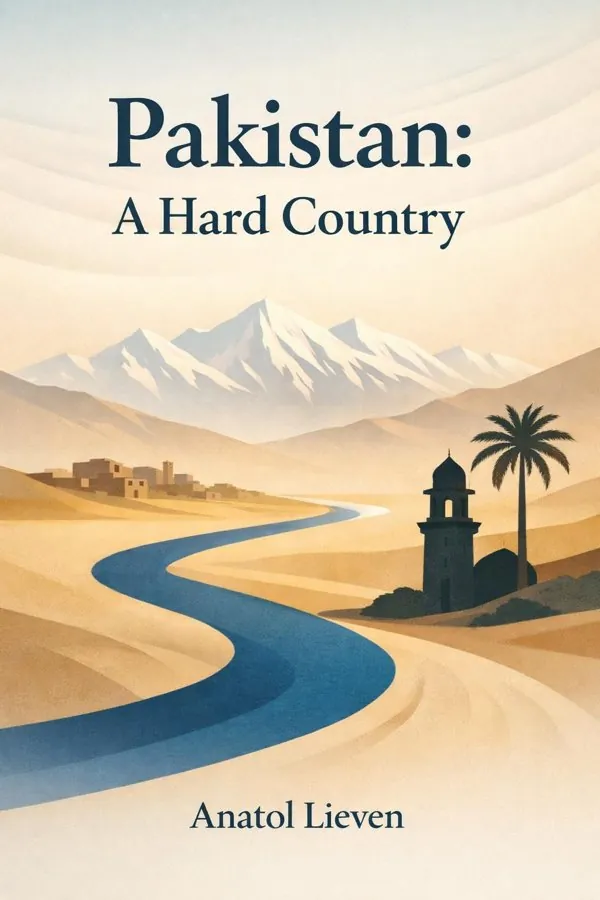
Pakistan: A Hard Country: Summary & Key Insights
 10 min9 chaptersAudio available
Key Takeaways from Pakistan: A Hard Country
Nations do not simply begin on independence day; they carry their birth trauma for generations.
A map can mislead if it suggests political unity where social reality is fragmented.
What looks like dysfunction from the outside may actually be a different system of order.
A country can be institutionally weak without being close to collapse.
Religion in Pakistan is not a single political force; it is a field of identity, morality, legitimacy, and contestation.
What Is Pakistan: A Hard Country About?
Pakistan: A Hard Country by Anatol Lieven is a politics book spanning 13 pages. Pakistan is often described through a narrow vocabulary of crisis: coups, terrorism, corruption, extremism, and instability. In Pakistan: A Hard Country, Anatol Lieven pushes beyond these clichés to ask a deeper question: how does Pakistan continue to function, endure, and adapt despite its immense structural weaknesses? Drawing on extensive travel, interviews, historical analysis, and years of reporting, Lieven presents Pakistan not as a mystery or a failed state, but as a resilient society shaped by kinship, religion, regional loyalties, military power, and pragmatic survival. What makes this book so valuable is its refusal to settle for simplistic judgments. Lieven explains why Pakistan’s formal institutions often appear weak while its informal social structures remain remarkably strong. He examines the legacy of Partition, the power of biradari and patronage, the role of Islam, the dominance of the army, and the tensions between urban modernity and rural hierarchy. The result is a nuanced portrait of a country that is internally divided yet persistently durable. For readers seeking to understand South Asia, security politics, or state resilience under pressure, this book offers one of the most grounded and illuminating accounts available.
This FizzRead summary covers all 9 key chapters of Pakistan: A Hard Country in approximately 10 minutes, distilling the most important ideas, arguments, and takeaways from Anatol Lieven's work. Also available as an audio summary and Key Quotes Podcast.
Pakistan: A Hard Country
Pakistan is often described through a narrow vocabulary of crisis: coups, terrorism, corruption, extremism, and instability. In Pakistan: A Hard Country, Anatol Lieven pushes beyond these clichés to ask a deeper question: how does Pakistan continue to function, endure, and adapt despite its immense structural weaknesses? Drawing on extensive travel, interviews, historical analysis, and years of reporting, Lieven presents Pakistan not as a mystery or a failed state, but as a resilient society shaped by kinship, religion, regional loyalties, military power, and pragmatic survival.
What makes this book so valuable is its refusal to settle for simplistic judgments. Lieven explains why Pakistan’s formal institutions often appear weak while its informal social structures remain remarkably strong. He examines the legacy of Partition, the power of biradari and patronage, the role of Islam, the dominance of the army, and the tensions between urban modernity and rural hierarchy. The result is a nuanced portrait of a country that is internally divided yet persistently durable. For readers seeking to understand South Asia, security politics, or state resilience under pressure, this book offers one of the most grounded and illuminating accounts available.
Who Should Read Pakistan: A Hard Country?
This book is perfect for anyone interested in politics and looking to gain actionable insights in a short read. Whether you're a student, professional, or lifelong learner, the key ideas from Pakistan: A Hard Country by Anatol Lieven will help you think differently.
- ✓Readers who enjoy politics and want practical takeaways
- ✓Professionals looking to apply new ideas to their work and life
- ✓Anyone who wants the core insights of Pakistan: A Hard Country in just 10 minutes
Want the full summary?
Get instant access to this book summary and 100K+ more with Fizz Moment.
Get Free SummaryAvailable on App Store • Free to download
Key Chapters
Nations do not simply begin on independence day; they carry their birth trauma for generations. Lieven argues that Pakistan cannot be understood without returning to the upheaval of 1947, when British India was divided and millions were displaced in one of the bloodiest migrations in modern history. Pakistan emerged not from a settled national consensus, but from a contested political process driven by Muslim insecurity, elite bargaining, and the urgent fear of domination in a Hindu-majority India.
This origin mattered because it gave Pakistan both a powerful ideological foundation and a chronic identity problem. Islam provided the central argument for statehood, but it did not erase deep linguistic, ethnic, provincial, and class divisions. Punjabis, Sindhis, Baloch, Pashtuns, and Muhajirs did not become socially uniform because they shared a state. Partition also entrenched India as the defining external reference point, shaping military priorities, national narratives, and emotional politics for decades.
Lieven shows that these early conditions created a state with high insecurity and uneven legitimacy. The institutions of Pakistan were built quickly and under pressure, while the social consequences of Partition continued to ripple through migration, landholding, urban politics, and memory. Even debates about nationalism, federalism, and religion still echo the unfinished questions of the country’s creation.
A practical way to apply this insight is to resist judging Pakistan only by present-day headlines. Any serious analysis of its politics, security behavior, or identity debates must begin with the historical wounds and strategic anxieties of its founding. Actionable takeaway: when evaluating Pakistan, always ask how Partition-era fears and narratives are still influencing current choices.
A map can mislead if it suggests political unity where social reality is fragmented. One of Lieven’s most important insights is that Pakistan’s geography is not merely background; it is a central force shaping political behavior, state capacity, and regional identity. The country contains fertile river plains, mountain frontiers, arid deserts, tribal belts, megacities, and coastal commercial zones, each producing different social structures and political priorities.
Punjab, with its demographic weight and agricultural wealth, occupies a dominant place in the state. Sindh combines rural landlordism with the urban dynamism and ethnic complexity of Karachi. Balochistan is territorially vast but sparsely populated, with a long history of resentment toward the center. The Pashtun belt, stretching toward Afghanistan, has been shaped by cross-border ties, tribal structures, and geopolitical conflict. These regions are linked by the state but not homogenized by it.
Lieven explains that this diversity helps clarify why centralized reforms often falter. Policies designed in Islamabad may collide with local customs, patronage networks, and power balances that vary dramatically by province. Geography also affects security: porous borders, rugged terrain, and historically autonomous regions limit the reach of bureaucratic governance.
For readers, the broader lesson is that states are often less coherent than they appear from the outside. To understand Pakistan’s politics, one must think regionally, not just nationally. Analysts, journalists, and policymakers often make mistakes when they treat events in Lahore, Karachi, Quetta, and Peshawar as if they were expressions of the same social world. Actionable takeaway: whenever you read about Pakistan, identify the province or region involved before drawing conclusions about the country as a whole.
What looks like dysfunction from the outside may actually be a different system of order. Lieven emphasizes that in Pakistan, kinship, clan ties, and patronage networks frequently matter more than impersonal state institutions. Biradari, family alliances, local loyalties, and reciprocal obligations shape how people seek justice, secure jobs, win elections, and survive economic uncertainty. This does not mean the state is irrelevant; it means state power is filtered through social relationships.
In many communities, a politician is valued not for abstract policy commitments but for the ability to deliver favors, mediate disputes, protect supporters, and bring resources to the group. Similarly, courts, police, and bureaucracy are often approached through personal connections rather than neutral procedure. These patterns can encourage corruption and inequality, but Lieven warns against dismissing them too quickly. In contexts where formal institutions are weak, slow, or inaccessible, kinship systems also provide welfare, security, and dispute resolution.
The practical significance of this idea is enormous. Development programs, anti-corruption reforms, and democratic projects often fail when they assume that citizens primarily interact as isolated individuals. In Pakistan, social embeddedness matters. Reforms that ignore local power brokers, family structures, and reciprocal obligations may look elegant on paper but collapse in implementation.
This insight also helps explain political continuity. Elites are reproduced not only by wealth but by durable networks of loyalty. If you want to understand why certain families remain influential across generations, look beyond ideology to embedded social capital. Actionable takeaway: when analyzing power in Pakistan, follow relationships and obligations, not just official titles and constitutional rules.
A country can be institutionally weak without being close to collapse. One of Lieven’s central arguments is that Pakistan survives because its state is uneven rather than absent. Certain institutions fail regularly, public services can be poor, and legal enforcement is inconsistent. Yet the state still retains important sources of continuity, including bureaucracy, taxation, district administration, political routines, and above all the military. Pakistan does not fit neatly into the label of a failed state because many of its core systems continue operating, even if imperfectly.
Lieven urges readers to distinguish between formal weakness and practical endurance. Courts may be overloaded, police politicized, and civilian governments unstable, but the state still organizes elections, manages provinces, extracts loyalty, and reproduces elite authority. It can be fragmented and resilient at the same time. This duality explains why outside observers repeatedly predict collapse while Pakistan repeatedly muddles through.
This perspective is especially useful for understanding governance in difficult environments. States do not need full Weberian rationality to endure. They can persist through patchwork arrangements, negotiated authority, and selective effectiveness. In Pakistan, order is often achieved not by universal law but by bargains among institutions, elites, local bosses, and security actors.
For practical application, this means reform efforts should focus on strengthening what already works rather than imagining a total institutional reset. Incremental improvements in local administration, taxation, policing, and judicial access may matter more than grand constitutional rhetoric. Actionable takeaway: judge Pakistan’s state capacity sector by sector, because broad claims of either stability or collapse usually miss the reality of partial but persistent governance.
Religion in Pakistan is not a single political force; it is a field of identity, morality, legitimacy, and contestation. Lieven shows that Islam has been central to Pakistan’s existence from the beginning, serving as the emotional and ideological basis for a state created in the name of South Asia’s Muslims. Yet the very breadth of Islamic identity creates tension: it can unite people across ethnicity and class, but it can also intensify conflict over who represents authentic Islam and how religion should shape law and politics.
Lieven carefully avoids simplistic claims that Pakistan is either naturally extremist or straightforwardly secular. Instead, he demonstrates that religious belief in Pakistan is often conservative, sincere, and socially rooted, while support for radical revolution is much narrower. Most Pakistanis may value Islam deeply without supporting militant ideology. Religious parties often perform modestly in elections, yet Islamic language remains politically powerful because it confers moral legitimacy and national coherence.
This distinction matters. Islam in Pakistan operates not only through clerics or parties, but through education, family life, public ritual, charity, law, and national symbolism. Political actors of many kinds, including secular elites and military rulers, invoke religion to bolster authority. At the same time, sectarian differences and doctrinal disputes can produce violence when manipulated by organizations or geopolitical agendas.
The broader lesson is to treat religion as a social reality rather than a slogan. Any serious understanding of Pakistan must recognize both the integrative and destabilizing uses of Islam. Actionable takeaway: when assessing religious politics in Pakistan, separate everyday faith from organized extremism and ask who is using Islamic language, for what purpose, and with what social support.
When civilian institutions are mistrusted, the military often becomes more than an army. In Lieven’s account, Pakistan’s military is the single most cohesive and effective national institution, and its influence extends far beyond defense. Built in the shadow of conflict with India and reinforced by repeated civilian failures, the army came to see itself as the ultimate guardian of national stability, territorial integrity, and state survival.
This self-image helps explain the military’s enduring political role. It has ruled directly through coups, shaped policy from behind the scenes under civilian governments, and dominated security and foreign affairs even when not formally in charge. Its legitimacy is rooted not only in force but in comparative institutional performance: many Pakistanis have viewed the military as more disciplined, meritocratic, and nationally minded than political parties or civil bureaucracies.
Lieven does not romanticize this role. Military dominance distorts democracy, narrows policy debate, protects unaccountable power, and can encourage dangerous strategic habits, particularly regarding India and Afghanistan. Yet he insists that the army’s influence cannot be understood purely as authoritarian ambition. It also reflects the weakness of alternative institutions and the state’s deep security anxieties.
For analysts and citizens alike, the key is to understand civil-military relations as structural, not episodic. Elections alone do not resolve them. Lasting civilian authority requires stronger parties, better governance, and greater public confidence in nonmilitary institutions.
This insight applies beyond Pakistan too: wherever one institution clearly outperforms others, it may expand into domains not originally its own. Actionable takeaway: to understand Pakistan’s major decisions, always consider not just elected leaders but the military’s interests, worldview, and institutional leverage.
Modernization does not erase old hierarchies; it often reshapes them. Lieven challenges the idea that Pakistan can be neatly divided between a backward feudal countryside and a progressive modern city. Rural landlord power remains significant in many areas, especially through control of land, labor, credit, and electoral influence. Yet urbanization, migration, media growth, education, and the expansion of a middle class have introduced new energies that complicate older patterns.
In rural Pakistan, large landowners often act as political brokers, mediators, and patrons. Their influence is sustained not just by wealth but by dependence: tenants and local families may rely on them for protection, access, and dispute settlement. This weakens programmatic politics and reinforces personalized electoral behavior. But urban growth has created new constituencies less tied to agrarian hierarchy. Cities like Karachi and Lahore have generated professionals, traders, students, activists, and media consumers with different expectations from the state.
Still, urban Pakistan is not automatically liberal or institutionally clean. Cities can also intensify ethnic competition, clientelism, religious mobilization, and informal economies. Middle-class frustration may produce support for reform, but also impatience with democratic compromise. Lieven’s point is not that Pakistan is moving in a simple direction, but that old and new forms of power are layered together.
This is practically important because many forecasts overestimate linear social change. Electoral behavior, reform prospects, and class politics must be understood as hybrid. Rural patronage and urban aspiration coexist and interact.
Actionable takeaway: when evaluating Pakistan’s political future, avoid assuming that urban growth alone will dissolve entrenched power; instead, watch how new classes negotiate with old elites.
States often fear ideological enemies, but internal fragmentation can be the deeper danger. Lieven argues that Pakistan’s most serious long-term challenge is not simply Islamist militancy or constitutional instability, but the persistent strain of ethnic and regional tensions. The country’s provinces and peoples are bound together by a common state and shared Islamic identity, yet they also carry distinct histories, grievances, and political aspirations that can challenge national cohesion.
This is especially visible in Balochistan, where resentment over resource extraction, military repression, and political marginalization has fueled recurring insurgency. Sindhi, Pashtun, and Muhajir politics have also reflected struggles over language, migration, representation, and local control. Even Punjab’s dominance, though often normalized, creates imbalance by feeding perceptions that the central state serves some regions better than others.
Lieven’s analysis is valuable because he shows that these conflicts are rarely just about culture. They are about power, resources, dignity, and recognition. Ethnic identity becomes politically explosive when combined with economic exclusion, weak federal arrangements, or heavy-handed security responses. The lesson is that national unity cannot rest on symbolism alone; it requires a workable balance between central authority and provincial autonomy.
This idea has broad relevance for multiethnic states everywhere. Shared religion or nationalism may help hold a country together, but durable cohesion depends on fair institutions and negotiated inclusion. For Pakistan, strengthening federalism, local governance, and equitable resource distribution is not merely administrative reform; it is state preservation. Actionable takeaway: when studying Pakistan’s stability, pay close attention to provincial grievances, because the future of the state may hinge more on federal accommodation than on ideological slogans.
A state’s external obsessions can reshape its internal life. Lieven makes clear that Pakistan’s relationships with India and Afghanistan are not separate foreign policy files; they are central to the country’s domestic politics, military structure, ideological framing, and security crises. The enduring conflict with India has justified military primacy, sustained strategic paranoia, and narrowed room for civilian reorientation. Meanwhile, the Afghan frontier has drawn Pakistan into decades of proxy warfare, refugee flows, tribal militarization, and militant blowback.
The rivalry with India, especially over Kashmir, has reinforced the idea that Pakistan faces an existential threat requiring constant vigilance. This has elevated the army’s institutional status and made compromise politically risky. On the western border, support for Afghan Islamist actors during the anti-Soviet war and later strategic competition in Afghanistan produced networks that did not remain controllable. Some militant groups initially seen as useful foreign policy instruments evolved into domestic threats.
Lieven’s insight is especially sharp here: Pakistan’s security establishment often pursued short-term strategic depth while underestimating the long-term social and political costs. Militancy, sectarian violence, and radicalization did not remain neatly confined to frontier zones. They seeped into cities, politics, education, and public fear.
For readers, the practical lesson is to reject the domestic-foreign divide in understanding fragile states. External strategy can deeply distort internal development. In Pakistan’s case, peace with neighbors and a less militarized regional posture could free resources and political space for governance reform.
Actionable takeaway: to assess Pakistan’s internal stability, always examine how its India and Afghanistan policies are feeding incentives, narratives, and institutions at home.
All Chapters in Pakistan: A Hard Country
About the Author
Anatol Lieven is a British author, journalist, and policy analyst known for his work on international relations, nationalism, conflict, and security. Over the course of his career, he has reported for major publications including The Times and the Financial Times, covering regions such as South Asia, Russia, and Eastern Europe. His writing is respected for combining firsthand observation with deep historical and political analysis. Lieven has also worked in research and academic settings, including as a senior research fellow associated with Georgetown University in Qatar. His expertise on Pakistan is grounded not only in scholarship but in extensive travel, interviews, and long engagement with the region. That blend of field reporting and strategic insight makes him an especially authoritative guide to Pakistan’s complex realities.
Get This Summary in Your Preferred Format
Read or listen to the Pakistan: A Hard Country summary by Anatol Lieven anytime, anywhere. FizzRead offers multiple formats so you can learn on your terms — all free.
Available formats: App · Audio · PDF · EPUB — All included free with FizzRead
Download Pakistan: A Hard Country PDF and EPUB Summary
Key Quotes from Pakistan: A Hard Country
“Nations do not simply begin on independence day; they carry their birth trauma for generations.”
“A map can mislead if it suggests political unity where social reality is fragmented.”
“What looks like dysfunction from the outside may actually be a different system of order.”
“A country can be institutionally weak without being close to collapse.”
“Religion in Pakistan is not a single political force; it is a field of identity, morality, legitimacy, and contestation.”
Frequently Asked Questions about Pakistan: A Hard Country
Pakistan: A Hard Country by Anatol Lieven is a politics book that explores key ideas across 9 chapters. Pakistan is often described through a narrow vocabulary of crisis: coups, terrorism, corruption, extremism, and instability. In Pakistan: A Hard Country, Anatol Lieven pushes beyond these clichés to ask a deeper question: how does Pakistan continue to function, endure, and adapt despite its immense structural weaknesses? Drawing on extensive travel, interviews, historical analysis, and years of reporting, Lieven presents Pakistan not as a mystery or a failed state, but as a resilient society shaped by kinship, religion, regional loyalties, military power, and pragmatic survival. What makes this book so valuable is its refusal to settle for simplistic judgments. Lieven explains why Pakistan’s formal institutions often appear weak while its informal social structures remain remarkably strong. He examines the legacy of Partition, the power of biradari and patronage, the role of Islam, the dominance of the army, and the tensions between urban modernity and rural hierarchy. The result is a nuanced portrait of a country that is internally divided yet persistently durable. For readers seeking to understand South Asia, security politics, or state resilience under pressure, this book offers one of the most grounded and illuminating accounts available.
You Might Also Like
Antifa: The Anti-Fascist Handbook
Mark Bray
10 min
Attack from Within: How Disinformation Is Sabotaging America
Barbara McQuade
10 min
Coercion, Capital, and European States, AD 990–1992
Charles Tilly
10 min
Digital Democracy: Concepts, Methodologies, Tools, and Applications
Various Authors
10 min
Fascism
Stanley G. Payne
10 min
Fire And Fury: Inside The Trump White House
Michael Wolff
10 minBrowse by Category
Ready to read Pakistan: A Hard Country?
Get the full summary and 100K+ more books with Fizz Moment.