
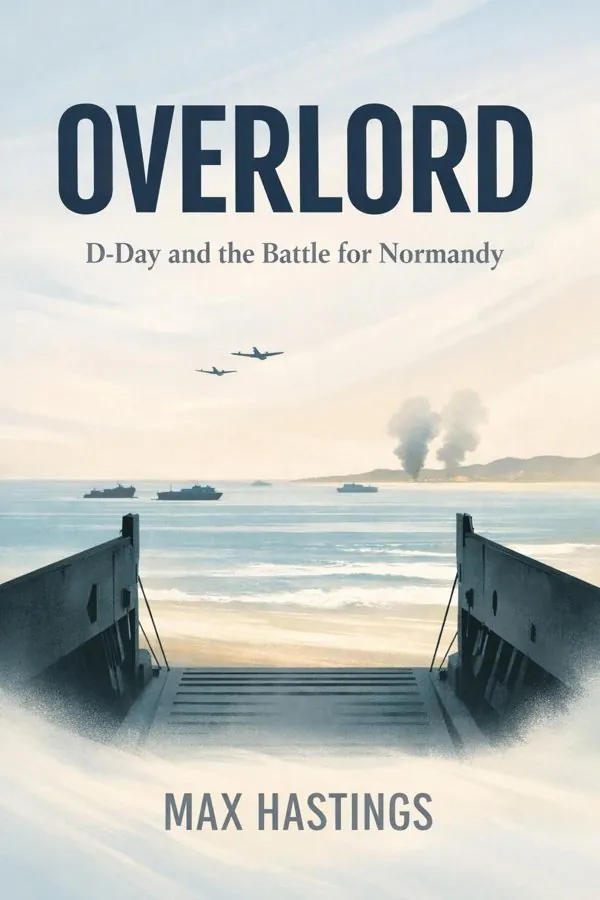
Overlord: D-Day and the Battle for Normandy: Summary & Key Insights
by Max Hastings
 10 min10 chaptersAudio available
Key Takeaways from Overlord: D-Day and the Battle for Normandy
Great campaigns are often remembered for their drama, but they begin in grim necessity.
Military genius is often romanticized, but Hastings reminds us that large victories are usually won by managers of friction rather than masters of flair.
Defenders can lose wars not only through weakness, but through disagreement about how to fight.
Sometimes the most important battlefield achievement happens before the first shot is fired.
Elite units are often imagined as instruments of precision, yet Hastings shows that the airborne assaults before dawn on D-Day were defined as much by disorder as by courage.
What Is Overlord: D-Day and the Battle for Normandy About?
Overlord: D-Day and the Battle for Normandy by Max Hastings is a war_military book spanning 10 pages. Some victories become so famous that they harden into legend. In Overlord: D-Day and the Battle for Normandy, Max Hastings breaks open the legend of D-Day and shows the invasion as it was actually lived: chaotic, costly, improvised, and profoundly human. The book follows the Allied landings of June 6, 1944, and the brutal campaign that followed across the Norman beaches, villages, hedgerows, and roads until the German army in France was shattered. Rather than presenting a simple triumphalist narrative, Hastings asks harder questions about leadership, planning, morale, combat effectiveness, and the price paid by soldiers and civilians alike. What makes the book matter is its refusal to separate strategy from suffering. Hastings combines high command decisions with eyewitness testimony from infantrymen, paratroopers, tank crews, sailors, and French civilians, revealing how grand plans were shaped by weather, fear, confusion, luck, and endurance. His authority comes from deep archival research, journalistic sharpness, and an exceptional talent for turning military history into vivid human history. The result is not just a study of a decisive campaign, but a powerful meditation on what modern war demands from nations and individuals.
This FizzRead summary covers all 10 key chapters of Overlord: D-Day and the Battle for Normandy in approximately 10 minutes, distilling the most important ideas, arguments, and takeaways from Max Hastings's work. Also available as an audio summary and Key Quotes Podcast.
Overlord: D-Day and the Battle for Normandy
Some victories become so famous that they harden into legend. In Overlord: D-Day and the Battle for Normandy, Max Hastings breaks open the legend of D-Day and shows the invasion as it was actually lived: chaotic, costly, improvised, and profoundly human. The book follows the Allied landings of June 6, 1944, and the brutal campaign that followed across the Norman beaches, villages, hedgerows, and roads until the German army in France was shattered. Rather than presenting a simple triumphalist narrative, Hastings asks harder questions about leadership, planning, morale, combat effectiveness, and the price paid by soldiers and civilians alike.
What makes the book matter is its refusal to separate strategy from suffering. Hastings combines high command decisions with eyewitness testimony from infantrymen, paratroopers, tank crews, sailors, and French civilians, revealing how grand plans were shaped by weather, fear, confusion, luck, and endurance. His authority comes from deep archival research, journalistic sharpness, and an exceptional talent for turning military history into vivid human history. The result is not just a study of a decisive campaign, but a powerful meditation on what modern war demands from nations and individuals.
Who Should Read Overlord: D-Day and the Battle for Normandy?
This book is perfect for anyone interested in war_military and looking to gain actionable insights in a short read. Whether you're a student, professional, or lifelong learner, the key ideas from Overlord: D-Day and the Battle for Normandy by Max Hastings will help you think differently.
- ✓Readers who enjoy war_military and want practical takeaways
- ✓Professionals looking to apply new ideas to their work and life
- ✓Anyone who wants the core insights of Overlord: D-Day and the Battle for Normandy in just 10 minutes
Want the full summary?
Get instant access to this book summary and 100K+ more with Fizz Moment.
Get Free SummaryAvailable on App Store • Free to download
Key Chapters
Great campaigns are often remembered for their drama, but they begin in grim necessity. Hastings shows that by early 1944 the Allies had reached a strategic point where a direct return to Western Europe was no longer optional. The Soviet Union had carried a crushing burden on the Eastern Front and demanded a second front. Air power and bombing alone could not defeat Germany. Mediterranean operations had weakened the Axis, but they could not deliver the decisive blow. To end the war in Europe, the Western Allies had to land a huge army in France and keep it there.
This context matters because it corrects a common misunderstanding: D-Day was not chosen because it was easy or because leaders were overconfident. It was chosen because every alternative was worse. Delay would have prolonged the war, strained Allied unity, and left Hitler free to concentrate forces elsewhere. Hastings highlights the immense logistical challenge behind the decision: assembling landing craft, training multinational forces, stockpiling fuel and ammunition, and coordinating air, naval, and ground power on an unprecedented scale.
In practical terms, the story offers a lesson in strategic timing. Leaders in any field sometimes face moments when conditions are imperfect but action is unavoidable. Waiting for ideal certainty can be more dangerous than acting amid risk. Overlord succeeded not because uncertainty disappeared, but because the Allies accepted that decisive action demanded imperfect knowledge, disciplined preparation, and political resolve.
Actionable takeaway: When a mission is essential, stop asking whether conditions are perfect and start asking whether your preparation is strong enough to move despite uncertainty.
Military genius is often romanticized, but Hastings reminds us that large victories are usually won by managers of friction rather than masters of flair. At the top of Overlord stood Dwight D. Eisenhower and Bernard Montgomery, very different men united by necessity more than temperament. Eisenhower was not the most dazzling battlefield technician, but he excelled at the political and interpersonal labor required to hold together a coalition of Americans, Britons, Canadians, and others with competing priorities and egos. Montgomery, by contrast, was intensely self-confident, methodical, and difficult, yet often brilliant in shaping operational plans and imposing clarity on chaos.
Hastings treats leadership with balance. He neither worships commanders nor dismisses them. He shows how their personalities affected outcomes: Montgomery’s insistence on broad-front landings improved the invasion plan, while later controversies around Caen reflected both ambition and overstatement. Eisenhower’s calm under pressure proved indispensable when weather, casualties, and delays threatened confidence. Good command, the book argues, is not only about issuing orders. It is about absorbing uncertainty, managing talent, containing vanity, and preserving unity under stress.
This has broad application beyond military history. In complex organizations, leaders rarely succeed by personal brilliance alone. They win by aligning capable but difficult people around a common objective, making decisions with incomplete information, and owning responsibility when outcomes are mixed. Hastings shows that command is as much emotional labor as strategic calculation.
Actionable takeaway: In high-stakes teamwork, judge leadership not just by bold ideas, but by the ability to maintain trust, coherence, and momentum among strong personalities.
Defenders can lose wars not only through weakness, but through disagreement about how to fight. Hastings uses Field Marshal Erwin Rommel and the Atlantic Wall to illustrate a central German dilemma before D-Day. Rommel believed Allied air superiority made deep maneuver nearly impossible. If the invasion came, he thought, it had to be crushed at the water’s edge before Allied troops, tanks, and supplies built unstoppable momentum inland. Other German commanders favored holding armored reserves back for a concentrated counterattack once the main landing site was identified.
The problem was not simply which theory was right. It was that Germany never resolved the dispute cleanly. Hitler’s command system, built on rivalry, delay, and personal interference, produced dangerous ambiguity. Panzer units were split, authority was blurred, and reaction time suffered. The Atlantic Wall itself, much publicized by Nazi propaganda, was formidable in places but inconsistent overall. Beach obstacles, minefields, strongpoints, and artillery could inflict heavy casualties, yet static defenses were only as effective as the system directing them.
Hastings also shows Rommel as more than a legend. He was energetic, realistic about Germany’s worsening prospects, and deeply aware of Allied material superiority. Still, no defensive genius could compensate for fractured command and strategic overextension. In modern terms, this is a warning against building appearances of strength without decision-making clarity. Institutions often invest in visible barriers while neglecting the authority structures that determine whether those barriers can be used effectively.
Actionable takeaway: A strong defense requires more than assets and fortifications; make sure decision rights are clear before the crisis begins.
Sometimes the most important battlefield achievement happens before the first shot is fired. Hastings explains how Operation Fortitude and the broader deception campaign helped make Overlord viable by persuading German leaders that the main Allied blow might fall at Pas-de-Calais rather than Normandy. Through dummy formations, fake radio traffic, double agents, controlled leaks, and the careful cultivation of German expectations, the Allies amplified confusion at exactly the moment clarity mattered most.
The brilliance of deception was not that it created fantasy from nothing. It worked because it exploited what the Germans were already inclined to believe. Pas-de-Calais was the shortest route across the Channel and therefore seemed the most logical invasion point. Allied planners reinforced that assumption, encouraging the Germans to hesitate and to retain important forces away from Normandy even after the landings began. This delay bought precious time for vulnerable beachheads to harden into an expanding front.
Hastings’s treatment reveals a practical truth about competition: successful deception aligns with the opponent’s existing mental model. Whether in business, diplomacy, or security, people are easiest to mislead when false signals confirm what they already expect. The lesson is not simply to admire Allied cleverness, but to understand how assumptions become vulnerabilities. Organizations often fail because they defend against what is possible in theory while overlooking what they are psychologically primed to miss.
Actionable takeaway: Test your plans against your own assumptions, because the enemy, competitor, or crisis will likely exploit what you already believe to be obvious.
Elite units are often imagined as instruments of precision, yet Hastings shows that the airborne assaults before dawn on D-Day were defined as much by disorder as by courage. American and British paratroopers and glider troops were dropped to seize bridges, secure flanks, disrupt German communications, and prevent counterattacks against the beaches. Weather, darkness, anti-aircraft fire, navigation problems, and hurried timing scattered many units far from their intended drop zones. Small groups landed in marshes, orchards, villages, and flooded fields, often without clear knowledge of where they were.
What followed is one of the book’s most revealing themes: disciplined initiative can compensate for broken plans. Rather than waiting for perfect regrouping, officers and enlisted men improvised. Ad hoc formations attacked gun batteries, captured crossings, ambushed patrols, and created the impression of larger forces than actually existed. The airborne troops did not achieve every objective neatly, but they generated disruption out of proportion to their numbers and helped protect the seaborne invasion at a critical moment.
This episode has wide relevance. In any complex project, early execution rarely matches the blueprint. Teams may be separated from resources, information may be incomplete, and coordination may break down. The decisive question then becomes whether people at the edge can understand intent and act independently. Hastings values not only bravery, but adaptability under stress.
Actionable takeaway: Build teams that understand the mission deeply enough to improvise when the plan fragments, because in real operations confusion is normal, not exceptional.
History tends to compress D-Day into a clean heroic tableau, but Hastings restores its confusion, unevenness, and terror. The June 6 landings succeeded, yet not because everything went according to plan. On some beaches, bombardment failed to destroy strongpoints. On others, currents and smoke disrupted landing waves. Tanks sank. Units arrived in the wrong places. Communications faltered. Junior officers and sergeants made decisions in the surf that no headquarters could script. Nowhere was the cost clearer than Omaha Beach, where American troops faced murderous fire, severe disorganization, and appalling casualties before small groups gradually forced openings inland.
At the same time, other sectors such as Gold, Juno, and Sword showed both competence and opportunity, while Utah benefited from a fortunate landing error that placed troops in a less heavily defended area. Hastings insists on this unevenness because it reveals the truth of amphibious war: success emerges from resilience across many local crises, not from mechanical execution. Naval gunfire, engineering work, individual initiative, and German hesitation all combined to keep disaster from tipping into failure.
For readers outside military history, D-Day is a case study in operating under extreme complexity. Large endeavors should not be judged solely by whether reality matches the plan. More often, success comes from having enough redundancy, courage, and decentralized judgment to keep moving when reality refuses to cooperate. The Allies won the day not by avoiding mistakes, but by recovering faster than the Germans could exploit them.
Actionable takeaway: In complex execution, plan carefully but measure success by your system’s ability to absorb shocks and keep advancing.
The hardest part of victory often begins after the celebrated breakthrough. Once ashore, Allied armies did not sweep easily across France. Hastings emphasizes the brutal reality of the Norman bocage, a landscape of hedgerows, sunken lanes, small fields, and concealed positions that favored defenders and shattered the advantages of Allied mobility and firepower. Tanks struggled to see and maneuver. Infantry advanced field by field under constant threat from machine guns, mortars, mines, and snipers. Every hedgerow became a miniature fortress.
This terrain exposed a central truth about war: superior resources do not eliminate the need to close with a determined enemy in costly local fights. The Allies had overwhelming air power, artillery, logistics, and manpower compared with many German formations, yet progress often remained agonizingly slow. Hastings pays close attention to morale, fatigue, replacement quality, and the cumulative strain on infantrymen who bore the campaign’s worst burden. He also notes the suffering of French civilians trapped amid shelling and bombardment, reminding readers that battlefield geometry translates into human ruin.
The broader lesson is that environments can neutralize advantages if strategy ignores operational reality. In business or public policy, organizations often assume that scale or technology will guarantee swift progress. But local conditions, legacy systems, and human resistance can turn planned acceleration into attrition. The answer is not despair, but adaptation: revised tactics, better tools, realistic timelines, and respect for frontline experience.
Actionable takeaway: When progress stalls, study the terrain, literal or metaphorical, and adapt methods to conditions rather than forcing conditions to fit the original model.
Campaigns are rarely won by a single dramatic stroke; they are often shaped by complementary efforts that look unequal in the moment. Hastings treats the fighting around Caen and the American breakout under Operation Cobra as two linked parts of the Allied path to success. Caen, assigned as an early objective to British and Canadian forces, became the center of prolonged and controversial fighting. Montgomery was criticized for failing to seize it quickly, yet Hastings suggests that the battles east of the front also fixed powerful German armored formations in place.
Meanwhile, in the west, American forces ground forward through the bocage until Operation Cobra, launched with massive air support, finally ruptured German defenses near Saint-Lô. Once the line cracked, mobility returned. The U.S. advance accelerated into Brittany and then swung east, threatening to envelop retreating German forces. Hastings does not reduce this to a simple national comparison between British caution and American dynamism. Instead, he argues that different sectors faced different tactical realities and that attritional pressure in one area made exploitation possible in another.
This is a valuable corrective to simplistic performance narratives. Complex enterprises often contain teams doing visibly dramatic work and others doing slower, less celebrated tasks that make the breakthrough possible. The temptation is to praise only the movement everyone can see. Hastings reminds us that fixing the enemy can matter as much as breaking him.
Actionable takeaway: Evaluate major efforts as systems, not isolated performances, and recognize that holding pressure in one area may enable decisive gains elsewhere.
Even when defeat is certain, destroying a retreating enemy is harder than maps suggest. Hastings presents the Falaise campaign as the culminating chance to trap and annihilate much of the German army in Normandy. As American forces drove north, and British, Canadian, and Polish forces pressed south and east, the Allies sought to close a pocket around retreating German formations. Tremendous destruction followed: roads choked with wrecked vehicles, dead horses, abandoned guns, and shattered columns under relentless air attack. Yet many German troops still escaped through narrowing gaps before the trap fully sealed.
Hastings uses Falaise to resist easy judgments. Some critics have argued the Allies missed an opportunity for total encirclement through caution or poor coordination. He acknowledges real frustrations, but also underlines battlefield realities: exhausted troops, confused communications, fierce German resistance, and the difficulty of synchronizing multinational armies moving through chaos. The result was both a major Allied victory and an imperfect one. German forces in the west were broken, but not eliminated.
This ambiguity is one of the book’s strengths. It teaches that success in large operations often arrives incomplete. Decision-makers must act amid fatigue, uncertainty, and conflicting reports, not with the panoramic clarity historians enjoy later. In practical terms, Falaise warns against assuming that opportunities are easy to exploit simply because they appear obvious in retrospect.
Actionable takeaway: After a breakthrough, do not confuse visible enemy weakness with easy closure; final success usually requires as much coordination and urgency as the initial attack.
The deepest achievement of Hastings’s book is not merely reconstructing battles, but dismantling comforting myths about them. Overlord is often celebrated as proof of Allied superiority in every dimension. Hastings offers a more demanding view. The Allies possessed overwhelming material advantages and a just cause, but many German soldiers fought with formidable tactical skill and determination. Some Allied formations performed unevenly. Some commanders disappointed. Some plans worked only partially. Civilians suffered horribly under liberation’s fire. Heroism coexisted with fear, confusion, exhaustion, and luck.
This realism does not cheapen the victory; it gives the victory moral and historical weight. By stripping away pageantry, Hastings shows what modern war actually requires: industrial capacity, coalition politics, superior logistics, air-sea integration, adaptive leadership, and above all ordinary people willing to endure extraordinary violence. He also leaves readers with a sobering reflection on morale. Armies are not machines. Their effectiveness rests on trust, training, discipline, and the belief that sacrifice serves a meaningful purpose.
The wider application is clear. Organizations often create myths of flawless execution after success, then try to repeat a sanitized version of the past. But myths are poor teachers. Honest postmortems, even when uncomfortable, produce better learning. Hastings models that honesty by honoring achievement without sentimentalizing it.
Actionable takeaway: Replace heroic simplifications with candid analysis, because the most useful lessons come from understanding how imperfect people achieved difficult things under pressure.
All Chapters in Overlord: D-Day and the Battle for Normandy
About the Author
Sir Max Hastings is a British journalist, editor, and historian renowned for his writing on war and modern history. Born in 1945, he built his early reputation as a foreign correspondent before rising to become editor-in-chief of The Daily Telegraph and later editor of the Evening Standard. Alongside his journalism, he developed into one of the English-speaking world’s most respected military historians. His books are noted for combining rigorous archival research with firsthand testimony and clear, forceful prose. Hastings has written extensively on World War II and other major conflicts, often challenging patriotic myths while preserving a deep respect for the people who fought. In Overlord, his strengths are fully evident: strategic insight, narrative power, and a sharp eye for the human truths hidden behind famous events.
Get This Summary in Your Preferred Format
Read or listen to the Overlord: D-Day and the Battle for Normandy summary by Max Hastings anytime, anywhere. FizzRead offers multiple formats so you can learn on your terms — all free.
Available formats: App · Audio · PDF · EPUB — All included free with FizzRead
Download Overlord: D-Day and the Battle for Normandy PDF and EPUB Summary
Key Quotes from Overlord: D-Day and the Battle for Normandy
“Great campaigns are often remembered for their drama, but they begin in grim necessity.”
“Military genius is often romanticized, but Hastings reminds us that large victories are usually won by managers of friction rather than masters of flair.”
“Defenders can lose wars not only through weakness, but through disagreement about how to fight.”
“Sometimes the most important battlefield achievement happens before the first shot is fired.”
“Elite units are often imagined as instruments of precision, yet Hastings shows that the airborne assaults before dawn on D-Day were defined as much by disorder as by courage.”
Frequently Asked Questions about Overlord: D-Day and the Battle for Normandy
Overlord: D-Day and the Battle for Normandy by Max Hastings is a war_military book that explores key ideas across 10 chapters. Some victories become so famous that they harden into legend. In Overlord: D-Day and the Battle for Normandy, Max Hastings breaks open the legend of D-Day and shows the invasion as it was actually lived: chaotic, costly, improvised, and profoundly human. The book follows the Allied landings of June 6, 1944, and the brutal campaign that followed across the Norman beaches, villages, hedgerows, and roads until the German army in France was shattered. Rather than presenting a simple triumphalist narrative, Hastings asks harder questions about leadership, planning, morale, combat effectiveness, and the price paid by soldiers and civilians alike. What makes the book matter is its refusal to separate strategy from suffering. Hastings combines high command decisions with eyewitness testimony from infantrymen, paratroopers, tank crews, sailors, and French civilians, revealing how grand plans were shaped by weather, fear, confusion, luck, and endurance. His authority comes from deep archival research, journalistic sharpness, and an exceptional talent for turning military history into vivid human history. The result is not just a study of a decisive campaign, but a powerful meditation on what modern war demands from nations and individuals.
You Might Also Like
Patriot
Andrew Britton
10 min
War
John Hersey
10 min
An Army at Dawn: The War in North Africa, 1942–1943
Rick Atkinson
10 min
Brave New War: The Next Stage of Terrorism and the End of Globalization
John Robb
10 min
Catch-22
Joseph Heller
10 min
Command and Control: Nuclear Weapons, the Damascus Accident, and the Illusion of Safety
Eric Schlosser
10 minBrowse by Category
Ready to read Overlord: D-Day and the Battle for Normandy?
Get the full summary and 100K+ more books with Fizz Moment.