
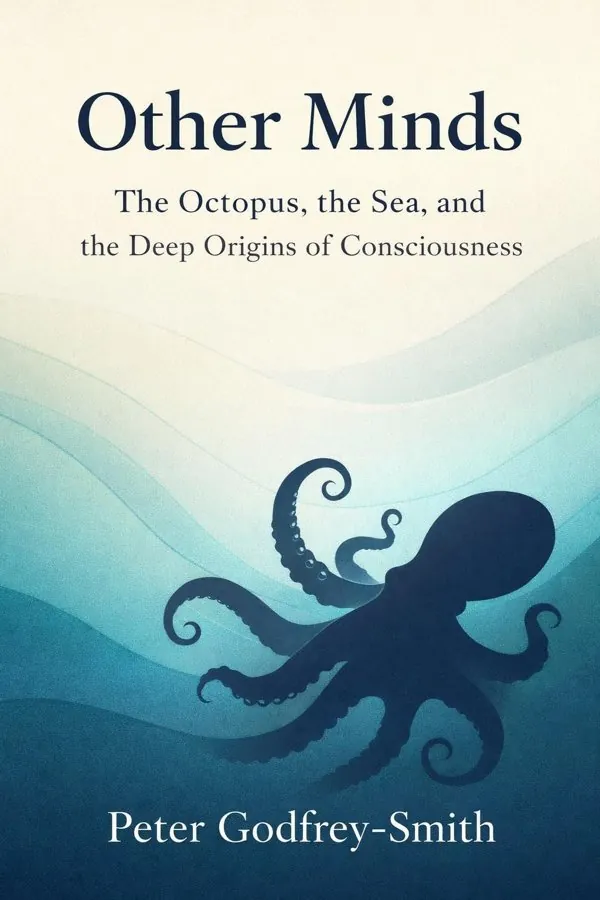
Other Minds: The Octopus, the Sea, and the Deep Origins of Consciousness: Summary & Key Insights
 10 min8 chaptersAudio available
What Is Other Minds: The Octopus, the Sea, and the Deep Origins of Consciousness About?
Other Minds: The Octopus, the Sea, and the Deep Origins of Consciousness by Peter Godfrey-Smith is a popular_sci book spanning 8 pages. This book explores the evolution of consciousness through the study of cephalopods, particularly octopuses and cuttlefish. Drawing on philosophy, biology, and personal diving experiences, Peter Godfrey-Smith examines how these intelligent sea creatures provide insights into the origins and nature of mind itself.
This FizzRead summary covers all 8 key chapters of Other Minds: The Octopus, the Sea, and the Deep Origins of Consciousness in approximately 10 minutes, distilling the most important ideas, arguments, and takeaways from Peter Godfrey-Smith's work. Also available as an audio summary and Key Quotes Podcast.
Other Minds: The Octopus, the Sea, and the Deep Origins of Consciousness
This book explores the evolution of consciousness through the study of cephalopods, particularly octopuses and cuttlefish. Drawing on philosophy, biology, and personal diving experiences, Peter Godfrey-Smith examines how these intelligent sea creatures provide insights into the origins and nature of mind itself.
Who Should Read Other Minds: The Octopus, the Sea, and the Deep Origins of Consciousness?
This book is perfect for anyone interested in popular_sci and looking to gain actionable insights in a short read. Whether you're a student, professional, or lifelong learner, the key ideas from Other Minds: The Octopus, the Sea, and the Deep Origins of Consciousness by Peter Godfrey-Smith will help you think differently.
- ✓Readers who enjoy popular_sci and want practical takeaways
- ✓Professionals looking to apply new ideas to their work and life
- ✓Anyone who wants the core insights of Other Minds: The Octopus, the Sea, and the Deep Origins of Consciousness in just 10 minutes
Want the full summary?
Get instant access to this book summary and 100K+ more with Fizz Moment.
Get Free SummaryAvailable on App Store • Free to download
Key Chapters
The starting point for understanding octopus intelligence is evolutionary history. Half a billion years ago, animal life split into two great trajectories: one leading to vertebrates, and another to invertebrates. Among invertebrates, mollusks diversified into shelled creatures—like clams and snails—and a small, extraordinary offshoot: the cephalopods.
When cephalopods abandoned the protective shell and adopted active predation, their nervous systems exploded in complexity. This development was independent of vertebrate evolution, meaning humans and octopuses represent two distinct experiments in building minds. The octopus’s lineage diverged so early that its intelligence evolved almost completely separately, offering us an alternate model of cognition.
In vertebrates, the brain is centralized—a command center guiding all bodily functions. In octopuses, nervous tissue is distributed: roughly two-thirds of their neurons lie in their arms, not their head. This anatomical difference sets the stage for everything that follows in the book. It means that awareness, control, and decision-making in octopuses occur through a body that is both unified and decentralized. It means movement and perception are not just driven by the brain but by the body itself.
From the evolutionary standpoint, cephalopods remind us that intelligence is not a singular path, but a possibility toward which life can tend through many routes. At its heart, the history told here is about divergence—that across the branching tree of life, the light of consciousness has flickered more than once, illuminating beings whose ways of sensing and knowing are alien to ours but not incomprehensible.
Of all cephalopods, the octopus stands out as both solitary and remarkably clever. When I encountered them underwater, I often felt their gaze—a direct assessment, as though they were appraising not a threat but a curiosity. Observations and laboratory studies have long confirmed their problem-solving capabilities. They can open jars, manipulate locks, and escape enclosures with Houdini-like skill. But what strikes me most is not the cleverness itself; it’s the individuality that accompanies it.
Octopuses are improvisers. They have been seen collecting coconut shells and using them as portable shelters—behaviors that suggest foresight and planning. They show preferences, habits, even moods. In human terms, they appear playful, mischievous, and occasionally aggressive. Scientists often say they are both “smart” and “alien"—their intelligence does not resemble ours in structure or style.
While vertebrate intelligence grew within social frameworks—communication, cooperation, and hierarchical organization—the octopus mind evolved largely alone. This solitude makes its sophistication all the more mysterious. The octopus demonstrates that sentience does not require society. Awareness can form even in isolation, built from sensory richness and motor complexity.
When you watch an octopus exploring its world, you feel its curiosity vibrating through every movement. To interact with such an animal underwater is not merely an encounter with a creature—it is an encounter with another point of view, another way of being aware. And that confrontation is perhaps the most profound reminder the sea can give us: minds are not human artifacts but phenomena that emerge wherever life becomes complex enough to feel.
+ 6 more chapters — available in the FizzRead app
All Chapters in Other Minds: The Octopus, the Sea, and the Deep Origins of Consciousness
About the Author
Peter Godfrey-Smith is an Australian philosopher of science and diver. He is known for his work on the philosophy of biology and the evolution of cognition. He teaches at the University of Sydney and has written several influential books on the intersection of philosophy and biology.
Get This Summary in Your Preferred Format
Read or listen to the Other Minds: The Octopus, the Sea, and the Deep Origins of Consciousness summary by Peter Godfrey-Smith anytime, anywhere. FizzRead offers multiple formats so you can learn on your terms — all free.
Available formats: App · Audio · PDF · EPUB — All included free with FizzRead
Download Other Minds: The Octopus, the Sea, and the Deep Origins of Consciousness PDF and EPUB Summary
Key Quotes from Other Minds: The Octopus, the Sea, and the Deep Origins of Consciousness
“The starting point for understanding octopus intelligence is evolutionary history.”
“Of all cephalopods, the octopus stands out as both solitary and remarkably clever.”
Frequently Asked Questions about Other Minds: The Octopus, the Sea, and the Deep Origins of Consciousness
Other Minds: The Octopus, the Sea, and the Deep Origins of Consciousness by Peter Godfrey-Smith is a popular_sci book that explores key ideas across 8 chapters. This book explores the evolution of consciousness through the study of cephalopods, particularly octopuses and cuttlefish. Drawing on philosophy, biology, and personal diving experiences, Peter Godfrey-Smith examines how these intelligent sea creatures provide insights into the origins and nature of mind itself.
You Might Also Like

Structures: Or Why Things Don"t Fall Down
J.E. Gordon
10 min
The Road to Wigan Pier
George Orwell
10 min
Bonk: The Curious Coupling of Science and Sex
Mary Roach
10 min
First Bite: How We Learn to Eat
Bee Wilson
10 min
In Pursuit Of The Unknown: 17 Equations That Changed The World
Ian Stewart
10 min
Napoleon's Buttons: 17 Molecules That Changed History
Penny Le Couteur and Jay Burreson
10 minBrowse by Category
Ready to read Other Minds: The Octopus, the Sea, and the Deep Origins of Consciousness?
Get the full summary and 100K+ more books with Fizz Moment.