
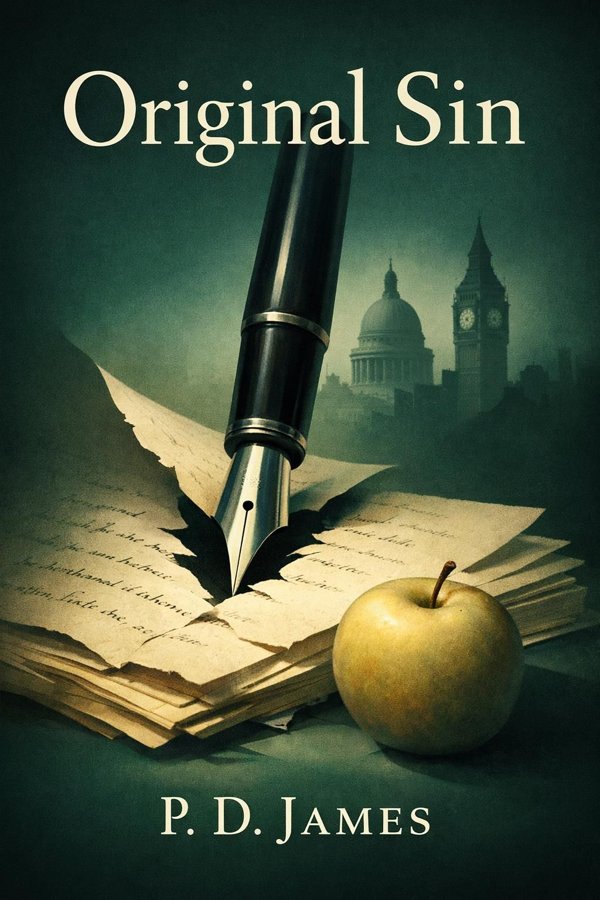
Original Sin: Summary & Key Insights
by P. D. James
 10 min9 chaptersAudio available
Key Takeaways from Original Sin
A building can hold secrets as surely as any person.
Professional calm often hides personal pain.
A violent death does more than end a life; it exposes the unstable order around it.
The worlds that speak most often about culture are not automatically the most humane.
Once deception becomes normal, every new lie demands another.
What Is Original Sin About?
Original Sin by P. D. James is a mystery book spanning 5 pages. P. D. James’s Original Sin is far more than a classic detective story. Set in the imposing riverside headquarters of Peverell Press, a distinguished London publishing house, the novel begins with the death of a powerful executive and unfolds into a layered investigation of envy, vanity, family inheritance, and moral decay. Commander Adam Dalgliesh, one of modern crime fiction’s most intelligent and introspective detectives, must navigate a world where culture and cruelty coexist behind polished manners and literary prestige. The result is a mystery that is as psychologically rich as it is suspenseful. What makes Original Sin matter is the way James uses murder not simply as a puzzle, but as an entry point into human weakness. The novel examines how institutions preserve reputation while hiding corruption, how private guilt shapes public behavior, and how the past continues to wound the present. James writes with rare authority: as one of Britain’s most respected crime novelists, she brought literary depth, ethical seriousness, and acute social observation to detective fiction. Original Sin stands as a prime example of her gift for turning a murder investigation into a profound study of character, power, and conscience.
This FizzRead summary covers all 9 key chapters of Original Sin in approximately 10 minutes, distilling the most important ideas, arguments, and takeaways from P. D. James's work. Also available as an audio summary and Key Quotes Podcast.
Original Sin
P. D. James’s Original Sin is far more than a classic detective story. Set in the imposing riverside headquarters of Peverell Press, a distinguished London publishing house, the novel begins with the death of a powerful executive and unfolds into a layered investigation of envy, vanity, family inheritance, and moral decay. Commander Adam Dalgliesh, one of modern crime fiction’s most intelligent and introspective detectives, must navigate a world where culture and cruelty coexist behind polished manners and literary prestige. The result is a mystery that is as psychologically rich as it is suspenseful.
What makes Original Sin matter is the way James uses murder not simply as a puzzle, but as an entry point into human weakness. The novel examines how institutions preserve reputation while hiding corruption, how private guilt shapes public behavior, and how the past continues to wound the present. James writes with rare authority: as one of Britain’s most respected crime novelists, she brought literary depth, ethical seriousness, and acute social observation to detective fiction. Original Sin stands as a prime example of her gift for turning a murder investigation into a profound study of character, power, and conscience.
Who Should Read Original Sin?
This book is perfect for anyone interested in mystery and looking to gain actionable insights in a short read. Whether you're a student, professional, or lifelong learner, the key ideas from Original Sin by P. D. James will help you think differently.
- ✓Readers who enjoy mystery and want practical takeaways
- ✓Professionals looking to apply new ideas to their work and life
- ✓Anyone who wants the core insights of Original Sin in just 10 minutes
Want the full summary?
Get instant access to this book summary and 100K+ more with Fizz Moment.
Get Free SummaryAvailable on App Store • Free to download
Key Chapters
A building can hold secrets as surely as any person. In Original Sin, Peverell Press is not just the setting of the crime; it is an active force in the novel’s atmosphere and meaning. Housed in a converted Victorian structure beside the Thames, the publishing firm feels steeped in memory, pride, and unease. Its corridors, offices, and old architectural peculiarities create a sense that the past is never fully buried. P. D. James uses place with extraordinary precision, showing how institutions can preserve culture while also trapping resentment, hierarchy, and fear.
The setting matters because the murder does not occur in a neutral space. It happens inside a workplace built on status, inherited authority, and hidden tensions. Peverell Press presents itself as civilized, intellectual, and refined, yet beneath that image lies a network of professional rivalry and private humiliation. The contrast is central to the novel’s power: the more respectable the surface, the more disturbing the rot underneath. James reminds us that environments shape behavior. A grand old building can inspire loyalty, but it can also encourage secrecy, nostalgia, and resistance to necessary change.
This idea applies beyond fiction. Many workplaces, schools, and families rely on a cherished identity to mask dysfunction. An institution may pride itself on tradition while ignoring bullying, exclusion, or entrenched resentment. The longer a place tells itself a flattering story, the harder it becomes to confront what that story leaves out.
Actionable takeaway: whenever you assess an organization, look beyond its reputation and ask what its culture quietly permits, rewards, or conceals.
Professional calm often hides personal pain. When Commander Adam Dalgliesh enters the novel, he is returning to work after profound loss, and that grief shapes everything about his presence. He is restrained, disciplined, and observant, but never emotionally empty. P. D. James gives him an inwardness rare in detective fiction, allowing the investigation to unfold alongside a quieter drama: how a thoughtful person resumes ordinary duty after life has been permanently altered.
Dalgliesh’s grief matters because it changes the texture of detection. He is not a mechanical problem-solver who treats murder as an intellectual game. He understands suffering, and that understanding deepens both his patience and his seriousness. He sees vanity and deception clearly, but he also sees vulnerability. This makes him especially suited to the world of Peverell Press, where polished professionalism masks injury, loneliness, ambition, and fear. His detachment is not coldness; it is discipline forged by loss.
James also uses Dalgliesh to show that leadership need not be loud. In an environment full of posturing personalities, he brings order through attention, courtesy, and moral steadiness. That example translates well to everyday life. People often assume authority requires dominance or theatrical confidence. Dalgliesh suggests the opposite: real authority may come from listening carefully, noticing what others miss, and refusing to let personal emotion cloud judgment.
For readers, his return to work is quietly inspiring. It acknowledges that grief does not end neatly, yet meaningful work can still be done. One can carry sorrow without surrendering competence or integrity.
Actionable takeaway: in times of private strain, focus on disciplined presence—show up, observe carefully, and let steadiness become a form of strength.
A violent death does more than end a life; it exposes the unstable order around it. The murder at the center of Original Sin is not presented merely as a sensational event, but as the trigger that reveals everything Peverell Press has tried to suppress. When a senior figure in the organization is found dead, the institution’s routines immediately begin to fracture. Personal grievances come into sharper focus, buried histories re-emerge, and those who once seemed secure become vulnerable to scrutiny.
P. D. James excels at showing how murder acts as a moral and social solvent. It strips away performance. Politeness becomes strained, alliances become suspect, and even the innocent are forced to confront what they have tolerated. In this sense, the crime is a catalyst rather than the whole story. The real subject is the ecosystem around the victim: who benefited, who suffered, who resented, and who looked away while damage accumulated over years.
This is one reason James’s mysteries feel richer than standard whodunits. The question is not only who committed the act, but what kind of environment made such an act imaginable. Readers are invited to see crime as connected to character, power, and history. In practical terms, this insight applies to any crisis. A scandal, collapse, or public failure often seems sudden, but it usually exposes problems long in formation. The event shocks people into attention, yet the warning signs were often present all along.
Murder in the novel is therefore both crime and revelation. It forces truth into the open, though not without resistance.
Actionable takeaway: when a crisis erupts, resist the temptation to treat it as isolated; instead, investigate the conditions, patterns, and ignored tensions that allowed it to happen.
Once deception becomes normal, every new lie demands another. In Original Sin, the investigation grows more intricate as letters, hidden motives, acts of sabotage, and a second death widen the field of suspicion. P. D. James shows how wrongdoing rarely remains contained. People who begin by protecting themselves often end by deepening the danger for everyone around them. What starts as secrecy becomes manipulation; what starts as concealment creates panic.
This escalation gives the novel much of its tension. The first murder destabilizes Peverell Press, but the subsequent developments reveal that the institution is not merely unlucky—it is saturated with mistrust. Anonymous communications and concealed relationships turn the workplace into a psychological maze. Characters interpret each gesture defensively. Small acts acquire threatening significance. The result is a world in which truth becomes harder to identify precisely because so many people have reasons to distort it.
James handles this complexity with control. The growing web of deceit does not feel arbitrary; it feels human. People lie for familiar reasons: shame, loyalty, fear, self-preservation, and the desire to preserve status. In ordinary life, too, confusion often arises not because one master villain orchestrates everything, but because many people each hide a portion of the truth. A family conflict, workplace crisis, or public controversy can become nearly impossible to resolve once partial honesty replaces full candor.
The novel’s second death underlines a harsh reality: evasion has consequences. Untended lies do not simply linger in the background. They intensify pressure until someone breaks.
Actionable takeaway: address small deceptions early, because unchallenged secrecy tends to multiply, distort judgment, and raise the human cost of eventual truth.
The past does not disappear when it stops being discussed. A major undercurrent in Original Sin is inheritance: not only financial inheritance, but emotional, institutional, and moral inheritance as well. Peverell Press is shaped by family history, old loyalties, and the burdens attached to maintaining a legacy. Characters do not act in a vacuum; they are constrained by expectations handed down through bloodlines, traditions, and long-established power structures.
P. D. James is especially perceptive about the ambiguity of legacy. Inheritance can offer continuity, meaning, and belonging. It can also trap people inside outdated obligations or unresolved grievances. A family business, for example, may present itself as honorable and enduring while quietly binding its members to roles they never freely chose. The desire to protect what has been inherited can become morally dangerous when it justifies silence, denial, or domination.
This theme broadens the novel beyond immediate crime. The murder investigation becomes a way of examining what institutions pass on besides property and prestige. They also transmit habits of secrecy, assumptions about rank, and patterns of emotional damage. Many readers will recognize this dynamic from real life. Families pass down more than heirlooms; they pass down ways of handling conflict. Organizations inherit more than missions; they inherit blind spots.
James does not argue that legacy is inherently corrupt. Rather, she insists it must be examined. Honoring the past is not the same as obeying it blindly. True stewardship requires moral courage, including the willingness to confront what earlier generations left unresolved.
Actionable takeaway: ask what habits, assumptions, and loyalties you have inherited—and consciously decide which deserve preservation and which require change.
Not everyone who contributes to harm is the one who commits the final act. One of the deepest ideas in Original Sin is that guilt operates on multiple levels. There is legal guilt, which belongs to the murderer. But there is also moral complicity, which may be dispersed across an entire community. P. D. James invites readers to consider how silence, cowardice, vanity, and indifference create the conditions in which violence can emerge.
At Peverell Press, relationships are shaped by long-standing resentments and tolerated cruelties. Some characters inflict damage directly; others simply fail to intervene. Still others preserve outward order while ignoring deeper injustice. The novel’s title points toward this broader understanding of wrongdoing. “Original sin” suggests not just one bad decision, but a flawed human condition—our tendency to rationalize selfishness, avoid truth, and accept suffering when it is politically convenient.
This does not erase individual responsibility. James is too morally precise for that. The killer remains accountable. Yet she insists that communities should not congratulate themselves too quickly once a culprit is found. Solving the case does not automatically absolve those who enabled the atmosphere in which the crime became possible.
This insight has clear real-world value. In workplaces, schools, and families, people often focus on the person who crossed the line while ignoring the broader culture that rewarded intimidation or punished honesty. Prevention requires more than punishing the worst offender. It requires examining tolerated patterns.
Actionable takeaway: when something goes badly wrong, look beyond the obvious perpetrator and ask what forms of passivity, fear, or convenience allowed harm to grow unchecked.
To investigate well is also to judge carefully. Adam Dalgliesh’s method in Original Sin is not based on flashy deduction alone, but on an ethical seriousness that distinguishes him from many fictional detectives. He understands that a murder inquiry is not merely an intellectual challenge. It is an encounter with grief, reputation, vulnerability, and irreversible consequences. Because of that, he proceeds with rigor, discretion, and restraint.
What makes Dalgliesh compelling is his refusal to reduce people to suspects only. He studies character, context, and motive, but he does so without losing sight of human dignity. Even when individuals are vain, manipulative, or absurd, he sees them as morally significant. This balance between skepticism and empathy is central to James’s vision of justice. A good investigator must neither sentimentalize nor dehumanize.
There is a practical lesson here for anyone who has to make difficult judgments—managers, teachers, parents, lawyers, or team leaders. In moments of conflict, people often slide into one of two errors: harsh certainty or weak avoidance. Dalgliesh demonstrates a third path. He asks precise questions, gathers facts patiently, listens for contradiction, and resists premature conclusions. Yet he also remembers that truth affects lives, not just case files.
James suggests that ethical inquiry is slow by nature. It requires attention to what people say, what they omit, and how power shapes testimony. Speed may satisfy impatience, but carefulness serves justice.
Actionable takeaway: when evaluating a serious conflict, combine factual rigor with human sensitivity—seek the truth fully, but never forget that every judgment lands on real lives.
Solving a crime does not return the world to what it was before. In Original Sin, the final reckoning brings explanation and accountability, but not simple healing. P. D. James is too realistic to suggest that justice erases loss. Instead, she presents justice as a necessary moral act: it names wrongdoing truthfully, limits further harm, and restores a measure of order. Yet the emotional and institutional damage remains.
This is one of the novel’s most mature insights. Many mysteries end with the satisfying closure of revelation, as though the restoration of facts fully repairs the world. James offers something more sober. The truth matters immensely, but truth can also expose how much has already been broken. Relationships do not automatically mend. Grief is not canceled by explanation. Reputations, once stripped of illusion, cannot always be rebuilt.
At the same time, the novel does not descend into despair. Justice still has value precisely because innocence cannot be recovered. It is the means by which a damaged community refuses to surrender entirely to falsehood. By identifying the murderer and confronting the hidden histories behind the crime, Dalgliesh reasserts moral seriousness in a setting that has drifted into denial and compromise.
This applies widely. In personal disputes, organizational failures, or public scandals, accountability will rarely produce a perfect ending. But imperfect justice is better than polished evasion. Naming reality accurately is often the first condition of any honest future.
Actionable takeaway: do not expect truth and accountability to erase harm; value them instead for what they can genuinely do—clarify reality, assign responsibility, and make renewal possible.
All Chapters in Original Sin
About the Author
P. D. James, born Phyllis Dorothy James in 1920, was a distinguished British novelist best known for transforming detective fiction into a more literary and psychologically complex form. She created Commander Adam Dalgliesh, one of crime fiction’s most memorable investigators, and built a body of work admired for its elegance, moral seriousness, and sharp observation of institutions and human behavior. Before becoming a full-time writer, James worked in the civil service and in areas connected to the criminal justice system, experiences that deepened the realism of her novels. Her books, including the Dalgliesh series and The Children of Men, earned international acclaim. She was widely honored in Britain and beyond, and she remains one of the most respected crime writers of the twentieth century.
Get This Summary in Your Preferred Format
Read or listen to the Original Sin summary by P. D. James anytime, anywhere. FizzRead offers multiple formats so you can learn on your terms — all free.
Available formats: App · Audio · PDF · EPUB — All included free with FizzRead
Download Original Sin PDF and EPUB Summary
Key Quotes from Original Sin
“A building can hold secrets as surely as any person.”
“Professional calm often hides personal pain.”
“A violent death does more than end a life; it exposes the unstable order around it.”
“The worlds that speak most often about culture are not automatically the most humane.”
“Once deception becomes normal, every new lie demands another.”
Frequently Asked Questions about Original Sin
Original Sin by P. D. James is a mystery book that explores key ideas across 9 chapters. P. D. James’s Original Sin is far more than a classic detective story. Set in the imposing riverside headquarters of Peverell Press, a distinguished London publishing house, the novel begins with the death of a powerful executive and unfolds into a layered investigation of envy, vanity, family inheritance, and moral decay. Commander Adam Dalgliesh, one of modern crime fiction’s most intelligent and introspective detectives, must navigate a world where culture and cruelty coexist behind polished manners and literary prestige. The result is a mystery that is as psychologically rich as it is suspenseful. What makes Original Sin matter is the way James uses murder not simply as a puzzle, but as an entry point into human weakness. The novel examines how institutions preserve reputation while hiding corruption, how private guilt shapes public behavior, and how the past continues to wound the present. James writes with rare authority: as one of Britain’s most respected crime novelists, she brought literary depth, ethical seriousness, and acute social observation to detective fiction. Original Sin stands as a prime example of her gift for turning a murder investigation into a profound study of character, power, and conscience.
You Might Also Like





Browse by Category
Ready to read Original Sin?
Get the full summary and 100K+ more books with Fizz Moment.