
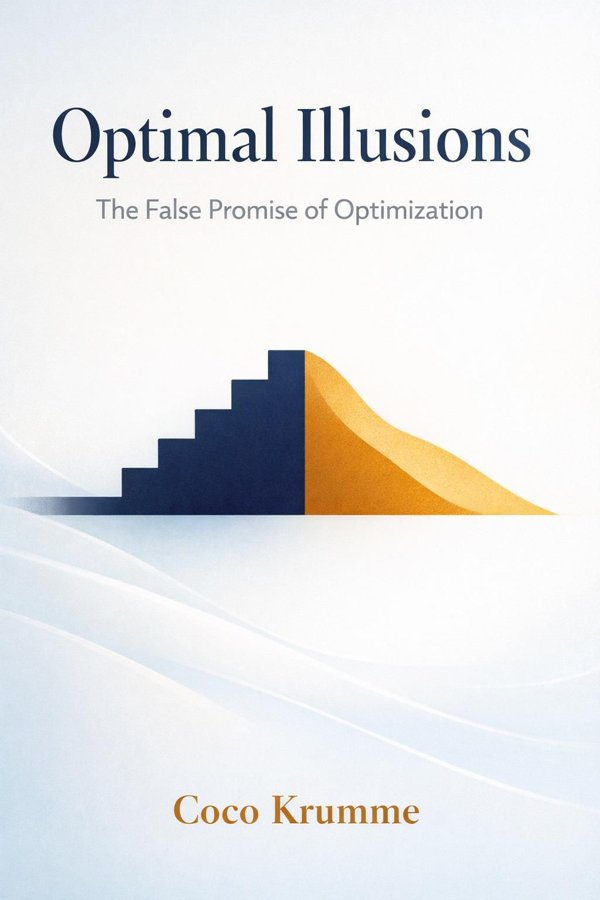
Optimal Illusions: The False Promise of Optimization: Summary & Key Insights
by Coco Krumme
 10 min8 chaptersAudio available
What Is Optimal Illusions: The False Promise of Optimization About?
Optimal Illusions: The False Promise of Optimization by Coco Krumme is a popular_sci book spanning 8 pages. In this thought-provoking work, mathematician Coco Krumme examines the cultural and historical roots of optimization, tracing how the pursuit of efficiency and perfection has shaped modern life. Through engaging narratives and interdisciplinary insights, she reveals the hidden costs of our obsession with optimization and argues for a more balanced approach to progress and human flourishing.
This FizzRead summary covers all 8 key chapters of Optimal Illusions: The False Promise of Optimization in approximately 10 minutes, distilling the most important ideas, arguments, and takeaways from Coco Krumme's work. Also available as an audio summary and Key Quotes Podcast.
Optimal Illusions: The False Promise of Optimization
In this thought-provoking work, mathematician Coco Krumme examines the cultural and historical roots of optimization, tracing how the pursuit of efficiency and perfection has shaped modern life. Through engaging narratives and interdisciplinary insights, she reveals the hidden costs of our obsession with optimization and argues for a more balanced approach to progress and human flourishing.
Who Should Read Optimal Illusions: The False Promise of Optimization?
This book is perfect for anyone interested in popular_sci and looking to gain actionable insights in a short read. Whether you're a student, professional, or lifelong learner, the key ideas from Optimal Illusions: The False Promise of Optimization by Coco Krumme will help you think differently.
- ✓Readers who enjoy popular_sci and want practical takeaways
- ✓Professionals looking to apply new ideas to their work and life
- ✓Anyone who wants the core insights of Optimal Illusions: The False Promise of Optimization in just 10 minutes
Want the full summary?
Get instant access to this book summary and 100K+ more with Fizz Moment.
Get Free SummaryAvailable on App Store • Free to download
Key Chapters
To understand our collective fixation on optimization, we must begin with its roots. The story starts not in Silicon Valley but in the Enlightenment, when reason and calculation emerged as new gods of progress. In that era, thinkers like Newton and Descartes transformed nature into something quantifiable. What could be measured could be improved; what could be improved could be perfected. The Industrial Revolution carried these ideals forward. The steam engine, the assembly line, and later Taylor’s scientific management all shared a faith in measurable efficiency. Work became an equation: inputs and outputs, speed and precision.
Optimization, in those early centuries, wasn’t just a technical goal—it was a philosophy of order. It symbolized mastery over chaos. But alongside the triumphs came a narrowing of vision. The human rhythms of labor, creativity, and rest were sacrificed on the altar of productivity. What was once an art became a system, and what was once a livelihood became a metric.
By the time we reach the 20th century, this logic entrenches itself not only in industry but in everyday life. Optimization becomes synonymous with rational modernity: to be modern was to be efficient, to waste no time, to find the perfect ratio. Yet the seeds of fragility were already sown. The drive for perfection assumed that the world was a closed system, a machine to be tuned. It left little room for randomness, emotion, or ecological interdependence—qualities that defy calculation but sustain life itself.
As a mathematician, I see optimization not merely as an abstraction but as one of our most powerful intellectual inventions. The mathematics of optimization grew out of calculus—methods to find maxima and minima, to balance competing variables. Later, linear programming and dynamic optimization models allowed us to allocate resources and design systems with extraordinary precision. These methods shaped fields from logistics to economics, from engineering to machine learning. Their elegance lies in their promise of universality: whatever the problem, optimization offered a solution.
Yet elegance can deceive. Optimization functions are bound by their assumptions—what we choose to model, what we exclude as noise, what we define as success. The world, however, rarely behaves so neatly. When the complexities of human behavior enter the equation, the pursuit of an ‘optimum’ can distort reality rather than reveal it. The models don’t fail because they’re mathematically incorrect but because they’re humanly incomplete.
Consider the way tech algorithms optimize engagement. They maximize for clicks, not for comprehension; for retention, not for reflection. The mathematics behind these processes is flawless—but the societal effect is corrosive. By modeling only what can be measured, we reduce experience to what can be quantified, and the immeasurable—the moments of leisure, curiosity, empathy—vanishes from view. In this chapter, I encourage the reader to recognize the dual nature of optimization’s mathematical beauty: it builds systems of astonishing clarity while erecting walls that separate us from the fullness of life.
+ 6 more chapters — available in the FizzRead app
All Chapters in Optimal Illusions: The False Promise of Optimization
About the Author
Coco Krumme is an applied mathematician and writer whose research spans modeling, systems theory, and the philosophy of optimization. She holds degrees from MIT and has worked in both academia and industry, exploring how quantitative thinking influences human decision-making and societal structures.
Get This Summary in Your Preferred Format
Read or listen to the Optimal Illusions: The False Promise of Optimization summary by Coco Krumme anytime, anywhere. FizzRead offers multiple formats so you can learn on your terms — all free.
Available formats: App · Audio · PDF · EPUB — All included free with FizzRead
Download Optimal Illusions: The False Promise of Optimization PDF and EPUB Summary
Key Quotes from Optimal Illusions: The False Promise of Optimization
“To understand our collective fixation on optimization, we must begin with its roots.”
“As a mathematician, I see optimization not merely as an abstraction but as one of our most powerful intellectual inventions.”
Frequently Asked Questions about Optimal Illusions: The False Promise of Optimization
Optimal Illusions: The False Promise of Optimization by Coco Krumme is a popular_sci book that explores key ideas across 8 chapters. In this thought-provoking work, mathematician Coco Krumme examines the cultural and historical roots of optimization, tracing how the pursuit of efficiency and perfection has shaped modern life. Through engaging narratives and interdisciplinary insights, she reveals the hidden costs of our obsession with optimization and argues for a more balanced approach to progress and human flourishing.
You Might Also Like
Structures: Or Why Things Don"t Fall Down
J.E. Gordon
10 min
The Road to Wigan Pier
George Orwell
10 min
Bonk: The Curious Coupling of Science and Sex
Mary Roach
10 min
First Bite: How We Learn to Eat
Bee Wilson
10 min
In Pursuit Of The Unknown: 17 Equations That Changed The World
Ian Stewart
10 min
Napoleon's Buttons: 17 Molecules That Changed History
Penny Le Couteur and Jay Burreson
10 minBrowse by Category
Ready to read Optimal Illusions: The False Promise of Optimization?
Get the full summary and 100K+ more books with Fizz Moment.