
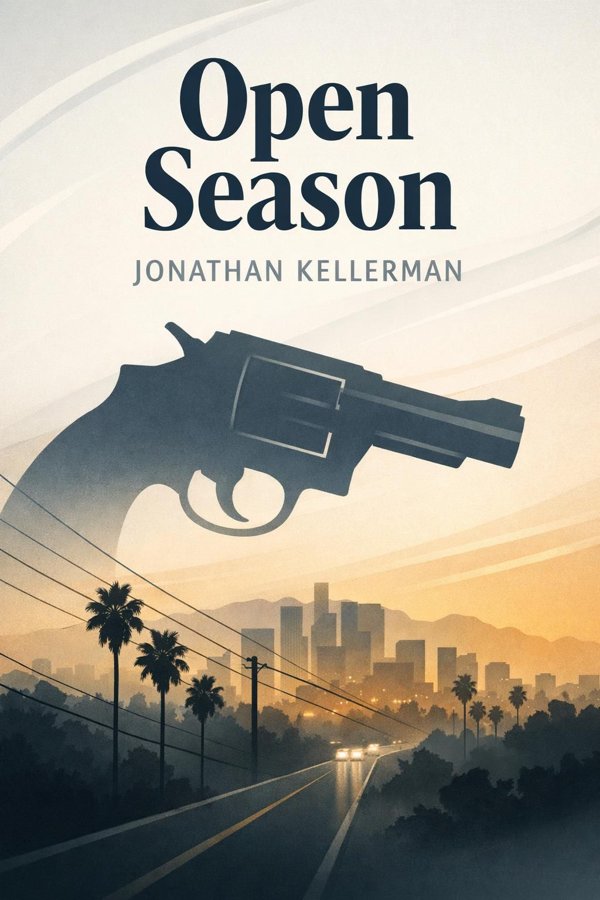
Open Season: Summary & Key Insights
 10 min9 chaptersAudio available
Key Takeaways from Open Season
A detective’s real burden is not solving crimes, but continuing to care in a world that trains people to stop caring.
The most dangerous lie in an investigation is the one that seems to explain everything too quickly.
Crime is never investigated in a vacuum; it is filtered through power, fear, and the social map of a city.
The truth is often hardest to find where people most insist that order already exists.
Every investigation eventually stops being about evidence alone and becomes a test of endurance, judgment, and moral courage.
What Is Open Season About?
Open Season by Jonathan Kellerman is a mystery book spanning 6 pages. Open Season is Jonathan Kellerman’s sharp, atmospheric crime novel about what happens when violence that looks routine turns out to be anything but. Set in Los Angeles, the story follows LAPD detective Petra Connor as she investigates a string of killings initially dismissed as gang-related. What begins as another brutal case in a city shaped by fear, race, class tension, and territorial conflict slowly reveals a deeper pattern—one that forces Petra to challenge assumptions built into the justice system itself. The novel works as a gripping police procedural, but its real strength lies in how it explores the human cost of urban crime, institutional pressure, and moral compromise. Kellerman, best known for blending psychological depth with suspense, brings unusual authority to the genre through his background as a clinical psychologist. That training gives his characters emotional realism and makes the investigation feel as much about motive, trauma, and perception as evidence. Open Season matters because it refuses easy answers: it shows how crime stories are never just about who committed the act, but also about who gets ignored, who gets blamed, and who is willing to keep asking difficult questions.
This FizzRead summary covers all 9 key chapters of Open Season in approximately 10 minutes, distilling the most important ideas, arguments, and takeaways from Jonathan Kellerman's work. Also available as an audio summary and Key Quotes Podcast.
Open Season
Open Season is Jonathan Kellerman’s sharp, atmospheric crime novel about what happens when violence that looks routine turns out to be anything but. Set in Los Angeles, the story follows LAPD detective Petra Connor as she investigates a string of killings initially dismissed as gang-related. What begins as another brutal case in a city shaped by fear, race, class tension, and territorial conflict slowly reveals a deeper pattern—one that forces Petra to challenge assumptions built into the justice system itself. The novel works as a gripping police procedural, but its real strength lies in how it explores the human cost of urban crime, institutional pressure, and moral compromise. Kellerman, best known for blending psychological depth with suspense, brings unusual authority to the genre through his background as a clinical psychologist. That training gives his characters emotional realism and makes the investigation feel as much about motive, trauma, and perception as evidence. Open Season matters because it refuses easy answers: it shows how crime stories are never just about who committed the act, but also about who gets ignored, who gets blamed, and who is willing to keep asking difficult questions.
Who Should Read Open Season?
This book is perfect for anyone interested in mystery and looking to gain actionable insights in a short read. Whether you're a student, professional, or lifelong learner, the key ideas from Open Season by Jonathan Kellerman will help you think differently.
- ✓Readers who enjoy mystery and want practical takeaways
- ✓Professionals looking to apply new ideas to their work and life
- ✓Anyone who wants the core insights of Open Season in just 10 minutes
Want the full summary?
Get instant access to this book summary and 100K+ more with Fizz Moment.
Get Free SummaryAvailable on App Store • Free to download
Key Chapters
A detective’s real burden is not solving crimes, but continuing to care in a world that trains people to stop caring. Petra Connor enters Open Season as more than a capable LAPD officer. She is intelligent, disciplined, and resilient, but what makes her compelling is the tension between professionalism and vulnerability. Kellerman uses her not as a flawless hero, but as a person shaped by the emotional consequences of working in a city where violence can become routine. That matters because routine is one of the book’s quiet villains. Once murder becomes paperwork, justice begins to thin out.
Petra’s perspective grounds the novel in lived reality. She understands departmental expectations, neighborhood tensions, and the practical demands of police work, yet she also notices the human residue that statistics erase. This dual vision allows her to see what others miss. She can process evidence, read situations, and manage pressure, but she cannot fully detach from the suffering around her. That balance gives the novel its emotional credibility.
In practical terms, Petra represents the importance of engaged professionalism in any high-stakes field. Whether in policing, medicine, law, education, or leadership, competence alone is not enough. People who do difficult work must also resist numbness. The best professionals combine skill with moral attention. Petra shows that emotional awareness is not weakness; it is often what protects truth from being buried under convenience.
One way to apply this insight is to examine how you respond to repeated stress in your own work. Have efficiency and habit dulled your judgment? Petra’s example suggests a simple practice: pause before accepting the obvious explanation and ask what a more attentive observer would notice. The actionable takeaway is this: protect your standards by protecting your capacity to care.
The most dangerous lie in an investigation is the one that seems to explain everything too quickly. In Open Season, the murders that launch Petra Connor’s case appear to fit a familiar Los Angeles script: gang violence, territorial retaliation, young victims, frightened communities, and an atmosphere of inevitability. At first glance, the pattern seems obvious. But Petra’s instincts tell her that the evidence does not line up as neatly as the narrative suggests. Kellerman turns that suspicion into one of the novel’s central ideas: recognizable violence is often used as a cover for unseen violence.
The brilliance of this plot device is that it exposes how systems rely on templates. When a case resembles what authorities expect to see, investigation can harden into assumption. Labels become shortcuts. In neighborhoods already marked by prejudice and neglect, those shortcuts are especially dangerous. Petra notices inconsistencies in victim profiles, motive patterns, and crime-scene implications that suggest these killings are not simply random eruptions of gang warfare. Her refusal to accept the default explanation becomes the engine of the novel.
This idea extends far beyond crime fiction. In everyday life, organizations often misread complex problems because they rely on familiar categories. A struggling employee is labeled unmotivated when they are actually overwhelmed. A drop in performance is blamed on attitude rather than broken systems. A conflict is treated as personal when it is structural. In each case, the first explanation may be socially convenient but factually incomplete.
Kellerman’s message is practical: when a story feels too tidy, question the framework behind it. Look for anomalies, not just patterns. Ask who benefits when a problem is declared already understood. The actionable takeaway is this: challenge default narratives by identifying one fact that does not fit and following it until the larger truth starts to emerge.
Crime is never investigated in a vacuum; it is filtered through power, fear, and the social map of a city. One of Open Season’s strongest achievements is its portrait of Los Angeles as more than a backdrop. The city becomes a fractured ecosystem where race, class, media pressure, gang anxiety, and institutional politics all shape how crimes are interpreted. Petra Connor is not just solving murders; she is working inside a structure that has already decided which victims matter, which neighborhoods are dangerous, and which explanations are easiest to sell.
Kellerman shows how political pressure distorts justice without needing cartoon villains. Departments care about public perception. Leaders care about fallout. Communities carry historical distrust. Reporters amplify simplified narratives. Each force nudges the investigation toward conclusions that may calm panic or protect reputations rather than reflect reality. Petra’s challenge, then, is not merely evidentiary. It is cultural. She must separate fact from the layers of assumption that institutions and citizens project onto urban violence.
This remains highly relevant because modern decision-making is still shaped by narratives tied to identity and location. A problem in a wealthy neighborhood is often framed as exceptional; the same problem in a poor neighborhood may be treated as inevitable. Public debate then builds on those biases. For readers, the novel becomes a reminder that information is never neutral once it enters a political environment.
A practical application is to examine how context changes your interpretation of the same event. Would you judge a person, conflict, or failure differently if it came from another setting or social group? If so, bias may be steering your conclusions. The actionable takeaway is this: before accepting any public narrative, ask how politics, prejudice, and institutional self-protection might be shaping what you are being told.
The truth is often hardest to find where people most insist that order already exists. As Petra digs deeper in Open Season, the case begins to point beyond street-level violence toward hidden interests, compromised loyalties, and forms of corruption that thrive in shadows. Kellerman is less interested in corruption as spectacle than in corruption as erosion. It weakens trust, redirects blame, and makes honest people doubt what they can prove. The conspiracy elements in the novel do not feel exaggerated because they grow naturally out of neglected details and institutional blind spots.
What makes this section of the story effective is the way corruption emerges incrementally. Petra does not discover a single secret that explains everything at once. Instead, she uncovers contradictions, evasions, and subtle manipulations that suggest the official version of events is being protected. This mirrors real-world corruption, which usually survives through fragmentation. One person avoids a question. Another files incomplete paperwork. Someone above them discourages curiosity. The result is not just hidden wrongdoing but a culture in which truth becomes difficult to assemble.
Readers can apply this insight to any complex environment—corporate, civic, academic, or personal. Major failures often persist because small acts of avoidance accumulate. A team ignores warning signs. A leader rewards silence. An institution prioritizes appearance over accountability. By the time the damage is visible, the pattern has become normalized.
The lesson is not to become paranoid, but to become observant. Look for repeated inconsistencies, especially when they cluster around authority or convenience. If several small facts feel strangely resistant to explanation, there may be a larger pattern beneath them. The actionable takeaway is this: when accountability seems absent, trace the chain of small omissions—because corruption often reveals itself through what people repeatedly refuse to clarify.
Every investigation eventually stops being about evidence alone and becomes a test of endurance, judgment, and moral courage. In Open Season, the pressure on Petra Connor intensifies as the case moves from puzzling to dangerous. The closer she gets to the truth, the more resistance she encounters—from institutional caution, external threats, and the emotional toll of pursuing a reality others would rather leave undisturbed. Kellerman uses this escalation to explore a key theme: justice is not simply discovering facts, but staying committed when facts become costly.
This is where the novel earns its emotional impact. Petra is forced to confront not only the case but also the personal consequences of obsession, responsibility, and risk. The investigation strains patience and tests trust. Revelations do not arrive cleanly; they come with ambiguity, disappointment, and the recognition that even solved cases leave damage behind. The confrontation and resolution matter because they are not framed as triumph in a simplistic sense. They are framed as hard-won clarity in a compromised world.
Outside fiction, this idea applies whenever people must act on uncomfortable truths. Whistleblowers, ethical managers, honest journalists, and principled friends all face versions of the same challenge: will you continue when truth threatens comfort, status, or safety? Many people value integrity in theory but retreat when the social cost rises.
A useful practice is to define your non-negotiables before you enter a crisis. If you wait until pressure peaks, fear and convenience may decide for you. Petra’s arc suggests that resilience depends on values prepared in advance. The actionable takeaway is this: identify one principle you will not abandon under pressure, and let that principle guide you when circumstances become confusing or costly.
Closing a case does not close the emotional ledger that crime opens. One of Open Season’s most mature insights is that resolution is never total. Even after the central mystery is solved, the novel lingers on what remains: grief, institutional scars, altered relationships, and the uneasy knowledge that one victory does not repair the wider conditions that allowed violence to flourish. Kellerman resists the false neatness common to conventional thrillers. He understands that justice can be real without being complete.
This aftermath matters because it reframes what success means. Petra Connor does not emerge untouched, and neither do the communities surrounding the case. The reader is left with the sense that truth has value precisely because it is difficult and partial. Solving the murders matters deeply, yet the social tensions, fears, and inequalities underlying them do not vanish. By emphasizing consequences beyond the reveal, Kellerman gives the novel moral weight and psychological honesty.
This idea has broad application in personal and professional life. People often seek closure as if it means a clean emotional ending: a hard conversation, a breakup, a legal win, a workplace dispute, a medical diagnosis. In reality, clarity may arrive before comfort. You can resolve a situation and still need time to absorb what it cost, what it changed, and what remains unfinished.
A healthier way to think about outcomes is to separate resolution from restoration. Resolution tells you what happened and what must be done. Restoration requires longer-term healing, rebuilding, and reflection. The actionable takeaway is this: after solving a major problem, ask not only “Is it over?” but also “What still needs repair?” That question helps transform short-term answers into lasting recovery.
A crime story becomes more powerful when it treats motive as more than plot machinery. Jonathan Kellerman’s background in psychology gives Open Season a distinctive depth: behavior is never reduced to a simple checklist of clues. Instead, people act from fear, pride, trauma, status anxiety, desire for control, and the need to preserve identity. The procedural elements of the novel are strong, but what keeps the story compelling is the psychological texture beneath them.
Petra Connor’s investigation depends not only on gathering facts but on reading people accurately. Witnesses distort memory. Suspects present edited versions of themselves. Colleagues carry biases into decision-making. Communities react according to accumulated distrust. In this world, evidence is essential, but interpretation determines whether evidence leads to truth or to a comfortable misunderstanding. Kellerman repeatedly shows that perception is unstable. What people notice, ignore, confess, and rationalize is shaped by inner life.
This insight is useful for readers because it sharpens attention to motive in real situations. When behavior seems irrational, the missing piece is often psychological rather than logical. A person clings to a bad decision because admitting error threatens self-image. A manager resists criticism because authority feels fragile. A family member lies not to deceive expertly, but to protect a narrative they need in order to function.
The practical lesson is to ask better questions about behavior. Instead of asking only “What did they do?” also ask “What emotional need might this action be serving?” That does not excuse harmful conduct, but it often explains it more fully and leads to better decisions. The actionable takeaway is this: in any conflict, look beneath actions to motives—because understanding psychology often reveals the path that facts alone cannot.
Stereotypes do more than simplify reality; they make injustice easier to ignore. Throughout Open Season, Los Angeles is presented as a city people think they already understand. Certain neighborhoods are presumed violent, certain victims are assumed to be disposable, and certain crimes are filed mentally before the evidence has time to speak. Kellerman uses Petra Connor’s investigation to challenge that flattening impulse. The novel insists that every social shorthand carries a cost, especially when it shapes who receives empathy, scrutiny, and protection.
This theme is especially potent in a crime narrative because policing, media, and public opinion often rely on pattern recognition. Pattern recognition can be useful, but it becomes harmful when it turns into stereotype. Once a label is attached, complexity disappears. Individual stories are absorbed into group assumptions. Petra’s careful attention to discrepancy becomes, in effect, a rebellion against stereotype-driven thinking. She recognizes that the city’s apparent logic may conceal deeper truths.
Readers can apply this lesson in daily life by noticing where they substitute category for curiosity. We do this in workplaces, schools, neighborhoods, and online spaces. We assume the outspoken colleague is difficult, the quiet one disengaged, the affluent one stable, the struggling one irresponsible. Such assumptions save time, but they also distort judgment and weaken ethical response.
A practical exercise is to challenge one stereotype you hold by seeking specific, contrary evidence. Replace generalized impressions with actual observation. Ask what details get erased when a person or place is turned into a type. The actionable takeaway is this: when a label feels instantly convincing, slow down and look for the individual reality underneath it—because better judgment begins where stereotypes end.
Persistence is often described as determination, but Open Season shows that it is also a way of seeing. Petra Connor keeps going not because she is stubborn for its own sake, but because she senses that stopping early would mean accepting a false picture of reality. In that sense, persistence is moral vision: the refusal to let convenience define truth. Kellerman presents investigation as an act of disciplined attention, where small inconsistencies matter because they signal unseen harm.
This is one of the novel’s most transferable ideas. Many important problems remain unsolved not because answers are impossible, but because people tire before reaching them. The first draft of explanation is accepted. The first resistance is taken as a warning. The first partial answer is mistaken for the whole story. Petra demonstrates that meaningful progress often comes after the point where others have concluded that further effort is not worth it.
That lesson applies to research, leadership, negotiation, creative work, and personal relationships. A parent keeps asking why a child’s behavior changed instead of punishing the surface issue. A founder investigates customer complaints beyond the obvious metric. A student revises an argument until it reflects nuance rather than convenience. In each case, persistence creates a more truthful outcome.
Of course, persistence is useful only when paired with reflection. Blind insistence can become ego. Petra’s example works because she remains evidence-driven, adaptable, and ethically anchored. The actionable takeaway is this: when you face a complex problem, do not stop at the first reasonable answer. Stay with the discomfort a little longer, review the anomalies, and let persistence reveal what speed would have missed.
All Chapters in Open Season
About the Author
Jonathan Kellerman is an American novelist and former clinical psychologist whose work helped redefine the modern psychological thriller. Born in New York City in 1949 and raised in Los Angeles, he earned degrees in psychology and built early professional experience working with children and families before turning to fiction full time. He became widely known through his bestselling Alex Delaware novels, which blend criminal investigation with deep psychological insight. Kellerman’s clinical background gives his characters unusual emotional realism and allows him to explore motive, trauma, and moral conflict with authority. Across a long and successful career, he has written numerous acclaimed crime novels and earned a large international readership. Open Season reflects his signature strengths: sharp suspense, urban atmosphere, and an intelligent understanding of human behavior.
Get This Summary in Your Preferred Format
Read or listen to the Open Season summary by Jonathan Kellerman anytime, anywhere. FizzRead offers multiple formats so you can learn on your terms — all free.
Available formats: App · Audio · PDF · EPUB — All included free with FizzRead
Download Open Season PDF and EPUB Summary
Key Quotes from Open Season
“A detective’s real burden is not solving crimes, but continuing to care in a world that trains people to stop caring.”
“The most dangerous lie in an investigation is the one that seems to explain everything too quickly.”
“Crime is never investigated in a vacuum; it is filtered through power, fear, and the social map of a city.”
“The truth is often hardest to find where people most insist that order already exists.”
“Every investigation eventually stops being about evidence alone and becomes a test of endurance, judgment, and moral courage.”
Frequently Asked Questions about Open Season
Open Season by Jonathan Kellerman is a mystery book that explores key ideas across 9 chapters. Open Season is Jonathan Kellerman’s sharp, atmospheric crime novel about what happens when violence that looks routine turns out to be anything but. Set in Los Angeles, the story follows LAPD detective Petra Connor as she investigates a string of killings initially dismissed as gang-related. What begins as another brutal case in a city shaped by fear, race, class tension, and territorial conflict slowly reveals a deeper pattern—one that forces Petra to challenge assumptions built into the justice system itself. The novel works as a gripping police procedural, but its real strength lies in how it explores the human cost of urban crime, institutional pressure, and moral compromise. Kellerman, best known for blending psychological depth with suspense, brings unusual authority to the genre through his background as a clinical psychologist. That training gives his characters emotional realism and makes the investigation feel as much about motive, trauma, and perception as evidence. Open Season matters because it refuses easy answers: it shows how crime stories are never just about who committed the act, but also about who gets ignored, who gets blamed, and who is willing to keep asking difficult questions.
More by Jonathan Kellerman

You Might Also Like




Browse by Category
Ready to read Open Season?
Get the full summary and 100K+ more books with Fizz Moment.