
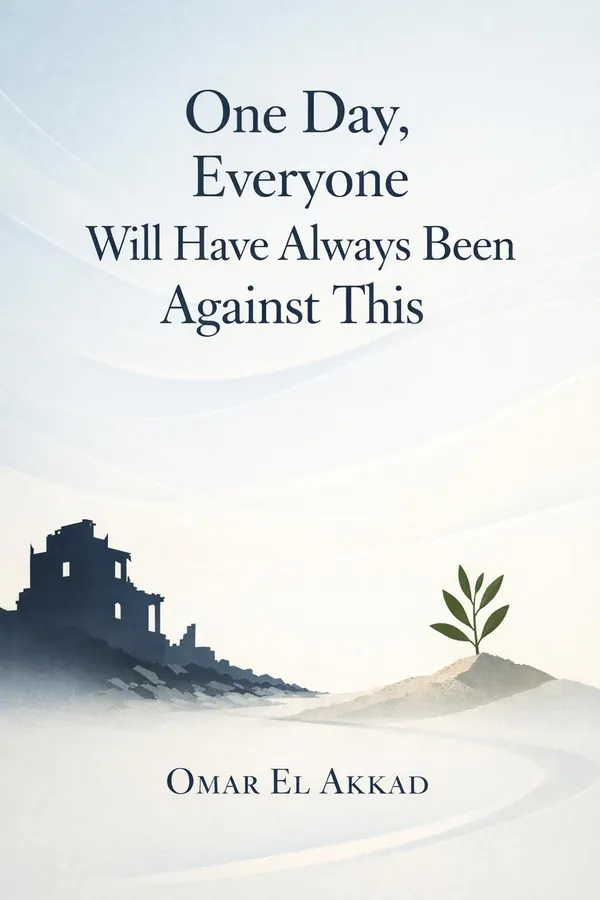
One Day, Everyone Will Have Always Been Against This: Summary & Key Insights
 10 min11 chaptersAudio available
What Is One Day, Everyone Will Have Always Been Against This About?
One Day, Everyone Will Have Always Been Against This by Omar El Akkad is a politics book spanning 11 pages. A memoir and manifesto by Omar El Akkad that intertwines personal history, war reporting, and moral reflection on Western liberalism and the Gaza genocide. Through vivid narrative and political critique, the author examines displacement, empire, and conscience, urging readers to confront complicity and rediscover justice and humanity.
This FizzRead summary covers all 11 key chapters of One Day, Everyone Will Have Always Been Against This in approximately 10 minutes, distilling the most important ideas, arguments, and takeaways from Omar El Akkad's work. Also available as an audio summary and Key Quotes Podcast.
One Day, Everyone Will Have Always Been Against This
A memoir and manifesto by Omar El Akkad that intertwines personal history, war reporting, and moral reflection on Western liberalism and the Gaza genocide. Through vivid narrative and political critique, the author examines displacement, empire, and conscience, urging readers to confront complicity and rediscover justice and humanity.
Who Should Read One Day, Everyone Will Have Always Been Against This?
This book is perfect for anyone interested in politics and looking to gain actionable insights in a short read. Whether you're a student, professional, or lifelong learner, the key ideas from One Day, Everyone Will Have Always Been Against This by Omar El Akkad will help you think differently.
- ✓Readers who enjoy politics and want practical takeaways
- ✓Professionals looking to apply new ideas to their work and life
- ✓Anyone who wants the core insights of One Day, Everyone Will Have Always Been Against This in just 10 minutes
Want the full summary?
Get instant access to this book summary and 100K+ more with Fizz Moment.
Get Free SummaryAvailable on App Store • Free to download
Key Chapters
The prologue opens in the aftermath of destruction. A young girl, fog-colored and bloodied, is carried from the ruins of her home. Around her, men speak words that carry centuries of meaning—Mashallah, Inti zay el amar—phrases that in translation lose their depth but in their native tongue hold both grief and tenderness. The scene is not only a depiction of physical ruin but of linguistic fracture. The author juxtaposes the orchestral richness of Arabic with the stiff monophony of English, showing how empire flattens meaning. Language itself becomes a casualty of violence, a medium through which the powerful justify killing and the powerless struggle to preserve humanity.
The prologue establishes the book’s moral landscape: a world divided by language and power. Beyond the walls and checkpoints lies the empire, cocooned in its fortress of euphemism. In the empire’s tongue, buildings do not collapse—they spontaneously combust; people are not murdered—they perish in necessary operations. This linguistic distortion protects the conscience of the middle, the liberal center that must look upon atrocity and call it tragic but necessary. The author exposes this middle as the true beneficiary of sanitized language, the class that needs words to make horror palatable.
Through the image of the girl who believes she has ended, the prologue introduces the book’s recurring motif: the dead dig wells in the living. Every act of violence leaves a residue in those who survive, a moral debt that language must either pay or conceal. The author’s reflection on the soldier’s lesson about overpressure—the invisible wave that kills before shrapnel—becomes a metaphor for how words, too, force the air from the lungs. The empire’s speech is an overpressure wave, flattening truth and suffocating empathy.
In this opening, the author situates himself as both witness and participant. He recalls the soldier’s story, the father’s fear, the child’s search for God amid rubble. Each fragment of narrative converges on the question of how to live and speak in a world where language is used to erase the dead. The prologue is not merely an introduction to war; it is an anatomy of how words become weapons. It prepares the reader for a journey through the ruins of history and the ruins of meaning, where every translation is an act of survival.
The first chapter begins with an image of innocence violated—an eighteen-month-old with a bullet wound to the forehead—and then shifts to the quiet domesticity of Oregon, where the author’s daughter builds a paper city in the hallway. This juxtaposition defines the book’s moral tension: the coexistence of peace and atrocity, of safety and complicity. The author lives in the woods, far from the chaos of his birthplace, yet the distance does not absolve him. He watches videos of children pulled from rubble, closes his computer when his daughter approaches, and recognizes the cowardice in his silence.
The narrative traces the author’s lineage of departures: his father’s decision to leave Egypt after being humiliated by soldiers, his own migration from Qatar to Canada, and the perpetual scattering of his family across continents. Each departure is both escape and exile, a movement away from oppression but also away from belonging. The author reflects on the hierarchy of migration—the way Westerners are called expats while others are labeled aliens or illegals—and exposes the hypocrisy of privilege. He recalls his childhood in Qatar, the Gulf War, and the arrival of American soldiers who were celebrated as saviors. Gratitude was demanded, and he learned early that survival required deference to power.
Through his father’s story, the author articulates a philosophy of political malice: that law and principle exist only as long as they serve power. The torn papers at the checkpoint become a symbol of this truth. Rules are expendable; people are expendable. The father’s departure from Egypt, his failed attempt to enter Libya, and his eventual relocation to Qatar illustrate how colonialism mutates into local authoritarianism. The author’s family, like millions of others, becomes part of the diaspora of survival.
The chapter expands into a meditation on Western liberalism’s fiction of moral convenience. The author dismantles the comforting narrative that resistance to empire was always virtuous, showing instead that survival often required imitation of the colonizer. His parents’ generation believed fluency in the languages of power was the only path to dignity. This belief shaped his own life, landing him in an American school writing thank-you letters to soldiers.
The chapter culminates in the author’s reckoning with the Gaza genocide of 2023. He recounts the slaughter, the displacement of millions, the destruction of hospitals and schools, and the moral collapse of the Western world that financed and justified it. The narrative shifts from personal memory to collective indictment. The author exposes the hollowness of the rules-based order, the hypocrisy of liberal democracies that preach human rights while endorsing mass murder. The moment becomes a fracture—a severance from belief in the West’s moral core. The author declares that millions have looked at the empire and said: I want nothing to do with this. Departure, then, is not only physical but spiritual—a walking away from the illusion of virtue.
+ 9 more chapters — available in the FizzRead app
All Chapters in One Day, Everyone Will Have Always Been Against This
About the Author
Omar El Akkad is an author and journalist born in Egypt, raised in Qatar, and later moved to Canada and the United States. He is a two-time winner of the Pacific Northwest Booksellers Association Award and the Oregon Book Award for fiction. His debut novel, American War, was named by the BBC as one of one hundred novels that shaped our world.
Get This Summary in Your Preferred Format
Read or listen to the One Day, Everyone Will Have Always Been Against This summary by Omar El Akkad anytime, anywhere. FizzRead offers multiple formats so you can learn on your terms — all free.
Available formats: App · Audio · PDF · EPUB — All included free with FizzRead
Download One Day, Everyone Will Have Always Been Against This PDF and EPUB Summary
Key Quotes from One Day, Everyone Will Have Always Been Against This
“The prologue opens in the aftermath of destruction.”
“This juxtaposition defines the book’s moral tension: the coexistence of peace and atrocity, of safety and complicity.”
Frequently Asked Questions about One Day, Everyone Will Have Always Been Against This
One Day, Everyone Will Have Always Been Against This by Omar El Akkad is a politics book that explores key ideas across 11 chapters. A memoir and manifesto by Omar El Akkad that intertwines personal history, war reporting, and moral reflection on Western liberalism and the Gaza genocide. Through vivid narrative and political critique, the author examines displacement, empire, and conscience, urging readers to confront complicity and rediscover justice and humanity.
You Might Also Like
Antifa: The Anti-Fascist Handbook
Mark Bray
10 min
Attack from Within: How Disinformation Is Sabotaging America
Barbara McQuade
10 min
Coercion, Capital, and European States, AD 990–1992
Charles Tilly
10 min
Digital Democracy: Concepts, Methodologies, Tools, and Applications
Various Authors
10 min
Fascism
Stanley G. Payne
10 min
Fire And Fury: Inside The Trump White House
Michael Wolff
10 minBrowse by Category
Ready to read One Day, Everyone Will Have Always Been Against This?
Get the full summary and 100K+ more books with Fizz Moment.