
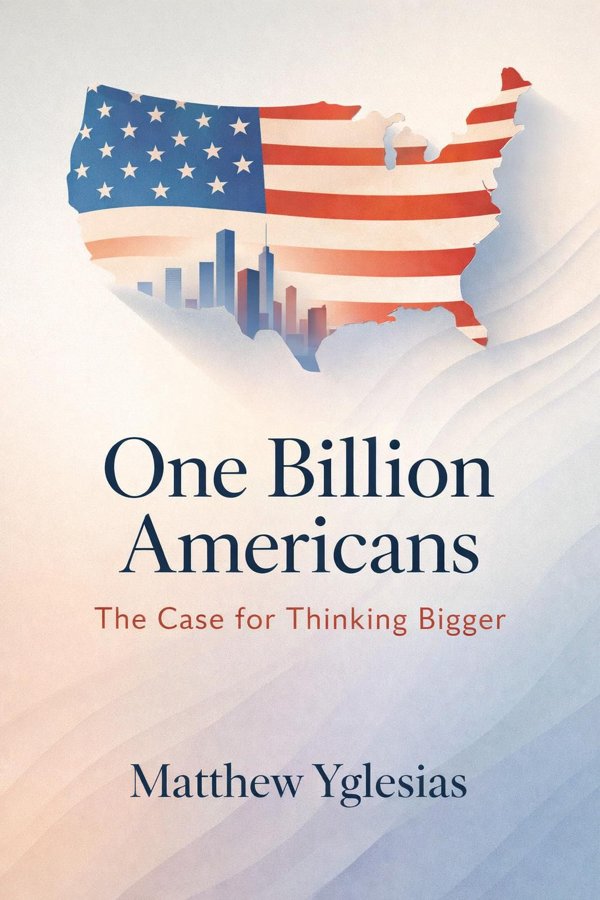
One Billion Americans: The Case for Thinking Bigger: Summary & Key Insights
 10 min10 chaptersAudio available
What Is One Billion Americans: The Case for Thinking Bigger About?
One Billion Americans: The Case for Thinking Bigger by Matthew Yglesias is a politics book spanning 10 pages. In 'One Billion Americans: The Case for Thinking Bigger', Matthew Yglesias argues that the United States should aim to triple its population to one billion people. He contends that a larger population would strengthen the nation’s global influence, economic vitality, and innovation capacity. Yglesias explores policies to support this vision, including immigration reform, family support, and urban development, presenting a provocative case for reimagining America’s future.
This FizzRead summary covers all 10 key chapters of One Billion Americans: The Case for Thinking Bigger in approximately 10 minutes, distilling the most important ideas, arguments, and takeaways from Matthew Yglesias's work. Also available as an audio summary and Key Quotes Podcast.
One Billion Americans: The Case for Thinking Bigger
In 'One Billion Americans: The Case for Thinking Bigger', Matthew Yglesias argues that the United States should aim to triple its population to one billion people. He contends that a larger population would strengthen the nation’s global influence, economic vitality, and innovation capacity. Yglesias explores policies to support this vision, including immigration reform, family support, and urban development, presenting a provocative case for reimagining America’s future.
Who Should Read One Billion Americans: The Case for Thinking Bigger?
This book is perfect for anyone interested in politics and looking to gain actionable insights in a short read. Whether you're a student, professional, or lifelong learner, the key ideas from One Billion Americans: The Case for Thinking Bigger by Matthew Yglesias will help you think differently.
- ✓Readers who enjoy politics and want practical takeaways
- ✓Professionals looking to apply new ideas to their work and life
- ✓Anyone who wants the core insights of One Billion Americans: The Case for Thinking Bigger in just 10 minutes
Want the full summary?
Get instant access to this book summary and 100K+ more with Fizz Moment.
Get Free SummaryAvailable on App Store • Free to download
Key Chapters
We cannot talk about America’s future without acknowledging the world around us. The global balance of power is shifting, and population plays a central role in that shift. China and India, each home to more than a billion citizens, are not just large — they are vast engines of labor, consumption, and innovation. Their scale gives them resilience and reach. America, by contrast, sits at around 330 million people — a figure that undersells our potential and limits our ability to compete at the same level.
When I compare these demographic realities, I don’t mean to stoke fear or rivalry, but rather awareness. In the postwar era, America’s dominance was built on an enormous domestic market and unrivaled capacity for invention. Our scale enabled broad industries, cultural exports, and global leadership. But in the coming decades, sheer volume will matter again. A billion Americans would mean a domestic market larger than any other democratic society — a base from which we could innovate, produce, and lead.
Our political debate too often centers on decline — fears of losing jobs, losing identity, losing global stature. But demographic ambition reverses that psychology. It moves us from reaction to initiative. Instead of lamenting that China has four times our population, we can set a course to grow responsibly and build a society capable of leading by example. Demography is destiny not because numbers alone matter, but because numbers represent people — their aspirations, talents, and capacity to contribute. And if America remains open to those talents, both homegrown and immigrant, our destiny can be renewed.
Economics is the realm where scale turns into strength. A larger population means a larger workforce, larger markets, and more diverse innovation. The idea of one billion Americans isn’t just about global power status — it’s about making the domestic economy more dynamic, egalitarian, and future-proof.
Every major economy benefits from agglomeration, from the clustering of people and ideas that spark new industries. More people mean more specialization, greater competition, and faster technological development. Think of Silicon Valley, New York, or Austin — vibrant places where density breeds innovation. A one-billion-person America would multiply those hubs across the country, spreading opportunity rather than concentrating it.
But scale requires design. We need policies that ensure growth lifts everyone. Affordable housing, modern infrastructure, and inclusive education are not luxuries — they’re the engines that make productivity meaningful. And with more people come more consumers whose needs fuel business creation. The point is that population growth is not an expense; it’s an investment in shared prosperity. Shrinking societies stagnate because their economic ecosystems lose energy. Expanding ones renew themselves through constant churn and diversity.
The moral dimension here is worth underscoring. Economic scale gives us more capacity to tackle great collective problems — from climate change to aging populations. America’s promise has always rested on its ability to imagine and build at scale. With one billion citizens, that promise would be stronger, not weaker.
+ 8 more chapters — available in the FizzRead app
All Chapters in One Billion Americans: The Case for Thinking Bigger
About the Author
Matthew Yglesias is an American journalist, blogger, and political commentator. He co-founded Vox and has written extensively on politics, economics, and public policy. Known for his analytical and often contrarian perspectives, Yglesias has contributed to publications such as Slate, The Atlantic, and ThinkProgress.
Get This Summary in Your Preferred Format
Read or listen to the One Billion Americans: The Case for Thinking Bigger summary by Matthew Yglesias anytime, anywhere. FizzRead offers multiple formats so you can learn on your terms — all free.
Available formats: App · Audio · PDF · EPUB — All included free with FizzRead
Download One Billion Americans: The Case for Thinking Bigger PDF and EPUB Summary
Key Quotes from One Billion Americans: The Case for Thinking Bigger
“We cannot talk about America’s future without acknowledging the world around us.”
“Economics is the realm where scale turns into strength.”
Frequently Asked Questions about One Billion Americans: The Case for Thinking Bigger
One Billion Americans: The Case for Thinking Bigger by Matthew Yglesias is a politics book that explores key ideas across 10 chapters. In 'One Billion Americans: The Case for Thinking Bigger', Matthew Yglesias argues that the United States should aim to triple its population to one billion people. He contends that a larger population would strengthen the nation’s global influence, economic vitality, and innovation capacity. Yglesias explores policies to support this vision, including immigration reform, family support, and urban development, presenting a provocative case for reimagining America’s future.
You Might Also Like

Antifa: The Anti-Fascist Handbook
Mark Bray
10 min
Attack from Within: How Disinformation Is Sabotaging America
Barbara McQuade
10 min
Coercion, Capital, and European States, AD 990–1992
Charles Tilly
10 min
Digital Democracy: Concepts, Methodologies, Tools, and Applications
Various Authors
10 min
Fascism
Stanley G. Payne
10 min
Fire And Fury: Inside The Trump White House
Michael Wolff
10 minBrowse by Category
Ready to read One Billion Americans: The Case for Thinking Bigger?
Get the full summary and 100K+ more books with Fizz Moment.