
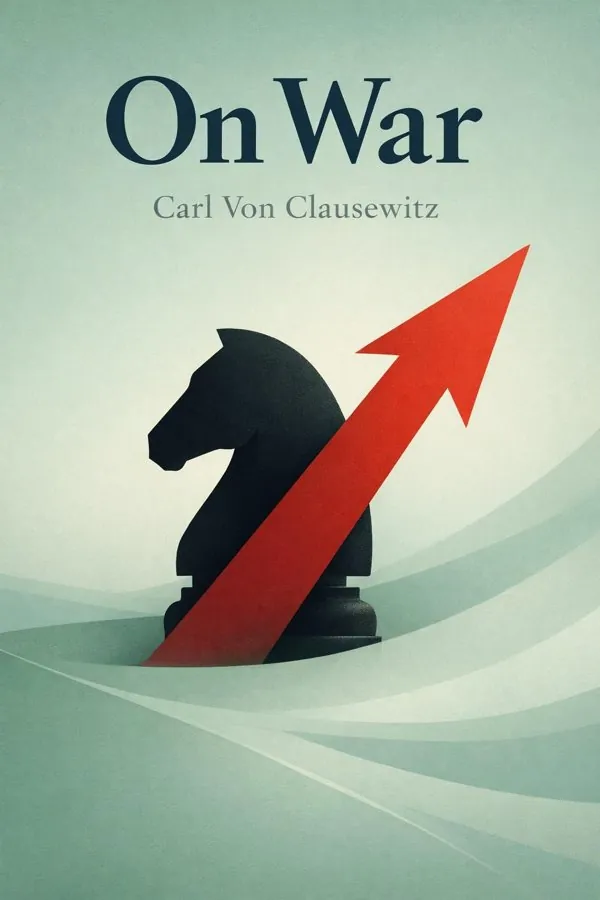
On War: Summary & Key Insights
 10 min12 chaptersAudio available
What Is On War About?
On War by Carl Von Clausewitz is a war_military book spanning 12 pages. On War is the English translation of Carl von Clausewitz’s seminal treatise on military theory and strategy. First published posthumously in 1832, the work explores the complex nature of war, its relationship to politics, and the interplay of chance, friction, and moral forces. Clausewitz’s famous assertion that war is a continuation of politics by other means has made this book a cornerstone of military and political thought, studied by strategists, historians, and policymakers worldwide.
This FizzRead summary covers all 12 key chapters of On War in approximately 10 minutes, distilling the most important ideas, arguments, and takeaways from Carl Von Clausewitz's work. Also available as an audio summary and Key Quotes Podcast.
On War
On War is the English translation of Carl von Clausewitz’s seminal treatise on military theory and strategy. First published posthumously in 1832, the work explores the complex nature of war, its relationship to politics, and the interplay of chance, friction, and moral forces. Clausewitz’s famous assertion that war is a continuation of politics by other means has made this book a cornerstone of military and political thought, studied by strategists, historians, and policymakers worldwide.
Who Should Read On War?
This book is perfect for anyone interested in war_military and looking to gain actionable insights in a short read. Whether you're a student, professional, or lifelong learner, the key ideas from On War by Carl Von Clausewitz will help you think differently.
- ✓Readers who enjoy war_military and want practical takeaways
- ✓Professionals looking to apply new ideas to their work and life
- ✓Anyone who wants the core insights of On War in just 10 minutes
Want the full summary?
Get instant access to this book summary and 100K+ more with Fizz Moment.
Get Free SummaryAvailable on App Store • Free to download
Key Chapters
The first step in understanding war is to strip away illusion. I begin by distinguishing between what I call absolute, or ideal, war and real war. Absolute war is the logical extreme of force—a realm where each side, pursuing total victory, escalates violence to its utmost limit. In theory, such war knows no bounds, seeking the complete disarming and destruction of the enemy. Yet in practice, this ideal never occurs. Real wars are always limited by friction: the countless small impediments that prevent the pure application of power. Human fatigue, weather, logistics, and chance—all intervene to temper the ideal with the possible.
Here lies the paradox that defines the entire subject. War is driven by the impulses of violence and hatred but must be contained by political purpose. It is both a duel of annihilation and an instrument of rational policy. This tension explains its unpredictable rhythm. Chance pervades every engagement; uncertainty clouds every decision; the fog of war, I call it, blinds even the best minds. The commander who endures must cultivate what I term coup d’œil—the ability to discern truth in chaos.
Friction and uncertainty distinguish the world of the soldier from that of the theorist. In the quiet of study, one can construct perfect plans, but in battle, every detail is subject to change. The difference between the paper strategist and the true commander lies in adapting to friction without losing sight of the objective. War therefore demands both rigorous thought and the courage to act without certainty. It is an art that unites reason and danger in a single act of judgment.
Having explored the reality of friction, I must next confront the danger of theoretical rigidity. Many writers seek to make war a science—a closed system of rules. But war defies such simplification. Its field is too vast, its variables too many, its essence too bound to human will. Theory, therefore, must serve practice, not enslave it. The purpose of theory is to clarify concepts, sharpen understanding, and prepare the mind to act under uncertainty. It cannot supply ready-made solutions.
I argue for critical analysis over mechanical prescription. Historical study becomes crucial here—not as a collection of examples to imitate but as a way to train judgment. By examining campaigns, the student of war learns how theory interacts with decision, how principle meets circumstance. The true theorist uses history as a testing ground for ideas, but never mistakes past patterns for present rules. Each conflict bears its own political character, its own moral and technological conditions.
In this way, theory becomes a guide to self-education. It fosters flexibility and intellectual courage, qualities that enable the commander to think creatively in the midst of doubt. The science of war, if it can be called that, lies not in formulas but in cultivating an understanding mind that can see the whole amidst the chaos.
+ 10 more chapters — available in the FizzRead app
All Chapters in On War
About the Author
Carl Philipp Gottlieb von Clausewitz (1780–1831) was a Prussian general and military theorist best known for his influential work On War. He served in the Napoleonic Wars and later became director of the Prussian War Academy in Berlin. His ideas on strategy, the nature of war, and the role of uncertainty continue to shape modern military and political analysis.
Get This Summary in Your Preferred Format
Read or listen to the On War summary by Carl Von Clausewitz anytime, anywhere. FizzRead offers multiple formats so you can learn on your terms — all free.
Available formats: App · Audio · PDF · EPUB — All included free with FizzRead
Download On War PDF and EPUB Summary
Key Quotes from On War
“The first step in understanding war is to strip away illusion.”
“Having explored the reality of friction, I must next confront the danger of theoretical rigidity.”
Frequently Asked Questions about On War
On War by Carl Von Clausewitz is a war_military book that explores key ideas across 12 chapters. On War is the English translation of Carl von Clausewitz’s seminal treatise on military theory and strategy. First published posthumously in 1832, the work explores the complex nature of war, its relationship to politics, and the interplay of chance, friction, and moral forces. Clausewitz’s famous assertion that war is a continuation of politics by other means has made this book a cornerstone of military and political thought, studied by strategists, historians, and policymakers worldwide.
You Might Also Like
Patriot
Andrew Britton
10 min
War
John Hersey
10 min
An Army at Dawn: The War in North Africa, 1942–1943
Rick Atkinson
10 min
Brave New War: The Next Stage of Terrorism and the End of Globalization
John Robb
10 min
Catch-22
Joseph Heller
10 min
Command and Control: Nuclear Weapons, the Damascus Accident, and the Illusion of Safety
Eric Schlosser
10 minBrowse by Category
Ready to read On War?
Get the full summary and 100K+ more books with Fizz Moment.