
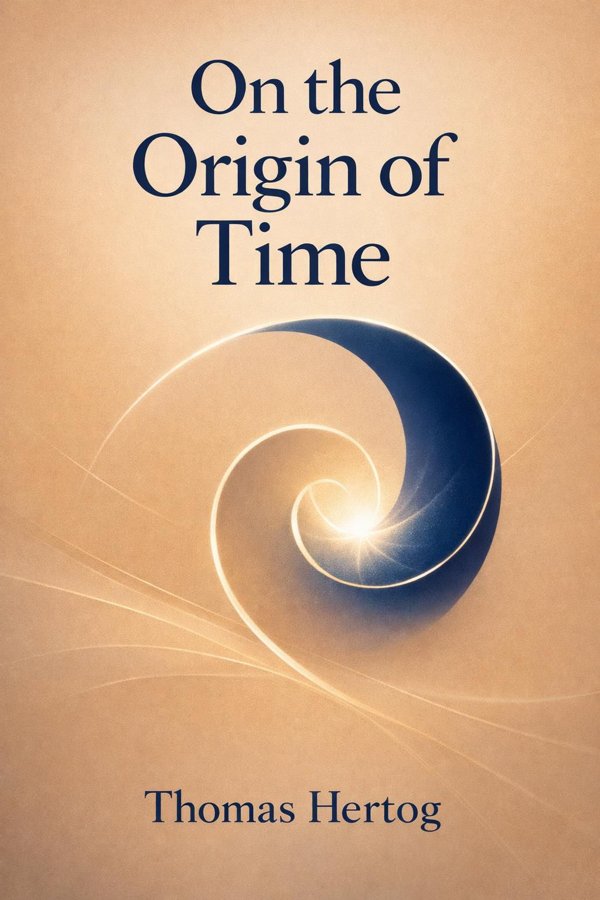
On the Origin of Time: Stephen Hawking's Final Theory: Summary & Key Insights
 10 min10 chaptersAudio available
What Is On the Origin of Time: Stephen Hawking's Final Theory About?
On the Origin of Time: Stephen Hawking's Final Theory by Thomas Hertog is a popular_sci book spanning 10 pages. In this groundbreaking work, cosmologist Thomas Hertog, a close collaborator of Stephen Hawking, explores the final theory Hawking developed before his death. The book reimagines the origins of the universe, proposing that the laws of physics themselves evolved along with the cosmos. Hertog recounts his partnership with Hawking and presents a radical new vision of cosmology that challenges the traditional notion of timeless physical laws.
This FizzRead summary covers all 10 key chapters of On the Origin of Time: Stephen Hawking's Final Theory in approximately 10 minutes, distilling the most important ideas, arguments, and takeaways from Thomas Hertog's work. Also available as an audio summary and Key Quotes Podcast.
On the Origin of Time: Stephen Hawking's Final Theory
In this groundbreaking work, cosmologist Thomas Hertog, a close collaborator of Stephen Hawking, explores the final theory Hawking developed before his death. The book reimagines the origins of the universe, proposing that the laws of physics themselves evolved along with the cosmos. Hertog recounts his partnership with Hawking and presents a radical new vision of cosmology that challenges the traditional notion of timeless physical laws.
Who Should Read On the Origin of Time: Stephen Hawking's Final Theory?
This book is perfect for anyone interested in popular_sci and looking to gain actionable insights in a short read. Whether you're a student, professional, or lifelong learner, the key ideas from On the Origin of Time: Stephen Hawking's Final Theory by Thomas Hertog will help you think differently.
- ✓Readers who enjoy popular_sci and want practical takeaways
- ✓Professionals looking to apply new ideas to their work and life
- ✓Anyone who wants the core insights of On the Origin of Time: Stephen Hawking's Final Theory in just 10 minutes
Want the full summary?
Get instant access to this book summary and 100K+ more with Fizz Moment.
Get Free SummaryAvailable on App Store • Free to download
Key Chapters
For centuries, cosmology sought to uncover the timeless laws that define our universe. The dominant narrative has been the Big Bang model—the notion that time and space emerged from a singular explosive beginning roughly 13.8 billion years ago, governed ever since by a fixed set of equations. These laws of physics, we were told, exist independently of the universe they describe, eternal and perfect like mathematical Platonic forms.
Einstein’s general relativity gave immense power to this picture, portraying gravity as the curvature of spacetime. Yet it also harbored a contradiction. Follow Einstein’s equations backward far enough, and spacetime itself collapses into a singularity where those same equations break down. In classical cosmology, this singularity marks a limit—a point where time loses meaning. It implies that physics cannot explain its own beginning.
That paradox troubled Stephen deeply. The idea of a universe emerging from a mathematical singularity suggested that science could describe time once it existed, but not its birth. The traditional model left us suspended before the origin, staring into a void where the laws of nature fall silent. Yet, if physics is truly universal, it must also explain its own foundations. From that unease arose our shared conviction: perhaps the way forward lay in questioning the permanence of those laws themselves.
Before we could reimagine cosmic origins, it was crucial to understand how Stephen’s path had transformed physics. His early work on black holes changed our view of what these regions of spacetime truly are. By linking Einstein’s geometry with quantum mechanics, he showed that black holes are not eternal prisons, but thermodynamic systems that radiate heat—what is now called Hawking radiation. This discovery bridged physics’ two great pillars and revealed that information and entropy are inseparably tied to the structure of spacetime.
Stephen’s studies of singularities with Roger Penrose also profoundly altered our conception of the universe. He demonstrated that singularities are not exceptional pathological points but a general outcome of Einstein’s equations. The same mathematics that described the heart of a black hole also implied that the cosmos itself began from such a singularity.
However, this realization brought Stephen face to face with the very limits of classical physics. Singularities are regions where predictability fails—where determinism, one of science’s proudest assumptions, collapses. That tension planted the seeds of his later vision: if singularities render classical laws inadequate, then only a quantum approach to the universe itself could reveal what truly happens at the beginning of time.
+ 8 more chapters — available in the FizzRead app
All Chapters in On the Origin of Time: Stephen Hawking's Final Theory
About the Author
Thomas Hertog is a Belgian theoretical physicist and cosmologist. He was a long-time collaborator of Stephen Hawking at the University of Cambridge, focusing on quantum cosmology and the origins of the universe. Hertog is a professor at KU Leuven and a leading figure in theoretical physics.
Get This Summary in Your Preferred Format
Read or listen to the On the Origin of Time: Stephen Hawking's Final Theory summary by Thomas Hertog anytime, anywhere. FizzRead offers multiple formats so you can learn on your terms — all free.
Available formats: App · Audio · PDF · EPUB — All included free with FizzRead
Download On the Origin of Time: Stephen Hawking's Final Theory PDF and EPUB Summary
Key Quotes from On the Origin of Time: Stephen Hawking's Final Theory
“For centuries, cosmology sought to uncover the timeless laws that define our universe.”
“Before we could reimagine cosmic origins, it was crucial to understand how Stephen’s path had transformed physics.”
Frequently Asked Questions about On the Origin of Time: Stephen Hawking's Final Theory
On the Origin of Time: Stephen Hawking's Final Theory by Thomas Hertog is a popular_sci book that explores key ideas across 10 chapters. In this groundbreaking work, cosmologist Thomas Hertog, a close collaborator of Stephen Hawking, explores the final theory Hawking developed before his death. The book reimagines the origins of the universe, proposing that the laws of physics themselves evolved along with the cosmos. Hertog recounts his partnership with Hawking and presents a radical new vision of cosmology that challenges the traditional notion of timeless physical laws.
You Might Also Like

Structures: Or Why Things Don"t Fall Down
J.E. Gordon
10 min
The Road to Wigan Pier
George Orwell
10 min
Bonk: The Curious Coupling of Science and Sex
Mary Roach
10 min
First Bite: How We Learn to Eat
Bee Wilson
10 min
In Pursuit Of The Unknown: 17 Equations That Changed The World
Ian Stewart
10 min
Napoleon's Buttons: 17 Molecules That Changed History
Penny Le Couteur and Jay Burreson
10 minBrowse by Category
Ready to read On the Origin of Time: Stephen Hawking's Final Theory?
Get the full summary and 100K+ more books with Fizz Moment.