
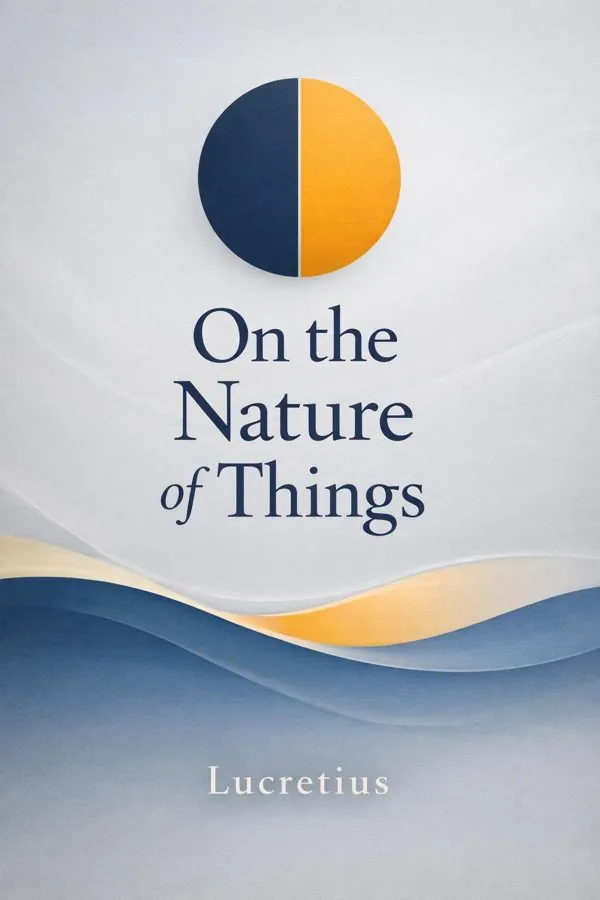
On the Nature of Things: Summary & Key Insights
by Lucretius
 10 min12 chaptersAudio available
What Is On the Nature of Things About?
On the Nature of Things by Lucretius is a western_phil book spanning 12 pages. On the Nature of Things is a philosophical poem in six books by the Roman poet Lucretius, written in the 1st century BCE. The work presents Epicurean philosophy, explaining the nature of the universe, matter, the soul, and the gods, with the aim of freeing humans from the fear of death and superstition.
This FizzRead summary covers all 12 key chapters of On the Nature of Things in approximately 10 minutes, distilling the most important ideas, arguments, and takeaways from Lucretius's work. Also available as an audio summary and Key Quotes Podcast.
On the Nature of Things
On the Nature of Things is a philosophical poem in six books by the Roman poet Lucretius, written in the 1st century BCE. The work presents Epicurean philosophy, explaining the nature of the universe, matter, the soul, and the gods, with the aim of freeing humans from the fear of death and superstition.
Who Should Read On the Nature of Things?
This book is perfect for anyone interested in western_phil and looking to gain actionable insights in a short read. Whether you're a student, professional, or lifelong learner, the key ideas from On the Nature of Things by Lucretius will help you think differently.
- ✓Readers who enjoy western_phil and want practical takeaways
- ✓Professionals looking to apply new ideas to their work and life
- ✓Anyone who wants the core insights of On the Nature of Things in just 10 minutes
Want the full summary?
Get instant access to this book summary and 100K+ more with Fizz Moment.
Get Free SummaryAvailable on App Store • Free to download
Key Chapters
At the poem’s threshold, I raise my voice to Venus, the mother of Aeneas and emblem of creative power, to adorn the beginning with beauty. She embodies nature’s generative principle—the force that brings motion, fertility, and harmony to all living things. Yet my prayer to her is not spiritual submission but philosophical reverence; she symbolizes the framework through which natural processes flourish. By invoking her, I prepare your mind to receive the true doctrine: everything that exists arises through natural causes, not divine decree.
I declare my aim openly: to transmit Epicurus’s teaching, to show how the understanding of nature dispels fear of gods and of death. Mortals tremble because they do not see the causes of things; they attribute thunder and disease to angry deities, eclipses to celestial punishment. I seek to lift that burden. Knowledge of how the world truly works reveals the gods, if they exist, to be tranquil and indifferent to human affairs. They dwell beyond our realm, untouched by passion or wrath. The universe operates on its own laws, independent of divine will.
Thus I blend devotion and reasoning. Through the gentle image of Venus, I invite the mind to approach truth not with violence but with affection. For philosophy, if rightly understood, is the tenderest art: it heals fear through clarity.
Now we turn to the first pillar of understanding—atoms and the void. I teach that everything which exists is composed of indivisible particles, eternal and unchanging. These atoms move through empty space, combining and separating according to their forms and motions. Nothing can come from nothing, and nothing can be reduced to nothing. Matter simply changes its arrangement, but the totality remains.
This insight overturns the primitive error that divine beings create or annihilate at whim. Instead, generation and decay are the ceaseless reorganizations of the same eternal matter. Even fire, water, earth, and air—all four elements of ancient thought—are but compounds of atoms differing in shape, weight, and motion.
These atoms move perpetually, colliding and rebounding, their endless dance forming the boundless variety of phenomena. In this eternal motion lies the explanation for the solidity of stones, the lightness of air, the fluidity of water. When we see decay, it is atoms separating; when we see growth, it is atoms joining. The universe itself is an infinite playground for matter’s permutations.
Understanding this grants peace of mind. Once you grasp that nature is self-sustaining and eternal, you cease to fear annihilation. You recognize that every living being is a temporary pattern in the great river of matter. You came together from atoms; you will dissolve back into them. Nothing miraculous, nothing dreadful—only the calm necessity of nature.
+ 10 more chapters — available in the FizzRead app
All Chapters in On the Nature of Things
About the Author
Get This Summary in Your Preferred Format
Read or listen to the On the Nature of Things summary by Lucretius anytime, anywhere. FizzRead offers multiple formats so you can learn on your terms — all free.
Available formats: App · Audio · PDF · EPUB — All included free with FizzRead
Download On the Nature of Things PDF and EPUB Summary
Key Quotes from On the Nature of Things
“At the poem’s threshold, I raise my voice to Venus, the mother of Aeneas and emblem of creative power, to adorn the beginning with beauty.”
“Now we turn to the first pillar of understanding—atoms and the void.”
Frequently Asked Questions about On the Nature of Things
On the Nature of Things by Lucretius is a western_phil book that explores key ideas across 12 chapters. On the Nature of Things is a philosophical poem in six books by the Roman poet Lucretius, written in the 1st century BCE. The work presents Epicurean philosophy, explaining the nature of the universe, matter, the soul, and the gods, with the aim of freeing humans from the fear of death and superstition.
You Might Also Like
A Little History of Philosophy
Nigel Warburton
10 min
Areopagitica
John Milton
10 min
How To Think Like A Philosopher: Essential Principles For Clear Thinking
Peter Cave
10 min
Language, Truth and Logic
A. J. Ayer
10 min
The Age of Reason
Thomas Paine
10 min
The Essays
Michel De Montaigne
10 minBrowse by Category
Ready to read On the Nature of Things?
Get the full summary and 100K+ more books with Fizz Moment.