
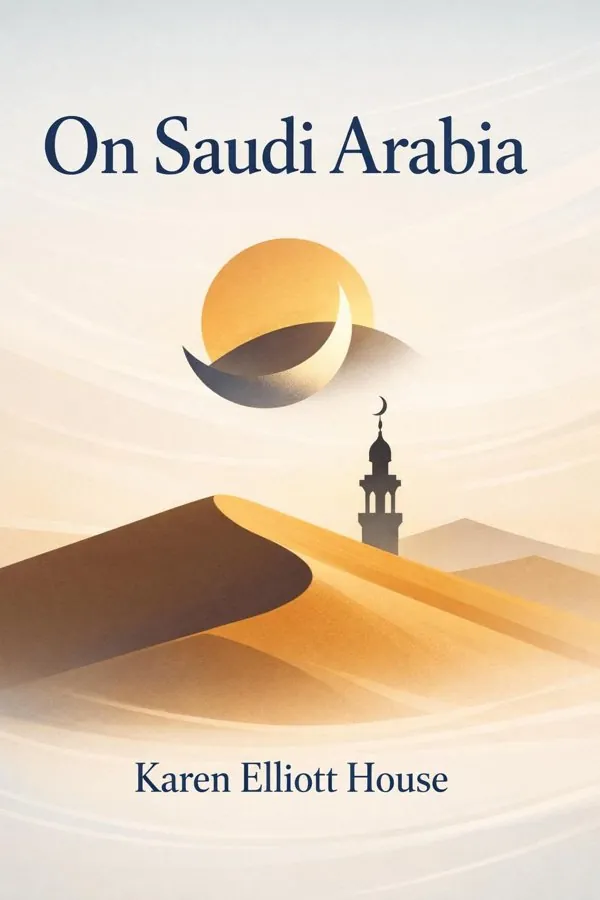
On Saudi Arabia: Its People, Past, Religion, Fault Lines—and Future: Summary & Key Insights
 10 min11 chaptersAudio available
What Is On Saudi Arabia: Its People, Past, Religion, Fault Lines—and Future About?
On Saudi Arabia: Its People, Past, Religion, Fault Lines—and Future by Karen Elliott House is a politics book spanning 11 pages. A penetrating exploration of Saudi Arabia by Pulitzer Prize–winning journalist Karen Elliott House, this book examines the kingdom’s complex social, political, and religious structures. Drawing on years of reporting and interviews, House reveals the tensions between modernization and tradition, the role of religion in daily life, and the challenges facing the monarchy as it navigates a rapidly changing world.
This FizzRead summary covers all 11 key chapters of On Saudi Arabia: Its People, Past, Religion, Fault Lines—and Future in approximately 10 minutes, distilling the most important ideas, arguments, and takeaways from Karen Elliott House's work. Also available as an audio summary and Key Quotes Podcast.
On Saudi Arabia: Its People, Past, Religion, Fault Lines—and Future
A penetrating exploration of Saudi Arabia by Pulitzer Prize–winning journalist Karen Elliott House, this book examines the kingdom’s complex social, political, and religious structures. Drawing on years of reporting and interviews, House reveals the tensions between modernization and tradition, the role of religion in daily life, and the challenges facing the monarchy as it navigates a rapidly changing world.
Who Should Read On Saudi Arabia: Its People, Past, Religion, Fault Lines—and Future?
This book is perfect for anyone interested in politics and looking to gain actionable insights in a short read. Whether you're a student, professional, or lifelong learner, the key ideas from On Saudi Arabia: Its People, Past, Religion, Fault Lines—and Future by Karen Elliott House will help you think differently.
- ✓Readers who enjoy politics and want practical takeaways
- ✓Professionals looking to apply new ideas to their work and life
- ✓Anyone who wants the core insights of On Saudi Arabia: Its People, Past, Religion, Fault Lines—and Future in just 10 minutes
Want the full summary?
Get instant access to this book summary and 100K+ more with Fizz Moment.
Get Free SummaryAvailable on App Store • Free to download
Key Chapters
The story of Saudi Arabia begins not in the twentieth century, but in a desert partnership forged nearly three centuries earlier — between Muhammad ibn Saud and the religious reformer Muhammad ibn Abd al-Wahhab. Their alliance, one of power and piety, built the foundation of Saudi legitimacy: the Al Saud would rule, and Wahhabism would define righteousness. This pact remains the cornerstone of the kingdom’s stability. Each side serves the other’s needs. The monarchy derives divine sanction from religious purity, while clerical authorities secure worldly protection for their moral doctrines.
As I traced this historical bond in my conversations and research, I discovered how this union, born in the sands of Najd, still governs modern Saudi life. Wahhabism was never merely theology — it was a social system, a moral code that insisted on unity through conformity. When Ibn Saud unified the Arabian Peninsula in the early 20th century, his success rested not just on conquest but on this spiritual alliance that gave every act of expansion divine justification.
To this day, the Saudi narrative presents its origins as divinely guided, not politically negotiated. That belief shapes every law and societal expectation. When challenges emerge — whether terrorism, women’s rights, or external criticism — the state's instinct is to refer back to its founding principle: stability through piety and obedience. Understanding this historical symmetry helps explain why reforms in Saudi Arabia move incrementally and cautiously. They threaten the framework that has preserved royal authority for generations.
This heritage of faith and rule intertwined means that every attempt at modernization must wrestle with the spiritual mandate that legitimizes the monarchy itself. The ghosts of Ibn Saud and Abd al-Wahhab linger not merely in memory, but in the architecture of power that still defines Saudi existence.
To understand Saudi Arabia’s governance is to recognize an extraordinary concentration of power — both centralized and distributed within the royal family. Thousands of princes occupy positions across government, military, business, and charity networks. The monarchy functions less like a political institution and more like an extended corporation, where loyalty and family hierarchy substitute for meritocratic systems.
I recall conversations with mid-level officials who admitted that governance often depends on proximity to royal favor rather than skill. The king is both patriarch and CEO of a sprawling enterprise. To maintain unity, he must balance competing family factions and distribute wealth through government contracts, subsidies, and appointments. This system fosters stability but also corruption and waste. Yet in a society that forbids political opposition, patronage becomes one of the few mechanisms through which individuals can still influence outcomes.
At the heart of this power web lies not just money but fear. Saudis are acutely aware of the regime’s red lines. Public criticism of the monarchy remains nearly unthinkable, not because dissenting thoughts are absent, but because the consequences are irreversible — economic exile, imprisonment, or worse. Fear sustains obedience across all class lines, magnified by a legal and religious establishment that warns against questioning authority.
Nevertheless, cracks show. Younger Saudis, especially those educated abroad, increasingly resent the inefficiency and inertia of such top-down rule. They see how power hoarded by a few constrains innovation and fuels inequality. Within the family itself, generational shifts alter the calculus. As older princes pass and younger ones ascend, the challenge is continuity — how to sustain loyalty in a post-oil world where patronage alone cannot feed ambition.
The monarchy thus becomes a paradox: absolute in form, fragile in function. Its durability lies less in political brilliance than in ritual continuity. Every crisis — whether the 1979 Mecca siege, the 1990 Gulf War, or the Arab Spring — reaffirms the monarchy’s ability to adapt without transformation. It absorbs shock, co-opts dissent, and renews its dominance through calculated generosity paired with religious endorsement.
+ 9 more chapters — available in the FizzRead app
All Chapters in On Saudi Arabia: Its People, Past, Religion, Fault Lines—and Future
About the Author
Karen Elliott House is an American journalist and former publisher of The Wall Street Journal. She won the Pulitzer Prize for International Reporting in 1984 for her coverage of the Middle East and has spent decades analyzing Saudi Arabia and its role in global affairs.
Get This Summary in Your Preferred Format
Read or listen to the On Saudi Arabia: Its People, Past, Religion, Fault Lines—and Future summary by Karen Elliott House anytime, anywhere. FizzRead offers multiple formats so you can learn on your terms — all free.
Available formats: App · Audio · PDF · EPUB — All included free with FizzRead
Download On Saudi Arabia: Its People, Past, Religion, Fault Lines—and Future PDF and EPUB Summary
Key Quotes from On Saudi Arabia: Its People, Past, Religion, Fault Lines—and Future
“Their alliance, one of power and piety, built the foundation of Saudi legitimacy: the Al Saud would rule, and Wahhabism would define righteousness.”
“To understand Saudi Arabia’s governance is to recognize an extraordinary concentration of power — both centralized and distributed within the royal family.”
Frequently Asked Questions about On Saudi Arabia: Its People, Past, Religion, Fault Lines—and Future
On Saudi Arabia: Its People, Past, Religion, Fault Lines—and Future by Karen Elliott House is a politics book that explores key ideas across 11 chapters. A penetrating exploration of Saudi Arabia by Pulitzer Prize–winning journalist Karen Elliott House, this book examines the kingdom’s complex social, political, and religious structures. Drawing on years of reporting and interviews, House reveals the tensions between modernization and tradition, the role of religion in daily life, and the challenges facing the monarchy as it navigates a rapidly changing world.
You Might Also Like

Antifa: The Anti-Fascist Handbook
Mark Bray
10 min
Attack from Within: How Disinformation Is Sabotaging America
Barbara McQuade
10 min
Coercion, Capital, and European States, AD 990–1992
Charles Tilly
10 min
Digital Democracy: Concepts, Methodologies, Tools, and Applications
Various Authors
10 min
Fascism
Stanley G. Payne
10 min
Fire And Fury: Inside The Trump White House
Michael Wolff
10 minBrowse by Category
Ready to read On Saudi Arabia: Its People, Past, Religion, Fault Lines—and Future?
Get the full summary and 100K+ more books with Fizz Moment.