
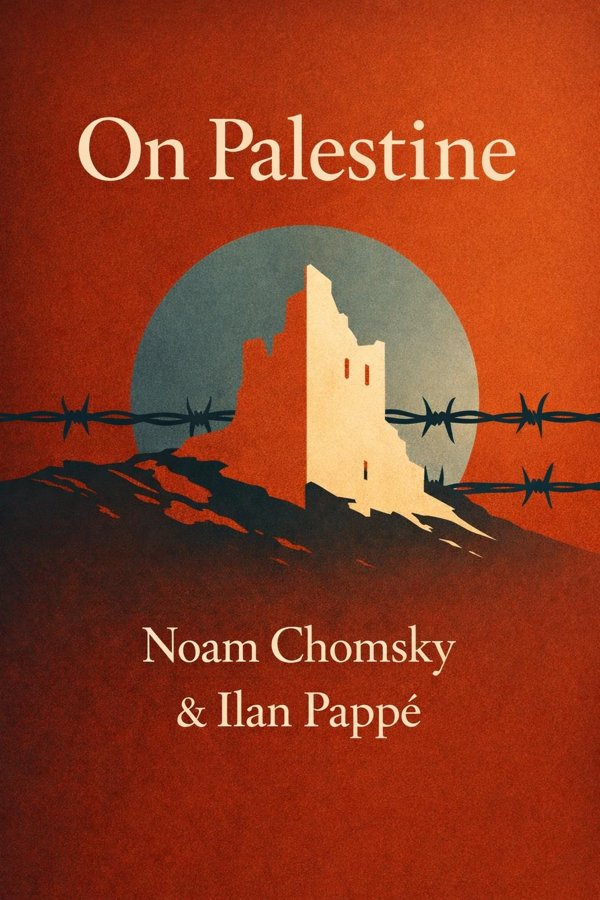
On Palestine: Summary & Key Insights
 10 min9 chaptersAudio available
What Is On Palestine About?
On Palestine by Noam Chomsky, Ilan Pappé is a politics book spanning 9 pages. This book presents a series of conversations between Noam Chomsky and Ilan Pappé, exploring the history, politics, and ongoing conflict surrounding Palestine and Israel. It examines the roots of the Israeli occupation, the role of Western powers, and the prospects for justice and peace in the region. The authors provide critical insights into the realities of Palestinian life under occupation and the global implications of the conflict.
This FizzRead summary covers all 9 key chapters of On Palestine in approximately 10 minutes, distilling the most important ideas, arguments, and takeaways from Noam Chomsky, Ilan Pappé's work. Also available as an audio summary and Key Quotes Podcast.
On Palestine
This book presents a series of conversations between Noam Chomsky and Ilan Pappé, exploring the history, politics, and ongoing conflict surrounding Palestine and Israel. It examines the roots of the Israeli occupation, the role of Western powers, and the prospects for justice and peace in the region. The authors provide critical insights into the realities of Palestinian life under occupation and the global implications of the conflict.
Who Should Read On Palestine?
This book is perfect for anyone interested in politics and looking to gain actionable insights in a short read. Whether you're a student, professional, or lifelong learner, the key ideas from On Palestine by Noam Chomsky, Ilan Pappé will help you think differently.
- ✓Readers who enjoy politics and want practical takeaways
- ✓Professionals looking to apply new ideas to their work and life
- ✓Anyone who wants the core insights of On Palestine in just 10 minutes
Want the full summary?
Get instant access to this book summary and 100K+ more with Fizz Moment.
Get Free SummaryAvailable on App Store • Free to download
Key Chapters
To understand Palestine today, one must begin with 1948—not as a symbolic year but as a rupture that redefined an entire region. For Ilan Pappé, this is the year of the Nakba, the catastrophe. It was not, he insists, an accident of war, nor a tragic byproduct of mutual hostility; it was a systematic campaign of ethnic cleansing, meticulously planned by Zionist leadership seeking to establish a Jewish state with minimal Arab presence.
In our conversations, Ilan’s research draws from archival evidence documenting expulsions, massacres, and the destruction of hundreds of villages. What Palestinians experienced in 1948 was the loss not only of land but of political existence—a dismemberment that created the conditions for every subsequent injustice. For me, analyzing this event through the lens of imperial continuity reveals how settler-colonialism bridges centuries. The logic that justified the removal of indigenous populations in North America found a new incarnation in the rhetoric of Zionism.
We emphasize that this historical foundation is not dead past but living present. The Israeli state continues to draw legitimacy from myths of self-defense and divine promise, obscuring the material reality of displacement. Recognition of the Nakba is therefore not merely historical correction—it is moral necessity. By tracing these origins, we expose how 'homeland security' and 'statehood' were erected upon dispossession, and how that original catastrophe persists every time a Palestinian home is demolished or a refugee’s right of return is denied.
Only when history is told truthfully can justice begin.
Since 1967, the Israeli occupation of Palestinian territories has evolved into one of the most sophisticated systems of control in modern history. In our dialogues, we examine this apparatus not only as a military regime but as an administrative and psychological network. It is built on checkpoints, permits, surveillance, and the constant fragmentation of Palestinian space and identity. We discuss how occupation colonizes time as well as land—people living under its shadow learn that even ordinary actions, such as traveling to school or visiting family, depend on arbitrary permissions.
Ilan describes the settlements as instruments of ideology, strategically placed to fracture Palestinian contiguity, while I draw attention to their geopolitical significance: each expansion is a signal of impunity, backed by overwhelming military support from abroad. Together, we analyze the way legal language is weaponized—the distinction between 'Judea and Samaria' versus 'occupied West Bank' is itself an act of control, shaping perception internationally.
This section makes clear that the occupation’s genius lies in its normalization. It has become a permanent emergency, where military necessity justifies civic paralysis. The mechanisms of control—economic strangulation, environmental degradation, and segregation—create a system that resembles apartheid in form and logic. Yet what sustains it most effectively is the illusion of inevitability, the global silence that allows the status quo to proceed unchecked.
To unravel this machinery is to confront the deep complicity of our world’s political and moral institutions.
+ 7 more chapters — available in the FizzRead app
All Chapters in On Palestine
About the Authors
Noam Chomsky is an American linguist, philosopher, and political activist known for his critiques of U.S. foreign policy and media. Ilan Pappé is an Israeli historian recognized for his work on the history of Israel and Palestine and his advocacy for Palestinian rights.
Get This Summary in Your Preferred Format
Read or listen to the On Palestine summary by Noam Chomsky, Ilan Pappé anytime, anywhere. FizzRead offers multiple formats so you can learn on your terms — all free.
Available formats: App · Audio · PDF · EPUB — All included free with FizzRead
Download On Palestine PDF and EPUB Summary
Key Quotes from On Palestine
“To understand Palestine today, one must begin with 1948—not as a symbolic year but as a rupture that redefined an entire region.”
“Since 1967, the Israeli occupation of Palestinian territories has evolved into one of the most sophisticated systems of control in modern history.”
Frequently Asked Questions about On Palestine
On Palestine by Noam Chomsky, Ilan Pappé is a politics book that explores key ideas across 9 chapters. This book presents a series of conversations between Noam Chomsky and Ilan Pappé, exploring the history, politics, and ongoing conflict surrounding Palestine and Israel. It examines the roots of the Israeli occupation, the role of Western powers, and the prospects for justice and peace in the region. The authors provide critical insights into the realities of Palestinian life under occupation and the global implications of the conflict.
You Might Also Like
Antifa: The Anti-Fascist Handbook
Mark Bray
10 min
Attack from Within: How Disinformation Is Sabotaging America
Barbara McQuade
10 min
Coercion, Capital, and European States, AD 990–1992
Charles Tilly
10 min
Digital Democracy: Concepts, Methodologies, Tools, and Applications
Various Authors
10 min
Fascism
Stanley G. Payne
10 min
Fire And Fury: Inside The Trump White House
Michael Wolff
10 minBrowse by Category
Ready to read On Palestine?
Get the full summary and 100K+ more books with Fizz Moment.