
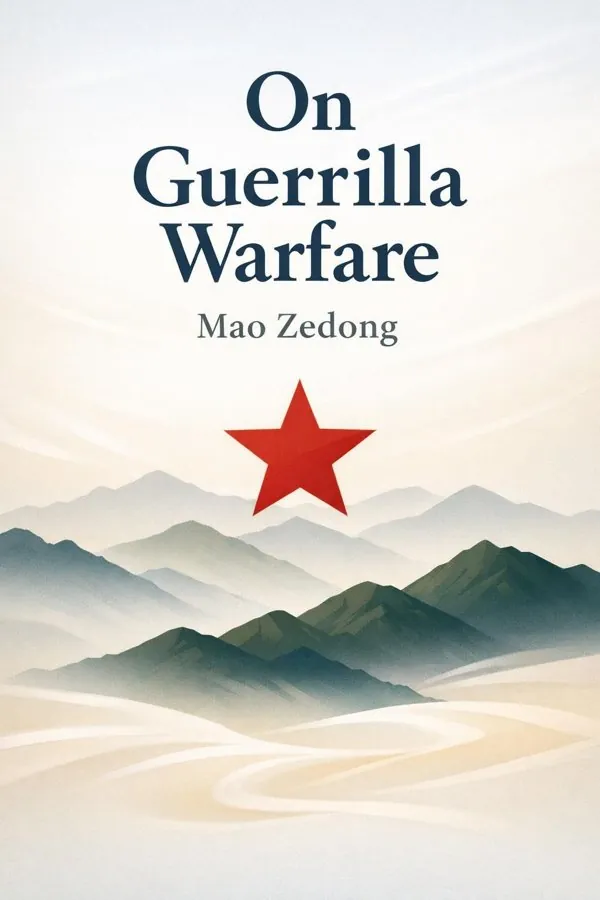
On Guerrilla Warfare: Summary & Key Insights
by Mao Zedong
 10 min8 chaptersAudio available
What Is On Guerrilla Warfare About?
On Guerrilla Warfare by Mao Zedong is a war_military book spanning 8 pages. On Guerrilla Warfare is a military treatise written by Mao Zedong in 1937 during the early stages of the Second Sino-Japanese War. It systematically outlines the strategic role, guiding principles, and organizational methods of guerrilla warfare. Mao emphasizes the importance of relying on the masses, maintaining flexibility, and achieving victory through cumulative small successes. The work became a foundational text for revolutionary warfare and influenced military thought worldwide.
This FizzRead summary covers all 8 key chapters of On Guerrilla Warfare in approximately 10 minutes, distilling the most important ideas, arguments, and takeaways from Mao Zedong's work. Also available as an audio summary and Key Quotes Podcast.
On Guerrilla Warfare
On Guerrilla Warfare is a military treatise written by Mao Zedong in 1937 during the early stages of the Second Sino-Japanese War. It systematically outlines the strategic role, guiding principles, and organizational methods of guerrilla warfare. Mao emphasizes the importance of relying on the masses, maintaining flexibility, and achieving victory through cumulative small successes. The work became a foundational text for revolutionary warfare and influenced military thought worldwide.
Who Should Read On Guerrilla Warfare?
This book is perfect for anyone interested in war_military and looking to gain actionable insights in a short read. Whether you're a student, professional, or lifelong learner, the key ideas from On Guerrilla Warfare by Mao Zedong will help you think differently.
- ✓Readers who enjoy war_military and want practical takeaways
- ✓Professionals looking to apply new ideas to their work and life
- ✓Anyone who wants the core insights of On Guerrilla Warfare in just 10 minutes
Want the full summary?
Get instant access to this book summary and 100K+ more with Fizz Moment.
Get Free SummaryAvailable on App Store • Free to download
Key Chapters
In 1937, when I first articulated the principles of guerrilla warfare, China was divided and beleaguered. The Japanese armies, mechanized and disciplined, advanced swiftly through our cities, while our regular forces suffered from fragmented command and limited resources. Yet beneath the surface of despair lay the potential for resistance—the boundless energy of millions of ordinary Chinese. The enemy could occupy our territory, but he could not extinguish our will. It was in understanding this difference between material strength and moral strength that the necessity of guerrilla warfare became clear.
The regular armies of China, though brave, were unsuited to meet the better-equipped enemy on open ground. To continue fighting conventionally meant annihilation. But if we could disperse our strength, blend with the people, and rely upon surprise and movement, then the enemy’s superiority would dissolve into weakness. The vastness of China itself became our ally—its hills, villages, and rivers forming a great natural fortress. In this setting, guerrilla warfare was not a choice born of preference but of destiny. It was the only path through which China might resist and, ultimately, triumph.
I emphasized to my comrades that guerrilla warfare is neither disorganized nor unprincipled. It follows its own laws—laws suited to the particular conditions of semi-colonial China. It is a form of war that refuses to meet the enemy where he is strongest, that transforms retreat into opportunity, and that turns adversity into endurance. In the crucible of invasion, our scattered efforts would unite under a single purpose: national liberation through people’s struggle.
Guerrilla warfare is not a purely military phenomenon; it is political warfare. Every action taken by a guerrilla unit—from ambush to propaganda—is an expression of political purpose. Its goal is not merely to destroy the enemy’s forces but to awaken, organize, and mobilize the masses to assume their role as makers of history. Without this political foundation, guerrilla warfare cannot exist.
When I describe guerrilla warfare as the warfare of the people, I mean that the line between soldier and civilian dissolves in the heat of national struggle. The peasant who hides weapons beneath his floor, the woman who carries messages under her basket, the youth who sabotages enemy supply lines—all are combatants in this invisible army. It is this unity of the people and the fighters that grants guerrilla warfare its inexhaustible vitality.
The purpose of guerrilla warfare is therefore dual: to weaken the enemy and to unite the nation. Every Japanese soldier killed is a blow to imperialism, but every peasant inspired to action is the birth of a new China. This symbiosis of politics and combat transforms war from a contest of arms to a moral confrontation between oppression and liberation. The guerrilla’s rifle is thus not only a weapon but also a voice—a statement that the people will not surrender.
+ 6 more chapters — available in the FizzRead app
All Chapters in On Guerrilla Warfare
About the Author
Mao Zedong (1893–1976) was a Chinese revolutionary leader, political theorist, and founding father of the People's Republic of China. As a military strategist, he developed theories of people's war and guerrilla tactics that shaped modern revolutionary movements. His writings and leadership profoundly influenced twentieth-century Chinese history and global political thought.
Get This Summary in Your Preferred Format
Read or listen to the On Guerrilla Warfare summary by Mao Zedong anytime, anywhere. FizzRead offers multiple formats so you can learn on your terms — all free.
Available formats: App · Audio · PDF · EPUB — All included free with FizzRead
Download On Guerrilla Warfare PDF and EPUB Summary
Key Quotes from On Guerrilla Warfare
“In 1937, when I first articulated the principles of guerrilla warfare, China was divided and beleaguered.”
“Guerrilla warfare is not a purely military phenomenon; it is political warfare.”
Frequently Asked Questions about On Guerrilla Warfare
On Guerrilla Warfare by Mao Zedong is a war_military book that explores key ideas across 8 chapters. On Guerrilla Warfare is a military treatise written by Mao Zedong in 1937 during the early stages of the Second Sino-Japanese War. It systematically outlines the strategic role, guiding principles, and organizational methods of guerrilla warfare. Mao emphasizes the importance of relying on the masses, maintaining flexibility, and achieving victory through cumulative small successes. The work became a foundational text for revolutionary warfare and influenced military thought worldwide.
You Might Also Like
Patriot
Andrew Britton
10 min
War
John Hersey
10 min
An Army at Dawn: The War in North Africa, 1942–1943
Rick Atkinson
10 min
Brave New War: The Next Stage of Terrorism and the End of Globalization
John Robb
10 min
Catch-22
Joseph Heller
10 min
Command and Control: Nuclear Weapons, the Damascus Accident, and the Illusion of Safety
Eric Schlosser
10 minBrowse by Category
Ready to read On Guerrilla Warfare?
Get the full summary and 100K+ more books with Fizz Moment.