
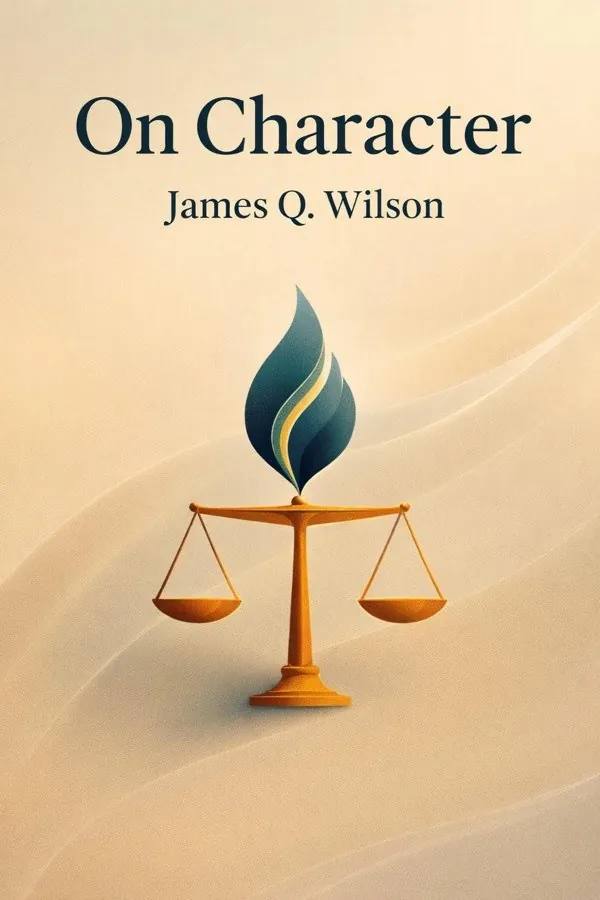
On Character: Summary & Key Insights
 10 min9 chaptersAudio available
What Is On Character About?
On Character by James Q. Wilson is a ethics book spanning 9 pages. In this collection of essays, political scientist James Q. Wilson explores the moral foundations of individual and social behavior. He examines how character—defined by habits of honesty, self-control, and compassion—shapes civic life and public policy. Wilson argues that moral sense is not merely a private virtue but a public necessity, influencing everything from family stability to crime prevention.
This FizzRead summary covers all 9 key chapters of On Character in approximately 10 minutes, distilling the most important ideas, arguments, and takeaways from James Q. Wilson's work. Also available as an audio summary and Key Quotes Podcast.
On Character
In this collection of essays, political scientist James Q. Wilson explores the moral foundations of individual and social behavior. He examines how character—defined by habits of honesty, self-control, and compassion—shapes civic life and public policy. Wilson argues that moral sense is not merely a private virtue but a public necessity, influencing everything from family stability to crime prevention.
Who Should Read On Character?
This book is perfect for anyone interested in ethics and looking to gain actionable insights in a short read. Whether you're a student, professional, or lifelong learner, the key ideas from On Character by James Q. Wilson will help you think differently.
- ✓Readers who enjoy ethics and want practical takeaways
- ✓Professionals looking to apply new ideas to their work and life
- ✓Anyone who wants the core insights of On Character in just 10 minutes
Want the full summary?
Get instant access to this book summary and 100K+ more with Fizz Moment.
Get Free SummaryAvailable on App Store • Free to download
Key Chapters
Human beings are born not as blank slates but as moral creatures with predispositions toward empathy, fairness, and attachment. We can observe this even in children, who manifest distress when others cry and pleasure when others are comforted. This moral sense is a natural sentiment, as much emotional as rational, that underlies moral conduct. Yet it does not dictate particular laws or commandments; rather, it equips us to learn them through experience, imitation, and approval.
In arguing for a moral sense, I stand against the cold rationalism that treats morality as a calculus of self-interest. People do not refrain from theft because they fear punishment alone. They are inhibited, first, by conscience—a voice internalized from family and community, reminding them that theft is wrong, that others' welfare matters. Our sense of justice, compassion, and self-control are innate tendencies, shaped over millennia of social living. Societies that ignore or distort this nature—by denying personal responsibility, for instance—breed alienation and disorder.
This understanding matters because it reorients our view of ethics. If morality grows from sentiment as much as reason, then moral education must nurture feeling as well as thought. We cannot reduce behavior to external incentives without eroding the very emotional currents that make decency possible. Indeed, much of our trouble arises when sentiment is detached from responsibility—when compassion loses discipline, or self-assertion forgets humility.
Thus, the moral sense offers both hope and warning: hope that moral order is within human nature, and warning that culture can subvert it. Our task is to align instinct with virtue—to form habits that make goodness habitual rather than heroic.
The family is the seedbed of character. Within it, children first encounter authority and affection, rewards and restrictions. A child learns to say no to impulse because a parent once said no to him. He learns kindness because he has been comforted when sad. These early experiences weave emotional grammar into the moral sense.
But we must recognize how fragile this institution has become. When families disintegrate, the lessons of empathy, sacrifice, and restraint become harder to learn. A single mother, heroic though she may be, cannot fully substitute the durable framework of mutual obligation that parental partnership provides. The problem is not merely economic but moral: children deprived of consistent moral models find it harder to see how generosity or self-discipline operate in daily life.
In defending the family, I do not romanticize it. Families can also perpetuate cruelty and dysfunction. Yet despite variations, the intact family remains the most effective moral school, teaching both love and limits. No government program can replicate what a steady parent accomplishes by example. If we desire civic virtue, we must begin by strengthening those private institutions that quietly shape the conscience of the next generation.
+ 7 more chapters — available in the FizzRead app
All Chapters in On Character
About the Author
James Q. Wilson (1931–2012) was an American political scientist known for his influential work on public administration, crime, and moral behavior. He taught at Harvard University and UCLA and authored several landmark books, including 'Thinking About Crime' and 'Bureaucracy: What Government Agencies Do and Why They Do It.'
Get This Summary in Your Preferred Format
Read or listen to the On Character summary by James Q. Wilson anytime, anywhere. FizzRead offers multiple formats so you can learn on your terms — all free.
Available formats: App · Audio · PDF · EPUB — All included free with FizzRead
Download On Character PDF and EPUB Summary
Key Quotes from On Character
“Human beings are born not as blank slates but as moral creatures with predispositions toward empathy, fairness, and attachment.”
“Within it, children first encounter authority and affection, rewards and restrictions.”
Frequently Asked Questions about On Character
On Character by James Q. Wilson is a ethics book that explores key ideas across 9 chapters. In this collection of essays, political scientist James Q. Wilson explores the moral foundations of individual and social behavior. He examines how character—defined by habits of honesty, self-control, and compassion—shapes civic life and public policy. Wilson argues that moral sense is not merely a private virtue but a public necessity, influencing everything from family stability to crime prevention.
You Might Also Like

What We Owe the Future
William MacAskill
10 min
Abortion
David Boonin
10 min
Blind Spots: Why We Fail to Do What's Right and What to Do About It
Max H. Bazerman, Ann E. Tenbrunsel
10 min
Digital Ethics: Research and Practice
Christopher Burr, Luciano Floridi (Editors)
10 min
Doing Good Better: Effective Altruism and a Radical New Way to Make a Difference
William MacAskill
10 min
Eating Animals
Jonathan Safran Foer
10 minBrowse by Category
Ready to read On Character?
Get the full summary and 100K+ more books with Fizz Moment.